High-Impact Tools for Teams: 5 Tools to Align Team Members, Build Trust, and Get
Stefano Mastrogiacomo
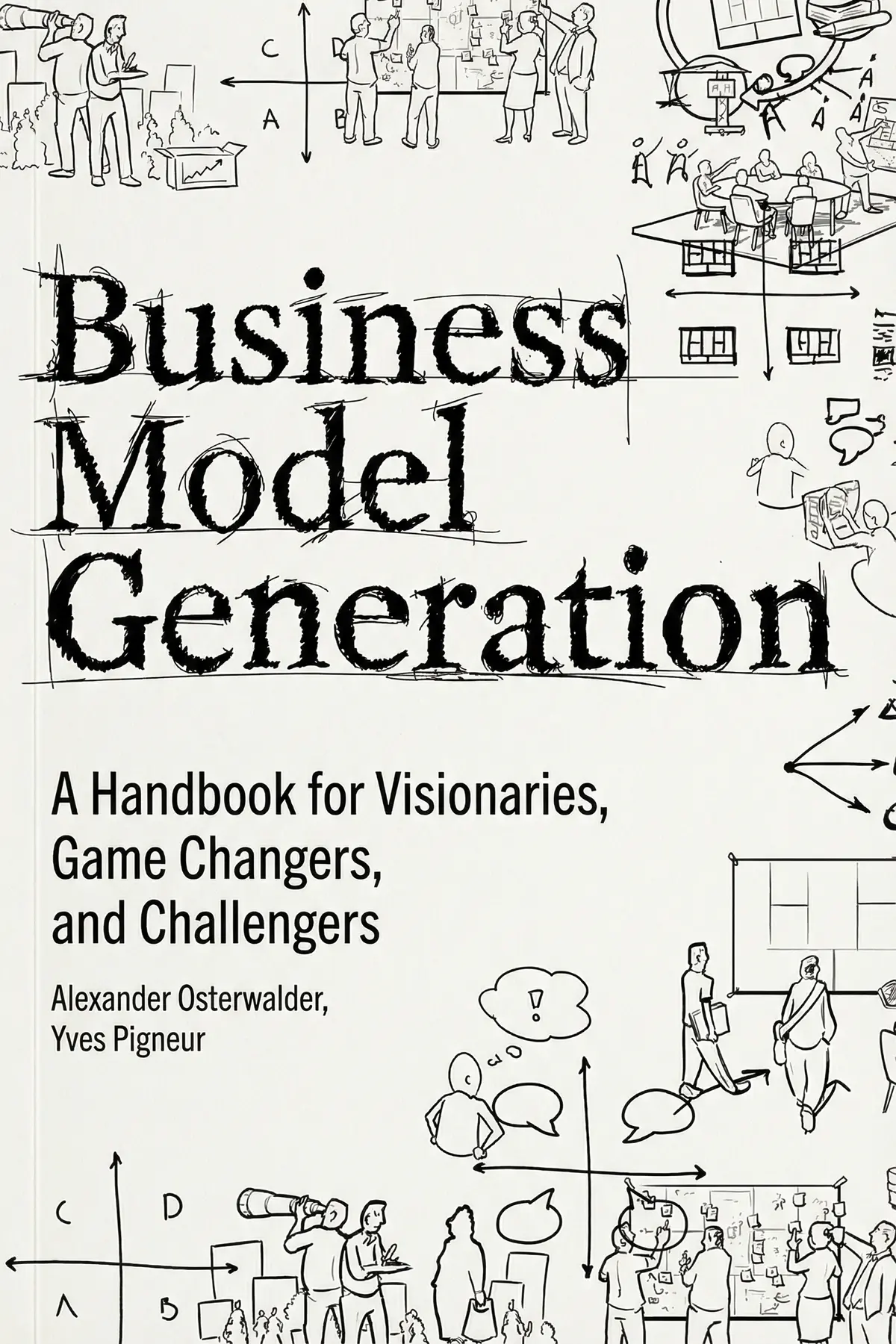
Business Model Generation provides a strategic framework for entrepreneurs and visionaries to design, analyze, and pivot their business models using customer-centric tools and innovative organizational patterns.
1 min 32 sec
Every global giant, from the coffee shop on the corner to the massive tech conglomerates that define our modern era, relies on a foundational architecture. This architecture is the business model. It is the silent engine that dictates how a company creates something of value, how it gets that value into the hands of the right people, and how it captures a portion of that value to sustain its own growth. But far too often, entrepreneurs start with a product rather than a model, leading to confusion and missed opportunities.
In our exploration today, we are going to walk through a visionary approach to designing these models. We aren’t just looking at spreadsheets or dry financial projections. Instead, we are looking at a living, breathing framework. This framework considers the deep needs of the customer, the specific channels used to reach them, and the intricate web of partnerships and activities that happen behind the scenes.
The central throughline of this summary is the idea that a successful business is an ecosystem. Each part must support the other. If you change your customer base, your value proposition must shift. If you change your revenue stream, your resources must adapt. We will learn how to navigate these dependencies and use tools like empathy mapping and scenario writing to stay ahead of the curve. Whether you are launching a brand-new startup or looking to revitalize an existing organization, the goal is to build something that isn’t just profitable, but is also resilient and deeply connected to the market it serves. Let’s begin by looking at the very first building blocks of any successful enterprise.
2 min 30 sec
Discover why the heart of every business lies in identifying precisely who you serve and what unique problems you solve for them.
2 min 32 sec
Learn how the way you interact with your customers and the way you charge them forms the lifeblood of your company.
2 min 23 sec
Explore the behind-the-scenes activities and collaborations that determine your business’s efficiency and long-term viability.
2 min 15 sec
Uncover the secret to innovation by looking at the world through the eyes, ears, and hearts of your target audience.
1 min 55 sec
See how crafting detailed narratives can help you test your business ideas and prepare for the uncertainties of tomorrow.
2 min 04 sec
Investigate how giving away value for free can actually lead to a highly profitable and scalable business.
2 min 06 sec
See how niche products and user-generated content are challenging the traditional dominance of mass-market hits.
1 min 27 sec
As we have seen, building a successful business is about far more than just having a good idea. It is about the careful and intentional design of an entire system. By walking through the core building blocks—from the value you promise to the partners who help you deliver it—you gain a holistic view of how your organization actually functions.
We explored the importance of empathy, learning that the most successful entrepreneurs are those who can truly feel the frustrations and aspirations of their customers. We saw how storytelling and scenario planning can act as a laboratory for your ideas, allowing you to experiment with different futures without the risk of real-world failure. And we looked at the disruptive patterns of the modern age, from the ‘free’ lure of the freemium model to the community-driven power of the long tail.
The ultimate lesson is that a business model is never finished. It is a living document that must be constantly tested, analyzed, and pivoted as the world changes. The tools we’ve discussed provide you with a common language and a visual framework to make those changes with confidence.
Now, it’s your turn to take these concepts and apply them. Start by mapping out your current ideas. Where is the value coming from? Who are your true customers? Where are the gaps in your understanding? By consistently returning to these foundational blocks and viewing them through the lens of your customer’s needs, you can ensure that your business remains not just a visionary dream, but a practical, thriving reality that delivers real value to the world.
This guide moves beyond traditional business planning to offer a visual and practical methodology for building successful companies. It introduces the core components that make up any business, from identifying target customer segments to establishing sustainable revenue streams. The authors provide a toolkit for innovation, helping readers understand how to deliver real value in a crowded marketplace. At its heart, the book is a promise of clarity for those facing the uncertainty of a new venture or a stagnant corporate structure. It explores how to empathize with customers, how to use storytelling to forecast future challenges, and how to adopt disruptive models like freemium or long-tail structures. By the end, readers will have a comprehensive blueprint for turning a creative spark into a functional, profitable, and adaptable enterprise.
Alexander Osterwalder is a co-founder of Strategyzer, an SaaS solution for business model generation. He offers online courses on creating innovative business models. Yves Pigneur is a computer scientist from Belgium. He has taught management information systems at the University of Lausanne, the National University of Singapore and at HEC Montreal. Osterwalder and Yves also co-authored Value Proposition Design and Business Model You.
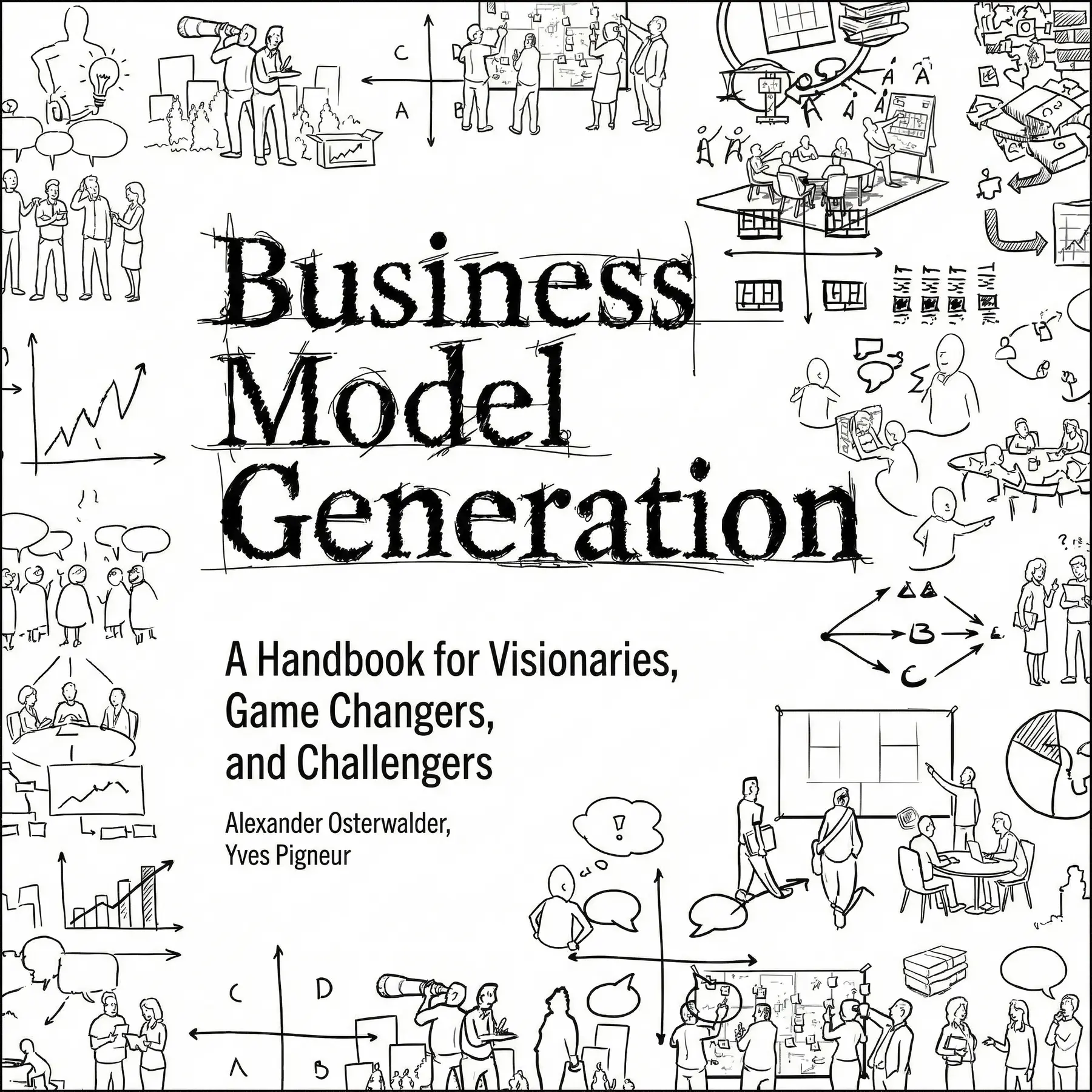
Listeners find that this guide offers deep clarity on constructing business models and remains highly accessible, mainly due to its uncomplicated business model canvas method. It functions as a robust instrument for both developing and analyzing business frameworks, and one listener highlights it as a roadmap for businesses of the future. Furthermore, the audience values the thorough perspective and creative visual design, viewing it as essential material for both aspiring entrepreneurs and business students.
This book is a visual masterpiece that completely redefines how we think about organizational structure. Instead of wading through dense paragraphs of academic theory, the authors use a graphic-heavy layout to explain the Business Model Canvas. It’s incredibly intuitive; the nine building blocks offer a language that anyone from a CEO to a first-year student can speak. I particularly loved the focus on value propositions and how they bridge the gap between internal operations and customer needs. Frankly, it’s the most accessible management guide I’ve ever held. While some might find it a bit too high-level, I think that simplicity is its greatest strength. It forces you to strip away the noise and look at the core of how your company actually generates revenue and stays viable. Every entrepreneur needs a copy on their desk.
Show moreFinally got around to reading this seminal work on value creation, and I’m genuinely impressed by the collaborative effort that went into it. The fact that it was co-created by 470 practitioners really shows in the diversity of perspectives. It’s not just a book; it’s a roadmap for the modern economy. I especially appreciated the link to Blue Ocean Strategy and how the canvas can be used to identify factors to eliminate or raise to create a new market space. The emphasis on the Empathy Map to understand customer pains and gains is something every marketing team should implement immediately. It’s rare to find a business book that is both aesthetically pleasing and practically useful, but this one nails it. It’s definitely a handbook for game changers who want to challenge the status quo.
Show moreForget everything you know about boring, unreadable management textbooks. This is a game-changer for anyone who prefers visual learning over rote memorization. The authors have created a framework that makes business model innovation feel like a creative puzzle rather than a chore. I’ve used the canvas for three different projects now, and it’s the only tool that keeps the whole team on the same page regarding our key activities and resources. The graphic layout is innovative, making the information stick much better than traditional text ever could. Truth is, the simplicity of the nine building blocks is what makes it so powerful. It serves as a visual language that bridges the gap between the rational cost side and the intuitive value side. It’s absolutely essential for any aspiring entrepreneur.
Show moreWow, what an incredible tool for anyone looking to disrupt their industry. This book doesn't just tell you how businesses work; it shows you. The graphic design is stunning and makes the complex concepts of infrastructure, customer relationships, and cost structures feel incredibly accessible. I was particularly captivated by the examples of cloud computing and how Amazon transformed their internal resources into a global service. To be honest, most business guides are too focused on the how of management and not enough on the why of the model itself. This book corrects that balance perfectly. Whether you're a student or a seasoned executive, the Business Model Canvas is a roadmap you can't afford to ignore. It’s the definitive guide for the next generation of businesses.
Show moreEver wonder why most business plans end up gathering dust in a drawer while the actual business pivots elsewhere? Osterwalder and Pigneur suggest it's because those plans are static, whereas the Business Model Canvas is a living document. I found the sections on business model patterns, like the Long Tail and Multi-Sided Platforms, to be the most insightful parts of the text. The visual design is stunning—it feels more like a workbook or a designer's portfolio than a dry economics text. My only real gripe is that the book feels a bit repetitive towards the end. Once you've mastered the canvas in the first few chapters, the later sections on strategy and process seem to restate the same concepts with minor tweaks. Still, the roadmap it provides for innovation is worth the price alone.
Show morePicked this up on a whim after seeing the unique landscape layout and hearing it was the gold standard for startups. I’m glad I did. The silly cow exercise mentioned in the book is a great example of how the authors try to break you out of traditional, rigid corporate thinking. By focusing on design thinking and customer-centricity, they help you see your business through the eyes of the people actually paying for your services. The concept of unbundling was a real eye-opener for me, especially the examples regarding telecommunications and banking. It’s not a perfect book—some of the later chapters on process feel like filler—but the core methodology is robust. Look, if you want a tool that helps you prototype ideas quickly without writing a 60-page manifesto, this is the one for you.
Show moreAfter hearing my colleagues rave about the Canvas for months, I decided to see what the fuss was about. The book is undoubtedly a powerful tool for visualizing how a company creates and delivers value. It’s easy to understand and provides a clear framework for evaluating your own business ideas against established patterns. Personally, I loved the case studies on Amazon and LEGO—they made the abstract concepts feel much more grounded. However, I have to agree with other reviewers who mentioned that the book gets a bit thin in the later chapters. The Strategy and Process sections didn't add as much to my mental model as the initial introduction to the Canvas did. Regardless, it’s a must-read for business students who need a practical way to apply theory to real-world scenarios.
Show moreIn my experience, I wasn't expecting a business book to be this engaging or aesthetically pleasing. Usually, management literature is a slog, but Business Model Generation feels alive. The authors emphasize that a business model isn't just a spreadsheet; it's a rationale for how you capture value. I found the chapter on Design Thinking particularly helpful, as it encourages you to prototype multiple models before settling on one. The visual summaries of the six general business patterns were a highlight for me, especially the Free model. My only criticism is that the chapters from Process until the end feel a bit like they were rehashed from earlier content. Still, the roadmap provided in the first half is so valuable that I can't help but recommend it to anyone in the startup space.
Show moreAs someone with a background in economic modeling, I found this to be a bit of a mixed bag. On one hand, the Business Model Canvas is a brilliant visual tool that simplifies complex infrastructure and revenue streams into something digestible. It’s a great way to facilitate brainstorming sessions. However, the content is extremely high-level. If you are looking for deep, granular data analysis or complex strategic frameworks, you won't find them here. Not gonna lie, I felt like I was reading a very expensive, very beautiful introductory pamphlet at times. The chapter on design tools felt particularly vague and could have used more concrete case studies instead of just pretty pictures. It’s a fantastic starting point for beginners or visionaries who hate spreadsheets, but professionals might find the rehashed feel of the second half a bit frustrating.
Show moreTo be fair, the first hundred pages are absolutely revolutionary for anyone trying to visualize their startup's structure. The Business Model Canvas is a world-class tool. But once you move past the initial explanation of the nine building blocks, the book loses its momentum. I felt like the authors were stretching a very good 50-page idea into a 280-page book. Some of the diagrams are beautiful but don't actually convey much information beyond the obvious. It’s a great coffee table book for managers, and it’s certainly fun to flip through, but the academic depth is lacking. I’d recommend it to someone just starting out or a visionary boss who needs a push toward innovation, but seasoned consultants might find it a bit too light on substance. A good book, just not the life-changing experience I was promised.
Show more
Hamilton Helmer
Duncan Clark

John Carreyrou
AUDIO SUMMARY AVAILABLE
Get the key ideas from Business Model Generation by Alexander Osterwalder, plus 5,000+ more titles in English and Thai.