
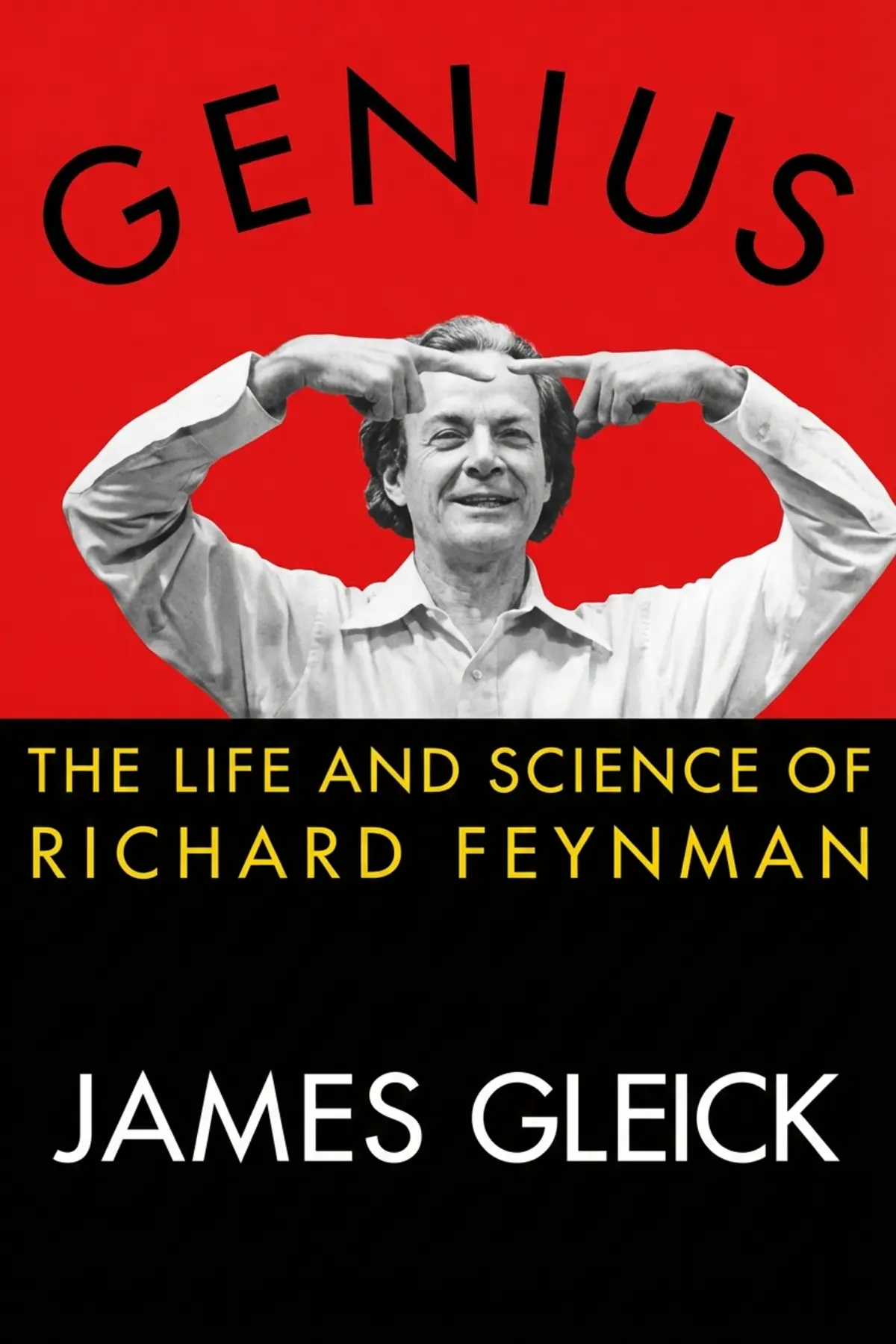
Genius: The Life and Science of Richard Feynman
James Gleick
Chaos explores the groundbreaking discovery of chaos theory, revealing the hidden patterns within seemingly random systems. From weather patterns to heart rhythms, it shows how simple rules create the beautiful complexity of our world.
1 min 53 sec
For much of human history, the goal of science was to find the ultimate order of the universe. We looked at the stars and saw predictable orbits. We looked at physics and saw laws that promised cause and effect would always be proportional. If you pushed something twice as hard, it should go twice as far. This was the dream of the clockwork universe—a world where everything, if measured precisely enough, could be predicted. But there was a problem. In the cracks of this orderly vision, there were always flukes. There was the irregular drip of a faucet, the sudden jaggedness of a lightning bolt, and the wild, impossible-to-predict behavior of the weather. For a long time, scientists simply dismissed these as noise or errors. They were the messy details that didn’t fit the beautiful, clean equations.
Then, in the 1960s and 70s, a new generation of thinkers began to look directly at that noise. What they found wasn’t just randomness, but a new kind of science entirely: chaos theory. They discovered that within what looked like a mess, there were actually sophisticated patterns. They found that nature doesn’t follow a simple straight line; it follows a path that is both structured and incredibly sensitive to change. This throughline—the idea that order and chaos are two sides of the same coin—changed everything. It didn’t just change physics; it changed how we understand biology, economics, and our own bodies. As we dive into the history of this movement, we’ll see how these scientists stopped trying to ignore the irregularities of life and started using them to unlock the secrets of how the world actually works. This is the story of how we learned that a tiny, localized event can have global consequences, and how the jagged edges of a coastline or a leaf are not accidents, but the very signature of nature’s design.
3 min 36 sec
A simple rounding error in a weather simulation led Edward Lorenz to a discovery that would forever change our understanding of predictability and precision.
3 min 19 sec
When Lorenz plotted his chaotic equations, he didn’t find a mess; he found a beautiful, haunting structure known as a strange attractor.
3 min 16 sec
Moving beyond rigid formulas, mathematicians like Stephen Smale used the art of topology to visualize the stretching and folding of reality.
3 min 22 sec
Animal populations don’t just grow and shrink; they follow a chaotic path of bifurcations that mirrors the complexity of the physical world.
3 min 12 sec
Benoit Mandelbrot discovered that nature isn’t made of circles and squares, but of fractals—jagged shapes that hold infinite detail within themselves.
3 min 15 sec
Turbulence was the great unsolved puzzle of physics, until chaos theory provided a map through the swirling eddies of fluid dynamics.
3 min 06 sec
Mitchell Feigenbaum discovered a hidden number that governs the transition to chaos, proving that different systems follow the exact same rules.
2 min 49 sec
A group of graduate students used early computers and everyday objects like dripping faucets to show that chaos is a creative force.
3 min 22 sec
From the rhythm of the heart to the movement of the eyes, our biology relies on a delicate balance of chaos to stay healthy and adaptable.
2 min 18 sec
In the end, chaos theory didn’t just give us a new set of equations; it gave us a new set of eyes. We started this journey with the idea of a clockwork universe—a world where the future was just a calculation away if we had enough data. But through the work of people like Edward Lorenz, Benoit Mandelbrot, and Mitchell Feigenbaum, we’ve learned that the world is much more interesting than that. We’ve seen that the weather is fundamentally unpredictable not because of our limitations, but because of its own nature. We’ve seen that the jaggedness of a mountain or a coastline is not a mistake, but an infinite fractal geometry that connects the smallest pebble to the largest continent. And we’ve seen that the very chaos we once feared is actually what makes our bodies resilient and our universe creative.
As the physicist Joseph Ford suggested, Einstein was wrong when he said that God doesn’t play dice with the universe. The dice are being thrown every second, in every raindrop and every heartbeat. But the secret of chaos theory is that those dice are loaded. There are rules to the randomness. There is a deep, universal structure that guides the transition from the smooth to the turbulent. This realization doesn’t make the world feel smaller; it makes it feel more vast and more alive. It tells us that we live in a universe where a tiny change can have a massive impact, and where complexity is born from simple, beautiful laws.
As you move through your day, take a moment to look at the world through this lens. Notice the way a river swirls around a rock, or the way the branches of a tree divide into smaller and smaller versions of themselves. Don’t see them as a mess. See them as the visible fingerprints of chaos. Remember that even when life feels unpredictable and out of control, there is often a hidden attractor beneath the surface, guiding the flow. The lesson of chaos is not that we are lost in a random world, but that we are part of a deeply interconnected and infinitely structured masterpiece. Order isn’t the opposite of chaos; it’s the partner that allows chaos to create the world we see.
For centuries, the scientific establishment operated under a comforting assumption: the universe was a giant clockwork mechanism. If you knew the initial position of every gear and spring, you could predict the future with perfect accuracy. Chaos: Making a New Science tells the story of the maverick thinkers who shattered this illusion, proving that our world is far more sensitive, unpredictable, and intricately structured than we ever imagined. This summary guides you through the emergence of chaos theory, starting with a meteorologist’s accidental discovery of the butterfly effect. You will explore how mathematicians, biologists, and physicists moved beyond linear models to embrace the jagged reality of nature. From the self-similar geometry of fractals to the universal constants that govern the transition from order to turbulence, the book reveals a new way of seeing the world. Ultimately, it promises a deeper understanding of the balance between randomness and regularity that defines everything from the rhythm of your heart to the shapes of the clouds above.
James Gleick is an acclaimed science historian, journalist, and author known for his ability to translate complex scientific concepts into compelling narratives. Widely regarded as one of the preeminent writers on physics and technology over the past several decades, Gleick's work has had a significant cultural impact. His writing was reportedly a primary inspiration for the character of Ian Malcolm in the Jurassic Park franchise. Gleick is the author of several international bestsellers, including the highly praised biography Genius: The Life and Science of Richard Feynman.
James Gleick
James Gleick
Listeners find this book expertly crafted and straightforward, offering a fantastic starting point for learning about chaos theory. The writing is compelling and follows a clear arrangement, with one listener highlighting how the author masterfully interweaves human stories. Additionally, the content is deeply reflective, opening listeners' eyes to a world beyond measure or comprehension. Nevertheless, there are differing views regarding the lucidity of the text, with some finding it exceptionally transparent while others feel it is hard to track.
Gleick has a real talent for turning abstract mathematical equations into something that feels almost like a gripping novel. This isn't just a dry textbook about physics; it’s a story about a scientific revolution that changed how we view everything from clouds to heartbeats. The way he describes fractals and the Mandelbrot set made me see the world through a completely different lens. Suddenly, the jagged edges of a coastline or the branching of a tree looked like beautiful, recursive patterns rather than random accidents. The book is well-structured and moves at a brisk pace, interweaving human stories with profound philosophical questions about determinism. Truth is, I haven't been this excited about a science book in years. It’s rare to find an author who can explain such complex ideas without talking down to the reader or losing the inherent magic of the subject matter.
Show moreThe way the author interweaves the personal struggles of researchers like Mitchell Feigenbaum and Benoit Mandelbrot with their discoveries is simply brilliant. It makes the science feel human and urgent rather than just a series of cold facts. I was especially captivated by the descriptions of the Great Red Spot on Jupiter and how chaos theory explains its persistence. This book is a masterful guide through what would ordinarily be a very difficult and frightening intellectual landscape. Gleick never makes you feel overwhelmed, taking you through the discovery of 'period doubling' and 'scaling' with incredible care and assurance. Not gonna lie, I’ve started looking at the smoke rising from a cigarette or water dripping from a faucet in a totally different way. It’s an eye-opening journey that proves there is a hidden, beautiful order underlying what we perceive as total disorder.
Show moreWow, what a journey through the hidden patterns of our seemingly messy universe! This book is pure poetry in parts, especially when Gleick describes the infinite complexity of the Mandelbrot set. I loved the inclusion of the illustrations and quotes, which added to the feeling that I was reading a work of art rather than a science text. It’s one of those rare books that completely changes your perspective on everyday reality. I found the discussion of the 'Julia Set' and the way computers were first used to map these equations to be particularly enlightening. Everything about this read felt like a discovery. It’s a comprehensive and elegant discussion of how chaos isn’t just noise, but a sophisticated form of information. For anyone who feels like the world is too chaotic to understand, this book offers a strange kind of comfort.
Show moreEver wonder why the weather is so impossible to predict even with our massive supercomputers? Gleick provides a fascinating answer by tracing the history of nonlinear systems and the pioneers who dared to challenge traditional reductionism. The narrative is incredibly engaging because it focuses on the scientists themselves, showing their struggles against a skeptical establishment that preferred order over messy reality. While some of the mathematical descriptions of strange attractors got a bit dense for me, the overall prose is elegant and accessible. It’s a thought-provoking look at how small changes can lead to massive, unpredictable results in the real world. To be fair, some sections feel like a product of the 1980s, but the core concepts remain essential for anyone curious about how nature actually functions. I particularly enjoyed the chapters on the Butterfly Effect, which cleared up a lot of my previous misconceptions.
Show moreAfter hearing about chaos theory for years, I finally feel like I have a grasp on what a 'strange attractor' actually is. Gleick’s writing is evocative and descriptive, painting vivid pictures of the patterns that emerge from chaotic systems. He manages to capture the energy and excitement of a new field being born, which is no small feat for a non-fiction book. My only real gripe is that he occasionally dances around the science instead of putting the reader directly into the thick of it. It’s a book that focuses more on the story of the science than the rigorous details, which makes it perfect for a casual reader but perhaps frustrating for a student. Still, the impact of the book is undeniable. It provides a wonderful explanation of how nature is both unpredictable and predetermined at the same time.
Show moreFrankly, this book is more of a historical snapshot of a scientific revolution than a technical manual for modern physics. It captures a moment in time when scientists from disparate fields—biology, meteorology, and mathematics—all began to notice the same patterns of irregularity. Gleick does an excellent job of showing how these people were often viewed as 'mystics' by their peers before their work was validated. The book is thought-provoking and opens your eyes to a world beyond traditional measurement or comprehension. Look, it’s not perfect; some of the transitions between chapters are a bit jarring, and the ending feels a little abrupt. But for a book written over thirty years ago, it remains surprisingly relevant as an entry point into nonlinear dynamics. If you enjoy authors like John McPhee, you will likely appreciate Gleick’s narrative-driven approach to complex topics.
Show moreFractals are everywhere once you finish this book, from the jagged edges of a coastline to the way a tree branches out into the sky. Gleick’s investigation of the order underlying disorder is truly impressive and well-structured. He takes concepts that sound incredibly intimidating and breaks them down into digestible human narratives. I particularly enjoyed the sections on how chaos theory applies to biological systems, like the rhythm of a human heart. While I agree with other reviewers that it can be a bit breezy at times, I think that’s exactly why it was so successful with a general audience. It’s a quick, engaging read that manages to be both informative and deeply philosophical. Even if you aren't a math whiz, you’ll get a lot out of this exploration of the unpredictable nature of our world.
Show morePicked this up because I wanted to understand the actual science behind the 'Butterfly Effect' instead of just the movie tropes. The book starts off strong with Edward Lorenz and his weather simulations, which really helps ground the theory in something tangible. However, as the chapters go on, the narrative starts to feel a bit disconnected as it jumps between widely divergent fields of research. I appreciated the insight into how these scientists were often working in isolation, but I wish there was more depth to the actual mechanics of the systems described. Personally, the language clarity was a bit of a mixed bag for me; some parts were crystal clear while others required multiple re-reads. It’s a decent introductory text for a layman, but if you’re looking for a deeper dive into complexity theory, you might find this a bit too 'pop-sci' for your tastes.
Show moreIn my experience, the language clarity in this book is a bit of a rollercoaster. There are sections where I felt like a genius for understanding such high-level concepts, followed immediately by pages that left me feeling totally lost in the weeds. Gleick is a fantastic storyteller, but I think he focuses so much on the 'drama' of the scientists that the actual logic of the math gets pushed to the background. It’s definitely a product of the late 1980s, which gives it a certain nostalgic charm but also makes some parts feel slightly obsolete compared to modern complexity theory. I'm glad I read it for the historical context, but I was hoping for something a bit thicker and more rigorous. It’s a good 'lazy layman's' guide, but it left me wanting more substance.
Show moreTo be fair, I found this to be a bit of a letdown considering the massive hype it still gets in popular science circles. Gleick gives an unorganized overview of various mathematical concepts, but he often exaggerates their importance as if they overthrew all of classical physics. Having spent a lot of time working with computer modeling, many of the 'revelations' here felt like painfully obvious common sense to me. The writing style is breezy, but it floats too far above the actual science, leaving me with more metaphors than actual understanding. By the time I reached the final chapter, it felt less like physics and more like a collection of mystical tangents that didn't really lead anywhere. It’s a very dated piece of work that might have been revolutionary in 1987, but today it feels shallow and surprisingly imprecise.
Show more
Lisa Kaltenegger


J. Craig Venter
Carl Zimmer
Bill Bryson
AUDIO SUMMARY AVAILABLE
Get the key ideas from Chaos by James Gleick, plus 5,000+ more titles in English and Thai.







