
15 min 33 sec
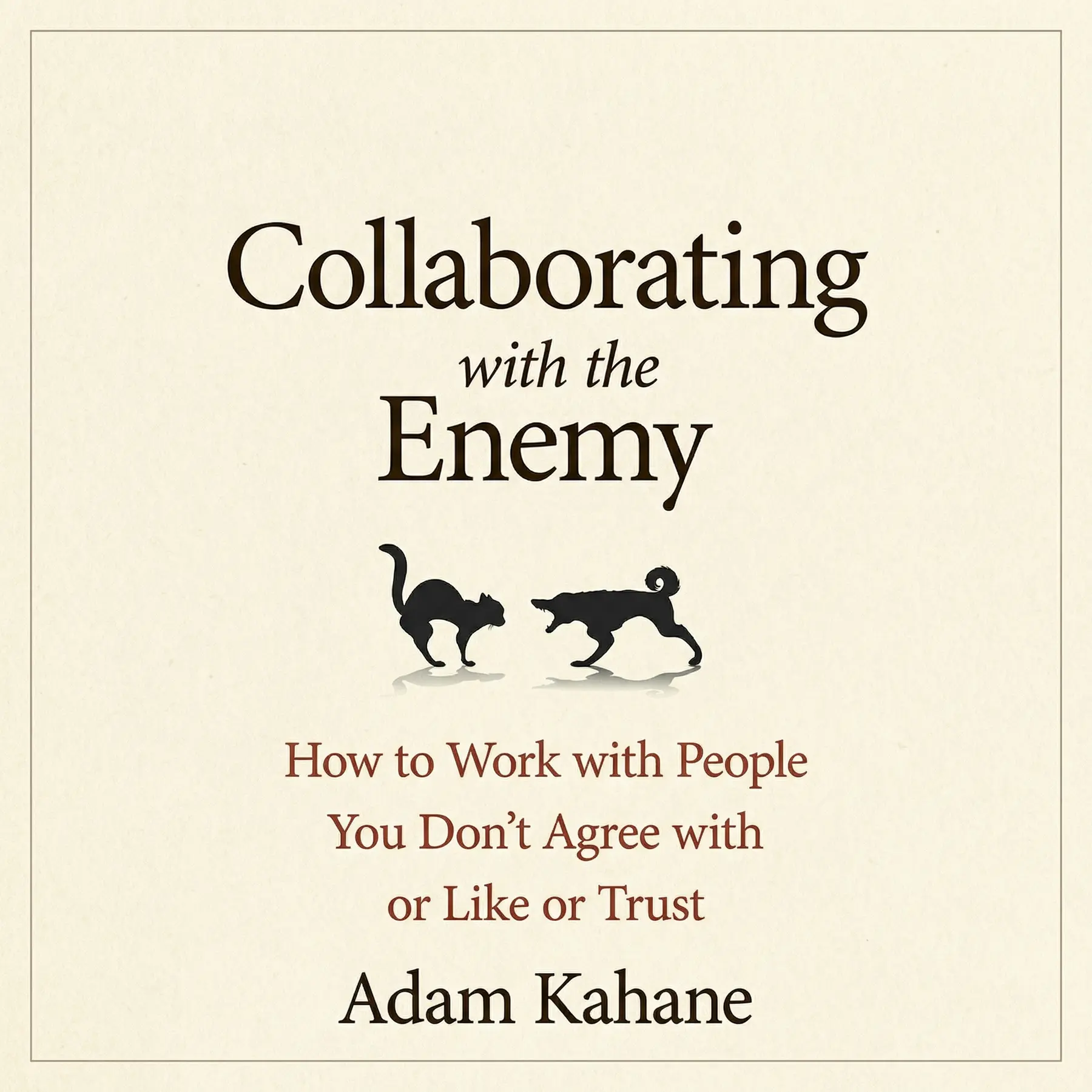
Collaborating with the Enemy: How to Work with People You Don't Agree with or Like or Trust
By Adam Kahane
Learn how to navigate complex teamwork when agreement is impossible. This guide offers a new framework for collaborating with adversaries by embracing conflict, abandoning control, and prioritizing experimentation over rigid planning.
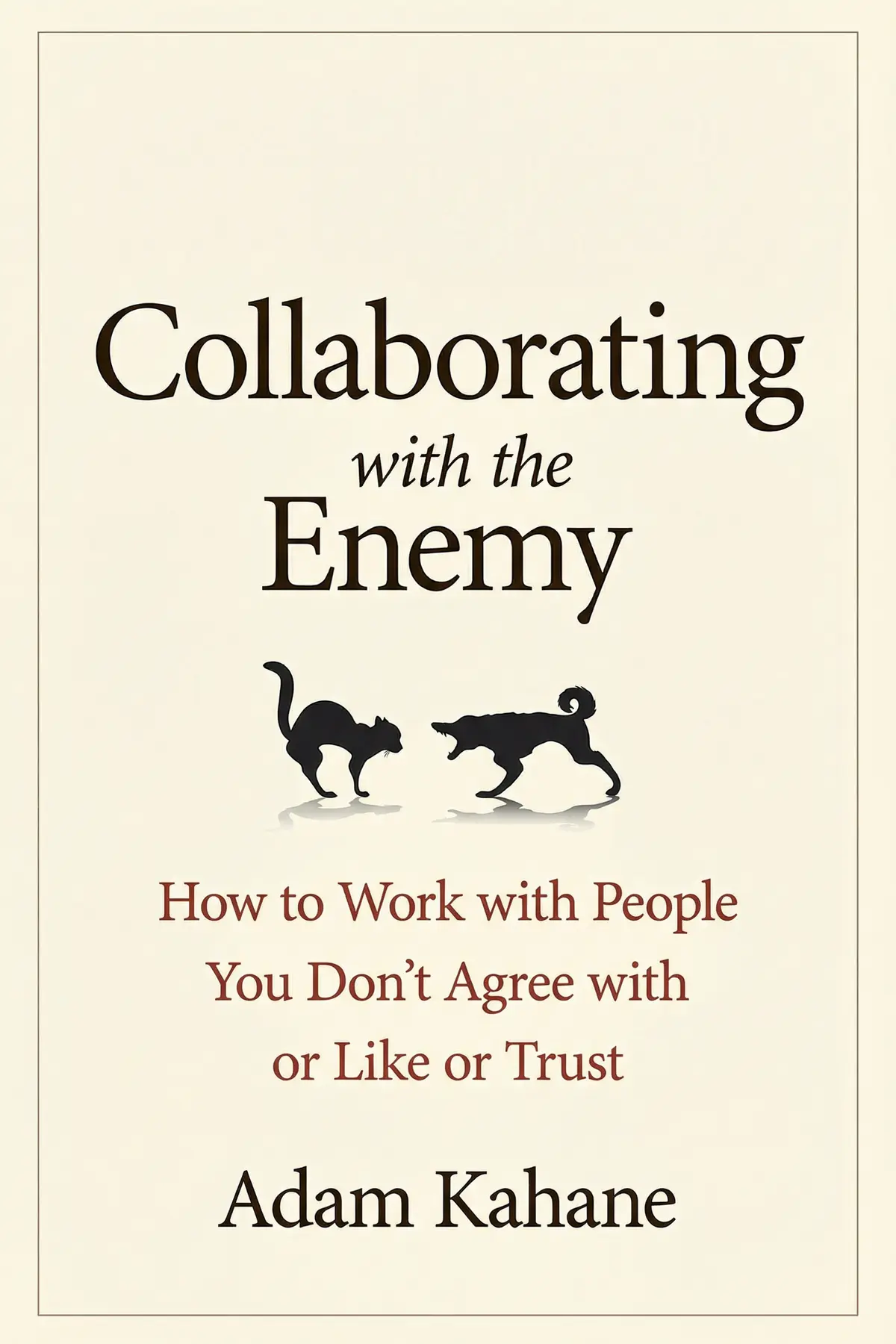
Table of Content
1. Introduction
1 min 48 sec
We have all been there: stuck in a meeting or a project with someone whose perspective feels not just different, but fundamentally wrong. In those moments, our instinct is often to shut down, fight back, or find a way to work around them. We’ve been told that true collaboration requires a shared vision, a common set of values, and a high level of mutual trust. But what happens when you simply don’t have those things? What do you do when the person you must work with is someone you consider an adversary, or even an enemy?
This is the central dilemma explored in Adam Kahane’s work. He suggests that our traditional understanding of teamwork is actually a barrier when we face truly complex, polarized problems. If we wait for harmony before we start working, we might never start at all. Instead, we need a different set of tools—a way to engage that doesn’t demand total agreement or personal liking. This approach is what he calls ‘stretch collaboration.’
In this summary, we are going to explore how to move past the need for consensus and toward a more flexible, realistic way of getting things done. We’ll look at why conflict isn’t just an obstacle but a necessary ingredient for innovation. We will also examine the psychological shifts required to stop trying to control others and start focusing on how we contribute to the very problems we’re trying to solve.
Through various stories—from corporate offices to community town halls—we will see how people just like you have turned gridlock into progress. This isn’t about being ‘nice’ or compromising your core beliefs. It’s about a pragmatic, sometimes messy, but ultimately effective way to navigate the world’s most difficult partnerships. By the end of this journey, you’ll have a new perspective on what it means to lead and participate in a world that is increasingly divided.
2. Moving Beyond Conventional Collaboration
2 min 23 sec
Traditional teamwork assumes we need trust and total agreement to succeed. But what happens when those elements are missing? Explore why a more flexible approach is needed.
3. The Balance of Power and Love
2 min 22 sec
Success in difficult partnerships requires more than just empathy or just strength. Discover the two fundamental forces that must be balanced to achieve lasting results.
4. Letting Go of the Master Plan
2 min 21 sec
In complex situations, you can’t predict the outcome from the start. Learn why experimenting is more effective than rigid planning when working with adversaries.
5. Recognizing Your Role in the Problem
2 min 15 sec
It’s easy to point fingers at others, but real change starts when we look inward. Discover why seeing yourself as part of the system is the key to breaking stalemates.
6. The Practice of Stepping In and Stepping Out
2 min 37 sec
Navigating difficult teamwork requires a constant movement between active engagement and quiet reflection. Learn how to maintain your balance in the heat of the fray.
7. Conclusion
1 min 47 sec
In a world that often feels like it’s pulling apart, the ability to work with people we don’t agree with is perhaps the most critical skill we can develop. As we’ve seen through the principles of Adam Kahane’s work, we don’t have to wait for trust, harmony, or a shared vision to begin making progress. By moving from conventional collaboration to a more flexible, ‘stretch’ approach, we can turn even our most difficult relationships into engines for change.
Remember the core shifts we’ve discussed: First, embrace the conflict. Don’t see disagreement as an obstacle to be avoided, but as a source of energy and a signal that diverse perspectives are present. Second, balance your power with love. Stand up for your purpose, but stay connected to the humanity of those across the table. Third, give up the illusion of control. Stop trying to plan every detail and start experimenting with small steps forward. And finally, never forget that you are part of the system. Your own shifts in behavior and perspective are often the most powerful tools you have for unlocking a stalemate.
The throughline of this journey is simple but profound: we are all interconnected, whether we like it or not. We cannot solve our biggest problems alone, and we cannot solve them only with people who agree with us. The next time you find yourself across from an ‘enemy,’ don’t reach for your shield or your sword. Reach for your curiosity. Ask what they see that you don’t. Admit what you don’t know. By doing so, you aren’t just solving a problem; you are building a bridge in a world that desperately needs them. The work is hard, it’s messy, and it’s never quite finished—but it is the only way to move forward together.
About this book
What is this book about?
Collaborating with the Enemy addresses a fundamental challenge of the modern world: how do we get things done with people we fundamentally disagree with or even dislike? Traditional collaboration usually assumes we need a common goal, a shared vision, and a high level of trust to succeed. However, in many of our most important challenges—from corporate silos to community disputes—these conditions simply don't exist. Adam Kahane argues that when we can’t force our way and can’t walk away, we must learn a new way to work together. The book promises a shift from 'conventional' collaboration to 'stretch' collaboration. This approach doesn't require us to like our partners or even trust them initially. Instead, it invites us to lean into the discomfort of disagreement, to see ourselves as part of the problem, and to move forward through small, iterative steps rather than master plans. By transforming our relationship with conflict, we can unlock innovative solutions that were previously hidden by our own biases and defensiveness. This is a manual for making progress in polarized times, showing that the very people we resist might be the ones we need most.
Book Information
About the Author
Adam Kahane
Adam Kahane is an author, facilitator, and expert in addressing complex societal challenges through collaborative methods. As a director of Reos Partners, he has worked in over fifty countries, guiding diverse groups in tackling difficult issues through innovative problem-solving approaches. Kahane's influential books, including Solving Tough Problems (2004) and Power and Love (2010), have contributed significantly to the field of collaborative leadership and social innovation.
Ratings & Reviews
Ratings at a glance
What people think
Listeners consider the book a vital read that offers pragmatic tips and collaborative case studies, with one listener noting its effectiveness for navigating the modern political environment. Opinions on the narrative flow and writing style are varied, with some listeners praising the prose while others remain unimpressed. Furthermore, listeners are divided on the feasibility of practicing and implementing the proposed strategies. Despite these points, several listeners feel the book is not a worthwhile use of their time or money.
Top reviews
Kaen
Wow, this really changed how I think about "enemyfying" the people I disagree with in professional and political circles. Adam Kahane provides a masterclass in how to move beyond the desire for control and instead embrace an emergent way of working together. I’ve read a lot of management books, but few address the reality that we often have to work with people we genuinely dislike or distrust. The metaphor of "crossing the river by feeling for stones" is beautiful and perfectly describes the experimentation needed in high-conflict zones. I found his analysis of the dialectic between love and power to be transformative for my own facilitation practice. Even though the writing style is simple, the wisdom contained in these pages is profound and immediately applicable. This should be required reading for anyone involved in community organizing or corporate leadership.
Show morePruet
Finally got around to reading this and it’s easily one of the most important books for the current political climate. Kahane doesn't offer "kumbaya" solutions; he offers a gritty, realistic framework for working through radical differences without requiring everyone to like each other. The stories from Colombia, where leaders sat down with paramilitaries who had tried to kill them, were incredibly moving and put my own petty office conflicts into perspective. I loved the emphasis on the fact that you cannot change the system without being willing to change yourself first. The book is short, but every chapter is packed with insights that I’ve already started applying to my work with non-profits. It isn't often that a book fundamentally shifts your worldview, but this one managed to do exactly that. It is worth every penny.
Show moreLincoln
After hearing Kahane speak on CBC radio, I had high expectations for this book, and for the most part, it delivered a much-needed perspective. This is truly a book for our times, especially given how divided our current political and social climates have become. Kahane challenges the myth that collaboration must be harmonious, arguing instead that we should embrace the discord and conflict inherent in any diverse group. I particularly loved the examples from his work with the global drug trade and South Africa’s transition away from apartheid. My only real gripe is that the writing can be a bit dull at times, which makes it a slow read despite the slim page count. Still, the guidelines for "unconventional collaboration" are practical enough to be used in any high-stakes environment. It’s a solid resource for anyone leading a team.
Show moreNiramai
This book offers a radical alternative to the standard "win-win" negotiation tactics that often fail when people truly don't trust each other. I was wishing I was reading this with a highlighter in hand instead of listening to the audiobook during my morning commute! The sections on "co-creating" and "open listening" are particularly strong and provide a roadmap for moving forward when there is no consensus on the problem. To be fair, the author’s background at Shell and in government might make some of the examples feel a bit "elite," but the core principles are sound. It requires a lot of personal growth to admit that your own perspective might be part of the system’s failure. It isn't an easy book to implement, but it’s a necessary one for anyone trying to solve complex problems.
Show moreDylan
I’m torn on this one because while the message is vital for our polarized world, the delivery is somewhat dry and uninspiring. The author does a great job explaining why we need to work with people we dislike, yet he falls short when explaining the technical "how." The power-love framework alone made the purchase worth it for me, as it perfectly encapsulates the tension in any collaborative effort. However, the book is quite short and feels like it could have been a long-form essay rather than a full-length publication. To be honest, the writing isn't exactly scintillating, and I found myself getting distracted by the strange formatting choices. It’s a decent introductory text for those new to systems thinking, but seasoned facilitators might find it a bit basic.
Show moreNuk
Is it possible to enjoy a book while also finding it somewhat repetitive and a bit superficial in its analysis? Kahane is clearly a master of his craft, but this volume feels like a high-level overview rather than a deep dive into the mechanics of conflict. I appreciated the honesty regarding his failures in places like Colombia, which made the advice feel more authentic. Yet, I kept waiting for a "lightbulb moment" that never quite arrived during my reading of the middle chapters. The idea that we must accept being part of the problem to be part of the solution is a powerful takeaway that I will definitely reflect on. In my experience, these kinds of "stretch" collaborations are much harder to pull off than the book suggests. It is an okay starting point, but you will need other resources to actually do the work.
Show moreThongchai
The central premise about "stretch collaboration" is intellectually interesting, but the execution falls flat for me. I was hoping for deep research and evidence-based strategies, but the book relies almost entirely on personal anecdotes and subjective reflections. While Kahane’s history in South Africa and Thailand is impressive, his "revelations" often felt like common sense dressed up in fancy terminology. I found the writing style a bit sluggish and struggled to stay engaged during the more theoretical chapters. To me, the most useful information was condensed into a single graphic on page 47 and the summary at the very end. Everything in between felt like filler that didn't quite justify the price of the book. It’s an okay read if you like hearing about high-level facilitation, but don't expect a rigorous academic study.
Show moreBoss
As an HR professional, I was expecting a new toolkit for mediation, but I found that most of these points are standard operating procedure in my field. Kahane speaks with authority, but his tone can come across as a bit self-indulgent when he recounts his successes. The concept of "enemyfying" others is a brilliant term, yet the book doesn't offer enough concrete guidance on how to stop doing it in the heat of a real argument. Look, the message is noble—we have to work together—but the path to get there is described through vague metaphors like "crossing the river by feeling for stones." It is frustrating because the author clearly knows his stuff, but he fails to translate that expertise into something the average reader can implement. I think there are better books on conflict resolution that are more grounded in reality.
Show moreRoongsak
Frankly, this was a massive disappointment given the hype surrounding Kahane's work in international conflict zones. The subtitle is incredibly misleading; I expected a manual for navigating office politics, but instead, I got stories about civil wars and paramilitary leaders. While the stakes are obviously higher in South Africa or Colombia, those examples feel light-years away from the daily grind of a corporate environment. The writing is surprisingly dull for such a high-stakes topic, and the amateurish illustrations actually made it harder for me to take the advice seriously. I found myself skimming by the halfway point because the "practical" tips felt more like vague philosophical musings. It is a rare case where a book’s title sounds more interesting than the actual content. Save your money and just look up the "power-love" framework online.
Show morePrae
What a confusing title choice for what is essentially a memoir of international diplomacy rather than a functional business guide. I picked this up because I wanted better strategies for dealing with a toxic boss, but Kahane focuses on "enemies" who literally want to kill each other. Unless you are brokering peace between warring factions in the Middle East, most of the anecdotes won't feel applicable to your life. To be fair, the author clearly has a wealth of experience, but he spends more time bragging about the influential people he knows than providing actionable steps. The layout feels like a homemade leaflet, which is bizarre for a mainstream publication. It honestly felt like a waste of time to trudge through the repetitive stories about Shell and various government entities. I would not recommend this to anyone looking for workplace advice.
Show moreFeatured in
Readers also enjoyed
A Year with Peter Drucker: 52 Weeks of Coaching for Leadership Effectiveness
Joseph A. Maciariello


Acting with Power: Why We Are More Powerful Than We Believe
Deborah Gruenfeld

AUDIO SUMMARY AVAILABLE
Listen to Collaborating with the Enemy in 15 minutes
Get the key ideas from Collaborating with the Enemy by Adam Kahane, plus 5,000+ more titles in English and Thai.
- 5,000+ titles
- Listen as much as you want
- 7-day free trial
- Cancel anytime







