
The Rights of Man
Thomas Paine
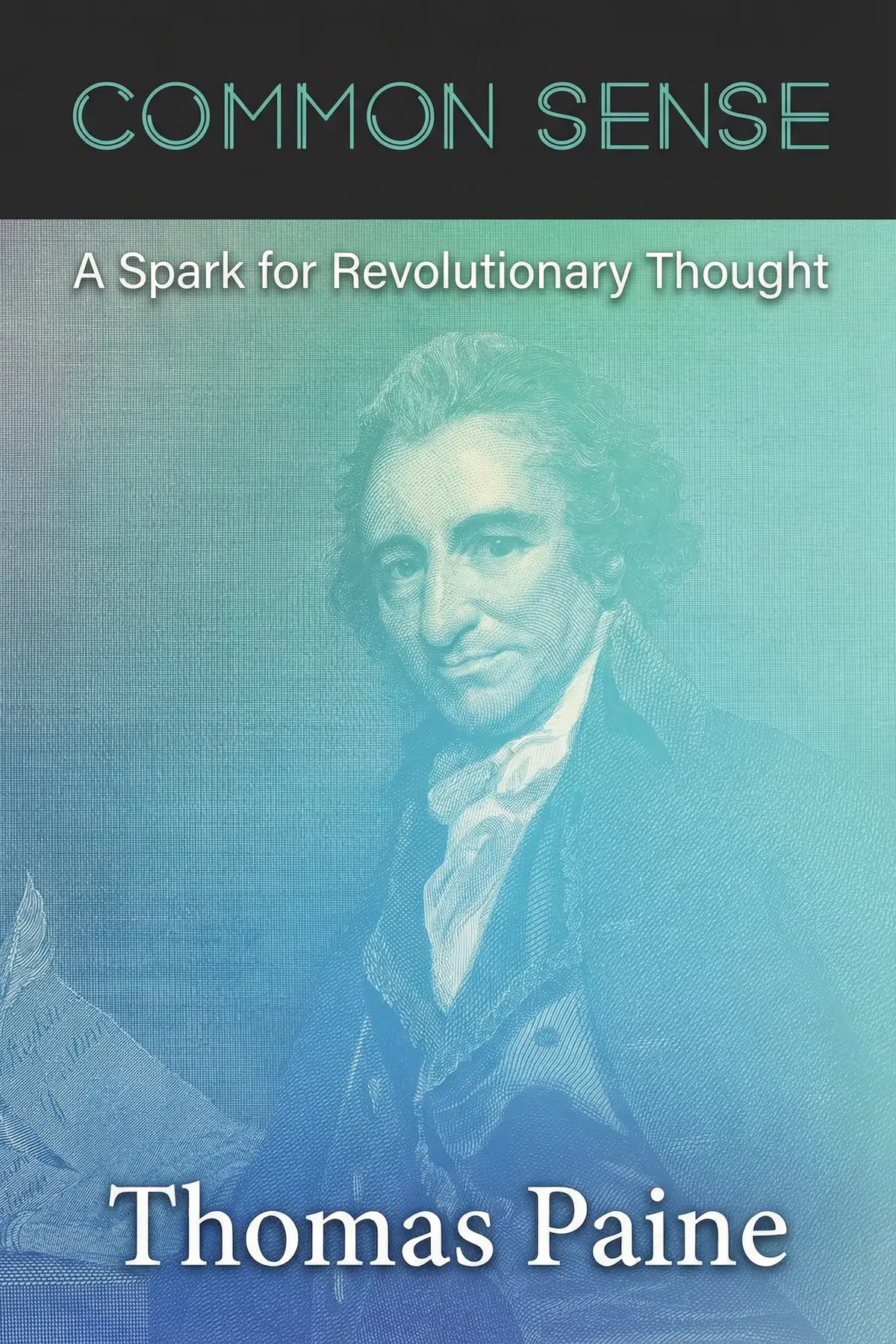
A foundational text of the American Revolution, Common Sense presents a fiery and logical argument for total independence from British rule, advocating for a republic rooted in natural rights and equality.
1 min 11 sec
In the early months of 1776, the American colonies stood at a precarious crossroads. Conflict with the British crown had already turned violent, yet many colonists remained hesitant, torn between their grievances and their long-standing loyalty to the English monarchy. Into this atmosphere of uncertainty stepped Thomas Paine, an immigrant with a talent for clear, uncompromising prose. His pamphlet, Common Sense, acted like a lightning bolt, illuminating the path toward a future that few had dared to imagine: a fully independent America.
Paine’s objective was as simple as it was radical. He wanted to strip away the complex, traditional arguments used to justify British rule and replace them with logic that any person could understand. He wasn’t just arguing for a change in policy or a reduction in taxes; he was arguing for a total transformation of how society is organized. By the time you finish this summary, you will understand how Paine dismantled the aura of the king, why he believed a tiny island had no business ruling a continent, and how he envisioned a new kind of government that served the people rather than the other way around. This is the story of the throughline from colonial frustration to the birth of a democratic republic.
2 min 03 sec
Explore why the author views society as a product of our needs and government as a consequence of our failures, setting the stage for radical political reform.
2 min 01 sec
Uncover the scathing critique of kings and the illogical nature of passing power through bloodlines, challenging centuries of European tradition.
2 min 09 sec
Move beyond emotional appeals to see the cold, hard facts of why a distant island could never effectively govern a vast, growing continent.
2 min 05 sec
Witness the birth of a political vision, moving from protest to the creation of a structured, representative democracy.
2 min 05 sec
Examine the practical assets that made the author confident in America’s ability to defend its freedom and thrive as a global player.
1 min 22 sec
Thomas Paine’s Common Sense did more than just argue for a political change; it redefined what was possible for the American people. By stripping away the prestige of the monarchy and replacing it with the logic of self-governance, he moved the conversation from ‘How do we fix our relationship with Britain?’ to ‘How do we build our own nation?’
The core throughline of his work is that independence is not just a strategic choice, but a natural right and a moral necessity. He demonstrated that the colonies possessed the economic strength, the military potential, and the intellectual maturity to govern themselves. More than two centuries later, the actionable takeaway remains clear: we must always be willing to question inherited systems of power and ask if they truly serve the public good. Paine reminds us that when a system becomes a ‘necessary evil’ that is no longer necessary and is only evil, it is the right and the duty of the people to imagine something better. His words served as the catalyst for the Declaration of Independence, and they continue to echo as a testament to the power of clear, honest communication in the pursuit of freedom. As you reflect on these ideas, consider the ‘common sense’ in your own world—what outdated systems or assumptions might be holding back progress, and what new structures of liberty could be built in their place? Marking this journey as finished, we see that the legacy of 1776 is not just a historical event, but an ongoing call to liberty.
This summary explores the revolutionary ideas of Thomas Paine, whose 1776 pamphlet shifted the American consciousness from seeking reconciliation with Britain to demanding full sovereignty. It examines Paine’s scathing critique of the British monarchy, his distinction between society and government, and his practical vision for a new democratic nation. Listeners will learn why Paine viewed government as a necessary evil and why he believed hereditary rule was fundamentally absurd. The text outlines the economic and military reasons why the colonies were ready to stand alone and how an independent America could serve as a beacon of liberty for the entire world.
Thomas Paine was an English-born American political activist, philosopher, political theorist, and revolutionary. He authored the two most influential pamphlets at the start of the American Revolution, inspiring the patriots in 1776 to declare independence from Britain.
Thomas Paine
Listeners find this book to be an accessible but informative listen that provides significant lessons and glimpses into the revolutionary mindset. They describe the prose as logical and clear, and listeners appreciate the carefully constructed points in favor of independence. Furthermore, the text serves as mandatory reading in high school history classes, helping listeners grasp the fundamental philosophical roots of liberty.
After hearing so many references to this pamphlet in history podcasts, I finally decided to dive into the primary source. Thomas Paine manages to articulate the very soul of the American spirit with a clarity that remains shocking even two centuries later. To be fair, I expected a dense, academic slog, but instead found a series of cogent arguments that felt incredibly modern. He breaks down the absurdity of hereditary succession with such biting logic that you can almost feel the heat radiating off the page. It’s not just a political manifesto; it’s a masterclass in how to move a population toward a singular, radical goal. While some of the specific military logistics for a 1776 navy feel a bit dated now, the philosophical foundations of freedom are timeless. Every citizen should experience this at least once to understand the intellectual spark that ignited a whole revolution. It is easy to see why this was the most influential pamphlet of its era.
Show moreThe chapter on the 'folly of hereditary right' is essentially the 18th-century version of a mic drop. Thomas Paine wasn't just making a polite suggestion for independence; he was offering a massive middle finger to the British Crown and its 'royal brutes.' I was particularly struck by how he used scripture to dismantle the idea of kings, turning the monarchy's own traditional justifications against them. It’s a scathing, derogatory, and brilliant piece of rhetoric that makes you want to go out and start a republic yourself. Even though I’m reading this 250 years later, the passion in his voice is still palpable and infectious. The book is remarkably short, but every sentence is designed to arouse the passions of the reader. If you want to understand the foundational logic of American independence, this is the only place to start. It is a masterpiece of persuasive writing that actually succeeded in its mission.
Show moreWow. I am genuinely surprised by how much I enjoyed this 'pamphlet.' Thomas Paine was a master wordsmith who knew exactly how to blend logical reasoning with raw, visceral emotion. He doesn't just argue for independence; he makes reconciliation seem like a cowardly and impossible dream. The way he describes the King of England as a 'hardened, sullen tempered Pharaoh' is incredibly powerful stuff. Personally, I found his destruction of the 'divine right' theory to be the highlight of the book. He uses a mix of common sense and biting sarcasm to show how ridiculous it is to let one family rule a nation forever. It’s easy to see why this had such a massive impact on the American colonists. It’s a short, punchy, and aggressive piece of writing that demands a reaction from the reader. If you haven't read this since you were a teenager, give it another shot as an adult.
Show moreFinally got around to reading this after years of putting it off, and I’m kicking myself for waiting so long. Thomas Paine is a true national treasure, and his sharp tongue is on full display here. He manages to explain the philosophical foundations of freedom in a way that feels visceral and urgent. I was fascinated to learn that he had only been in America for two years before writing this; he had such a clear grasp of the colonial struggle. The logic he uses to support separation from Britain is so well-thought-out that it truly does seem like 'common sense' by the end of the essay. My favorite part was his scathing wit—he isn't afraid to call out the 'crowned ruffians' for exactly what they are. This book is a must-read for anyone who wants to understand the intellectual courage it took to start a new country. It’s informative, passionate, and surprisingly readable.
Show moreI’ve been reading Common Sense by Thomas Paine, and yes, I absolutely have the Hamilton soundtrack stuck in my head now. Unlike the song suggests, the writing isn't insane, though it is certainly intense in its disdain for King George. Truth is, I was surprised by how accessible the language was, considering it was published in the 1770s. Paine wasn't trying to impress scholars; he was trying to convince farmers and merchants to commit treason for a better future. The way he strips away the 'divine right' of the monarchy is incredibly effective and serves as a great reminder of our country's philosophical roots. I did find the sections on ship-building a little tedious, which is why I'm not giving it a full five stars. Still, it provides a fascinating window into the revolutionary mind and should be required reading for anyone interested in how ideas take root. It’s a short read that packs a heavy punch.
Show morePicked this up for a history project and ended up finishing the whole thing in one sitting. What struck me most was how Paine avoided the flowery, elitist language of other founding fathers to speak directly to the people. He provides a cogent defense of human equality that must have felt like a lightning bolt in a world of kings and subjects. Not gonna lie, I expected something much more boring, but his wit is actually quite sharp. He calls out the hypocrisy of the British government with such boldness that you forget he was literally committing treason by publishing this. While some of the religious arguments didn't resonate with me personally, I can see why they were so effective for his intended audience. It’s an easy read that provides a necessary bridge to understanding the Declaration of Independence. This is a foundational text that still feels relevant when discussing the purpose of government today.
Show moreEver wonder what was actually going through the minds of the people who decided to fight the British Empire? This short book provides the answer in the most direct way possible. Paine’s arguments for independence are built on a solid foundation of natural rights and a deep-seated distrust of absolute power. In my experience, most political texts from this era are far too dense for a casual reader, but this one is different. It’s written with a clarity and purpose that cuts through the noise. While some of the specific grievances against the British monarchy feel like old news now, the underlying message about the purpose of government is still vital. It serves as a great reminder that our current freedoms weren't just 'given' to us; they were argued for and won. This is a powerful, cogent work that every American should have on their shelf. It’s a four-star classic for a reason.
Show moreAs someone who usually avoids 'required reading' from high school, I was hesitant to revisit this essay, but I’m glad I did. To be fair, Paine's tone can be a bit much, and he definitely doesn't hide his personal biases against the English. He frames every argument as the only logical conclusion, which is why the title 'Common Sense' is so masterfully chosen. However, some parts of the text are definitely more engaging than others. The middle section regarding the necessity of a continental navy feels very specific to that exact moment in time and doesn't hold up as well as his broader philosophical points. It’s an informative read that offers a lot of insight into why the colonists finally decided to break away. It isn't perfect, and the pacing is a bit uneven, but its historical value is undeniable. I’d recommend it to anyone who wants to see the actual arguments used to justify the revolution.
Show moreLook, I understand the historical significance of this work, but reading it in the 21st century is a different experience entirely. Frankly, it felt like eating a bowl of plain crackers in the middle of a desert—dry, dusty, and honestly a bit repetitive. I know it was written for the 'common man' of 1776, yet the endless circular reasoning regarding the biblical history of kings bored me to tears. I’m giving it two stars simply because it changed the world, but as a reading experience, it’s a chore. Maybe I’m just too cynical for this kind of 'revelation,' but I struggled to stay awake through most of the grievances. If you aren't a hardcore history buff or a student forced to read this for a Great Books class, you might want to skip the full text and just read a summary. It is important, sure, but it isn't exactly a page-turner by modern standards.
Show moreNot what I expected at all, and unfortunately, not in a good way. I know I’m supposed to respect this as a pillar of American history, but I found the tone incredibly grating and the arguments repetitive. To be fair, I’m probably just not the right audience for 18th-century political rants. It felt less like a 'revelation' and more like a long, angry social media thread that just goes on and on. I struggled with the archaic sentence structures and the heavy reliance on biblical justifications for political actions. I get that it was a product of its time, but that doesn't make it an enjoyable read today. It’s dry, dense, and honestly, I think a ten-minute YouTube summary would provide more value than slogging through the actual text. This is one of those books that is more important to have existed than it is to actually read. One star for the history, zero stars for the enjoyment.
Show more
Yanis Varoufakis
Yuval Noah Harari

Jacinda Ardern
Pankaj Mishra
Michael Axworthy
James Comey
Anthony Pratkanis
AUDIO SUMMARY AVAILABLE
Get the key ideas from Common Sense by Thomas Paine, plus 5,000+ more titles in English and Thai.







