
15 min 10 sec
Conversations Worth Having: Using Appreciative Inquiry to Fuel Productive and Meaningful Engagement
Discover how to transform every interaction into a catalyst for growth using Appreciative Inquiry. This guide provides practical tools for shifting perspectives, asking better questions, and fostering meaningful, productive connections.
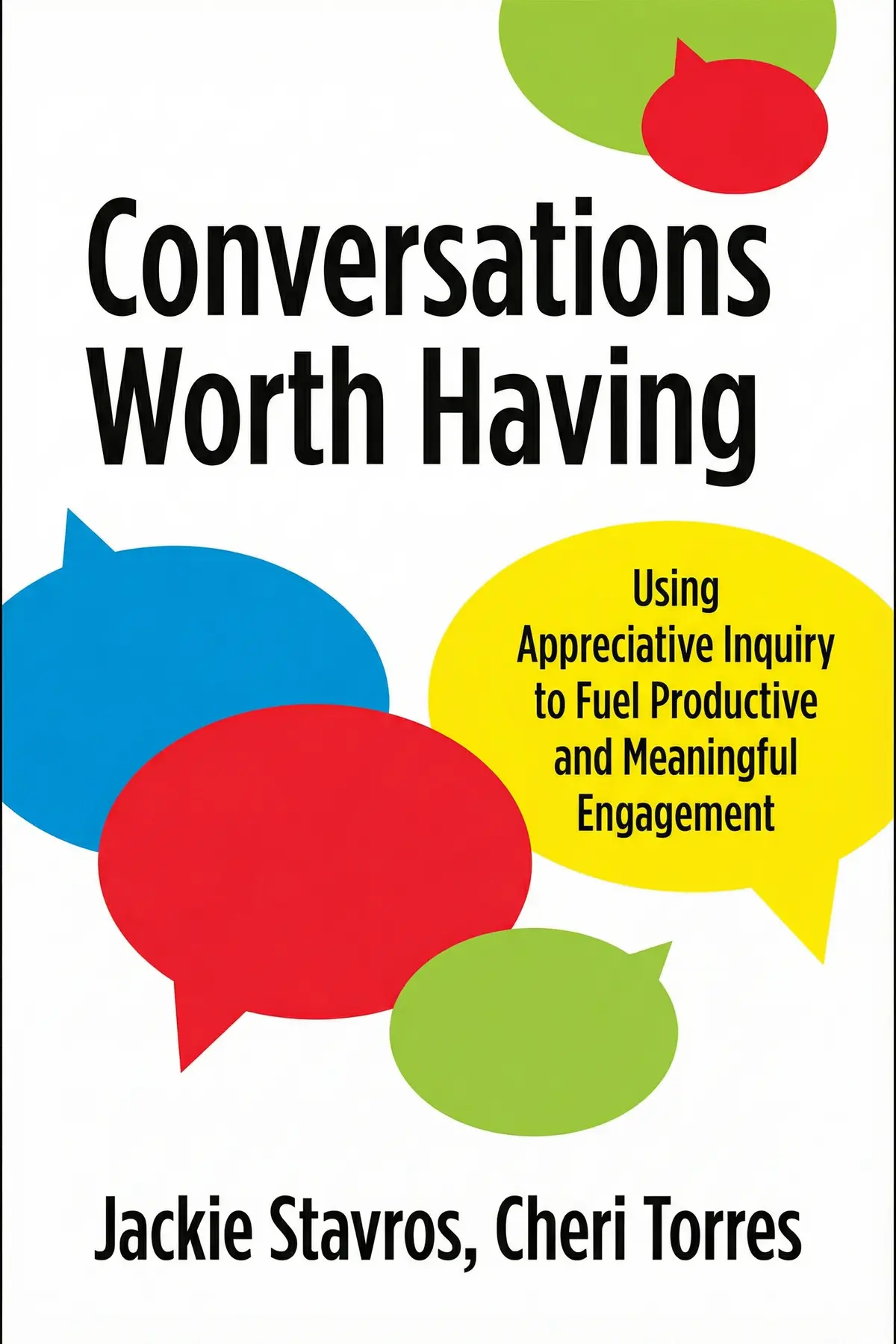
Table of Content
1. Introduction
1 min 44 sec
Have you ever walked away from a meeting or a discussion feeling completely drained, as if the life had been sucked out of the room? Or, on the flip side, have you ever had a talk that left you feeling inspired, energized, and ready to take on the world? The difference between these two experiences usually isn’t just the topic being discussed. Instead, it lies in the nature of the conversation itself. Conversations are the most powerful tools we have for building our world, yet we often treat them as if they just happen to us, rather than something we can consciously design.
In this exploration of the transformative power of dialogue, we are diving into the core concepts of Appreciative Inquiry. This isn’t just a fancy term for ‘staying positive.’ It is a robust, well-researched methodology that focuses on identifying what works and using that as a foundation for growth. When we approach our interactions through this lens, we stop looking for who to blame and start looking for how to thrive. We move from a mindset of deficit to a mindset of abundance.
Over the course of this summary, we will break down the mechanics of how our internal states influence our outward words. We will look at how to ‘flip’ a problem so that it becomes a goal, and we will examine the five core principles that govern how humans interact. Whether you are leading a large corporation, navigating a difficult family dynamic, or just trying to be more kind to yourself, these techniques offer a path toward engagement that is truly worth having. By the end, you will have a set of actionable tools to ensure that every word you speak serves a constructive purpose, building a bridge toward the future you want to see. Let’s begin the journey of reshaping your world, one conversation at a time.
2. Identifying and Shifting Hidden Influences
2 min 45 sec
Uncover the invisible forces that dictate how you talk to others and learn a simple three-step method to regain control over your reactions.
3. Mastering Generative Questions and Positive Framing
3 min 06 sec
Learn how to ask questions that create new possibilities and discover the ‘flipping’ technique to turn any obstacle into a clear, actionable goal.
4. Navigating the Five Principles of Human Connection
2 min 52 sec
Explore the psychological foundations of how we perceive others and how our expectations literally shape the outcomes of our interactions.
5. Applying Appreciative Mindsets to Life and Legacy
2 min 41 sec
See how Appreciative Inquiry can offer strength during life’s most difficult moments and learn to apply it to your personal relationships.
6. Conclusion
2 min 02 sec
As we wrap up this look at the art of communication, it is important to remember that the quality of your life is, in many ways, the quality of your conversations. We have seen how the invisible forces beneath our conscious awareness can either sink our relationships or propel them forward. By choosing to tune in—by pausing, breathing, and getting curious—you reclaim your power to lead and to connect. You’ve learned that you don’t have to be a victim of ‘problems.’ Instead, you can use the power of flipping and generative questions to turn any obstacle into a clear path toward a better future.
Think back to the five principles: the way we construct our reality, the immediate impact of our words, our choice of interpretation, the power of our expectations, and the resilience created by a positive focus. These are not just theoretical ideas; they are the tools of a master communicator. When you apply them, you stop merely exchanging words and start creating value. You begin to see the hidden potential in your colleagues, the secret strengths in your children, and the untapped possibilities in yourself.
To put this into practice immediately, try the ‘Ratio Challenge.’ For the next twenty-four hours, keep a small tally of your interactions. Mark them as either appreciative—adding value and looking forward—or depreciative—taking away value and looking backward. Research suggests that for a relationship or a team to thrive, you need a ratio of at least three positive, appreciative interactions for every one negative or critical one. If you find your ratio is lower than that, don’t despair. Use it as a starting point. Ask a generative question. Flip a problem into a goal. By doing so, you aren’t just changing a conversation; you are changing the trajectory of your world. Go out and start having the conversations that are truly worth having.
About this book
What is this book about?
Conversations are much more than just a simple exchange of information; they are the very fabric of our social systems and the primary engine for organizational and personal change. This summary explores how the tone and direction of our dialogue can either deplete energy or foster breakthrough innovation. By introducing the framework of Appreciative Inquiry, the authors provide a roadmap for moving away from criticism and toward a future-oriented, value-based approach to communication. The promise of this exploration is a complete shift in how you handle conflict, leadership, and personal growth. You will learn to move beyond problem-solving and toward possibility-finding. Through the application of generative questions and positive framing, you can reshape your workplace culture, strengthen your family bonds, and even improve your internal self-talk. The book serves as a practical manual for anyone looking to make their words count, ensuring that every engagement adds value rather than taking it away.
Book Information
About the Author
Jackie Stavros
Jackie Stavros is a professor at Lawrence Technological University with more than three decades of experience in the fields of leadership, organizational development, and strategic change. She has coauthored numerous influential works, including Learning to SOAR. Cheri Torres is a CEO who has partnered with thousands of leaders and organizations globally to enhance relationships and productivity through better communication. Her insights have appeared in prominent outlets such as Forbes, Training Magazine, and Careers in Government.
Ratings & Reviews
Ratings at a glance
What people think
Listeners find this book to be a superb resource for applying appreciative inquiry, noting its abundance of hands-on illustrations. The material is straightforward and accessible; indeed, one listener describes the work as an exquisite simplification of appreciative inquiry. Furthermore, listeners value how the text fosters significant interactions and generates beneficial outcomes, with one listener pointing out its ability to amplify mutual genuine affirmation.
Top reviews
Jong
Finally got around to reading this, and I’m genuinely impressed by how Stavros and Torres managed to simplify the complex concept of Appreciative Inquiry. The core idea is about flipping the narrative from what is wrong to what is working, which sounds simple but is incredibly difficult to execute in high-stress environments. I particularly resonated with the story of Alisha Patel and the medical center, as it showed a realistic application of moving from depreciative talk to generative questions. The writing is accessible, though the 'iceberg' metaphor for unconscious drivers was probably the most helpful visualization for me. It really helps you pause, breathe, and get curious instead of reacting defensively. If you want to foster mutual affirmation in your workplace or even just at the dinner table, this is an essential guide. It’s rare to find a business book that feels this applicable to your personal life as well.
Show moreFinn
Wow, what a refreshing perspective on human communication and organizational health. I’ve read a lot of self-help, but the focus here on 'generative questions' is what sets this apart from typical 'positive thinking' books. It isn't just about being nice; it’s about asking questions that actually reveal hidden information and create new possibilities. The story about Jackie’s daughter Ally was particularly moving and showed that these principles aren't just for the boardroom. It teaches you how to hold your own viewpoint lightly, which is a skill most of us are sorely lacking lately. Personally, I found the poetic principle—the idea that we can choose which perspective to focus on—to be a profound takeaway. This is an exquisite simplification of Appreciative Inquiry that doesn't sacrifice the depth of the science behind it. Truly a book worth having on your shelf.
Show moreMethinee
Stavros and Torres have created an exquisite simplification of a complex topic that I think every parent and boss should read. The shift from depreciative to appreciative inquiry isn't just a linguistic trick; it’s a total shift in how you perceive others. I loved the story of Jamal and his two teachers, Ms. Wittit and Ms. Summers, because it perfectly illustrated how our expectations dictate the outcomes of our interactions. When we anticipate failure, we usually find it, but when we focus on strengths, people rise to the occasion. The book is easy to understand and provides immediate steps to change your communication style. Not gonna lie, I was skeptical about the 'positive framing' for discipline issues, but it actually works. It amplifies mutual affirmation and leads to results that feel sustainable. Highly recommended for anyone wanting to improve their relationships.
Show moreArm
The chapter on generative questions really hit home for me because it changes the goal of a conversation from 'winning' to 'learning.' Jerry Sternin’s success in Vietnam was a standout example of how looking for 'positive deviants' can solve massive problems that traditional logic misses. I appreciated the well-cited research and the clear tables that help you structure your approach, making the concepts feel grounded in reality rather than just fluff. However, I’ll be frank: some of the case studies felt a bit long-winded and didn't stick in my mind as well as the core principles did. While the message is powerful, the book occasionally feels like it’s trying a bit too hard to sell you on the methodology. Still, the 'flipping' technique is a game-changer for anyone dealing with difficult employees or teenagers. It’s a solid 4-star read for its practical utility.
Show moreMaja
As a mid-level manager, I'm always looking for ways to boost morale without sounding like a corporate drone, and this book delivered. The concept of 'flipping'—defining a problem, finding its positive opposite, and focusing on the impact—is something I could implement immediately in my Wednesday meetings. I liked how the authors broke down the unseen influences like stress and bias that usually sink our interactions. The specific examples, like the one about Melissa being late for work, provided a clear roadmap for handling performance issues with empathy. My only gripe is that the writing style can be a bit dry in the middle sections where they get heavy into the theory. That said, the actionable advice at the end, like tracking your positive-to-negative conversation ratio, is fantastic. It’s an effective guide for anyone wanting to move beyond blame-based communication.
Show moreAnchalee
Ever wonder why some conversations leave you drained while others energize you? This book answers that by looking at the 'iceberg' of our unconscious drivers and teaching us to stay in the driver's seat. I found the five principles—especially the simultaneity principle—to be a great reminder that our words actually change the world as we speak them. The layout is great, with nice quotes starting the chapters, like the one from the Tao Te Ching about binding up wounds. My only minor criticism is that the case studies can drag on a bit, and I found myself skimming a few of the longer anecdotes. Nevertheless, the 'pause, breathe, and get curious' mantra has already helped me avoid two potential arguments this week. It’s a very practical guide for creating more meaningful engagements in every area of life.
Show moreRin
Picked this up on a whim after seeing a quote about how our words create our world, and I’m glad I did. The authors do a great job of explaining how to use 'flipping' to turn a negative situation into a productive one. I especially liked the actionable advice at the end of the book regarding observing your own conversations for a day to find your positive-to-negative ratio. It’s an eye-opening exercise that makes the theory feel very real. The research is cited well, and it's easy to follow up on the science if you're interested in the 'why' behind the 'what.' While the tone is a bit overly enthusiastic at times, the actual techniques are grounded and effective. It’s a wonderful guide for anyone looking to foster more constructive and hopeful dialogue in a world that often feels very polarized.
Show moreDing
This book provides a solid introduction to AI, but it felt a bit repetitive at times and leaned into a tone that was slightly preachy. I found the central message about positive framing insightful and useful for my daily interactions, yet the authors have a tendency to toot their own horn regarding the success of their methods. In my experience, real-life conflict isn't always solved as neatly as the story of Monica and her son Aiden suggests. Some sections felt like they were promising that Appreciative Inquiry would create rainbows and fix every organizational woe overnight. To be fair, the five principles are well-explained and the psychology makes sense. I just wish the narrative moved a bit faster and focused less on the 'miracle' aspect of the results. It's a decent tool for the toolkit, but keep your expectations grounded.
Show moreDuangjai
Look, the core message here is undeniably smart and the 'flipping' technique is something everyone should learn. I appreciated the emphasis on empathy and the way it mirrors non-violent communication. However, I have to agree with other reviewers that the book feels smothered by its own optimism at times. It gets a bit repetitive, hammering the same points over and over across different chapters. The case studies, while illustrative, didn't always feel authentic or memorable; they felt more like 'best-case scenarios' designed to prove a point. I think it’s a good read if you’re new to Appreciative Inquiry, but for those already familiar with the field, it might feel a bit basic. It’s a useful manual, but I wouldn't call it a page-turner. A solid choice for professional development, if a bit dry.
Show morePhu
Truth is, I struggled to stay engaged with the narrative despite agreeing with the underlying psychology. While the principles of Appreciative Inquiry make sense, the book feels like a long-form brochure for the authors' consulting work. It’s a bit too much 'tooting its own horn' for my taste, with constant reminders of how many thousands of people they’ve helped. I found the case studies to be unengaging and they seemed to drag on forever without adding much new information. The tables and the quotes at the beginning of chapters were the only parts I found truly useful. If you can get past the preachy tone and the 'rainbows and productivity' vibe, there is a good message buried in here. For me, it could have been a 30-page white paper instead of a full-length book.
Show moreReaders also enjoyed


AUDIO SUMMARY AVAILABLE
Listen to Conversations Worth Having in 15 minutes
Get the key ideas from Conversations Worth Having by Jackie Stavros, plus 5,000+ more titles in English and Thai.
- 5,000+ titles
- Listen as much as you want
- 7-day free trial
- Cancel anytime







