
Groundwork of the Metaphysics of Morals
Immanuel Kant
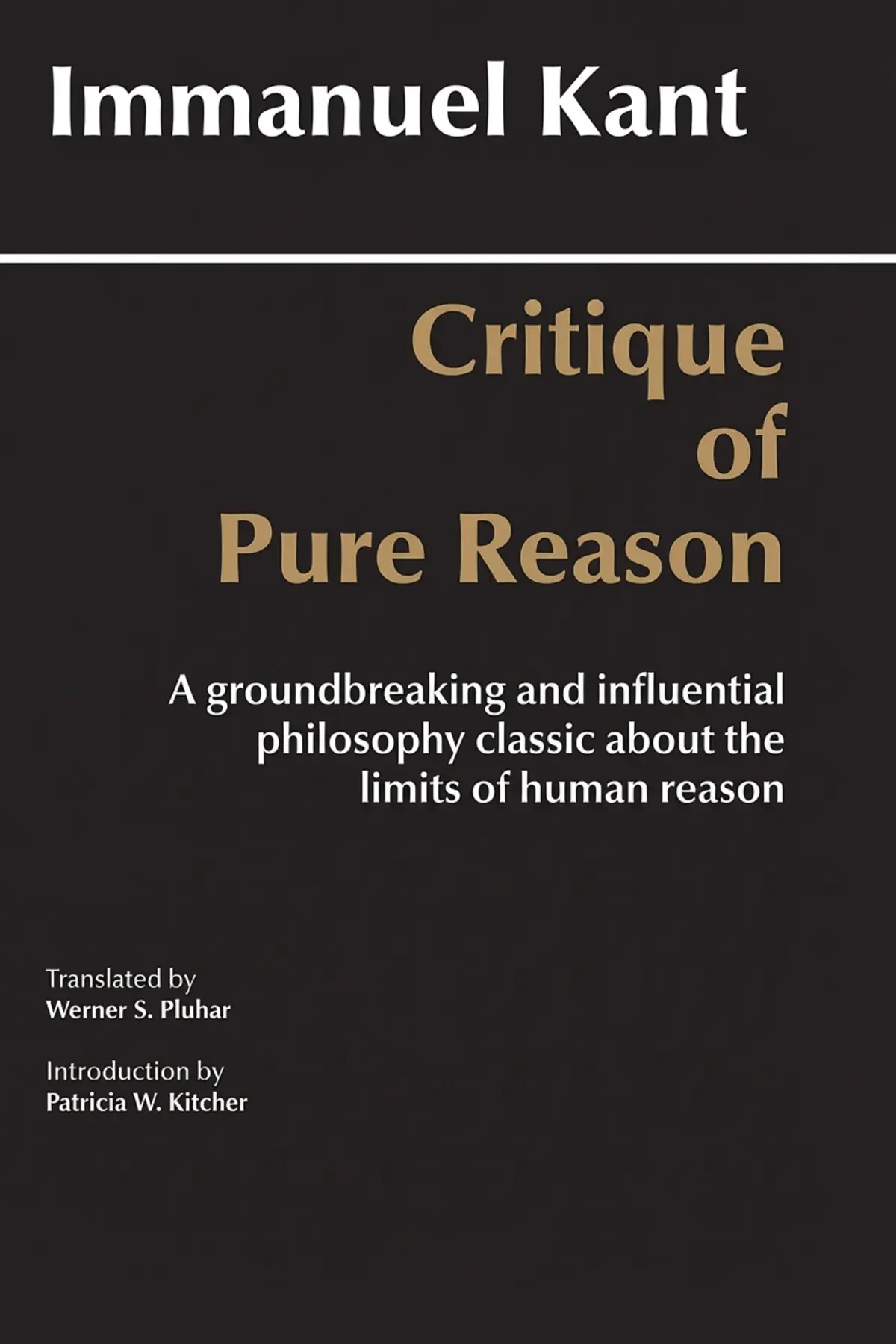
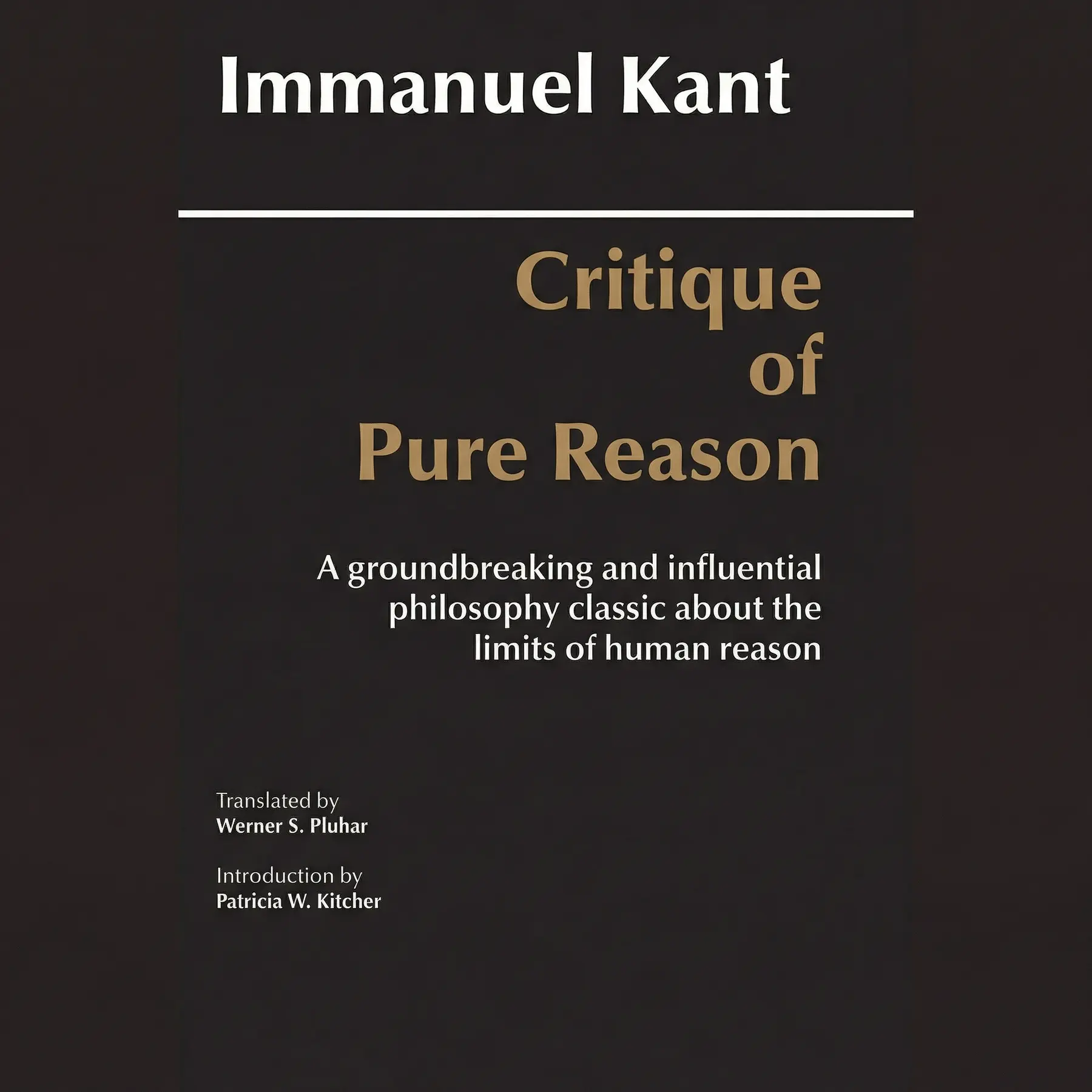
Immanuel Kant’s masterwork explores the boundaries of human understanding, arguing that our minds actively shape reality through internal filters, ultimately limiting our knowledge to the world as we experience it, rather than as it truly is.
2 min 07 sec
Have you ever wondered if the world you see around you is exactly as it appears? We often take for granted that our eyes, ears, and minds are like clear windows, letting in the light of reality just as it is. But what if those windows are actually lenses? What if they are tinted, shaped, or even distorting the very thing we think we are seeing? These are the kinds of questions that lie at the heart of one of the most influential books ever written: Immanuel Kant’s Critique of Pure Reason.
Now, let’s be honest. This is a book with a reputation. It is famous for being one of the most difficult, dense, and frankly impenetrable pieces of philosophy in history. Even Kant himself admitted that the writing was dry and long-winded. For centuries, scholars have dedicated their entire lives just to untangling single paragraphs from this eight-hundred-page beast. But beneath all that technical jargon and the complex sentence structures lies an idea so revolutionary that it completely changed how we think about the human mind and the universe itself.
In this exploration, we are going to look past the thick fog of Kant’s prose to find the core throughline of his thought. We’ll investigate the nature of space and time, not as things that exist out there in the galaxy, but as something much closer to home. We’ll look at the law of cause and effect and ask why we are so certain that one thing must follow another. Most importantly, we will follow Kant as he attempts to set the boundaries for human thought. He wanted to find out what we can know for certain, what we can only guess at, and where we must finally admit that we have reached the edge of our own maps.
Think of this as a journey into the architecture of your own consciousness. We are going to examine the very tools you use to think, see, and understand. By the end, you might find that the world looks a little bit different—and that the most fascinating thing about reality isn’t what’s out there, but how your mind makes sense of it.
2 min 43 sec
Before we can build a grand system of understanding, we must first inspect the tools and materials of our own minds to see if they are actually capable of the task.
2 min 16 sec
Philosophy must stop making blind assumptions about its own powers and instead subject our capacity for reason to a rigorous, honest examination.
2 min 11 sec
When philosophers fail to justify their claims, it leads to a total loss of confidence in our ability to know anything at all, endangering all human knowledge.
2 min 27 sec
Both our religious beliefs and our scientific laws rely on concepts that we cannot directly observe, making a defense of these ideas essential for modern life.
2 min 02 sec
Mathematics provides a clue that we are capable of knowing truths that are universal and necessary, independent of any specific life experience.
2 min 09 sec
We aren’t born with facts already in our heads; instead, our minds come with internal machinery that processes life’s data into meaningful knowledge.
2 min 09 sec
Our mental factory is divided into three main departments—Sensibility, Understanding, and Reason—each playing a specific role in how we perceive the world.
2 min 19 sec
Space and time aren’t things we discover in the world; they are the internal frameworks our minds use to organize every single thing we experience.
2 min 02 sec
Our minds come pre-programmed with twelve logical categories, like causality and existence, which act as the rules for how we think about objects.
2 min 00 sec
Conscious experience is not a direct reflection of the world, but a carefully built product of our mind’s internal templates and sensory data.
2 min 27 sec
We are forever separated from reality as it truly is, because we can only ever know the version of the world that our minds have filtered for us.
2 min 20 sec
Reason often gets into trouble by trying to answer questions about the ultimate nature of reality that it is simply not equipped to handle.
2 min 23 sec
So, what does it all mean? When we step back from the complex gears and pulleys of Kant’s mental machinery, what is the central takeaway for us today? The Critique of Pure Reason is a call for intellectual humility. It tells us that our perspective is not the only perspective, and that our human way of seeing the world is just that—a human way.
Kant’s throughline is clear: we are active participants in the creation of our own reality. The space we move through, the time that marks our lives, and the laws of cause and effect that allow us to build technology and predict the future are not just cold facts of the universe. They are the frameworks of our own minds. This realization is incredibly empowering because it explains why the world is intelligible to us. It’s intelligible because it has been shaped to fit our capacity for understanding.
But this power comes with a limit. We must accept that there is a vast, mysterious reality “in itself” that we can never truly grasp. We are like sailors on a vast ocean of experience. We can map the waves, we can study the winds, and we can build sturdy ships because we understand the laws of the sea as we perceive it. But we must never forget that there are depths beneath us that our anchors will never reach, and horizons ahead that we can never cross.
In our modern world, where we are often tempted by the extremes of either blind dogmatism or cynical skepticism, Kant offers a middle path. He encourages us to be rigorous and bold in our scientific pursuits, using our reason to its fullest extent within the world of experience. But he also warns us not to become arrogant, reminding us that our highest thoughts and most complex theories are still just human interpretations of a deeper reality.
As you move through the world after this exploration, try to notice the “lenses” of your own mind. When you see a cause leading to an effect, or when you feel the passage of time, remember that these are the tools your mind is using to make sense of the mystery of existence. By recognizing the limits of your own reason, you don’t lose the world; instead, you gain a more profound appreciation for the incredible, active power of the human spirit to turn chaos into a coherent, meaningful life.
This summary provides a deep dive into Immanuel Kant’s Critique of Pure Reason, one of the most significant yet challenging works in Western philosophy. It explores the revolutionary idea that the human mind is not a passive observer but an active architect of experience. By examining the "mental materials" we use to build our understanding of the world, Kant seeks to establish the limits of what we can truly know. The narrative navigates through the complex concepts of space and time as internal frameworks, the role of logic in shaping our perceptions, and the vital distinction between the world of appearances and the world as it exists independently of our senses. It aims to demystify Kant’s dense prose, offering a clear path through his arguments on causality, mathematics, and the limitations of metaphysical speculation, ultimately showing how reason must recognize its own boundaries to protect both science and faith.
Immanuel Kant was an eighteenth-century German philosopher who was one of the main thinkers of the Enlightenment. He was the central figure behind the philosophical movement that became known as German Idealism, which transformed Western philosophy and set in motion developments in the discipline that continue to this day. His main works are his three Critiques: the Critique of Pure Reason, the Critique of Practical Reason, and the Critique of Judgment.
Immanuel Kant
Listeners observe that perspectives differ regarding the book's complex prose and the accuracy of its scientific premises, yet the majority value it as a central tenet of modern philosophy. Furthermore, they prize the way the text reimagines the connection between experience and knowledge, presenting a transformative "Copernican turn" within the discipline. Listeners also point to its long-standing influence across many subjects, with one listener highlighting significant links to quantum mechanics and the prose of Marcel Proust. Despite the notorious difficulty of the subject matter, many portray finishing the work as a major accomplishment, with one listener equating the mental struggle to ascending a vertical cliff side.
Scaling this intellectual Everest was the single most grueling experience of my academic life. Kant doesn't just write; he constructs a labyrinthine fortress of definitions that require a literal pickaxe to navigate. Truth is, the reward at the summit is nothing short of a total paradigm shift for the patient reader. By the time I reached the final chapter, the feeling of accomplishment was momentous, like finally breathing thin air after months of climbing. Even if some of his scientific assumptions feel dusty to a modern reader, the foundational logic remains unshakable. It's a foundational pillar that forces you to rethink how you perceive every single object in your path. This is easily the most important book on my shelf, despite the sweat it cost me.
Show moreThis masterpiece effectively created the world of modern thought, influencing everything from the physics of Schrödinger to the internal monologues of Marcel Proust. Kant’s exploration of the transcendental unity of apperception provides the only coherent refutation of the skepticism that plagued earlier philosophers. Frankly, you have to be willing to endure hundred-page detours into the 'Antinomies' just to get a glimpse of his core brilliance. It’s an organic unity of thought where every gear must turn in perfect sync for the machine to function. Once you grasp the categories of the understanding, the world never looks quite the same again. It is a work of pure, unadulterated genius that demands multiple readings to fully appreciate the scope of its ambition.
Show moreWow, I feel like I just finished a ten-round boxing match with the concept of existence itself. Kant is a relentless thinker who refuses to let the reader take anything for granted, especially regarding the nature of time. Personally, I found his 'transcendental method' to be the most convincing way to bridge the gap between raw sense data and coherent thought. It’s not just a book; it’s a toolkit for understanding how our minds filter the world into something we can actually comprehend. There are moments where the terminology becomes a bit much, but the overall vision is breathtakingly vast. It’s a momentous achievement in human reasoning that everyone should attempt at least once. Just make sure you have a very large cup of coffee nearby.
Show moreJust finished the last page and I feel like my brain has been permanently rewired. Why did it take me so long to tackle the 'Copernican turn' for myself? The way Kant identifies the structural principles of the mind—the very conditions that make experience possible—is a stroke of sheer genius. While his tone is often austere and lacks the poetic flair of some of his successors, the depth of his analysis is unparalleled. This work is the ancestor of everything from quantum mechanics to the intricate literature of Marcel Proust. It’s a difficult, steep climb that requires immense focus, but the view of the foundations of human thought from the top is absolutely worth the toil. A truly transformative piece of literature.
Show moreEver since I heard a professor compare this book to a magic car that flies over transcendental illusions, I've been fascinated by its weird machinery. Finally finishing it felt like a marathon for the brain. Look, the material is notoriously dense and often joyless, but the way Kant redefines the relationship between the mind and reality is staggering. He calls it a 'Copernican turn,' and it’s a perfect description for how he centers the observer in the middle of the universe. It’s not an easy read by any stretch, and I found myself nodding off during the more repetitive sections on the categories. Still, the legacy of this work is undeniable, and you can see its fingerprints on everything from modern logic to cognitive psychology.
Show moreAs someone who usually prefers modern philosophy, I was surprised by how much this old text still has to say about our cognitive limits. The central insight—that we supply the structure to our own experience—is a revolutionary concept that prefigured much of today’s research. I did find the sections on formal logic a bit repetitive and dry, though. It’s like trying to drink from a firehose of pure abstraction without any clear relief. However, the way he maps the boundaries of what we can actually know is essential for avoiding groundless metaphysical speculation. It’s a dense, difficult, and ultimately rewarding piece of intellectual history. It isn't perfect, and his science is often wrong, but the philosophical core is solid as a rock.
Show moreAfter hearing so many people complain about the 'sauerkraut-scented' density of this work, I was terrified to start. It turns out that while the language is certainly thick, the logic is incredibly tight once you get into the rhythm. Kant’s ability to weave together the world of sensations and the world of concepts is something no one has done better since the 1780s. There are definitely parts that feel like a Pomeranian mysticism gone wrong, especially in the more speculative chapters about the soul. But the core project of mapping the mind’s own hardware is utterly brilliant. It’s a heavy lift, but every page is dripping with historical significance. You can really feel the weight of modern philosophy being born in these pages.
Show moreNot gonna lie, reading this felt like drowning in a vat of cold, thick German gravy. While I recognize its status as a cornerstone of modern thought, Kant’s pontificating on space and time feels remarkably dated in the wake of Einstein’s relativity. He treats space as a mere intuition, but we now know it’s a dynamic thing that interacts with matter in ways he couldn't have imagined. I appreciate the effort to bridge the gap between sensations and concepts, yet the prose is needlessly turgid. It’s important historically, but it’s definitely past its expiration date for anyone looking for actual physics. To be fair, he was a product of his time, but that doesn't make the text any less of a slog to get through.
Show moreThe chapter on the 'Antinomy of Pure Reason' was almost my breaking point because it felt like running in circles. It’s frustrating because Kant spends so much time arguing about whether the universe is finite or infinite when modern astronomy has rendered his specific approach mostly moot. Still, his 'Critique' remains a foundational pillar for a reason; you simply cannot ignore the way he forces you to justify your own claims to knowledge. In my experience, the book is best read in small chunks to avoid total mental exhaustion and resentment. It’s an important museum piece—magnificent to look at and conceptually massive, but not necessarily something that holds up under the scrutiny of modern physics or relativity.
Show morePicked this up expecting enlightenment but instead found a man who seems to take pleasure in sucking the joy out of human experience. Kant’s writing style is the literary equivalent of a grumpy neighbor wearing too-tight shorts and tending his garden with a joyless, mechanical precision. The text is unnecessarily complex, dragging the reader through a muck of 'synthetic a priori' propositions that often feel like empty wordplay. Look, his obsession with setting strict limits on reason feels more like a prison than a map. I understand why it’s famous, but the sheer lack of humanity in the prose makes it a miserable experience for anyone without a PhD in linguistics. It's a fossil of a book that treats the human mind like a cold, calculating machine.
Show more
William B. Irvine
Nigel Warburton
John Rawls
Robert Nozick
Nassim Nicholas Taleb
John Milton
AUDIO SUMMARY AVAILABLE
Get the key ideas from Critique of Pure Reason by Immanuel Kant, plus 5,000+ more titles in English and Thai.







