
18 min 41 sec
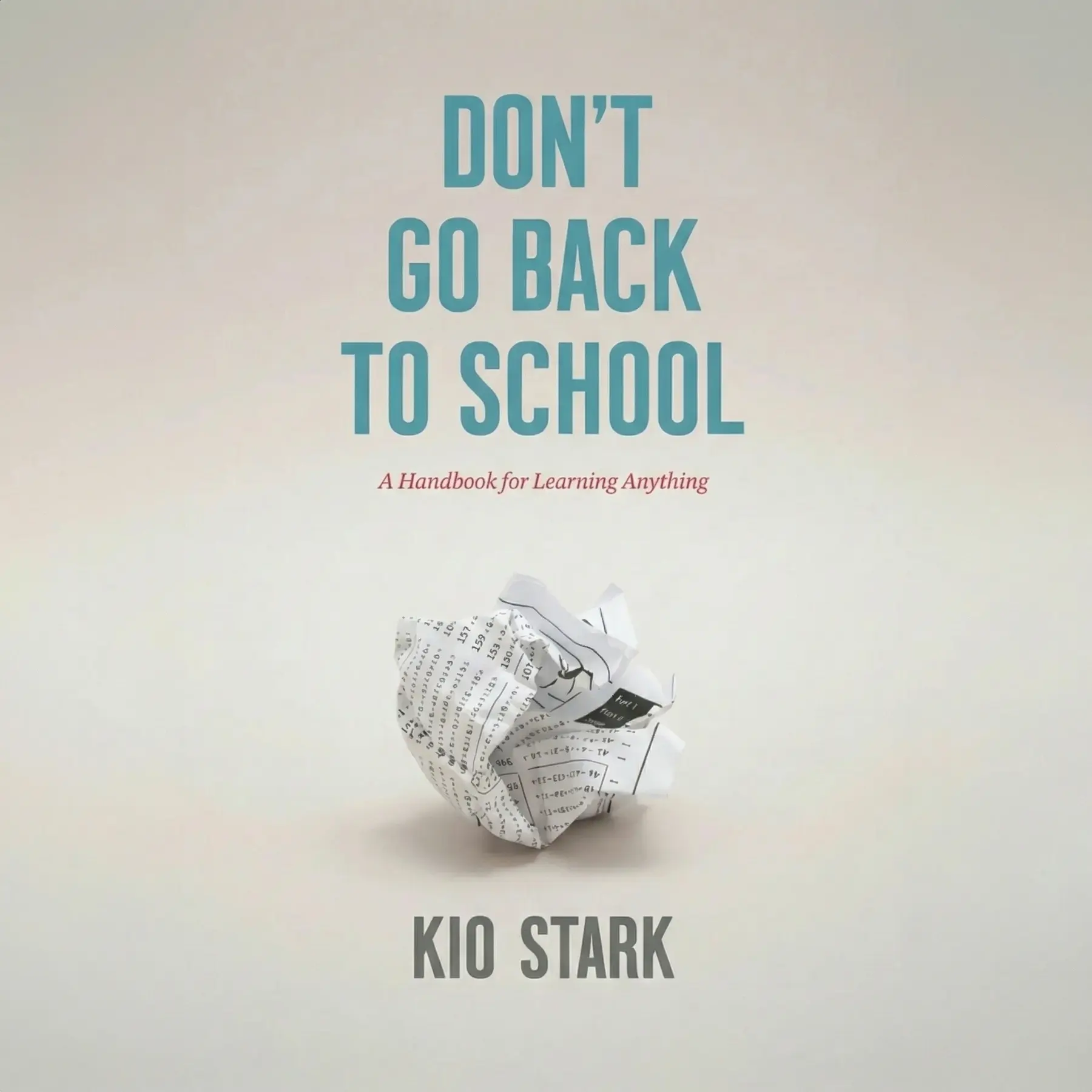
Don’t Go Back to School: A Handbook for Learning Anything
By Kio Stark
Don’t Go Back to School challenges the necessity of traditional degrees, offering a practical roadmap for independent learners to master new skills, build professional networks, and succeed in the modern job market without massive debt.
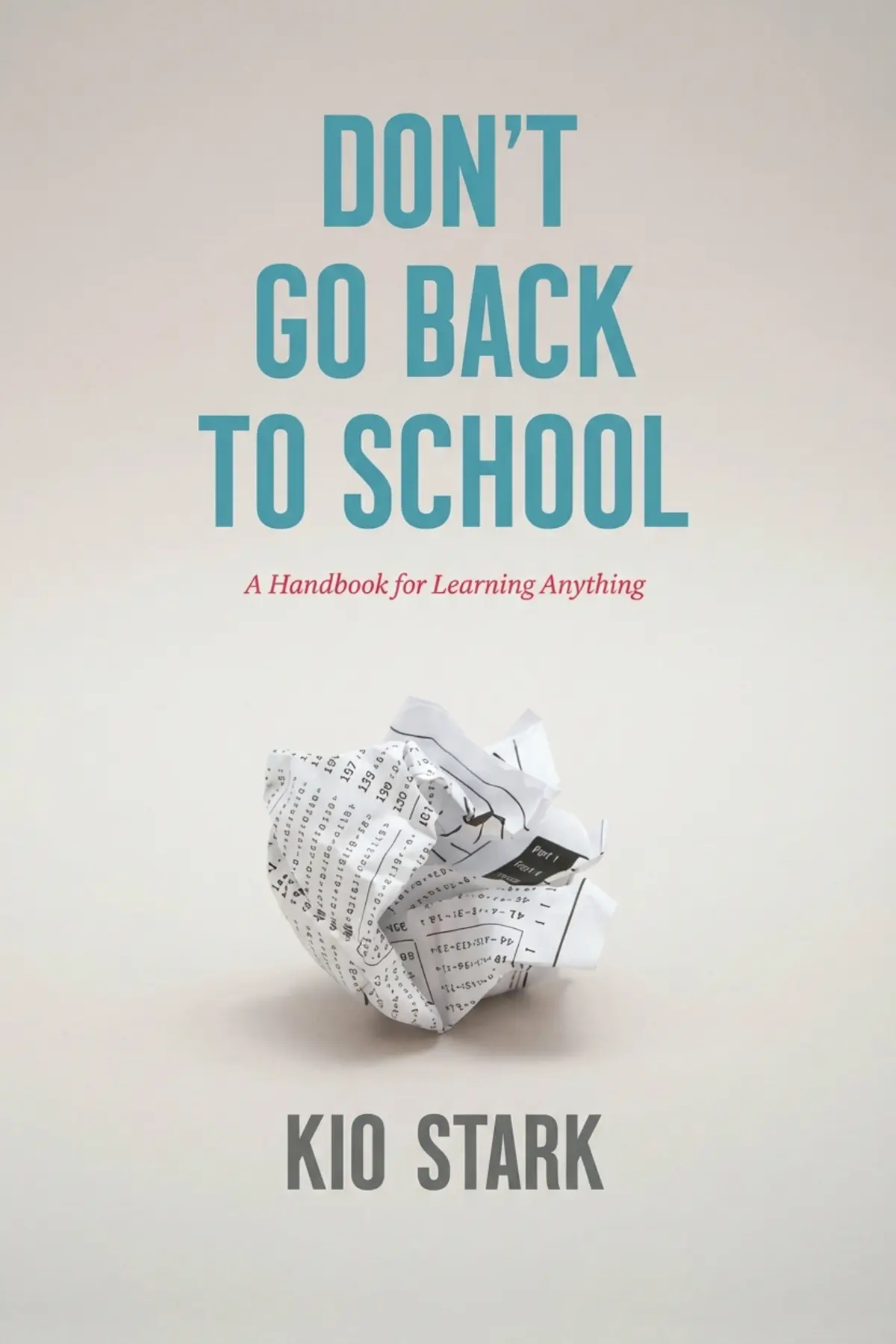
Table of Content
1. Introduction
1 min 42 sec
For generations, the script for a successful life has been written in the hallways of academia. We are told from a young age that the only reliable bridge to professional security and personal fulfillment is a university degree. The common wisdom suggests that without those specific letters behind your name, you are destined for a life of low-wage labor and limited horizons. But what if the ground beneath this traditional path has shifted? What if the ivory tower is no longer the only—or even the best—place to gain the knowledge and connections needed to thrive in the modern world?
In the following exploration of self-directed education, we will challenge the assumption that a classroom is the primary site of learning. The reality is that the value of a formal degree is undergoing a radical transformation, and for many, the debt-heavy pursuit of a diploma is becoming a risky gamble rather than a safe investment. As the job market evolves, the emphasis is moving away from where you studied and toward what you can actually do and who you truly know.
This isn’t just about opting out of a system; it’s about opting into a more vibrant, personalized, and effective way of gathering wisdom. We will dive into the strategies of independent learners who have successfully forged their own paths. You’ll discover how to harness your own curiosity, build powerful networks without a campus, and treat the entire world—especially the workplace—as your laboratory. By the end of this journey, you’ll see that education isn’t a destination you reach after four years of study; it’s a lifelong, social, and deeply rewarding process that you can start right now, on your own terms.
2. The Fading Promise of the Institutional Diploma
2 min 04 sec
Traditional degrees no longer guarantee the financial security they once did. Understand how economic shifts and rising education costs have transformed the university from a safe bet into a high-stakes risk.
3. Igniting the Engine of Internal Interest
2 min 01 sec
Conventional schooling often relies on external pressures that can stifle genuine curiosity. Discover why shifting toward internal motivation leads to faster mastery and more profound personal satisfaction.
4. Dismantling the Barriers to Academic Knowledge
1 min 50 sec
Academic information is becoming more accessible than ever before. Learn how to navigate the evolving world of open access and resource sharing to find the materials you need.
5. The Social Dimension of Self-Directed Learning
1 min 51 sec
Independence does not mean isolation. Explore why the most successful self-taught individuals rely on communities, feedback loops, and the act of teaching others.
6. Why Practical Experience Trumps Classroom Theory
1 min 58 sec
Abstract study can only take you so far. Discover why learning in a real-world context, where failure has actual stakes, is the fastest route to true expertise.
7. Mastering the Art of Confident Entry
1 min 55 sec
When you lack a formal degree, confidence and a bias toward action become your most important assets. Learn how to navigate the job market using ‘chutzpah’ and proof of ability.
8. Curating Your Own Mentorship Circle
1 min 56 sec
You don’t need a campus to meet world-class experts. Discover how simple, professional outreach and peer-led networks can provide a high-level education for the price of a few lunches.
9. The Workplace as the Ultimate Learning Laboratory
1 min 49 sec
A job is far more than a source of income; it is a primary site for education. Learn how to adopt an apprentice mindset to maximize your growth in any professional setting.
10. Conclusion
1 min 35 sec
The transition from being a student to being a learner is perhaps the most important shift you can make in your professional and personal life. As we have seen, the traditional institutions that once held a monopoly on knowledge and success are no longer the only path forward. The world is changing, and the tools for building a meaningful, successful career are now largely in your own hands. By prioritizing your own curiosity, seeking out community, and embracing the real-world application of your skills, you can achieve a level of mastery that far surpasses what is offered in a standardized classroom.
Remember that independence does not mean doing it all alone. It means taking responsibility for your own growth while building a vibrant network of mentors and peers. It means having the audacity to prove your worth through your work rather than a piece of paper. Whether you are looking to switch careers, start a business, or simply master a new craft, the path is open. The resources are there—in the libraries, in the open-access journals, in the workplace, and in the people around you.
Don’t wait for an institution to give you permission to start your education. Begin where you are, with what you have. Reach out to someone you admire, start that project you’ve been thinking about, and treat every failure as a lesson. The most valuable degree you can ever earn is the one you give yourself through years of dedicated, self-directed exploration. Your education belongs to you; it’s time to take the lead.
About this book
What is this book about?
In an era of rising tuition and a shifting job market, the traditional college degree is no longer the guaranteed path to success it once was. Don’t Go Back to School explores the liberating world of self-directed education, showing that the most effective learning often happens outside the classroom. Kio Stark argues that by harnessing intrinsic motivation and building community-based support systems, anyone can acquire high-level skills and professional recognition on their own terms. The book provides a guide for navigating the wealth of information available through open-access research and local networks. It emphasizes the importance of 'learning by doing' and explains how to replace formal credentials with a strong portfolio and a proactive attitude. By highlighting the stories of successful independent learners, Stark offers a promise: you can escape the cycle of student debt and institutional gatekeeping. This is a handbook for anyone ready to take control of their intellectual and professional future through curiosity, audacity, and collaborative growth.
Book Information
About the Author
Kio Stark
Kio Stark is an accomplished writer and researcher who explores the intersections of learning, technology, and human interaction. She serves as an adjunct professor at New York University’s prestigious graduate Interactive Telecommunications Program, where she conducts active research into the best practices for teaching and learning. In addition to her non-fiction work, Stark is a talented novelist, having published the acclaimed book Follow Me Down.
Ratings & Reviews
Ratings at a glance
What people think
Listeners enjoy the book’s take on education, as one listener points to its organized breakdown of different techniques while another stresses its concentration on internal drive. Additionally, the profiles and interviews are popular, with one listener calling them a fine assembly of achievement narratives. However, listeners hold conflicting views about the book’s overall readability.
Top reviews
Finn
As someone who has always struggled with the rigidity of traditional classrooms, I found this to be a total breath of fresh air. Kio Stark doesn't just bash the system; she offers a compelling roadmap for those of us who prefer to forge our own paths through the world. The focus on intrinsic motivation really hit home for me because that is the primary fuel for any real, lasting learning. I loved the way she breaks down the importance of finding a community rather than just trying to learn everything in a vacuum. To be fair, some of the interviews feel a bit similar after a while, but the sheer variety of successful stories is inspiring. It is a validating read that confirms my personal projects are worth the effort even without a fancy degree or a university stamp of approval.
Show moreKofi
If you are currently feeling like your university is brutally murdering your interest in your favorite subjects, you need to read this book immediately. It was like hearing my own internal monologue reflected back at me through the author’s sharp prose and the diverse interviewees. Stark understands that education is often more about jumping through hoops than it is about the actual mastery of a craft. This book provides the permission you didn't know you needed to stop waiting for a syllabus and start building your own curriculum. Not gonna lie, I have already started applying the feedback loop concept to my personal coding projects with great success. It is a transformative guide for anyone who feels trapped by the traditional academic trajectory and wants to reclaim their intellectual curiosity.
Show moreAria
Finally got around to reading this, and it is a solid resource for anyone looking to transition away from institutional learning. The book does a fantastic job explaining the difference between project-directed and knowledge-directed learning, which helped me categorize my own messy habits. Truth is, I preferred the systematic breakdown of methods over the long-winded interviews with various creatives. While the anecdotes are nice for color, they sometimes felt like they were repeating the same positive message. I would have appreciated a bit more grit or discussion on the actual failures one might face when going solo. Still, the practical advice on how to build a feedback loop is invaluable for staying motivated over the long haul. It's a quick read but one that stays with you long after you finish the last page.
Show moreNan
Picked this up after feeling completely burnt out by my current degree program and it was exactly the nudge I needed. Stark highlights that independent learning does not mean you have to learn alone, which was a major breakthrough moment for my mindset. The idea of using mailing lists or just taking a professor out to lunch to gain access to expert knowledge is brilliant and actionable. While the book leans heavily into the project-based approach, it explains the linear and associative processes with enough clarity for anyone to follow along. In my experience, the most valuable part was the emphasis on creating a community of peers to maintain your momentum. It is not a perfect manual, but it is an empowering collection of stories for the modern autodidact trying to navigate a digital world.
Show moreGor
Ever wonder how people actually manage to become experts in their fields without ever stepping foot back into a classroom? This book attempts to answer that by providing a systematic explanation of various self-learning methods that anyone can adopt. I particularly enjoyed the distinction between knowledge-directed and project-directed paths, as it helped me understand why I usually lose interest halfway through a new hobby. The readability is quite high, and the short-form essays make it easy to pick up and put down during a busy day. My only gripe is that it skips over some of the harder parts of being a self-learner, like managing the extreme isolation. Overall, it is a solid 4-star read that offers plenty of inspiration for the lifelong learner in all of us.
Show moreElla
After hearing about Kio Stark's work on several podcasts, I was eager to see her framework for independent study. The book is chalked full of useful tidbits, like how to use review articles to fast-track your understanding of a new field. It is definitely aimed at a specific type of person—someone who is already intrinsically motivated but perhaps feels a bit lost without a teacher. I found the advice on gaining access to experts by offering them something of value to be particularly practical and grounded. Personally, I would have liked more focus on the linear versus associative learning styles, as that section felt a bit brief. Still, it is a refreshing take on education that values the trajectory of digitization over dusty old histories and institutional gatekeeping.
Show moreTong
The chapter on specific techniques was easily the highlight for me, but the rest of the book felt somewhat inconsistent in its delivery. Stark clearly has a bone to pick with formal education, and at times the anti-school sentiment becomes a bit too much to swallow for a balanced reader. I don't think we need to tear down universities to prove that self-directed learning is a viable and powerful alternative. Many of the people interviewed actually had some form of college background, which makes the title feel slightly misleading. It is a quick, punchy read that works well for a commute, yet I left feeling like I needed more concrete next steps to follow. It is definitely a great starting point for beginners, though it lacks the deep pedagogical rigor I was originally expecting from the hype.
Show moreWeera
Look, I wanted to love this more than I actually did, even though the premise aligns perfectly with my own educational philosophy. The book is filled with aggrandizing positive reinforcement, but it rarely pauses to discuss the systemic barriers or the very real downsides of self-teaching. It is great to hear about successful designers and writers, but what about the fields where credentials are non-negotiable? The writing style is casual and easy to digest, which makes for a fast read, but it lacks the intellectual discipline I usually enjoy. I noticed there were hardly any interviews with scientists, which made the argument feel a bit narrow and geared mostly toward the creative class. It is a nice refresher, but it didn't quite live up to the high expectations I had.
Show moreSebastian
To be fair, the book functions better as a motivational tract than as a rigorous guide on how to actually learn. While I appreciated the list of resources at the end, the core of the book is really just a series of anecdotes. Some of the stories are fascinating, but after the tenth interview, they all start to blend together into a blur of personal success. I was hoping for more information on the cognitive science behind independent learning rather than just subjective personal stories. It is a helpful catalyst if you are stuck in a rut, but seasoned autodidacts might find the content a bit repetitive. It is a decent summary for beginners, but it does not go deep enough into the actual mechanics of mastery for my taste.
Show moreElena
Frankly, this was a huge disappointment because it feels more like a collection of blog posts rather than a cohesive, well-researched argument. The author makes these massive generalizations about how schools fail to offer individual growth, which is simply not true for every student. If we all followed this advice, who would be left to perform the complex surgeries or handle the legal defenses mentioned in the early chapters? I found the interviews incredibly repetitive and lacking in actual structure, focusing instead on vague successes. It is one thing to encourage DIY learning for art or coding, but it is another to ignore the value of public institutions. This feels like an echo chamber for people who are already convinced they do not need formal qualifications to succeed in the modern workplace.
Show moreReaders also enjoyed
AUDIO SUMMARY AVAILABLE
Listen to Don’t Go Back to School in 15 minutes
Get the key ideas from Don’t Go Back to School by Kio Stark, plus 5,000+ more titles in English and Thai.
- 5,000+ titles
- Listen as much as you want
- 7-day free trial
- Cancel anytime







