
15 min 33 sec
Don’t Say Um: How to Communicate Effectively to Live a Better Life
Don't Say Um provides a practical roadmap for mastering the art of public speaking. By focusing on connection over perfection, it offers actionable tools to eliminate fillers and speak with authentic authority.
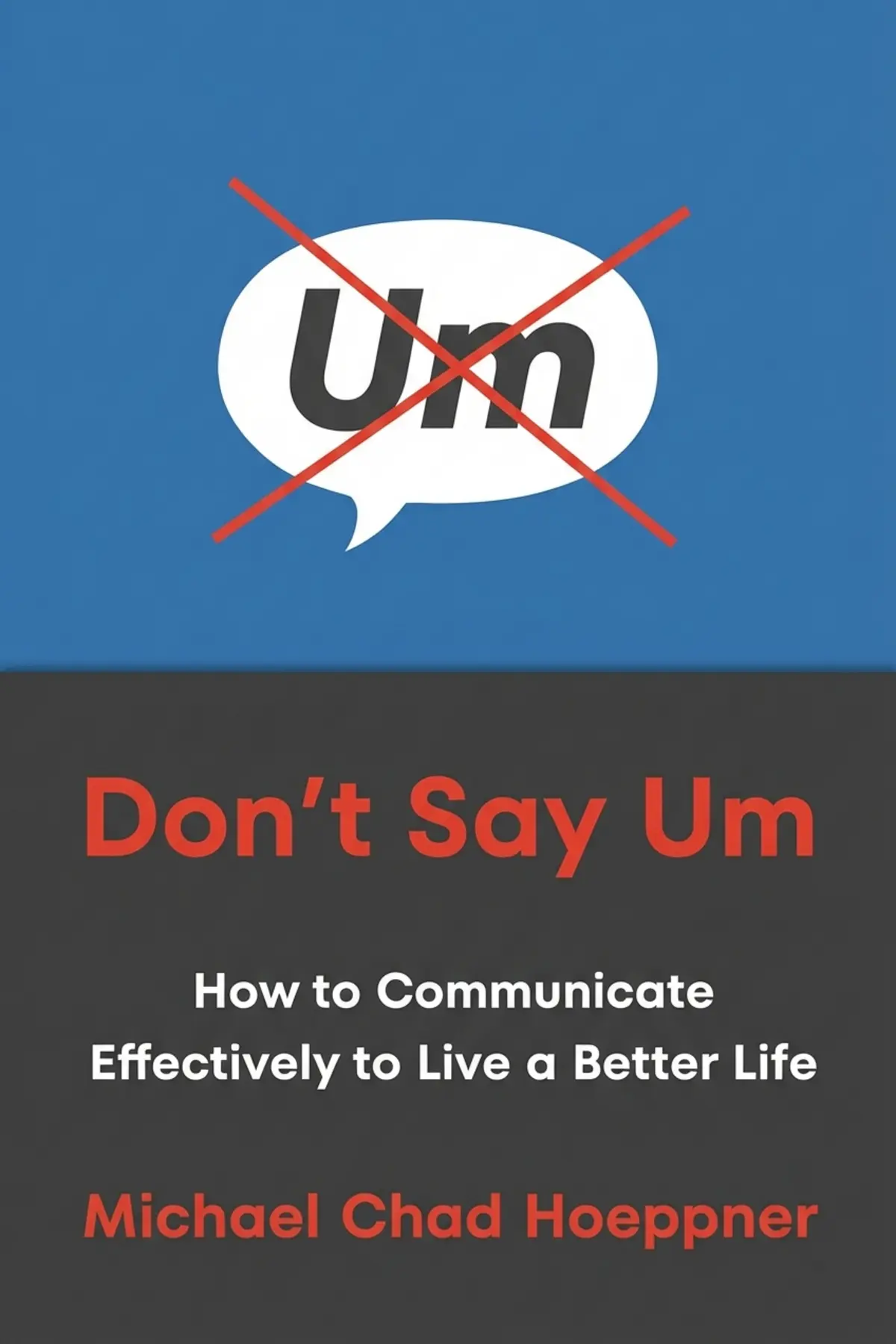
Table of Content
1. Introduction
1 min 56 sec
Why is it that the simple act of talking, something we do thousands of times every single day, suddenly becomes a Herculean task the moment we step in front of a microphone or enter a high-stakes boardroom? In our casual lives, we don’t agonize over where our hands are or whether we are making the ‘correct’ amount of eye contact. We just speak. But when the stakes rise, our brains often betray us. We become hyper-aware of ourselves, and that self-consciousness creates a wall between us and our listeners. Suddenly, the words don’t flow, our hands feel like heavy, awkward weights at our sides, and every pause is filled with a nervous ‘um’ or ‘uh.’
Part of the reason we struggle is that most of the advice we receive is, frankly, unhelpful. We are told to ‘be yourself’ or ‘just relax,’ which are basically impossible instructions when your heart is racing. Even worse is the advice that tells us what NOT to do—don’t fidget, don’t look at the floor, don’t use fillers. When we focus on the negatives, we only become more anxious about failing. This is the central problem that Don’t Say Um addresses. Instead of focusing on what you shouldn’t do, this guide provides a roadmap for what you SHOULD do.
Throughout this exploration, we are going to look at communication not as a performance, but as a connection. We’ll see how great communicators use their entire presence to bridge the gap with their audience. We’ll look at the mechanics of precision—how to make your words count and how to handle the inevitable slips and stumbles with grace. The goal here isn’t to turn you into a polished, robotic orator. It’s to help you regain the natural ease you already possess in your private life and bring that same authenticity to your professional world. Let’s dive into how you can transform your presence and finally stop worrying about those pesky ‘ums.’
2. Communicating with Full Presence
2 min 24 sec
Discover why your most natural interactions happen when you stop thinking about yourself and how mimicking everyday connection can transform your professional delivery.
3. Eliminating Fillers through Precision
2 min 37 sec
Ever wonder why your brain defaults to ‘um’ and ‘like’? Learn how a simple finger-walking technique can sync your thoughts with your speech for instant authority.
4. The Power of the Concise Pause
2 min 15 sec
In an era of shrinking attention spans, brevity is your greatest asset. See how physical objects like sticky notes can train you to deliver punchy, impactful sentences.
5. Training the Physicality of Speech
2 min 33 sec
Speaking isn’t just a mental act; it’s a physical workout for your face. Discover how treating your mouth like an instrument improves your clarity and confidence.
6. Turning Mistakes into Connection
2 min 21 sec
Perfection is actually a barrier to connection. Learn how to use transparency and humor when things go wrong to win your audience’s empathy and trust.
7. Conclusion
1 min 27 sec
As we wrap up our look at the principles found in Don’t Say Um, the most important takeaway is that effective communication is a skill you can build, not a talent you are born with. It’s not about finding some magical ‘confident version’ of yourself that only exists on a stage. It’s about taking the natural connection, physical presence, and conversational ease you already have and learning how to maintain it when the pressure is on.
We’ve explored how to move your focus from your own insecurities to the needs of your audience, using your whole presence to build a bridge between you and them. We’ve seen how physical exercises like finger walking and the cork drill can sync your brain with your voice, eliminating those filler words and sharpening your delivery. We’ve learned that brevity is a sign of respect for your listener’s time and that silence is often more powerful than speech. And perhaps most importantly, we’ve realized that our mistakes are not something to be feared, but are instead powerful tools for building trust and showing our humanity.
The next time you have a big meeting or a presentation, don’t aim for perfection. Aim for connection. Practice your precision, stay present in the moment, and if you stumble, just own it with a smile. Communication is ultimately about being seen and heard for who you really are. By applying these practical strategies, you can stop worrying about the ‘ums’ and start focusing on the impact your words can have. Now, take these tools out into the world and let your voice be heard with the authority and authenticity you deserve.
About this book
What is this book about?
Have you ever wondered why speaking to a crowd feels so much more difficult than chatting with a friend? Don't Say Um tackles this universal struggle by stripping away the complex, often unhelpful advice that clutters the world of communication coaching. Instead of telling you to just be yourself, it provides a set of concrete, physical exercises designed to bridge the gap between your thoughts and your voice. The book promises a transformation in how you carry yourself in high-stakes environments. It moves beyond the surface-level goal of stopping verbal fillers like 'um' and 'ah,' digging deeper into the psychology of presence, the mechanics of brevity, and the physical act of enunciation. You will learn how to sync your body with your message, how to use silence as a tool for clarity, and why your mistakes are actually your best opportunity to build trust with an audience. Ultimately, it’s about moving from self-consciousness to genuine engagement, ensuring that your message isn't just heard, but resonates deeply with everyone in the room.
Book Information
About the Author
Michael Chad Hoeppner
Michael Chad Hoeppner is a communication coach with nearly two decades of experience helping people speak effectively. He has worked with thousands of professionals globally, including clients from leading financial firms, multinational corporations, and top-tier law firms. His extensive background in the field allows him to provide practical, high-impact strategies for individuals navigating the complexities of modern professional communication.
Ratings & Reviews
Ratings at a glance
What people think
Listeners find this resource highly effective for sharpening their communication abilities, particularly regarding public speaking, and value the practical exercises that help them speak with greater impact. The material is easy to digest and incorporates humor, with one listener highlighting how the advice transformed their confidence as a leader. Furthermore, listeners consider the content to be both enjoyable and engaging to practice.
Top reviews
Tee
Ever wonder why some executives just seem to own the stage while others fade into the background? This book dives deep into the 'why' and 'how' of that presence. It transformed my confidence as a leader by giving me a concrete strategy rather than just vague encouragement. The 'Don't Say Um' title is really just a hook; the content is a comprehensive masterclass in delivery and concise communication. I loved how the author peppered the chapters with humor, making the learning process feel less like a chore and more like a fun challenge. Truth is, I’ve read a dozen books on this topic, but the focus on 'embodied cognition' here is what actually made the lessons stick. My team noticed the change in my presentation style almost immediately after I started the drills.
Show morePracha
The strategy approach to better communication found here is far more actionable than the vague advice found in most public speaking manuals. Picked this up on a whim before a big presentation and it genuinely changed my approach to the podium. Hoeppner emphasizes that speaking is a full-bodied sport, and he provides specific drills for enunciation and physical presence that actually work. I particularly loved the 'one-sentence summary' exercise. It forced me to be concise in a way I’ve always struggled with. The tone is conversational and the humor kept me engaged through the more technical bits. For anyone who does public speaking regularly—especially preachers or teachers—I can’t recommend this enough. It turns the daunting task of communication into a series of manageable, physical habits.
Show moreErn
As someone who has a fair amount of public-speaking experience, I was surprised by how much I still had to learn from this. Finally, a book that treats communication as a physical discipline! The drills are easy to integrate into a daily routine, and they really help with enunciation and presence. I’ve always used 'um' as a crutch when my mind searched for the next word, but learning to use my hands and modulate my voice has naturally reduced that habit. The writing is fun and engaging, making the concepts of embodied cognition feel accessible rather than academic. This is the book I wish I had at the start of my career. It is well-written, practical, and highly effective for anyone looking to communicate with more impact.
Show moreBam
This book functions like a high-intensity workout for your communication skills, which I found surprisingly refreshing. Most public speaking guides just tell you to 'be confident,' but Hoeppner actually provides the drills necessary to build that confidence from the ground up. I especially appreciated the focus on physical presence and how our bodies influence our speech patterns. Frankly, the concept of embodied cognition was a revelation for me. It makes sense that speaking is a full-bodied sport rather than just a mental exercise. While some of the breezy humor felt a bit forced at times, the actual techniques for reducing filler words through better enunciation are top-notch. If you are willing to actually do the exercises instead of just reading them, you will see a massive difference in how you carry yourself in meetings.
Show moreMilk
After struggling with social anxiety in meetings for years, I found the techniques in this book to be a total game-changer. The author argues that we should channel our nervous energy into passion and movement rather than trying to suppress it entirely. I used to stare at the back wall to avoid eye contact, but Hoeppner’s breakdown of why direct connection matters really changed my mind. The drills are reasonable, actionable, and easy to do even if you only have ten minutes a day. Look, some might find his tone a bit too informal or 'breezy,' but I found it accessible and relatable. It’s a well-written book that treats communication as a skill to be practiced like a sport. My only gripe is that it gets a little long-winded in the middle sections.
Show moreElise
Gotta say, the focus on posture in the middle chapters was a highlight for me because I never realized how much my slouching killed my authority. This book is eminently practical and focuses on the often-overlooked area of delivery. While the title suggests it’s just about filler words, it’s actually a deep dive into how to project confidence. The author’s style is a bit conversational, which makes the information easy to digest even if you aren't a communications expert. I did find that there are a LOT of exercises, perhaps more than the average person has time for. However, just knowing the techniques is still incredibly helpful for awareness. It’s a solid 4-star read that offers a lot of value if you’re looking to sharpen your professional edge.
Show morePensuda
Not what I expected from a book on speaking, as it feels more like a physical training manual than a collection of tips. I won a copy of this through a giveaway and was pleasantly surprised by the depth of the posture and movement chapters. The truth is, most of us are nervous when we speak, and this book teaches you how to channel that energy into focus. I didn't love the author's tendency to refer to himself with all three names constantly, but the core advice is too good to ignore. It’s a well-written book that keeps a conversational tone while conveying very important, actionable information. If you need to communicate more effectively in a corporate environment, the strategy approach here is excellent. It definitely made me more mindful of my delivery.
Show moreLeo
Michael Chad Hoeppner certainly has a unique voice, though his penchant for using all three names and speaking in parentheticals can be a bit distracting. I found the writing style a little cluttered with unnecessary provisos and apologies that occasionally buried the lead. To be fair, the core advice regarding eye contact and posture is genuinely useful for professionals. He mentions working with high-level politicians, which explains why some of the tactics feel very 'big shot' oriented. Not gonna lie, I skipped a few of the more repetitive drills, but the chapter on posture alone was worth the entry price. It’s a decent resource if you can get past the author's somewhat idiosyncratic personality and the long-winded tangents. It is definitely more of a practical workbook than a theoretical text.
Show moreEmily
It is quite rare to find a business book that encourages you to actually move your body rather than just nodding along to theories. Personally, I found the information on filler words very helpful, especially the advice to slow down and breathe. But the book gets a little long at times and tends to repeat itself. The author makes a big deal about eye contact, even going on a tangent about why he hates the term, which felt unnecessary. To be fair, if you actually do the many, many exercises, you will likely see improvement. For me, it was a bit too much homework. It’s good information that will improve your ability to communicate, but be prepared for a very specific, high-energy writing style that won't be for everyone.
Show moreChaiwat
Look, I really wanted to love this, but the author’s tone frequently rubbed me the wrong way. He has a habit of talking about himself in the third person which felt incredibly pretentious for a book about 'authentic' communication. I opted for the audiobook version, which I quickly regretted because his delivery didn't seem to match the expertise he claimed to have. He uses far too many parenthetical asides that break the flow of the actual instruction. In my experience, a guide for beginners should be more direct and less focused on the author's own 'big shot' client list. I think 'How to Give a Pretty Good Presentation' is a much better alternative for the rest of us. It was a struggle to finish this one because of the writing style.
Show moreFeatured in
Readers also enjoyed
AUDIO SUMMARY AVAILABLE
Listen to Don’t Say Um in 15 minutes
Get the key ideas from Don’t Say Um by Michael Chad Hoeppner, plus 5,000+ more titles in English and Thai.
- 5,000+ titles
- Listen as much as you want
- 7-day free trial
- Cancel anytime







