
16 min 38 sec
Ethics
An ambitious philosophical treatise that redefines God as nature itself. It maps out a geometric path toward human liberation by understanding the laws of cause, effect, and the power of reason.
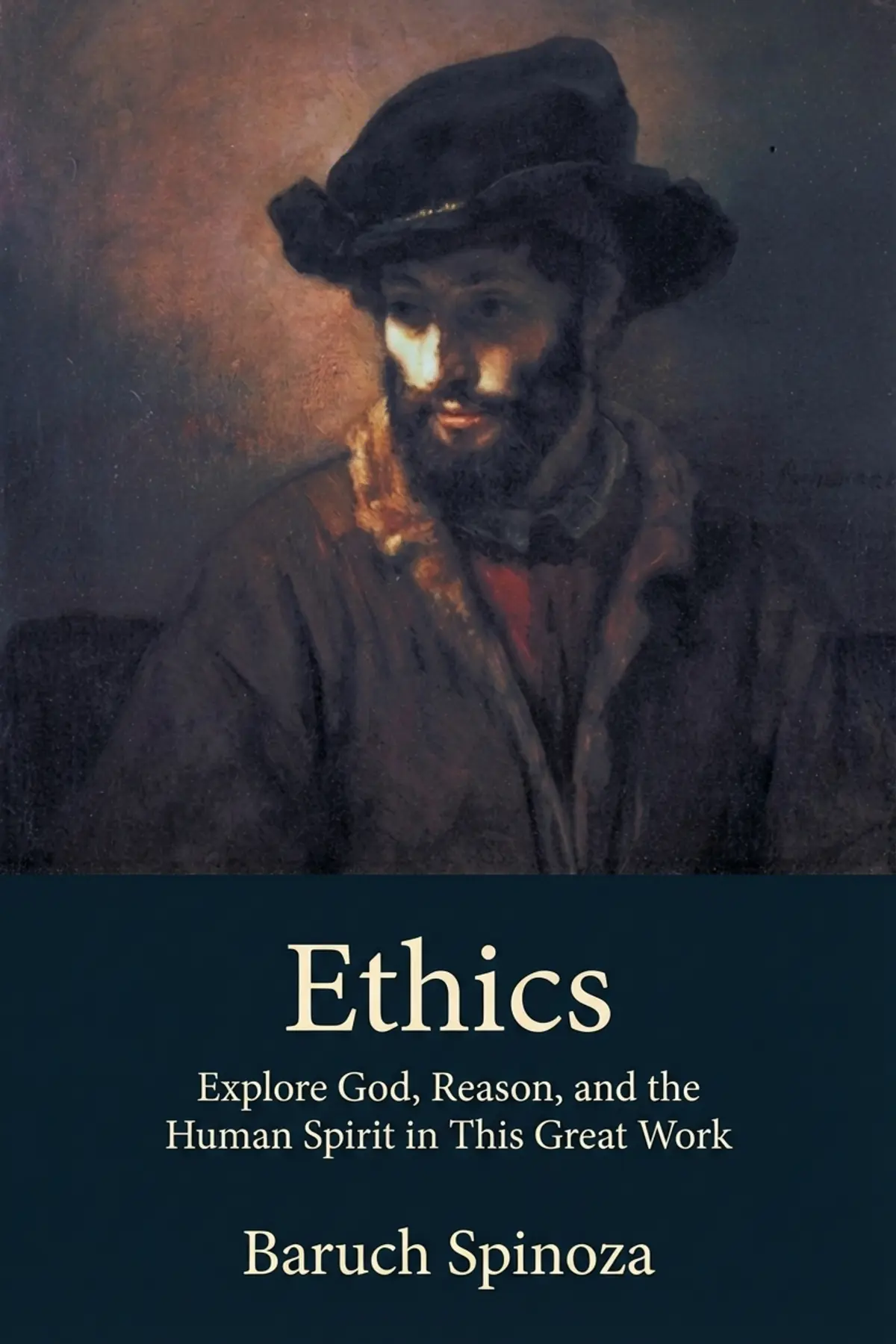
Table of Content
1. Introduction
2 min 00 sec
In the middle of the seventeenth century, in a quiet corner of Amsterdam, a man was engaged in a dual life that would eventually change the course of Western thought. By day, he performed the delicate, dangerous work of grinding glass lenses for telescopes and microscopes, breathing in the very dust that would eventually claim his life. By night, he applied that same precision to the invisible world of ideas. This man was Baruch Spinoza, and the work he was meticulously crafting was a text that many would find so dangerous it could only be published after his death.
Spinoza’s life was defined by a series of profound dislocations. Born into a family of Sephardic Jews who had fled the Inquisition, he was a child of refugees. By his early twenties, he was cast out from his own community through a formal excommunication, leaving him an outsider among outsiders. From this position of radical solitude, he did not sink into despair. Instead, he sought to build a logical fortress—a philosophy so grounded in reason that it could withstand the storms of religious dogma and social rejection.
He titled his greatest achievement simply as a study of conduct and character, but it encompasses far more than simple rules for living. It is a total reconstruction of reality. Rather than relying on poetic metaphors or emotional appeals, he chose the cold, hard language of geometry. He believed that if he could prove his points through definitions, axioms, and propositions, his conclusions would be unassailable. What he produced was a vision of a universe where the divine and the natural are one and the same, where the human mind is a reflection of an infinite intellect, and where true freedom is found not in escaping nature, but in understanding it completely. As we dive into this summary, we are entering the mind of a thinker who looked four hundred years into the future, laying the groundwork for how we understand science, ecology, and the very nature of the self today.
2. The Unity of God and Nature
2 min 28 sec
Spinoza challenges the traditional image of a distant, personal deity, proposing instead that the divine is synonymous with the entire universe and everything within it.
3. A World of Infinite Expressions
2 min 27 sec
Discover how individual things, from trees to people, are not separate entities but various modes of a single, universal substance manifesting in diverse ways.
4. The End of Mind-Body Dualism
2 min 32 sec
Spinoza dismantles the wall between the mental and the physical, arguing that they are two sides of the same coin rather than separate substances.
5. Navigating the Three Levels of Knowledge
2 min 41 sec
Understand the progression from deceptive sensory impressions to the highest form of intuitive insight that connects us to the true nature of reality.
6. The Path from Bondage to Freedom
2 min 42 sec
Learn how the mastery of our emotions through the application of reason allows us to break free from reactive suffering and achieve lasting peace.
7. Conclusion
1 min 48 sec
As we close the pages of Spinoza’s rigorous and luminous work, we are left with a vision of the world that is both challenging and deeply comforting. He has taken us from the isolation of an excommunicated lens-grinder to the heights of a philosophy that encompasses the entire cosmos. By equating God with Nature, he didn’t diminish the divine; instead, he elevated the world around us, inviting us to see every moment and every object as a manifestation of an infinite and eternal power.
The core throughline of Spinoza’s thought is that clarity of mind is the only true path to freedom. We live in a world governed by laws, and our struggle against those laws is what causes our suffering. But when we stop fighting reality and start understanding it—when we move from the reactive passions of the first level of knowledge to the rational and intuitive insights of the higher levels—we transform our experience of life. We find that we are not separate, fragile beings struggling against a hostile universe. We are, instead, integral parts of a single, magnificent substance that can never be destroyed.
Spinoza’s legacy is a call to intellectual honesty and emotional maturity. He asks us to look at our fears and our angers not as moral failings, but as errors in logic that can be corrected through the patient application of reason. He challenges us to build an ethics based not on fear of punishment, but on the joy of understanding. In a world that often feels fragmented and chaotic, his message of fundamental unity and the power of the human spirit to find peace remains as relevant today as it was in the seventeenth century. To live according to Spinoza is to live with our eyes wide open, recognizing that in the pursuit of truth, we find the only freedom that truly matters.
About this book
What is this book about?
This exploration of Baruch Spinoza’s magnum opus invites listeners into a world where the divine is not a distant judge, but the very fabric of existence. Written with the rigorous logic of a mathematical proof, the work challenges long-held beliefs about the separation of mind and body, the role of humanity in the natural world, and the true meaning of freedom. By following Spinoza’s unique logical progression, we discover a philosophy of monism—the idea that everything that exists is part of one single, infinite substance. The work promises a transformative perspective on emotions, showing how the shift from reactive passion to rational understanding can lead to a state of lasting peace and ethical clarity. It serves as both a metaphysical map and a practical guide for the human spirit seeking its place in the infinite.
Book Information
About the Author
Baruch Spinoza
Baruch Spinoza (1632–1677) was a philosopher of Jewish-Portuguese origin, born in Amsterdam, who is widely considered to have forged the foundations of the modern philosophies of postmodernism, poststructuralism, and posthumanism, centuries ahead of their time. He published two seminal works, Tractatus Theologico-Politicus and Ethics.
Ratings & Reviews
Ratings at a glance
What people think
Listeners find this to be a good read and appreciate its practical philosophy, with one noting it serves as an excellent foundation for modern ethical philosophy. The book receives positive feedback for its value, with one listener highlighting its great price. The quality of the language receives mixed reactions from listeners.
Top reviews
Mai
Finally got around to finishing this behemoth, and I’m struck by how Spinoza builds his world like a geometric proof. It isn’t just philosophy; it’s a rigorous, logical construction of reality that demands your total attention. The way he defines God as synonymous with Nature completely shifts your perspective on spirituality and existence. Truth is, you won’t understand it all on the first pass, but the effort pays off. Seeing the universe as a rational, interconnected system provides a sense of peace that few other texts offer. It’s the ultimate mental workout for anyone tired of vague, fluffy metaphysical claims.
Show moreSaranya
Picked this up because I wanted a foundation for modern ethics, and Spinoza delivered more than I bargained for. This is a manual for living a clear-headed life in a world full of chaotic emotions and irrational impulses. The section on human bondage really hit home, explaining why we feel like slaves to our passions. Frankly, his argument for determinism is the most convincing thing I’ve read in years, even if it’s a bit scary. It’s a book that invites you to be "resolute" in your pursuit of a good life. Definitely worth the struggle of navigating those long, complex logical proofs.
Show moreEnd
Wow. I didn’t expect a 17th-century philosophy book to feel this relevant to my daily mental health and emotional well-being. Spinoza treats the human spirit with the same precision a biologist might treat a specimen, and the results are fascinating. By understanding the causes of our actions, we gain a form of freedom that isn't about choice, but about clarity. Look, it’s a tough slog at times, and you might feel like you're reading a math textbook instead of an ethical guide. However, the moments where everything clicks are absolutely magical and worth every second of intense concentration.
Show moreSofia
This book is a masterclass in rational thought and serves as a powerful antidote to the superstition that often plagues ethical discussions. Spinoza’s message is simple: live right to think right, and use your reason to navigate the storms of your emotions. I found the price to be excellent for such a monumental work, making it accessible for any student of the human condition. It’s a book that demands you set your jaw and concentrate, but the rewards are a crystal-clear mind. One day you’ll rejoice in having pushed through these pages, as the world finally begins to make perfect sense.
Show moreCholada
Nature and God are one and the same here, a concept that feels incredibly modern despite being centuries old. Spinoza’s "Ethics" isn't a list of rules but a map of the human mind and its many bondages. While the Euclidean structure of axioms and propositions can be exhausting, the psychological insights are surprisingly sharp. He predicts so much of what we now call cognitive behavioral therapy. My only gripe is the translation; some passages felt needlessly dense and required three read-throughs. Still, for a dirt-cheap paperback, the sheer volume of wisdom you receive is staggering.
Show moreSai
As someone who enjoys analytical thinking, I loved how this treatise attempts to solve the problem of human happiness through pure reason. Spinoza’s confidence in the ability of the mind to transcend its limitations is infectious and deeply empowering. His view on emotions being "confused ideas" changed the way I look at my own occasional outbursts of anger or fear. The book is an essential piece of the Enlightenment puzzle, bridging the gap between old-world theology and new-world science. It isn’t a light read by any means, but the intellectual love of God is a beautiful destination.
Show moreFah
After hearing about the "God of Spinoza" for years, I finally decided to see what all the fuss was actually about. It’s a mystical journey disguised as a logical proof, leading you toward a deep appreciation for the necessity of nature. I can see why this was such a hit during the hippie era; it has that "all is one" vibe. The text encourages you to smile away the pain by recognizing that everything happens for a reason. While I don't buy into every single axiom he presents, his psychology of the emotions is remarkably ahead of its time.
Show morePat
To be fair, I found the "geometric method" to be more of a hindrance than a help in understanding the core message. Spinoza is clearly a genius, but the constant jumping between definitions, axioms, and scholia makes for a very clunky reading experience. I appreciate the historical significance and the revolutionary idea of a non-personal God, yet the writing is undeniably prolix. You find yourself wading through pages of logic just to find one nugget of practical advice. It serves as an excellent foundation for philosophy students, but casual readers might find it a bit too dry for comfort.
Show moreAhmed
Not what I expected at all, and I struggled to see the "practicality" that so many other reviewers seem to rave about. The structure is incredibly rigid, making it feel more like a technical manual for a machine than a guide for a human. I wanted a discussion on right and wrong, but instead, I got hundreds of propositions about substance and attributes. Maybe I’m just not the right audience for this level of scholasticism, but the language felt incredibly dated and inaccessible. It’s certainly a great price for a classic, but the "value" is lost if you can’t get past page fifty.
Show moreTee
Ever wonder why some people find comfort in the idea that they have no free will? Spinoza lays out the case for determinism with such cold, hard logic that it’s almost impossible to find a flaw. Personally, I found the experience more intellectually stimulating than spiritually fulfilling, as the geometry of it all leaves little room for wonder. The book is definitely an important foundation for modern thought, but the "human bondage" section was quite depressing to get through. It’s a dense, difficult work that requires a lot of supplemental reading to fully grasp the nuances.
Show moreReaders also enjoyed
A Guide to the Good Life: The Ancient Art of Stoic Joy
William B. Irvine
A Little History of Philosophy
Nigel Warburton
A Theory of Justice
John Rawls
Anarchy, State, and Utopia
Robert Nozick
Antifragile: Things That Gain from Disorder
Nassim Nicholas Taleb
Areopagitica: Philosophy)
John Milton
AUDIO SUMMARY AVAILABLE
Listen to Ethics in 15 minutes
Get the key ideas from Ethics by Baruch Spinoza, plus 5,000+ more titles in English and Thai.
- 5,000+ titles
- Listen as much as you want
- 7-day free trial
- Cancel anytime







