
19 min 23 sec
Eve: How the Female Body Drove 200 Million Years of Human Evolution
By Cat Bohannon
Eve re-evaluates 200 million years of history by placing the female body at the center of evolution, exploring how adaptations like milk and menopause fundamentally shaped the success of the human species.
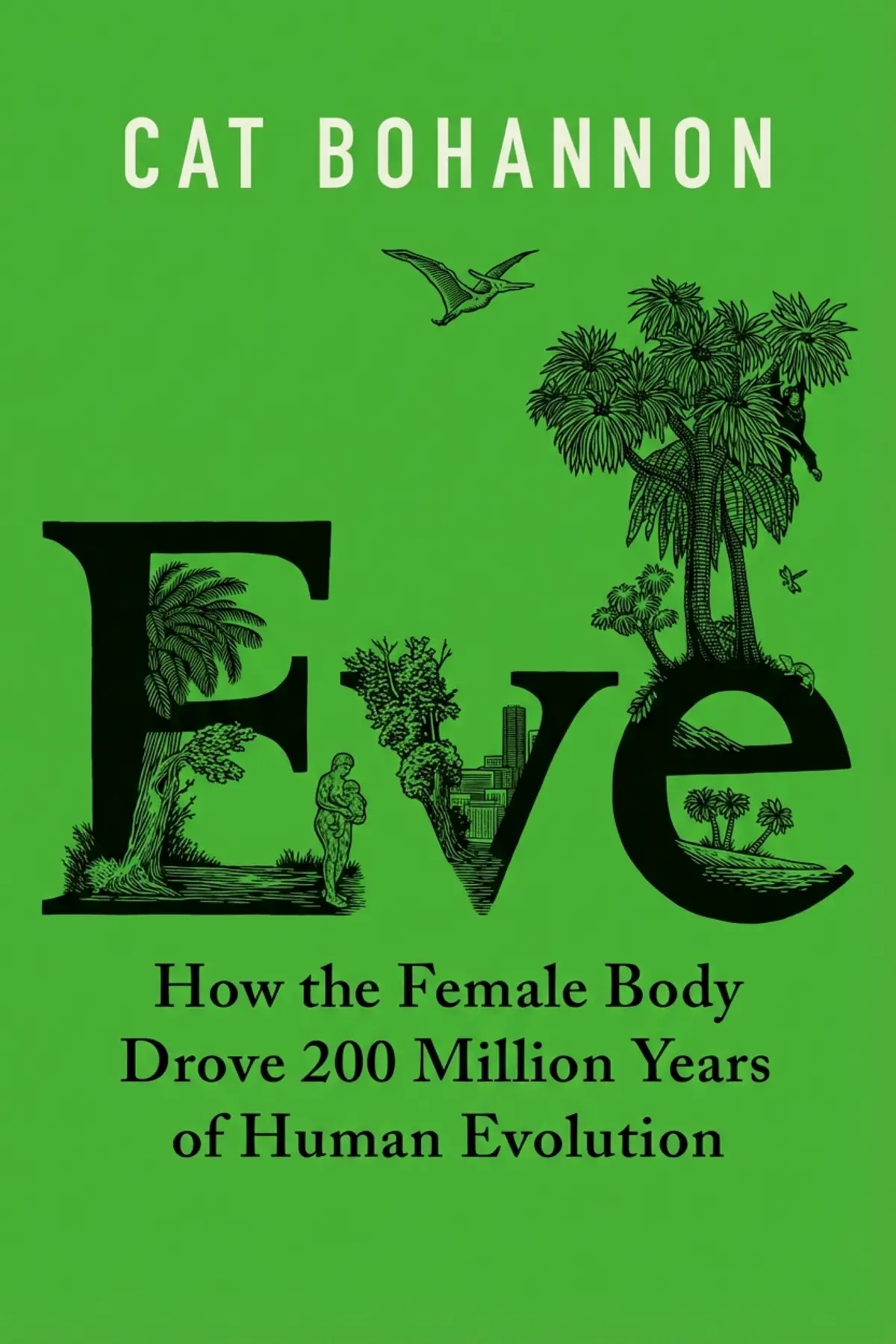
Table of Content
1. Introduction
1 min 34 sec
When we think about the story of human origins, we often conjure up a very specific set of images: early men hunting large game with stone-tipped spears or striking flint to create the first fires. This traditional perspective suggests that the push toward intelligence and civilization was driven almost entirely by male activities. But what if we’ve been looking at only half the picture? For a long time, the scientific community operated under a massive blind spot, focusing almost exclusively on the male body in everything from archeological theories to modern medical trials. Even animal studies have historically favored male subjects, leaving the nuances of the female experience largely unexamined.
This is where our throughline begins. To understand where we came from, we have to recognize that the female body was not just a passenger on the journey of evolution—it was the driver. From the earliest mammals to the rise of modern cities, the unique challenges and adaptations of women have propelled humanity forward. This summary will take you on a journey through 200 million years of biological history, rewriting the outdated origin story that has ignored the Eves of our lineage for too long. We will explore how motherhood created a social revolution, why the risks of pregnancy led to the first medical breakthroughs, and how the female body’s resilience has been the secret to our longevity. It is a story of survival, innovation, and a biological legacy that continues to shape every aspect of our lives today.
2. The Secret Molecular Dialogue of Motherhood
2 min 50 sec
Explore the surprising origins of the first mammalian mother and how a simple skin secretion transformed into a complex biological communication system that still defines the human experience today.
3. The Internal Conflict of Reproduction
2 min 31 sec
Reproduction is often romanticized, but the biological reality reveals a fascinating and intense struggle for resources within the body, leading to unique adaptations that distinguish us from most other mammals.
4. The Ancient Invention That Saved the Species
2 min 32 sec
While tools like spears often get all the credit for our survival, a different kind of ancient technological breakthrough was necessary for the continuation of our large-brained, upright-walking species.
5. Decoding the Myths of the Gendered Mind
2 min 44 sec
We’ve long been told that men and women have fundamentally different brains, but modern neuroscience suggests that our social environments play a much larger role in shaping our minds than biology.
6. The Evolutionary Strategy of Longevity
2 min 37 sec
Human females are unique in their ability to live long lives after their reproductive years end. Discover why this pause in fertility may have been a vital strategy for societal success.
7. The Complex Origins of Human Connection
2 min 47 sec
The way we form romantic bonds and structure our societies might be rooted in an ancient evolutionary trade-off that offered survival at the cost of changing our fundamental social dynamics.
8. Conclusion
1 min 48 sec
The journey through the history of the female body reveals a truth that science has ignored for far too long: women have never been the ‘weaker’ or ‘secondary’ sex. Instead, the specific biological and social adaptations of the female line—the Eves of our past—were the primary engines of human progress. From the first mammalian mothers who developed a molecular communication system through milk, to the early women who invented gynecology to overcome the risks of upright birth, every stage of our evolution has been marked by female innovation and resilience.
We’ve seen how the female brain is a model of adaptability, proving that our potential is not dictated by gender but by the opportunities we are given. We’ve explored how menopause and female longevity served as a vital survival strategy for the entire species, ensuring that knowledge and stability were passed down through the generations. And finally, we’ve looked at the complex origins of our social bonds, recognizing that while past survival strategies led to patriarchal structures, they do not have to define our future.
This summary serves as a call to rethink everything we thought we knew about our origins. When we honor the sacrifices and the biological brilliance of the female body, we get a much clearer, more accurate picture of how we became human. The throughline is clear: the success of Homo sapiens was built on the backs, the wombs, and the minds of women. As we move forward, let this understanding empower us to build a world that finally recognizes and supports the full potential of every Eve among us. The choices we make today are the next step in a 200-million-year-old story that is still being written.
About this book
What is this book about?
For centuries, the narrative of human evolution has focused primarily on the male experience, treating the female body as a secondary consideration or a biological deviation from a male norm. This book corrects that oversight by examining the pivotal role of female biology and behavior in the development of Homo sapiens. By looking back over 200 million years, it reveals how specific adaptations—from the way we nurse our young to the way our ancestors managed the risks of childbirth—drove the cognitive and social advancements that allowed humans to dominate the planet. The book promises a fresh understanding of gender, health, and what it means to be human. It challenges long-held stereotypes about the female brain and physical resilience, replacing them with a data-driven look at how the maternal line ensured survival. Through a mix of evolutionary biology and social critique, the author explains how women's health technology was the first true human innovation and why understanding the female body is essential for our species' future.
Book Information
About the Author
Cat Bohannon
Cat Bohannon has a PhD in the evolution of narrative and cognition from Columbia University. Her writing has been published in outlets including Scientific American, Science, and The Georgia Review.
Ratings & Reviews
Ratings at a glance
What people think
Listeners find this work both captivating and meticulously documented, noting that the informal prose keeps them entertained. They value the rigorous scientific lens and thorough investigation into female biology, and one listener points out that the author makes intricate biological concepts accessible to everyone. Audiences consider the content to be intellectually stimulating, funny, and informative, with one review praising how effectively the text distinguishes between sex and gender.
Top reviews
Supaporn
Cat Bohannon has achieved something truly rare here by turning 200 million years of evolutionary history into a page-turner that feels as intimate as a conversation over coffee. Her concept of identifying various 'Eves'—the common ancestors who first developed specific traits like lactation or bipedalism—is a brilliant narrative device. It's refreshing to see a book that centers the female experience not just as a niche interest, but as the primary driver of our species' survival. The sections on how female fat stores specifically cater to fetal brain development were absolutely eye-opening and made me realize how little we are taught about our own biology. While the book is quite hefty, the prose is so witty and approachable that the pages fly by. It strikes that perfect balance between being rigorously researched and genuinely fun to read. This isn't just a book for women; it’s an essential history of humanity that fills in the massive gaps left by traditionally male-centered science.
Show moreSomsak
Finally, someone has written the corrective to the male-centric narrative that has dominated our understanding of human development for centuries. I was stunned to learn how often female subjects are excluded from medical trials simply because our hormonal cycles are seen as 'complicating' the data. Bohannon dismantles this bias with sharp wit and a staggering amount of research. The way she describes the evolution of the womb and the complex 'milk-sweat' of our earliest mammalian ancestors is both poetic and grounded in fascinating biology. I particularly appreciated the distinction she makes between biological sex and the cultural constructs of gender. It’s a dense read, but the conversational tone keeps it from ever feeling like a dry textbook. Every chapter reveals something new and slightly mind-blowing about how our bodies have adapted to survive against all odds. It's a revelatory, empowering, and deeply necessary piece of work.
Show moreSiriphen
Wow, I will never look at my own body the same way again after finishing this masterpiece. Bohannon’s exploration of the 'Eve' who first developed menopause—and how that grandmotherly role likely saved our species—actually moved me to tears. We are so often told that the female body is a 'variation' of the male standard, but this book proves we were the innovators. The writing style is wonderfully irreverent and funny, making even the most complex neurobiological mechanisms feel totally relatable. I found myself highlighting passages on every other page, especially regarding the way our hips and thighs store nutrients specifically for our children's retinas. It’s rare to find a science book that feels this personal and life-affirming. If you want to understand why we are the way we are, you have to read this. It’s the kind of book you’ll want to buy for every woman in your life.
Show morePawinee
Forget Sapiens; this is the history of humanity we actually needed. Bohannon manages to make complex evolutionary biology feel as urgent and exciting as a thriller. I was particularly gripped by the discussion on bipedalism and how the narrowing of the pelvis changed everything for our ancestors. It’s a story of struggle, adaptation, and incredible resilience. The author doesn't shy away from the grosser or weirder parts of our history, which I found refreshing and honest. Her writing is punchy, smart, and deeply researched without ever feeling pretentious or inaccessible to a layperson. I finished this book feeling a profound sense of awe for the millions of years of 'Eves' who came before me. It is truly a revelatory vision of our past that everyone should read.
Show morePui
The way Bohannon structures each chapter around a specific 'Eve'—from the sweat-beaded Morganucodon to the first midwife—is nothing short of brilliant. This book isn't just about biology; it's about the narrative of who we are. I was fascinated by the exploration of sensory perception and how our primate ancestors' lives in the trees shaped the way we see the world today. The author’s voice is so engaging that I felt like I was being led through a museum by a particularly brilliant and funny friend. She addresses controversial topics with a balanced, scientific approach that still feels deeply human. It’s a monumental achievement that manages to make the deep past feel incredibly relevant to our modern lives. I've been recommending this to everyone, regardless of their background in science. It's simply one of the best nonfiction books I've read in years.
Show moreMadison
Picked this up on a whim after seeing it on several 'best of' lists and I was absolutely floored by the sheer depth of research combined with such a humorous, approachable voice. Bohannon takes us from the Jurassic period all the way to modern medical labs, showing exactly how the female body has been the primary engine of human evolution. I loved the 'Eden' segments that opened each chapter—they really helped visualize these ancient ancestors as living, breathing creatures rather than just fossils. The section on how our nipples communicate with a baby's saliva to change the milk's formula was particularly fascinating and felt like a superpower I never knew we had. This book is a triumph of popular science. It manages to be educational, thought-provoking, and deeply entertaining all at once. It’s a long journey, but every single page is worth it for the perspective shift it provides.
Show moreNaomi
While the 600-page length initially intimidated me, Bohannon’s witty and conversational prose made the dense biological concepts surprisingly digestible. I loved the chapters on tool use and the evolution of the voice, which offered a fresh perspective on why we communicate the way we do. Frankly, I think every doctor should be required to read the introduction about the 'male-as-default' model in medicine. There were a few moments where the author's personal asides felt a bit long-winded, and some of the evolutionary psychology felt more like educated guessing than hard fact. That said, the book remains a fascinating deep dive into what it means to be biologically female. It’s an ambitious project that mostly succeeds in its mission to rewrite the human story. I’ll definitely be thinking about the 'milk-baby communication' via nipples for a long time. Definitely worth the read if you enjoy accessible science.
Show moreAndrew
The chapter on menopause alone is worth the price of admission, offering a perspective that challenges everything I thought I knew about our 'evolutionary purpose.' Bohannon argues convincingly that older women weren't just 'left behind' by evolution, but were actually central to our survival as a species. While I found some of her personal anecdotes a bit distracting from the main scientific narrative, her ability to explain things like the Grandmother Hypothesis is top-notch. The book is definitely a commitment at 600 pages, but the conversational style keeps it from dragging too much. I appreciated the careful way she addressed the differences between sex and gender, even if she couldn't please everyone. It’s a thought-provoking read that will definitely spark some intense dinner-table conversations. Most importantly, it highlights just how much of our medical history has been based on a 'male as default' model that needs to change.
Show moreSaranya
To be fair, the first half of the book is a masterclass in engaging science writing, but the latter half loses its way in cultural commentary and some questionable historical facts. I loved the early chapters on lactation and the Morganucodon; they were genuinely informative and well-paced. However, as the book progressed, the author started making some very broad claims about things like the 'Dark Ages' and sex work statistics that felt sloppy compared to the earlier biological data. The prose is undeniably chatty and easy to read, which is great for such a thick volume, but I often found myself wanting to fact-check her asides. It’s a fun, imaginative journey through time, but you have to take some of the evolutionary psychology with a grain of salt. It’s a decent introductory text for the casual reader, though it lacks the rigorous accuracy a specialist might be looking for.
Show moreVera
As much as I wanted to love this ambitious look at the female body, the author’s tendency to drift into wild speculation and fundamental misunderstandings of natural selection became impossible to ignore. In the early chapters, the discussion on paleontology and 'tree thinking' is actually quite strong and beautifully written. However, the further Bohannon moves from hard data into evolutionary psychology, the shakier the ground becomes. She frequently references 'species fitness,' a concept that many evolutionary biologists would find problematic or outright incorrect. It feels like she’s trying to force biological facts into a specific cultural narrative rather than letting the data speak for itself. While the call for more inclusive medical testing is vital, the scientific errors regarding how evolution actually functions make it hard to recommend this as a serious educational text. Truth is, it's more of an entertaining 'what if' scenario than a rigorous scientific study.
Show moreReaders also enjoyed

A Biography of Loneliness: The History of an Emotion
Fay Bound Alberti
A Life Decoded: My Genome: My Life
J. Craig Venter

A Force for Good: The Dalai Lama's Vision for Our World
Daniel Goleman
A Planet of Viruses
Carl Zimmer


A Short History of Nearly Everything
Bill Bryson

A Room of One’s Own
Virginia Woolf
AUDIO SUMMARY AVAILABLE
Listen to Eve in 15 minutes
Get the key ideas from Eve by Cat Bohannon, plus 5,000+ more titles in English and Thai.
- 5,000+ titles
- Listen as much as you want
- 7-day free trial
- Cancel anytime







