
18 min 12 sec
Focus: The Future of Your Company Depends on It
By Al Ries
Focus reveals why narrowing a company's scope is more effective than chasing endless growth. It provides a blueprint for dominating niches by concentrating resources on a singular, powerful brand identity.
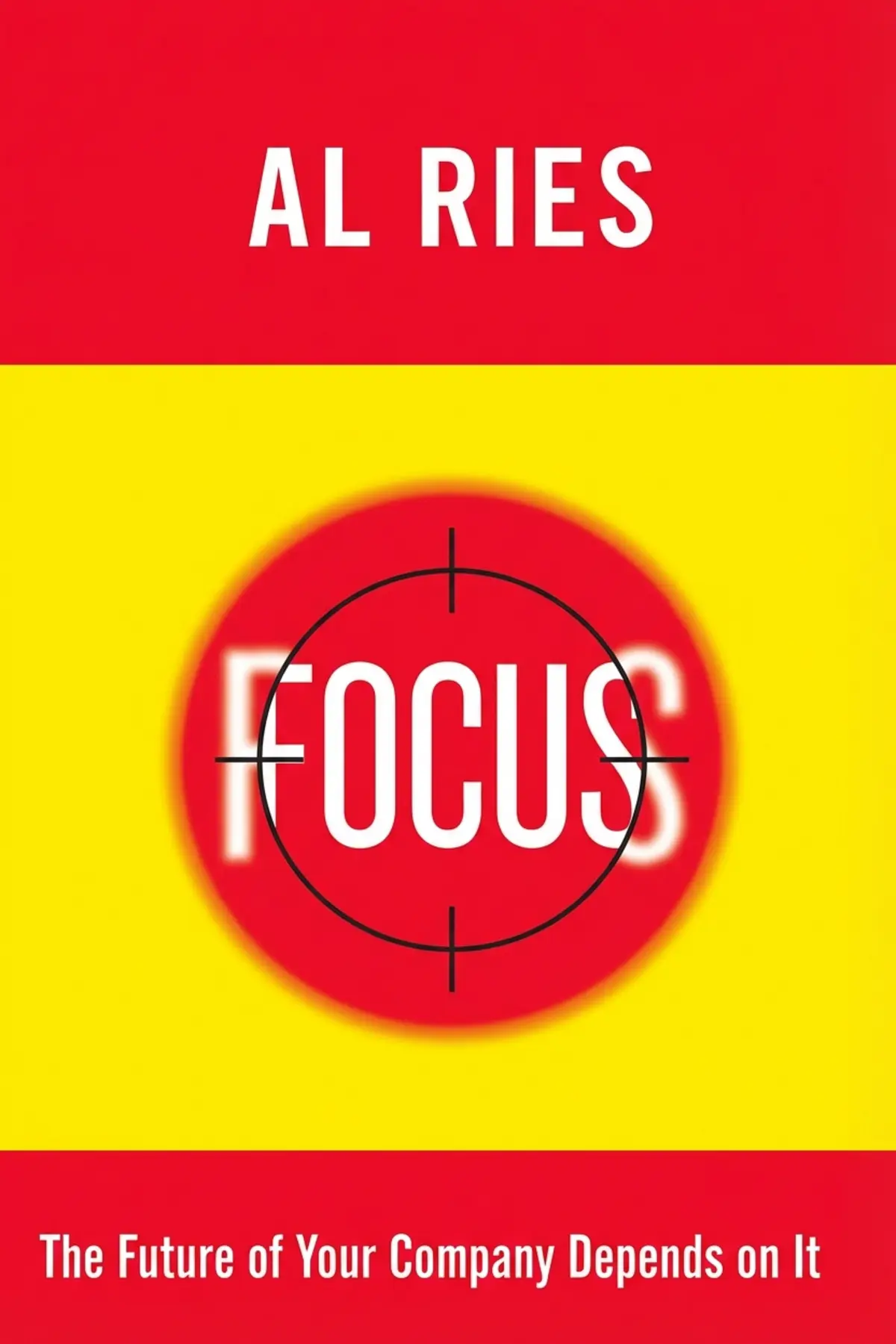
Table of Content
1. Introduction
1 min 38 sec
In the modern business world, there is an almost religious devotion to the idea of growth. Whether it is a small local shop looking to open its second branch or a multinational corporation aiming for global dominance, the assumption is that more is always better. We are taught that growth leads to efficiency, higher profits, and a stronger market position. But what if this obsession with expansion is actually a trap? What if the very strategies we use to grow are the ones that eventually lead to a company’s downfall?
This is the provocative question at the heart of the work by Al Ries. The core idea here is that a company’s most valuable asset isn’t its size, its diverse portfolio, or its global reach—it’s its focus. When a business spreads itself too thin, it loses the clarity that made it successful in the first place. It becomes a generalist in a world that increasingly rewards specialists.
Over the course of this summary, we will explore why the traditional drive for expansion can become an Achilles’ heel. We’ll look at how the push for diversification and line extensions can dilute a brand until it means nothing to the consumer. We will also examine the psychological power of specialization and why being the ‘expert’ in a narrow field is often more profitable than being a giant in many. Finally, we’ll discuss how to maintain that focus even when the world around you is changing due to new technology. This is about learning how to sharpen your competitive edge by narrowing your sights, ensuring that your brand doesn’t just grow, but actually succeeds.
2. The Growth Trap and the Logic of Scale
2 min 06 sec
Discover why the universal desire for corporate expansion is fueled by the promise of lower costs and higher efficiency, yet often leads to a dangerous fixation.
3. Why Market Size Doesn't Always Equal Market Value
2 min 11 sec
Learn how massive revenue can sometimes hide a lack of focus that makes a smaller, more concentrated company more valuable in the eyes of investors.
4. The Hidden Costs of Line Extension and Diversification
1 min 46 sec
Uncover the risks of using a successful brand name to launch unrelated products, a strategy that often confuses consumers and invites more competition.
5. The Globalization Trap
1 min 42 sec
Understand how the move toward international trade can accidentally dilute a company’s core strengths by forcing it to compete against established local experts.
6. The Power of Specialization over Variety
1 min 45 sec
Explore why narrowing your product line can actually attract more customers and why specialized stores are outperforming massive department stores.
7. Perception is Reality in the Mind of the Consumer
1 min 49 sec
Learn why being seen as a specialist is the most effective way to communicate high quality, even if the technology behind the product is similar to rivals.
8. Focusing Amidst the Storm of Technological Change
1 min 52 sec
Discover how even the most focused companies can fail if they don’t adapt their core mission to keep pace with new innovations.
9. The Strategy for Multi-Market Conglomerates
1 min 46 sec
Find out how massive corporations can still maintain focus by creating distinct, non-competing identities for each of their different brands.
10. Conclusion
1 min 37 sec
The message of this journey is clear: in an increasingly crowded and competitive marketplace, focus is the ultimate competitive advantage. While the siren song of growth and expansion is tempting for every manager and CEO, it often leads to a dilution of the brand and a loss of market power. We have seen how trying to be everything to everyone creates management friction, invites unnecessary competition, and confuses the very customers you are trying to serve.
To succeed, a company must have the discipline to say no. It must resist the urge to put its name on every new product and instead double down on what it does best. By specializing, a business earns the trust of consumers, who naturally gravitate toward the experts in any given field. This doesn’t mean standing still; as we saw with the example of Kodak, a company must be willing to evolve its focus as technology shifts. It means that even as the ‘how’ of your business changes, the ‘what’ and the ‘why’ should remain sharp and distinct.
Whether you are a single-product startup or a multi-brand conglomerate, the path to long-term survival is the same. Identify the niche you can own, dedicate your resources to being the undisputed leader in that space, and protect that focus with everything you have. In a world of generalists, the specialist doesn’t just survive—they dominate. By narrowing your focus today, you are actually broadening your potential for tomorrow.
About this book
What is this book about?
Many corporate leaders believe that bigger is always better, pushing for constant expansion into new markets and product lines. However, this book argues that the relentless pursuit of growth is often the very thing that weakens a business. When a company tries to be everything to everyone, it loses its distinctive edge and becomes vulnerable to leaner, more specialized competitors. In Focus, the central promise is that by narrowing your operational field, you actually increase your power. Through a series of compelling case studies, the narrative explores how the most successful brands are those that own a specific category in the consumer's mind. From the pitfalls of brand stretching to the necessity of adapting to technological shifts, the book provides a guide for managers to regain their competitive advantage by doing less, but doing it better.
Book Information
About the Author
Al Ries
Al Ries is a renowned marketing professional and author. He founded a highly successful consulting firm and has shared his insights through several influential works. His bibliography includes bestsellers such as The 22 Immutable Laws of Marketing and The Fall of Advertising and the Rise of PR.

Ratings & Reviews
Ratings at a glance
What people think
Listeners find the writing accessible and value the author’s delivery, with one listener pointing out the engaging examples. Feedback is divided regarding how well the material has aged; one listener claims it is still relevant, whereas another feels it has become dated.
Top reviews
Tippawan
Al Ries hits the nail on the head regarding why so many massive corporations eventually crumble under their own weight. The central premise is that narrowing your focus is the only way to build a truly dominant brand in the long run. Truth is, many companies try to be everything to everyone and end up becoming nothing to nobody. Ries uses a ton of case studies to prove his point, and while some might feel repetitive, they drive the message home effectively. I found the writing style punchy and very easy to get through in a few sittings. Even if you aren't in marketing, the logic applied here is useful for any career path where you need to stand out. It’s a classic for a reason.
Show moreJiraporn
Stop everything you are doing and read this if you are trying to scale a brand in a crowded market. The mantra 'Focus or Die' might sound extreme, but Ries makes a compelling case for why it is the fundamental law of branding. I love how he breaks down the dangers of growth for growth's sake. So many businesses get greedy and start slapping their name on everything, which just dilutes their power. This book teaches you the discipline required to say 'no' to opportunities that don't fit your core mission. It's a quick read but the mental shifts it triggers are profound and lasting. I've already started applying these principles to my own small business and the clarity it provides is refreshing. Definitely a must-read for entrepreneurs.
Show moreSombat
After hearing about Ries for years, I finally see why he is considered a titan in the marketing world. This book is a masterclass in staying disciplined when the market is screaming at you to diversify. I think the comparison to 'The E-Myth' is spot on because both books emphasize the importance of a clear, repeatable system. The way Ries explains that 'doing everything' is actually a competitive disadvantage changed my perspective on our company's roadmap. The writing is incredibly readable and lacks the dry, academic tone of most business books. I actually finished it in one afternoon because I couldn't put it down. It’s one of those rare books that provides immediate clarity on why certain brands win and others fade away.
Show moreChokdee
Simple truths are often the hardest to implement, and this book proves it on every single page. Ries challenges the conventional wisdom that bigger is always better. Instead, he advocates for being the best in a very specific category. In my experience, the businesses that struggle most are the ones that have lost their identity by trying to please everyone. This book is the cure for that identity crisis. The author’s tone is confident and persuasive, making it a joy to read. Even though the technology mentioned is old, the human psychology of how we perceive brands is timeless. This is going on my shelf of books to revisit every couple of years. It’s a vital reminder to stay narrow and stay deep.
Show moreYam
Picked this up during a weekend getaway and found it surprisingly digestible for a marketing text. The author’s style is conversational and bold, never shying away from making definitive statements about what works and what doesn't. My favorite part was the discussion on how companies lose their way by trying to chase every new trend. Look, we see this constantly in the modern era with tech giants overreaching into sectors where they have no business being. While the specific company names in the book might be dated, the behavior patterns are exactly the same. The only reason I’m not giving it five stars is that it lacks deep statistical data to back up some of the more controversial claims. It relies heavily on news clippings and anecdotes.
Show moreLuckana
While some critics argue that the examples are stuck in the nineties, the underlying logic remains incredibly potent. You have to be able to filter out the references to defunct computer companies and see the evergreen marketing strategy beneath. Ries writes with a clarity that is rare in business books today. He doesn't use jargon to sound smart; he uses plain English to explain complex market dynamics. I particularly enjoyed the sections on how to defend a niche against larger, more unfocused competitors. Not gonna lie, some of the chapters feel a bit 'samey' after a while, but the reinforcement helps the message stick. It’s a solid 4-star read that provides a great framework for anyone looking to understand brand positioning.
Show moreKanchana
The perpetual battle between diversification and specialization is the heartbeat of this entire book. Ries argues that the biggest threat to a successful company is actually its own desire to expand into new territories. It’s a counter-intuitive idea because we are always told that growth is the ultimate goal. But he shows, through dozens of examples, how that growth can lead to a slow death of mediocrity. The prose is sharp and the pacing is excellent. I found myself nodding along to his critiques of 'line extension' traps. My only gripe is that it feels a bit light on the 'how-to' side of things. It tells you what to do, but the execution steps are a bit vague. Still, it’s a foundational text for any strategist.
Show morePete
It is quite a trip reading these business predictions decades after the ink has dried. Some of the calls Ries makes, especially concerning Apple and the future of converged technology, are laughably wrong in hindsight. However, if you can look past the outdated tech references, the core principle of avoiding line extension still feels valid today. The book reads a bit like an extended magazine article, which makes it perfect for a lazy Sunday afternoon read on the sofa. I did find the sheer volume of examples a bit overwhelming after a while, though. It’s worth a look for the historical perspective, but maybe pair it with something more modern to see how these ideas evolved. To be fair, the basic psychology of branding hasn't changed that much.
Show moreBrooklyn
Is it possible for a book to be both brilliant and incredibly repetitive at the same time? Ries has a fantastic core thesis, but he beats you over the head with it until you’re almost tired of hearing the word 'focus.' To be fair, the examples are interesting from a historical standpoint, even if some of the predictions didn't age well. It’s the kind of book you can skim and still walk away with 90% of the value. I wouldn't call it a waste of time, but it certainly could have been a long essay instead of a full-length book. If you are new to the world of branding, this is a decent entry point. Just don't expect a lot of variety in the arguments presented.
Show moreOm
Frankly, this felt more like a collection of cherry-picked corporate anecdotes than a serious business study. The author has one single point—focus is good, diversification is bad—and he spends 200 pages repeating it with different company names. There is zero statistical rigor here, just a series of 'I told you so' moments based on headlines from the 90s. If a company failed, Ries blames a lack of focus; if they succeeded, he finds a way to credit their focus. It feels like a very simplistic way to view the complex world of global economics. I think you could read the first chapter and get everything you need from this book. Save your time and read something with more substance and less infotainment vibes.
Show moreReaders also enjoyed

All In: How Great Leaders Build Unstoppable Teams
Mike Michalowicz

7 Powers: The Foundations of Business Strategy
Hamilton Helmer

A Bigger Prize: How We Can Do Better Than the Competition
Margaret Heffernan



AUDIO SUMMARY AVAILABLE
Listen to Focus in 15 minutes
Get the key ideas from Focus by Al Ries, plus 5,000+ more titles in English and Thai.
- 5,000+ titles
- Listen as much as you want
- 7-day free trial
- Cancel anytime







