

15 min 55 sec
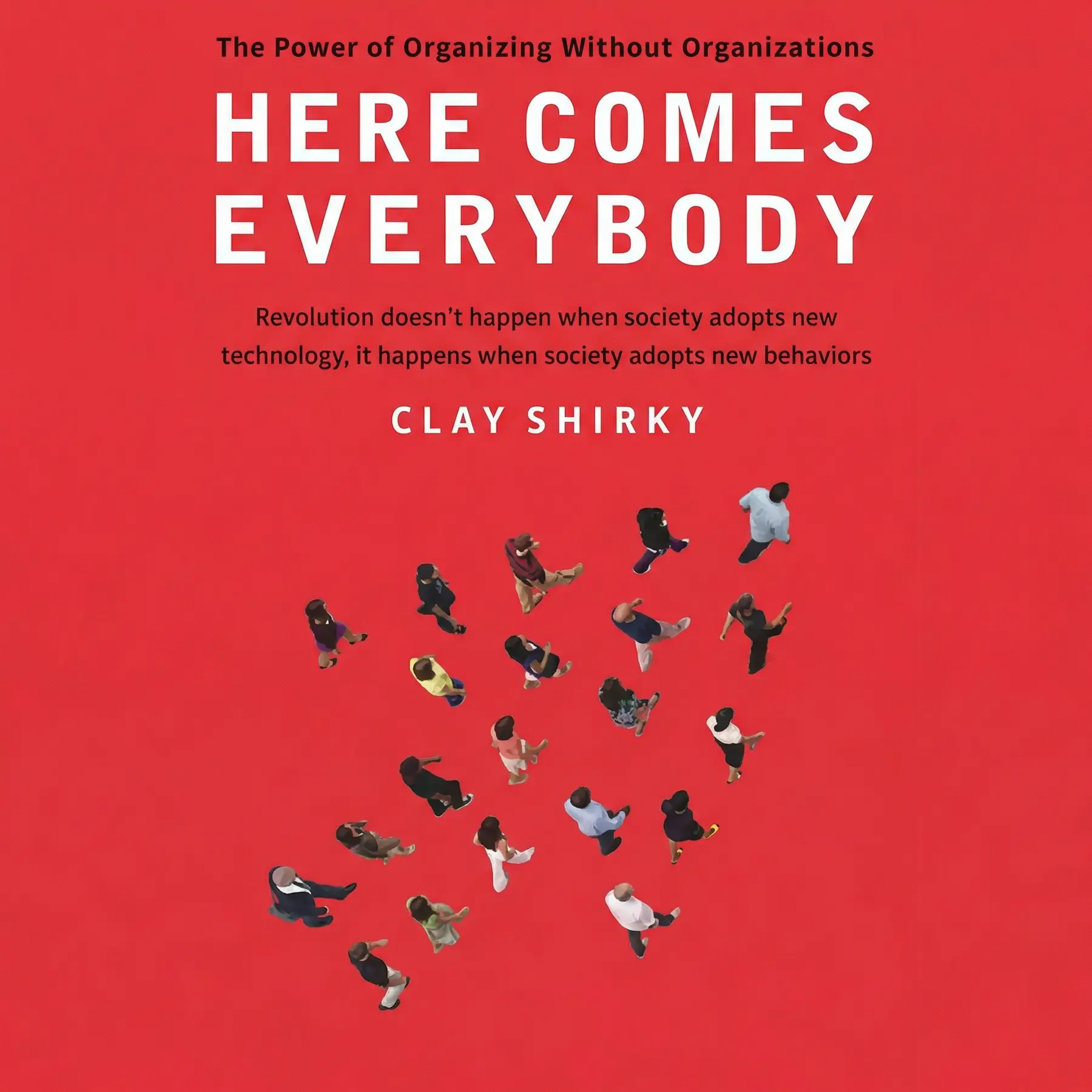
Here Comes Everybody: The Power of Organizing without Organizations
By Clay Shirky
Here Comes Everybody explores how digital tools have revolutionized group formation, allowing people to coordinate, collaborate, and take collective action outside of traditional institutional structures and hierarchies.

Table of Content
1. Introduction
1 min 40 sec
Think back to the way the world functioned before the palm of your hand held the collective knowledge of humanity. There was a time when looking up a fact meant trekking to a library or dusting off a heavy physical encyclopedia. Getting a message to a hundred people required a printing press, a mailing list, or a massive amount of manual labor. Today, we don’t even think twice about these actions. But underneath this convenience lies a profound structural change in how human beings exist as a species.
In Here Comes Everybody, we explore the deep sociological impact of the digital age. It is not just about the gadgets or the speed of the connection; it is about the fundamental transformation of group dynamics. For the first time in history, the cost of coordinating a group of people has dropped to nearly zero. This simple change—the removal of the ‘transaction cost’ of getting together—has unleashed a tidal wave of new possibilities. It allows us to form communities that aren’t bound by geography, to create massive works of art and information without a boss, and to demand accountability from those in power in ways that were previously impossible.
This throughline—the power of organizing without organizations—is what defines our current era. We are moving from a world where institutions were the only way to get big things done to a world where ‘everybody’ can participate. As we walk through these ideas, we will see how this shift affects everything from how we find a lost phone to how we decide what counts as news. It’s a journey into the new social architecture of our world, showing us that while our tools have changed, the fundamental human drive to cooperate is more alive than ever.
2. The Frictionless Formation of Groups
1 min 46 sec
Discover how a lost cell phone in New York City became a global phenomenon, illustrating a new world where groups form instantly without corporate help.
3. Scaling Cooperation and Sharing
1 min 38 sec
Explore how digital platforms have taken simple human acts like talking and sharing and amplified them to a global, unprecedented scale.
4. The Miracle of Peer Production
1 min 39 sec
Learn why Wikipedia succeeds not because of strict management, but because of a spontaneous division of labor fueled by passion.
5. Bypassing the Costs of Hierarchy
1 min 36 sec
See how online groups achieve massive goals without the expensive administrative bloat that slows down traditional corporations.
6. Technology as a Social Facilitator
1 min 37 sec
Understand why, despite our digital tools, we still crave face-to-face connection and how technology actually drives us back together.
7. The End of Geographic Boundaries
1 min 18 sec
Find out how the internet creates ‘global villages’ for niche interests, allowing even the most specialized groups to thrive.
8. The Media Revolution and the Fall of Gatekeepers
1 min 44 sec
Witness the shift from professional journalism to the rise of the citizen publisher, and how a few bloggers changed US Senate history.
9. The Democratization of Professionalism
1 min 36 sec
See why having a PhD might not matter as much as having a smartphone in a world where everyone has the tools of production.
10. Conclusion
1 min 21 sec
As we look at the world shaped by these new digital realities, the core message is clear: the internet hasn’t just given us new toys; it has given us new ways to be human together. We are witnessing the most significant change in human organization since the invention of the printing press. By lowering the cost of coordination to nearly zero, we have empowered ‘everybody’ to participate in the construction of our culture, our news, and our communities.
But as we navigate this new landscape, we must be mindful. First, for those in traditional industries—especially media and communications—it is vital to stay ahead of the curve. The old gatekeeper models are not coming back. Success in this new era requires embracing the ‘publish then filter’ reality and understanding how to engage with a world of amateur creators.
Second, and perhaps most importantly, we must remember our need for physical connection. While having a thousand followers online can feel like a community, it is not a replacement for the support and accountability of face-to-face relationships. The most effective use of our new digital tools is not to escape the real world, but to enhance it.
The power of organizing without organizations is a double-edged sword, capable of both viral justice and chaotic misinformation. But it is the reality of our age. By understanding these shifts, we can better navigate the transition from being a passive audience to being active, collaborative members of a truly global community.
About this book
What is this book about?
This summary dives into the seismic shift caused by social media and the internet on our social fabric. It examines how the radical drop in the cost of communication has enabled a new phenomenon: organizing without organizations. By moving away from rigid institutional structures, people are now able to form groups around niche interests, solve complex problems through spontaneous cooperation, and even challenge political powers. The book promises to explain why the line between professionals and amateurs is blurring and what this means for the future of media, business, and community. You will learn about the mechanics of large-scale collaboration, from the success of Wikipedia to the viral nature of online justice, and understand why these digital tools serve to amplify our innate human desire for connection rather than replace it.
Book Information
About the Author
Clay Shirky
Clay Shirky teaches and consults on how the internet affects society. He is currently an Associate Professor at New York University’s Interactive Telecommunications Program and the Journalism Department. He has consulted for Lego, the US Navy, BBC and Procter and Gamble and his work has been published in The New York Times, Wall Street Journal and Wired magazine.
Ratings & Reviews
Ratings at a glance
What people think
Listeners value the work for its extensive collection of examples and case studies, praising its engaging style and stimulating ideas. Furthermore, the material is accessible and skillfully composed, with one listener specifically pointing out the quality of its descriptive narratives. They also find the insights into social networking beneficial; one review mentions its focus on how groups are formed, while another notes its contribution to a better grasp of the modern social media environment.
Top reviews
Tawee
Rarely does a book fundamentally shift how I view the web, but this one managed to do exactly that. By comparing the internet's impact to Gutenberg’s printing press, Shirky highlights just how seismic our current shift in communication really is. I was particularly impressed by the detailed analysis of Wikipedia’s 'stubs' and how a community of amateurs can out-produce professional encyclopedias. Look, the examples are definitely older, but the logic regarding how we organize without organizations is timeless. It’s a brilliant piece of ethnography that captures the spirit of the early social web. If you want to understand the 'why' behind social media rather than just the 'how,' pick this up.
Show moreChanida
Finally got around to reading this classic and I was blown away by the clarity of the arguments. The chapter on the 'Birthday Paradox' and the logic of the 'Prisoner’s Dilemma' provided a great framework for understanding why groups fail or succeed. I loved the story about the blogger undermining a military coup; it perfectly illustrates the power shift away from centralized authorities. Shirky’s writing style is engaging and he has a knack for finding the perfect example to prove a point. It’s more than just a book about tech; it’s a book about how humans are wired to cooperate. Highly recommended for any student of sociology or digital media.
Show moreChon
Clay Shirky delivers a masterclass in explaining collective action and the death of traditional gatekeepers. His analysis of why Wikipedia works—despite every reason it shouldn't—remains one of the best explanations of the platform I've ever read. The book is easy to understand and well-written, even when it dives into the nitty-gritty of economic theory. My only real gripe is that he dismisses the loneliness and disconnection that can come with virtual companionship. We might be forming more groups, but are they actually meaningful? Despite that oversight, the wealth of case studies makes this a valuable addition to any bookshelf.
Show moreHazel
Shirky offers a fascinating look at how lowered communication costs fundamentally change our social fabric. The way he weaves together various case studies, like the formation of Flickr groups or the organizational power of Meetup, makes the theory accessible to any reader. I found the section on 'small world patterns' particularly eye-opening because it explains why some networks thrive while others wither away. To be fair, some of the technology mentioned feels like a time capsule from the mid-2000s, but the underlying social principles remain incredibly relevant. It’s an essential read for anyone trying to understand why the internet makes us act the way we do in large crowds.
Show moreJack
The breakdown of traditional institutional barriers is the core strength of this work. Shirky explains how the line between 'professional' and 'amateur' has blurred, particularly in journalism and photography, in a way that feels incredibly prescient. I enjoyed the specific details about things like the German Blitzkrieg's use of radios to show how communication can be a tactical advantage. Not gonna lie, the book is a bit heavy on the 'people are inherently good' trope, which feels naive in hindsight. But as a study of how technology facilitates collective action, it remains a powerhouse. It’s a thought-provoking deep dive into the mechanics of our modern social landscape.
Show moreRosa
Frankly, the title 'Here Comes Everybody' captures the spirit of this book perfectly. Shirky provides a deep dive into how technology facilitates group building, explaining why social networking is far more than just a fad. I loved the breakdown of how Wikipedia functions as a massive, self-correcting organism. While he can be a bit formulaic in his approach—anecdote, theory, repeat—the insights are robust enough to overlook the repetition. Gotta say, even though some of the platforms he discusses have changed, the fundamental shift in how we collaborate remains the core of our digital reality. It’s a well-written, thought-provoking piece that adds significantly to our understanding of the social media landscape.
Show moreSavannah
While the initial story about the lost phone grabs you immediately, the rest of the book feels like a dive into unchecked techno-optimism. Shirky seems convinced that every group formed online is a step toward some democratic utopia, largely ignoring the harassment we see today. The formulaic structure of anecdote followed by social theory becomes exhausting after a while. In my experience, the book fails to account for the darker impulses of human nature that the internet often amplifies rather than solves. It’s an interesting historical artifact of the 2008 mindset, but the lack of skepticism makes it a frustrating read at times.
Show moreAmelia
The historical context provided here is genuinely enlightening, especially the transition from medieval scribes to modern digital distribution. Shirky is a gifted writer who makes complex economic theories about transaction costs feel like light reading. However, I felt that he spent way too much time on basic concepts that could have been summarized in a few paragraphs. Do we really need twenty pages to explain that websites are cheaper to run than printing presses? It’s a solid introduction to social media theory, but seasoned tech readers might find it a bit repetitive. It's worth a look for the case studies alone, even if the pacing drags in the middle.
Show moreSomchai
Is it still relevant in the 2020s? That was the question on my mind as I navigated Shirky's enthusiastic take on the 'revolutionary' power of Flickr and early Twitter. The truth is, while his insights into group formation are sharp, the book suffers from a lack of foresight regarding how these tools could be used for harm. He focuses on the beauty of open-source collaboration and political activism but gives only cursory attention to the potential for surveillance or control. It's a quaint read that captures a moment of pure optimism before the tech giants took over. Still, the prose is clear and the illustrative stories are rich enough to keep you engaged.
Show moreSeksan
I struggled to get through this one. What starts as a series of interesting anecdotes, like the stolen phone story, quickly devolves into a repetitive cycle of cyber-utopian fluff that lacks a critical edge. Shirky takes massive liberties when interpreting social theories to fit his specific narrative about the 'goodness' of the crowd. Every time a complex problem arises, he seems to suggest that a motivated group with a website can fix it. This ignores the reality of power structures and the potential for tech to be used as a tool for control. Personally, I think his enthusiasm for social change via apps feels naive and dated in the current climate.
Show moreReaders also enjoyed





AUDIO SUMMARY AVAILABLE
Listen to Here Comes Everybody in 15 minutes
Get the key ideas from Here Comes Everybody by Clay Shirky, plus 5,000+ more titles in English and Thai.
- 5,000+ titles
- Listen as much as you want
- 7-day free trial
- Cancel anytime







