

Afropean: Notes From Black Europe
Johny Pitts
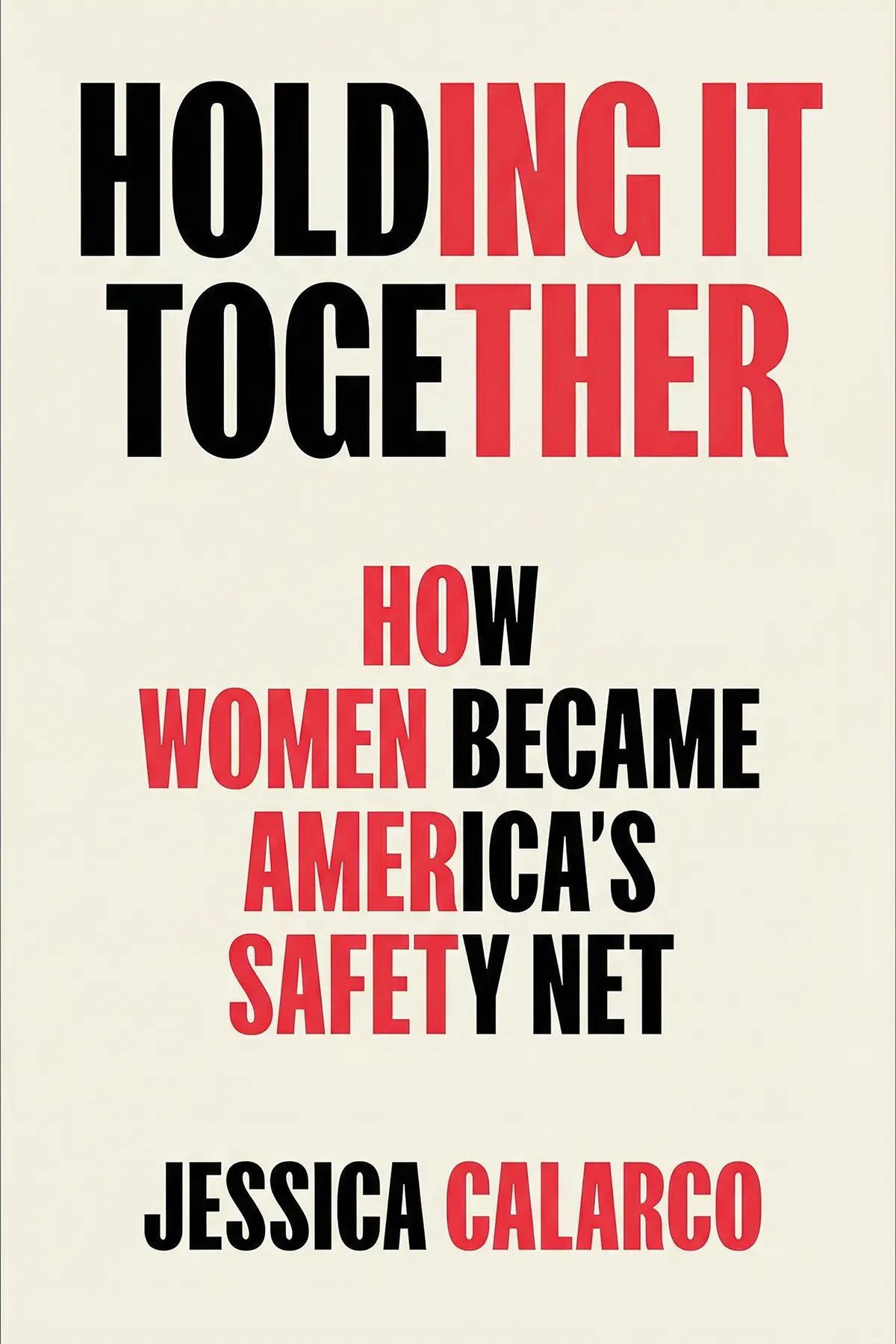
Holding It Together explores the precarious role American women play as the nation’s unofficial safety net, revealing how systemic failures and cultural myths force mothers into unsustainable cycles of labor and care.
1 min 27 sec
Imagine for a moment that you are standing in a crowded grocery store. In the checkout lane ahead of you is a woman who looks exhausted. She is trying to soothe two small children while her eyes remain fixed on the digital display of the cash register. You can see her doing the mental math, deciding which items are truly essential and which ones have to go back on the shelf today. This isn’t just a random moment of personal stress; it is a snapshot of a national crisis.
In her book Holding It Together, sociologist Jessica Calarco argues that this scene is played out millions of times a day across the United States. We often look at these women and admire their strength or their ability to ‘do it all,’ but Calarco asks a much more uncomfortable question: Why do they have to? Why, in a nation with such immense wealth, is the basic survival of families dependent on the superhuman endurance of mothers?
This summary will take you through Calarco’s research, based on hundreds of interviews with American families. We will explore how the United States has systematically dismantled its social safety nets, leaving women to act as the invisible glue holding the economy and society together. We’ll look at the cultural myths that keep this system in place, the political decisions that reinforce it, and a potential path forward that prioritizes care over corporate profit. It’s a journey into the heart of the American struggle, and it begins with understanding that the weight women carry is not a personal choice, but a policy requirement.
2 min 27 sec
Explore the reality of life without a social safety net and see how the burden of survival falls on women working multiple low-wage jobs just to stay afloat.
2 min 27 sec
Discover how girls are groomed to be mothers-in-waiting and how societal pressure forces women into caregiving roles regardless of their personal goals.
2 min 19 sec
Uncover why the American belief in ‘hard work’ often serves to justify a lack of public support and how self-help culture reinforces this mindset.
2 min 13 sec
Analyze how the COVID-19 pandemic briefly proved that a safety net is possible and why political interests worked to dismantle it so quickly.
2 min 07 sec
Learn about the concept of ‘unions of care’ and how looking at models like Iceland can help us rebuild a more equitable social structure.
1 min 17 sec
The central message of Jessica Calarco’s Holding It Together is that the American dream is being subsidized by the exhaustion of women. We have created a society that functions without a formal safety net because we expect mothers and female caregivers to fill every gap, no matter the personal cost. This isn’t a sustainable way to run a country, and it isn’t an inevitable way to live.
Throughout this exploration, we’ve seen how the lack of policy—from stagnant wages to restricted reproductive rights—traps women in cycles of poverty and guilt. We’ve seen how the myth of meritocracy is used to silence their complaints and justify their struggles. But we’ve also seen that it doesn’t have to be this way. The brief relief provided during the pandemic and the success of nations like Iceland show us that poverty and precarity are choices made by those in power.
The path forward requires a fundamental reimagining of what we value. It asks us to stop blaming individuals for their hardships and start holding our systems accountable. By building ‘unions of care’ and demanding collective support, we can finally take the weight of the world off the shoulders of women and build a society that truly holds us all together. The question is no longer whether we can afford to support families, but whether we can afford not to.
Have you ever wondered why so many families in one of the world’s wealthiest nations are constantly on the brink of collapse? This summary dives into Jessica Calarco’s profound investigation into the American social structure. It reveals a startling reality: the United States doesn't lack a safety net; it simply uses women to fill the holes where government policy should be. By examining the lives of families across the country, the book exposes how low wages, non-existent childcare, and the erosion of worker rights have created a crisis that falls squarely on the shoulders of women. The promise of this exploration is a deeper understanding of the myths we tell ourselves about success and hard work. Calarco dismantles the idea of meritocracy, showing how it serves to blame individuals for systemic failures. You will learn about the historical and political forces that dismantled public support and how the temporary relief of the pandemic showed a glimpse of a better way. Ultimately, it offers a vision for a more equitable future through collective responsibility and the radical idea of valuing care as a fundamental social contribution.
Jessica Calarco is a distinguished sociologist and a professor at the University of Wisconsin. She has dedicated her career to understanding social inequality and the ways institutions impact family life. In addition to her acclaimed work in Holding It Together, she is the author of Negotiating Opportunities, a book that examines how social class influences education. Her insights are frequently featured in major national publications, as she is a regular contributor to the New York Times and The Atlantic.
Listeners find the book to be thoroughly documented. They value the suggested policy frameworks, with one listener mentioning how it draws attention to vital challenges for building a secure future.
Jessica Calarco has written something that feels both urgent and deeply uncomfortable for anyone living in the current American landscape. The way she articulates how we’ve essentially outsourced our entire social safety net to the unpaid and underpaid labor of women is nothing short of brilliant. I was particularly struck by the ethnographic research from Indiana; these stories of mothers making impossible 'Faustian bargains' to secure basic childcare are heartbreaking but necessary to hear. It’s not just a collection of grievances, though. The data regarding tax rates and the wealth gap provides a sturdy backbone to her argument that our current 'DIY society' is a choice, not an inevitability. While the proposed solutions in the final chapters might feel like a stretch to some, they offer a vital glimmer of hope for a more stable future. This is essential reading for anyone who wants to understand why our systems are breaking down and who exactly is catching the pieces.
Show moreThe chapter on the 'Meritocracy Myth' alone is worth the price of admission because it perfectly deconstructs why we blame ourselves for systemic failures. Calarco’s writing is searing. She doesn't hold back when describing how we penalize the 'undeserving poor' while letting billionaires like Musk and Bezos pay virtually nothing in taxes. It’s infuriating. But it’s also validating to see the 'super mom' narrative exposed for what it is: a tool to keep women from demanding better government support. The stories from her Indiana and East Coast studies add a human element that prevents the book from feeling like a dry academic text. I’ve recommended this to every parent I know because we need to stop thinking of our struggles as individual failings. We are the safety net, and we are exhausted. Truly a powerful piece of work that demands a response from our policymakers.
Show moreWow, this is a searing indictment of the way we’ve built our economy on the backs of underpaid care workers. Calarco’s ethnographic work is top-tier. She captures the desperation of mothers in Indiana and the East Coast with such empathy and clarity that you can't help but feel the weight of their choices. The data on tax loopholes and the 'meritocracy myth' provides the necessary context to show that this isn't just about 'bad luck.' It’s about a system that intentionally leaves families behind to maximize corporate gains. I loved the way she connected the 'bootstrap' mentality to white supremacy and community isolation. It’s a complex, multi-layered argument that never feels overwhelming. If you want to understand the real reason why the U.S. lacks the social programs of other wealthy nations, read this. It’s a wake-up call for anyone who thinks we can just 'life-hack' our way out of a broken system.
Show moreEver wonder why you feel like you're drowning even when you're doing everything 'right' by society's standards? Calarco explains it perfectly through the lens of the 'Meritocracy Myth,' showing how we’ve been conditioned to view poverty as a moral failing rather than a policy choice. The book is incredibly well-researched, though I did find the repetitive use of phrases like 'Mars and Venus society' a bit grating after a while. To be fair, her breakdown of how the lack of government support forces women into low-wage care work is the most cohesive argument I’ve read on the subject in years. It’s a dense read at times, especially when she dives into the sociology of 'last place aversion,' yet the narrative remains accessible. I wish there had been more focus on women without children, as they are part of this safety net too, but the focus on mothers is understandable given the study's scope. Definitely a book that will spark a lot of dinner table debates.
Show moreFinally got around to reading this after seeing the viral interviews, and Calarco’s deep dive into how we’ve outsourced the welfare state to women is staggering. She effectively argues that the 'DIY society' isn't an accident; it’s a feature designed to keep labor cheap and corporations profitable. I appreciated the specific policy ideas she threw out, even if some felt a bit rushed in the conclusion. The prose is sharp, though I’ll admit the transition from qualitative stories to economic data felt a little clunky in the middle sections. Truth is, we’ve needed a book that connects the dots between the tax code and the 'mommy wars' for a long time. It’s a heavy read that might leave you feeling a bit hopeless, but the clarity it provides is invaluable. It’s definitely well-researched and provides a clear framework for understanding why 'holding it together' feels so impossible lately.
Show moreAs a mother who has spent years navigating the childcare crisis, I found myself nodding along until my neck hurt. Calarco hits the nail on the head regarding how we are forced to underpay other women just to survive in the workforce ourselves. It’s a cycle of exploitation that she documents with impressive precision. Look, the book can be a bit repetitive, and she uses certain catchphrases way too often, but the core message is too important to ignore. Her analysis of how we categorize the 'deserving' vs 'undeserving' poor was eye-opening and explains so much about our current political gridlock. I do think the book could have been a bit tighter in its editing, especially regarding the 'gender essentialism' sections. However, the overall impact is undeniable. It’s a sobering look at the precariousness of the American dream for anyone who isn't a billionaire.
Show moreLook, the data here is incredibly well-researched, specifically the ethnographic work centered around mothers in Indiana and East Coast hubs. Calarco does a fantastic job showing how the 'safety net' isn't a government program, but a person—usually a woman. I found the section on 'last place aversion' particularly fascinating as it explains why people often vote against their own interests. My only real criticism is that the tone occasionally veers into being a bit too academic, which might lose some readers. Also, the solutions chapter felt a little like an afterthought compared to the rigorous deconstruction of the problems. Still, the core argument is airtight. She proves that our reliance on women's unpaid labor is the only thing keeping the visible economy from collapsing. It’s a vital contribution to the conversation about labor, gender, and the future of the American family.
Show morePicked this up thinking it would be another 'mom-guilt' book, but it’s actually a rigorous political and economic argument. Calarco masterfully weaves together individual stories with broad systemic critiques. She shows how the 'DIY society' forces women to choose between their careers and their children’s safety, often with no good options in sight. I was particularly impressed by her take on how the meritocracy myth serves to isolate us and prevent collective action. Not gonna lie, some of the chapters are pretty bleak, and the writing style can be a bit dense with sociological jargon. However, the way she links the removal of social safety nets like WIC and Medicaid to corporate profit is a perspective I haven't seen articulated this well before. It’s an important read for anyone trying to make sense of our current social and economic precarity.
Show moreNot what I expected, but Calarco makes a compelling case that our lack of a government safety net is a deliberate feature designed to exploit domestic labor. The profiles of women making impossible trade-offs were the highlight for me; they ground the abstract economic theories in a very painful reality. Personally, I think the book could have spent more time on how this affects women of color and immigrants, though she does touch on it. The prose is generally strong, even if she leans a bit too hard on terms like 'engineers and profiteers.' Despite some minor factual quibbles and a slightly 'utopian' ending, the book's central thesis is incredibly persuasive. It highlights the critical issues we must face if we want to create a stable future for the next generation. A solid, thought-provoking read that will stay with me for a long time.
Show moreTo be fair, much of the sociological research presented here wasn't a total revelation for someone who already follows these policy debates closely. Calarco makes excellent points about the lack of universal childcare and the exploitation of educators, but I found myself skimming some of the repetitive case studies toward the middle. There’s a lot of 'stuff we live daily' in these pages, which makes it relatable but sometimes lacking in fresh insights for those of us already in the trenches. My biggest gripe is the final chapter on the 'union of care.' It felt a bit utopian and lacked a realistic roadmap for how we actually dismantle the corporate structures she so effectively indicts throughout the rest of the book. It’s a solid 3-star read—well-written and clearly argued, but perhaps better suited for someone just starting to think about these systemic issues rather than those already familiar with the 'invisible labor' discourse.
Show moreJohny Pitts

bell hooks

Fay Bound Alberti

Daniel Goleman


Virginia Woolf
Tracy Rosenthal
Jessica Valenti
AUDIO SUMMARY AVAILABLE
Get the key ideas from Holding It Together by Jessica Calarco, plus 5,000+ more titles in English and Thai.







