
20 min 18 sec
How to Decide: Simple Tools for Making Better Choices
By Annie Duke
Annie Duke provides a practical toolkit for making smarter choices by separating luck from skill, overcoming common cognitive biases, and focusing on the decision-making process rather than just the final outcome.
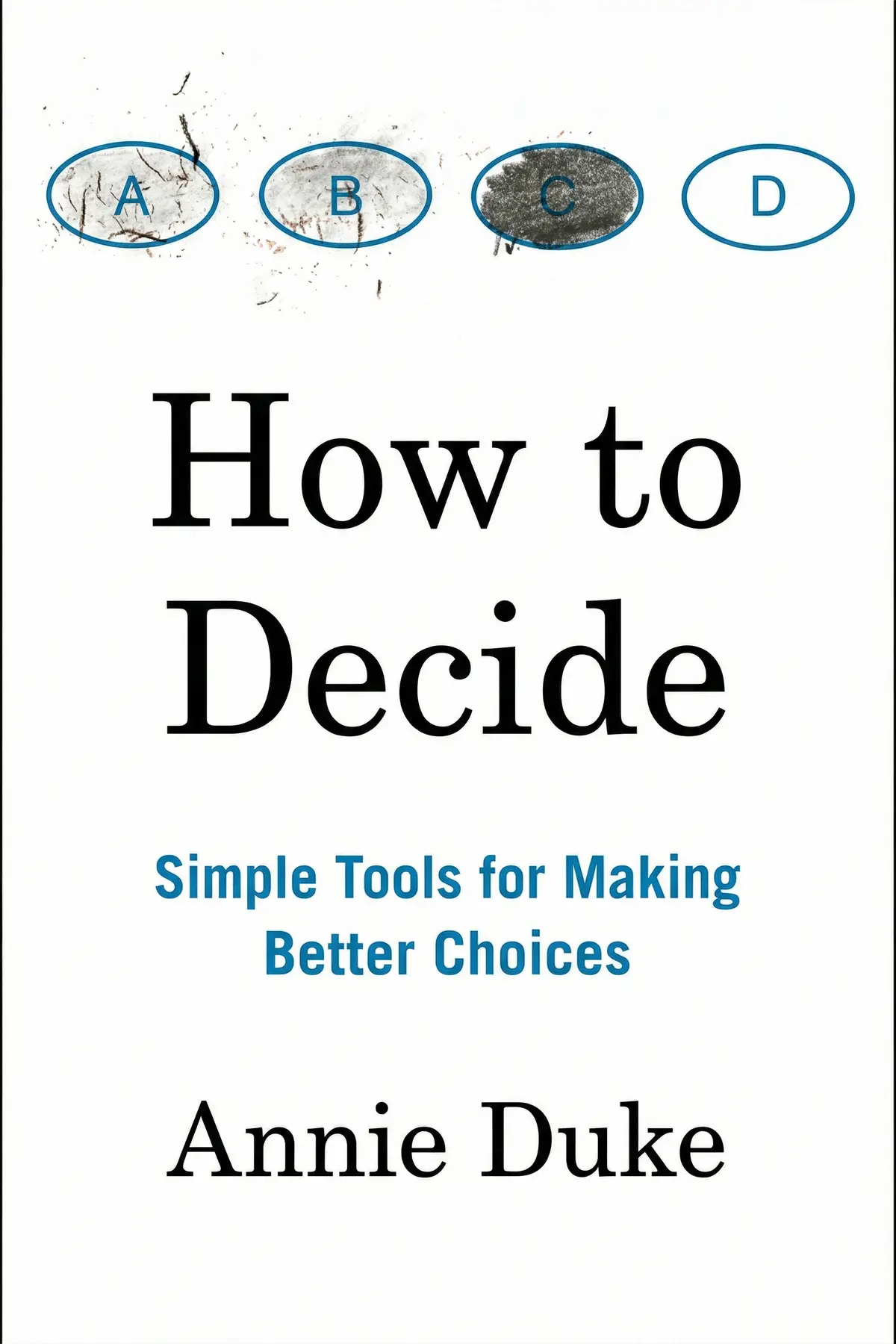
Table of Content
1. Introduction
1 min 30 sec
How often have you looked back on a choice and thought, ‘What was I thinking?’ Or, conversely, how often have you patted yourself on the back for a success that might have actually been a stroke of incredible luck? We tend to view our lives as a series of clear-cut outcomes, but the reality is far more complex. We are constantly making choices in a fog of uncertainty, where the information we have is incomplete and the role of chance is massive.
In this exploration of decision-making, we are moving away from the idea of ‘trusting your gut’ and toward a structured, reliable method for choosing. Annie Duke, drawing on her years as a world-class poker player, argues that we need to stop obsessing over results and start focusing on the quality of the process that led to those results. The human brain is naturally designed to take shortcuts that often lead us astray, making us overconfident when we win and overly critical when we lose.
Over the course of this summary, we will break down the specific tools and mental shifts needed to clear the fog. We’ll look at why a ‘good’ outcome doesn’t always mean a ‘good’ decision, how to stop the past from rewriting itself in our memories, and how to use a systematic six-step approach to handle life’s biggest crossroads. Whether you’re deciding on a career change, a major investment, or simply trying to optimize your daily routine, the goal is to bridge the gap between a random guess and an educated, strategic choice. By the end, you’ll have a roadmap for making decisions with clarity, even when the future is anything but certain.
2. The Danger of Judging Decisions by Outcomes
2 min 01 sec
Discover why a promotion doesn’t necessarily mean you made a good career move and how the ‘resulting’ trap blinds us to the role of luck.
3. Fighting Hindsight Bias with Knowledge Tracking
1 min 40 sec
Learn how our brains rewrite history to make every event seem inevitable and how to use a simple log to keep yourself honest.
4. Generating More Data Through Counterfactual Thinking
1 min 52 sec
Explore why a single experience isn’t enough to learn from and how your imagination can provide the statistical data you lack.
5. A Six-Step Framework for High-Stakes Choices
1 min 56 sec
Moving beyond pros and cons, this structured method helps you weigh probabilities and payoffs like a professional strategist.
6. The Power of Precision and the Shock Test
1 min 48 sec
Vague words like ‘probably’ lead to misunderstanding. Discover how using numbers can clarify your thinking and invite better feedback.
7. Blending the Inside and Outside Perspectives
1 min 58 sec
Your personal view is naturally biased. Learn how to look at your situation from the outside to find the patterns you’re missing.
8. Identifying Low-Impact Decisions to End Analysis Paralysis
1 min 57 sec
Stop wasting hours on what to eat or watch. Learn how to use the ‘happiness test’ to free up time for what really matters.
9. Using Negative Thinking as a Strategic Tool
1 min 54 sec
Forget blind optimism. Discover how ‘premortems’ and ‘prospective hindsight’ help you navigate obstacles before they even appear.
10. Quarantining Your Beliefs to Get Honest Feedback
1 min 51 sec
Don’t let your opinion spoil your advice. Learn why keeping your stance a secret is the best way to uncover the truth from others.
11. Conclusion
1 min 51 sec
In the end, the art of making better choices isn’t about finding a crystal ball; it’s about building a better machine for processing information. Throughout our journey through Annie Duke’s framework, the recurring theme is the separation of process from outcome. We’ve learned that a bad result doesn’t automatically mean you did something wrong, just as a win doesn’t always mean you’re a genius. By recognizing the role of luck, we can stop beating ourselves up over the unpredictable and start focusing on the variables we actually control.
We’ve explored the tools that help us see through the illusions of the mind. We now know how to use a knowledge tracker to stop hindsight from rewriting our history, how to use counterfactual thinking to generate the data we lack, and how to apply a rigorous six-step method to our most important dilemmas. We’ve seen the power of precision in our language and the necessity of looking at the outside view to keep our egos in check. We’ve also seen that not every decision deserves the same amount of effort—learning to move fast on low-impact choices is just as important as knowing when to slow down.
The most actionable takeaway you can apply immediately is the ‘Only-Option Test.’ The next time you find yourself stuck in the mud of indecision, whether it’s choosing a dinner spot or a new software provider, ask yourself: ‘If this were the only option available, would I be happy with it?’ This simple question clears away the clutter of endless comparisons and helps you realize when you’re just splitting hairs.
Decision-making is a skill that improves with practice. By being honest about what you don’t know, seeking out diverse perspectives, and constantly refining your process, you can navigate life with a sense of confidence and calm. You won’t always win—no one does—but you will always know that you played your hand as well as it could be played. And in the long run, that is exactly how you win the game.
About this book
What is this book about?
Most of us judge our choices based on whether they turned out well or poorly, but this approach is deeply flawed because it ignores the role of chance. In this guide, Annie Duke leverages her background in professional poker to reveal how we can improve our decision-making by focusing on the quality of our process. The book explores why our brains are wired to misinterpret the past and provides concrete strategies to navigate uncertainty. You will learn how to bypass hindsight bias, use 'mental time travel' to anticipate obstacles, and implement a six-step method for high-stakes choices. By shifting from a result-oriented mindset to a probabilistic one, you can make more confident decisions in your career, finances, and personal life. The promise of the book is not that every choice will lead to a perfect result, but that a better process will lead to better results over the long run.
Book Information
About the Author
Annie Duke
Annie Duke is a former professional poker player and a 2004 World Series of Poker champion. Beyond the poker table, she has established herself as a leading expert on decision-making under pressure. She has authored or co-authored several books, including Decide to Play Great Poker and the best-selling Thinking in Bets, which explores strategies for navigating uncertainty and risk.
Ratings & Reviews
Ratings at a glance
What people think
Listeners find that this guide delivers actionable strategies for choice-making and is an absolute joy to consume. They value the accessible prose and well-documented information, with one listener noting how it integrates concepts from probability theory. The work is highly rated for its clarity, with one review highlighting its easily understandable framework for making better choices.
Top reviews
Kek
Ever wonder why you make bad choices even when you have good intentions? This book answers that question through a rigorous yet approachable framework of probabilities and payoffs. Duke manages to take complex risk calculation and turn it into something a layperson can actually use in their career or personal life. Personally, I found the "pre-mortem" exercise to be the most valuable tool in the kit. By imagining a failure before it happens, you identify blind spots you’d otherwise ignore in your excitement. The layout is excellent, with plenty of space for notes and summaries at the end of each chapter. It’s rare to find a book that is both well-researched and a total pleasure to read. If you’re tired of analysis paralysis and want a scientific way to move faster, this is the manual you need.
Show moreNutnicha
The chapter on 'resulting' was a total game-changer for me. As someone who constantly beats themselves up over bad outcomes, Duke’s reminder that a good decision can still lead to a poor result (and vice-versa) was incredibly freeing. The book is remarkably well-researched and integrates probability theory without making your head spin. I loved the "Happiness Test" for its simplicity; it has already saved me hours of unnecessary stress over inconsequential choices. Truthfully, the practical nature of the toolkits and checklists makes this a book I will keep on my desk rather than my shelf. It’s not just theory; it’s a system. The writing is clear, direct, and avoids the fluff that usually fills this genre. A must-read for anyone in a leadership position or anyone who just wants to live more intentionally.
Show moreWyatt
Wow, what a practical guide. I’ve read a lot of books on cognitive bias, but most of them just tell you what’s wrong with your brain without telling you how to fix it. Annie Duke actually gives you the tools to combat your own biases in real-time. The "pre-commitment contracts" and the focus on "backcasting" have already changed how my team approaches project planning. Frankly, the book is a total pleasure because it’s so actionable. You aren't just reading; you're doing. The integration of probability theory is seamless and makes the concepts feel grounded in reality rather than just "positive thinking" fluff. If you want to improve your life by making even 5% better choices, buy this book immediately.
Show moreSurasit
Annie Duke's background in poker lends a fascinating edge to this guide, but you don't need to know a thing about cards to find value here. The core idea of "resulting"—the trap of judging a decision by its outcome rather than the process—is something I struggle with daily. Frankly, the writing style is accessible enough that I didn't feel bogged down by the cognitive psychology aspects. It’s a very tactical read, filled with flowcharts and "Happiness Tests" that help you stop overthinking the small stuff like what to eat for dinner. I did find some of the middle sections a bit repetitive, and if you aren't into doing literal homework, the worksheets might feel like a chore. However, the shift in perspective regarding luck versus skill is worth the price of admission alone. It’s a solid 4 stars for anyone looking to sharpen their mental models without needing a PhD in statistics.
Show moreEarn
This book is a masterclass in practical decision-making. Duke breaks down the three 'P's—Preferences, Payoffs, and Probabilities—in a way that feels intuitive rather than intimidating. I especially appreciated the sections on "Sheep in Wolf’s Clothing," which describes those high-impact decisions that feel impossible because the options are so similar. Turns out, that’s actually a signal to go faster, not slower! Not gonna lie, I usually skip the exercises in these types of books, but these were actually helpful for visualizing my own biases. My only minor gripe is that some of the poker analogies felt a bit recycled if you’ve already read her previous work. Still, it’s a great resource for anyone who feels stuck in a cycle of overthinking.
Show moreKevin
After hearing so much hype about Duke’s poker career, I expected more anecdotes from the table, but this is a much more serious academic-to-practical guide. The focus on "analysis paralysis" hit home for me. I spend way too much time deciding on things that won't matter in a year, and the frameworks provided here gave me the permission to speed up. To be fair, the book can be a bit repetitive, and the "math-y" parts might scare off some readers. But if you stick with it, the "pre-mortem" and "freeroll" concepts are incredibly useful. The worksheets are a nice touch, though they do make the book a bit bulky to carry around. Overall, it’s an excellent, digestible way to learn how to bet on yourself with more confidence.
Show moreChai
Finally got around to finishing this workbook and I’m glad I did. It’s essentially a toolkit for your brain. The most interesting part for me was the distinction between the quality of the decision and the quality of the outcome. We are so wired to think that if something went wrong, we made a mistake, but Duke shows that luck is a massive, uncontrollable variable. The "Sheep in Wolf's Clothing" metaphor for close calls was also brilliant. My only complaint is that the writing can be a bit dry in the middle chapters. It’s very structured, which is great for learning but doesn’t always make for a "page-turner" in the traditional sense. Still, the practical value outweighs the occasional boredom.
Show moreKaen
Picked this up after a recommendation from a colleague who swears by Annie Duke’s methods. It’s certainly a unique experience compared to your standard business book since it functions more like a workbook with actual activities to complete. In my experience, the concept of "backcasting" was the standout feature; it really helps you work backward from a successful future to see what steps are necessary today. However, the pacing is a bit uneven. Some sections feel like they are beating a dead horse regarding outcome bias, while other, more complex probability concepts felt a bit rushed. It’s a good introductory text for someone who has never thought about their decision-making process before. If you’re already familiar with Kahneman or Tetlock, you might find this a bit elementary, but it's a solid, functional tool for most readers.
Show moreStella
To be fair, I'm not a math person, so the probability calculations in the later chapters were a bit much for me. I was looking for something more narrative-driven. That said, the early sections on "resulting" were fantastic and really made me rethink how I evaluate my successes at work. It's a well-researched book with an approachable writing style, but it feels very much like a textbook. I found myself wanting more stories and fewer worksheets. If you are someone who likes a structured, step-by-step process, you will likely give this 5 stars. For me, it was a bit too clinical. I appreciate the logic and the "Happiness Test" is a great takeaway, but I struggled to stay engaged through the entire thing.
Show moreNaomi
Look, I really wanted to love this because the premise is so strong, but it felt like a 50-page essay stretched into a full-length book. The first few chapters on biases and "resulting" were genuinely insightful and changed how I looked at my past mistakes. After that, it descended into incredibly dry, "math-y" sections about probability trees that just didn't hold my interest. Truth is, the workbook format felt a bit condescending at times, like I was back in a high school stats class. The writing is technically fine, but it lacks the spark I expected from someone with such a high-stakes background in professional poker. If you’re a fan of deep-dive worksheets, you might enjoy it more than I did, but for me, it was a slog. I ended up skimming the last third just to find the summaries.
Show moreFeatured in
Readers also enjoyed
A High-Performing Mind: Strengthen Your Mind and Live Your Best Life
Andrew D. Thompson
Abundance: The Inner Path to Wealth
Deepak Chopra
59 Seconds: Change Your Life in Under a Minute
Richard Wiseman
AUDIO SUMMARY AVAILABLE
Listen to How to Decide in 15 minutes
Get the key ideas from How to Decide by Annie Duke, plus 5,000+ more titles in English and Thai.
- 5,000+ titles
- Listen as much as you want
- 7-day free trial
- Cancel anytime







