

A Planet of Viruses
Carl Zimmer
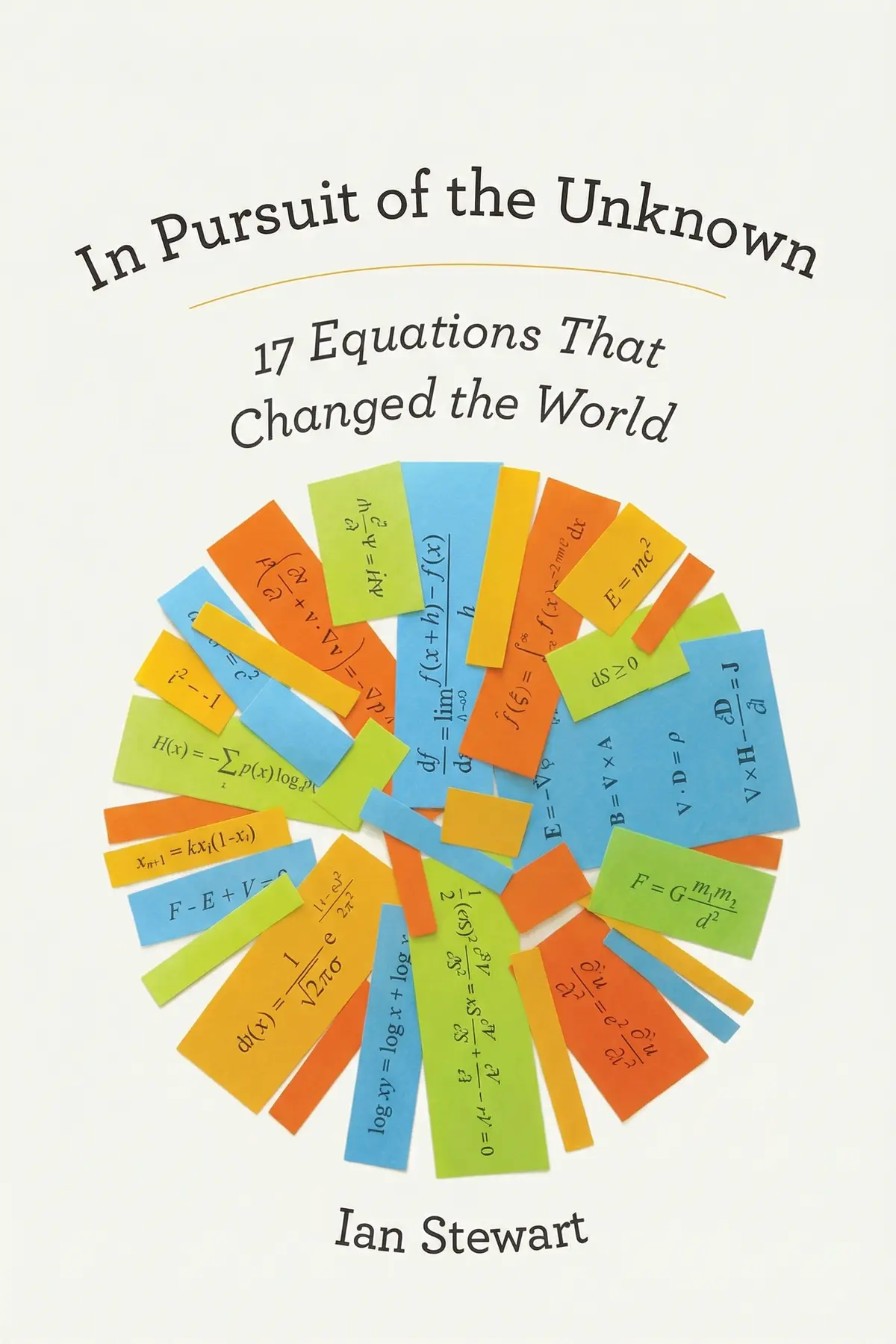
Ian Stewart explores how seventeen mathematical breakthroughs fundamentally reshaped human civilization. From ancient navigation to modern finance, discover the hidden equations that dictate our history, technology, and everyday reality.
1 min 49 sec
When we think of the great turning points in human history, our minds often drift to the dramatic: the crowning of kings, the clashing of massive armies, or the sudden upheaval of natural disasters. We remember the names of conquerors and explorers, but we rarely pause to consider the quiet, abstract symbols that made their journeys possible. In reality, the course of our civilization has been steered as much by mathematical equations as by any political revolution or military campaign. These strings of numbers and variables are more than just homework problems; they are the fundamental descriptions of how our universe functions.
From the way we navigate the vast oceans to the way we understand the subatomic particles that make up our bodies, equations serve as the bridge between human curiosity and concrete reality. They take the messy, unpredictable world around us and translate it into a language we can use to build, predict, and innovate. In this exploration of Ian Stewart’s work, we are going on a tour of the history of mathematics, looking specifically at the discoveries that moved us from ancient wonder to modern technological mastery.
As we look through these pivotal breakthroughs, we’ll see that mathematics isn’t just about calculating figures in a vacuum. It’s about the hidden connections that tie together seemingly unrelated things—like how the geometry of a simple triangle can tell us about the shape of the entire universe, or how a formula designed for physics can end up causing a global financial meltdown. By looking at these seventeen world-changing equations, or at least the most influential among them, we can start to see the invisible scaffolding that supports our modern life. We’ll learn how these ideas have shaped everything from your car’s navigation system to the very medicine that keeps us healthy. Let’s begin this journey by looking at the ancient foundations that first allowed us to map the world.
2 min 16 sec
Discover how a simple geometric relationship became the cornerstone of global navigation and our understanding of the universe’s curvature.
2 min 20 sec
Explore how Euler’s formula launched a new branch of mathematics that ignores rigid shapes to reveal the underlying structure of DNA.
2 min 07 sec
Learn how the normal distribution revealed that human behavior, though unpredictable in individuals, follows rigid mathematical laws in large groups.
2 min 04 sec
See how the Navier-Stokes equation allows us to predict the movement of everything from ocean currents to the blood in our veins.
1 min 57 sec
Understand how Newton’s simple realization about a falling apple united the heavens and the earth, enabling the age of space exploration.
1 min 57 sec
Observe how Einstein’s theories redefined the universe and why your smartphone’s navigation would fail without accounting for the warping of time.
1 min 56 sec
Uncover the strange reality of Schrödinger’s equation and how its bizarre rules for subatomic particles power every gadget you own.
1 min 57 sec
Learn why simple systems can lead to unpredictable results and how chaos theory transformed everything from weather forecasting to medicine.
2 min 02 sec
Discover the formula that fueled the growth of the banking world, while simultaneously creating the conditions for the 2008 financial crisis.
1 min 50 sec
As we have seen, the history of human progress is inextricably linked to the development of mathematical equations. These formulas are far more than just abstract thoughts or academic tools; they are the language through which we engage with the universe. We’ve traveled from the ancient Greeks using triangles to map the Earth, to modern physicists using quantum wave functions to build the digital world. We’ve seen how these strings of symbols allow us to launch spacecraft, predict the weather, and even manage the flow of blood through our hearts.
However, our journey also highlights a crucial balance. While equations give us the power to predict and control our environment, they are not infallible. The story of the Black-Scholes equation and the subsequent financial crisis reminds us that math is a model of reality, not reality itself. When we forget the limitations of our formulas, or when we apply them to systems as volatile as human psychology, we run the risk of overconfidence. The real power of mathematics lies in its ability to simplify complexity, but we must always remain aware of the details that get lost in that simplification.
The throughline of this exploration is clear: to understand the world we live in, we must understand the equations that describe it. They are the hidden logic behind the technology we use every day and the physical laws that keep our feet on the ground. As you move forward, keep a watchful eye for these invisible structures. Whether you are looking at a map, using a smartphone, or simply watching the rain fall, remember that there is an equation at work, translating the unknown into something we can navigate and master. Use this knowledge to stay curious, but also to stay skeptical—always questioning the models we use to define our lives.
In Pursuit of the Unknown reveals the profound impact of mathematical formulas on the development of the modern world. While traditional history books focus on the rise and fall of empires, this summary argues that the true architects of our reality are often found in the world of abstract symbols. We move through the centuries to see how geometry enabled global exploration, how statistics brought order to social chaos, and how the study of fluids revolutionized modern transport. The narrative bridges the gap between pure mathematics and practical application, showing how theories of gravity, relativity, and quantum mechanics transitioned from chalkboards to the essential technologies we use today, like GPS and smartphones. It also examines the limitations of mathematical modeling, specifically how financial formulas contributed to global economic instability. By the end, listeners will understand how equations serve as the invisible scaffolding for everything from the structure of DNA to the movement of the planets.
Ian Stewart is a professor emeritus of mathematics at the University of Warwick and a fellow of the Royal Society. His research focuses on Lie algebras, dynamical systems, and the intersections of chaos theory with biology. A prolific author, his popular science works include Does God Play Dice? and Why Beauty Is Truth.
Listeners find the thoroughly researched mathematical evidence and the explanation of natural occurrences highly valuable, with one listener mentioning it acts as a perfect primer for interested non-experts. The work is considered captivating; one listener calls it an engaging mix of mathematical perspectives, while another points out the straightforward writing style. Listeners prize the included historical background, with one listener identifying the adequate historical specifics, and they enjoy the absorbing narrative, with one listener citing the expressive storytelling. They like the level of discourse, as one review emphasizes the best topic of discussion in each chapter.
Ian Stewart manages to make the most intimidating symbols on a page feel like part of a grand narrative history. I loved how each chapter started with a breakdown of what the equation tells us and why it matters before diving into the meat of the discovery. It's more than just math; it’s about how these concepts physically shaped our modern world, from radio waves to the 2008 financial crisis. The historical context is rich and well-researched, making the mathematicians behind the formulas feel like real, flawed people rather than just names in a textbook. Some parts are definitely dense, but if you have even a passing interest in science, the payoff is worth the mental effort. It really bridges that gap between 'The Two Cultures' that C.P. Snow famously discussed. I came away with a much deeper appreciation for the hidden logic of the universe.
Show moreThe chapter on the Black-Scholes formula alone is worth the price of admission for this book. Stewart doesn't just explain the math; he provides a biting social commentary on how these tools have been weaponized by Wall Street. I’ve read a lot of pop-science, but few authors manage to balance technical detail with historical drama as well as this. He takes these abstract, intimidating equations—things like the Wave Equation or Entropy—and anchors them to the real world in a way that feels urgent. The structure is very user-friendly, allowing you to jump around to whichever equation piques your interest. Personally, I found the discussion on the Law of Gravity and its impact on the Enlightenment particularly moving. It’s a stellar example of how math is the ultimate tool for human progress. A must-read for anyone who wants to see the world through a more analytical lens.
Show moreWhat a fascinating dive into the "invisible" structures that govern our lives! I found this book to be an entertaining blend of mathematical insight and eloquent storytelling. Stewart doesn't just give you the formulas; he gives you the 'why' behind them, which is something my high school math classes desperately lacked. Each chapter is a self-contained story of human ingenuity, from the ancient Greeks to modern-day physicists. The way he handles the concept of entropy and its statistical likelihood was particularly clear compared to other books I've tried. It’s a dense read, sure, but the information is so well-structured that it never feels overwhelming if you take it one equation at a time. This is exactly what popular science should be—challenging, informative, and deeply respectful of the reader's intelligence.
Show moreEver wonder how a simple set of symbols can predict a planetary orbit or the behavior of a subatomic particle? This book attempts to answer that by profiling 17 monumental equations, and for the most part, it succeeds brilliantly. Stewart has a way of blending mathematical insight with eloquent storytelling that keeps the pages turning, even when the concepts get a bit hairy. I particularly enjoyed the sections on Maxwell’s Equations and the Second Law of Thermodynamics. However, I’ll admit that a few chapters, like the one on the Schrödinger Equation, left me feeling a bit out of my depth. He uses terms like 'eigenfunctions' without quite enough hand-holding for a true layman. Still, the overall experience was incredibly enlightening. It’s a great introduction for the curious mind, provided you don’t mind doing a little 'extra credit' reading on the side.
Show morePicked this up on a whim at a bookstore because the cover looked intriguing, and I’m glad I did. This isn’t just a dry list of formulas; it’s a well-documented exploration of how natural phenomena are translated into the language of mathematics. Stewart’s writing style is generally clear and engaging, which is no small feat given the subject matter. I was especially gripped by the "Midas Formula" chapter regarding the Black-Scholes equation and its role in the banking debacle. It’s a sobering reminder that even the most elegant math can be misused with catastrophic results. My only gripe is that some of the "simplified" explanations felt a bit like they were skipping the most important steps. You get the 'what' and the 'why,' but the 'how' remains a bit of a mystery in the more advanced chapters. Definitely worth a read if you want to understand the architecture of reality.
Show moreAfter years of dodging anything involving calculus, I decided to give this a try to see if I could finally understand what the fuss was about. Look, it’s not an easy read, but it is a rewarding one. Stewart provides a fascinating blend of history and science that makes you realize how much we take for granted. The way he describes the transition from the Pythagorean theorem to the development of complex numbers is actually quite beautiful. Not gonna lie, I definitely glazed over during some of the more technical derivations, but the "Why is it important?" summaries at the start of each chapter kept me grounded. It’s a well-researched piece of documentation that serves as a great bridge between the humanities and the sciences. It’s the kind of book that stays on your shelf because you know you’ll want to reference a specific chapter later.
Show moreIf you can get past the occasional burst of high-level jargon, "In Pursuit of the Unknown" is an absolute gem of a book. It’s rare to find an author who can explain the Navier-Stokes equations and the history of the French Revolution in the same breath without losing the thread. I really appreciated the specific details about how these equations led to the technology we use every day, like GPS and television. The writing style is generally clear, though there were a few moments where I wished for more diagrams to help visualize the more abstract points. It’s a heavy book, both physically and intellectually, but the sense of wonder it instills about the universe is priceless. It’s perfect for someone who wants to move beyond the surface-level "fun facts" and actually understand the foundation of modern science.
Show moreAs a high school teacher, I was hoping this would be the perfect supplementary text for my advanced students, but I’m not so sure. To be fair, the way Stewart frames the importance of each equation is masterclass-level work, but the 'popularization' of the actual math is hit or miss. There were times I found myself re-reading paragraphs just to follow the logic, and I have a degree in this stuff! For someone without a STEM background, I fear the density might be a dealbreaker. The book starts off with a lot of energy and excitement, but it seems to lose steam toward the end, becoming a bit of a slog through financial modeling and complexity theory. It’s certainly an interesting idea, and the historical anecdotes are top-tier, but it feels caught in a middle ground. It's too complex for the casual reader yet perhaps too brief for the expert.
Show moreTo be fair, Stewart is a prolific writer with a real talent for historical context, but this specific volume feels a bit uneven. Some chapters are incredibly lucid and move at a great pace—the section on logarithms stands out as particularly well-explained. However, others feel like they belong in a graduate-level seminar. The discussion on the Second Law of Thermodynamics was a bit of a muddle for me, and I felt he over-simplified some aspects while over-complicating others. I also agree with other reviewers that the book loses its momentum toward the final third. The ending chapters on chaos theory and the financial markets felt rushed compared to the deep dives into Newton and Maxwell. It’s an interesting idea, but it would have benefited from a co-author who could have helped "translate" the more abstract concepts for a general audience.
Show moreFrankly, this was a struggle from start to finish. I really wanted to like it because the premise of "17 equations that changed the world" sounds fantastic, but the execution was just too dense for me. I’m not a math major, and despite the "popular science" label, I felt like I needed a tutor sitting next to me to get through the middle sections. Stewart is clearly a brilliant mathematician, but he falls into the trap of assuming the reader has a much higher baseline of knowledge than most laypeople actually do. The prose is often dry, and by the time I got to the chapters on knot theory and relativity, I was just pushing myself to finish for the sake of finishing. It lacks that spark of excitement that makes books like this really sing. If you're an engineer, you'll probably love it, but for the rest of us, it’s a bit of a bore.
Show moreCarl Zimmer
Bill Bryson
Jeff Hawkins


Lisa Kaltenegger

AUDIO SUMMARY AVAILABLE
Get the key ideas from In Pursuit of the Unknown by Ian Stewart, plus 5,000+ more titles in English and Thai.







