

12 min 17 sec
In the Name of Identity: Violence and the Need to Belong
By Amin Maalouf
In the Name of Identity explores the complex layers of human belonging, challenging the rigid labels that fuel conflict and offering a vision for a more inclusive, multifaceted global community.
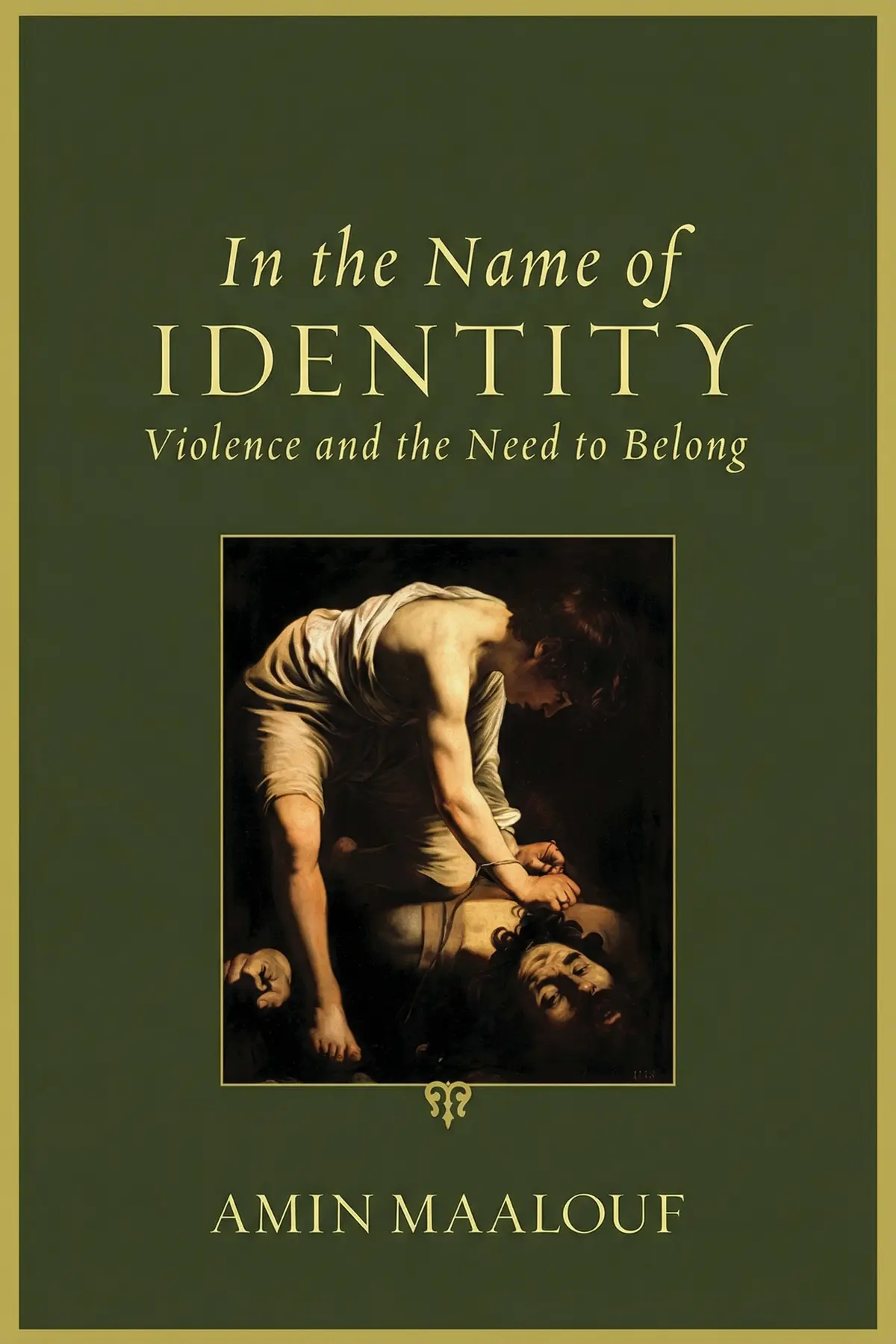
Table of Content
1. Introduction
1 min 12 sec
If someone asked you to define who you are without using your name, where would you even begin? Most of us might start with our profession, our family role, or perhaps our nationality. But as soon as we settle on one label, we realize it doesn’t capture the whole truth. We are all more than just a passport, a paycheck, or a prayer.
In this exploration of Amin Maalouf’s work, we are going to look at the concept of identity as a living, breathing thing—something that is often misunderstood and dangerously oversimplified. The central throughline of this journey is that identity is not a monolith; it is a complex intersection of many different allegiances. When we ignore this complexity, we fall into the trap of ‘us versus them’ thinking that has fueled centuries of violence and misunderstanding.
Over the next several minutes, we will look at how the world sees us, why no culture or religion has a monopoly on peace or violence, and how we can find a way to belong to a global community without losing the specific traits that make us unique. We’ll see that the answer to the question ‘Who are you?’ is never as simple as a single word, and that acknowledging this complexity is the first step toward a more compassionate world.
2. The False Choice of Singular Identity
2 min 11 sec
Discover why the pressure to choose a single defining label is a modern trap that ignores the rich, diverse reality of who we truly are.
3. The Power of the External Gaze
2 min 06 sec
Explore how the way others perceive us can force certain aspects of our identity to the surface, often in defensive and radical ways.
4. The Myth of Inherent Cultural Character
2 min 04 sec
Uncover why no religion or culture is hardwired for violence or peace, and how historical context changes our interpretation of sacred values.
5. Humiliation as a Driver of Radicalism
1 min 48 sec
Examine how Western dominance has left other cultures feeling marginalized, leading to a desperate search for identity through fundamentalism.
6. Forging a Global Tribe
1 min 49 sec
Learn how we can move toward a future that celebrates universal human rights without sacrificing the unique cultural differences that define us.
7. Conclusion
1 min 07 sec
As we wrap up our journey through Amin Maalouf’s insights, the most important takeaway is a call to reclaim our own complexity. We live in a world that constantly tries to file us into neat little folders, but we must resist the urge to do that to ourselves—or to anyone else. Identity is a vast and shifting landscape, and acknowledging that fact is a powerful act of peace.
Next time you find yourself labeling someone based on a single characteristic, stop and remind yourself of the thousand other things they might be. Remember that no religion or culture is set in stone; they are shaped by the choices of people like us. By choosing to see the multifaceted nature of every human being, we start to dismantle the walls that lead to conflict.
The path forward isn’t about erasing our differences, but about building a world where those differences don’t become death sentences. We can be proud of where we come from while still belonging to the entire human race. It starts with a simple shift in perspective: seeing identity not as a weapon, but as a bridge. Thank you for listening to this exploration of how we can all find a better way to belong.
About this book
What is this book about?
This exploration dives deep into the heart of why we define ourselves the way we do and how those definitions often lead to global tension. Amin Maalouf examines the concept of identity not as a single, unchanging stone, but as a rich tapestry woven from many different threads—religion, nationality, language, and personal history. He argues that the world’s current crises often stem from a reductive view of identity that forces individuals to choose one allegiance over all others. The book promises a journey through history and sociology to uncover why certain groups turn to radicalism and how Western dominance has shaped the self-perception of cultures worldwide. By the end, listeners will understand how to view themselves and others through a lens of 'universality' rather than 'uniformity,' providing a practical path toward a more peaceful coexistence in an era of rapid globalization.
Book Information
About the Author
Amin Maalouf
Amin Maalouf is a distinguished French-Lebanese novelist whose body of work includes seven acclaimed books. His notable titles include The Gardens of Light, Leo Africanus, and The Rock of Tanios, the latter of which earned him the prestigious Goncourt Prize. Beyond his literary success, Maalouf served as the director of An-Nahar, the preeminent newspaper in Beirut. Today, he makes his home in Paris, continuing to contribute his unique perspective to the global cultural conversation.
Ratings & Reviews
Ratings at a glance
What people think
Listeners find this an insightful work, and one review specifically points to its exploration of societal and human prejudices. It garners positive marks for its overall value, with listeners calling it great.
Top reviews
Pan
Picked this up after a friend recommended it for its insights into the immigrant experience, and it absolutely lived up to the hype. Maalouf doesn't just theorize; he shares his own struggles with belonging, making the concept of a multifaceted identity feel like a lived reality rather than a dry academic exercise. To be fair, I expected something much more dense, but the writing is incredibly accessible and flows with a poetic urgency. It really makes you question why we feel the need to negate others just to affirm ourselves. For anyone who has ever felt like they belong everywhere and nowhere at the same time, this book is a warm embrace. It offers a hopeful roadmap toward a future where we value our shared humanity over tribal divisions. Truly a masterpiece of empathy.
Show moreMeen
This book is a revelation for anyone moving between cultures or identifying as a Third Culture Kid. Maalouf understands the sustained crossroads of life better than almost any other contemporary writer, drawing on his own family’s rich, multilayered history to illustrate his points. I loved how he connects his personal experience in Lebanon to broader historical processes, similar to his approach in The Crusades Through Arab Eyes. He makes a compelling case that we shouldn't have to amputate parts of our heritage to fit into a neat, singular box. The prose is direct and avoids unnecessary jargon, which makes his profound observations about violence and belonging hit even harder. It’s a book I plan to return to whenever the world feels too polarized. It gave me a lot of hope for a future defined by plural fraternity rather than segregation.
Show moreSupachai
The chapter on the universal nature of human rights alone makes this book a mandatory read for the 21st century. Maalouf argues with such stubborn resistance against despondency that you can't help but feel inspired by his vision of a more tolerant world. As someone watching recent political upheavals regarding independence movements and nationalism, his warnings about the madness of exclusive belonging feel incredibly prophetic. He manages to be both a passionate critic of tribalism and a compassionate observer of the human need to belong somewhere. The way he bridges Islamic and Western thought is masterfully done, providing a necessary counter-narrative to the clash of civilizations rhetoric that usually dominates the headlines. This is a substantial essay that deserves a spot on every shelf. It’s an essential guide for anyone who values diversity over uniformity.
Show moreAva
Maalouf’s prose acts as a bridge between the fractured realities of East and West, offering a perspective that feels deeply intimate yet globally resonant. As a Lebanese-born writer living in France, he possesses a unique authority to dissect how we allow single labels like religion or nationality to define our entire being. I found his analysis of murderous identities particularly striking, as it explains why humans are so quick to pick up arms to defend a narrow sliver of their heritage. The book is slim but packs a heavy punch. It reminds us that we are all composed of multiple layers that should never be sacrificed for the sake of a tribe. While some of the geopolitical examples feel rooted in the late nineties, the core philosophy remains an essential shield against modern extremism. It is a graceful plea for complexity in an age that demands simple, often violent, allegiances.
Show moreFatou
How do we reconcile our local traditions with the steamroller of global uniformity? Maalouf tackles this question with a nuance that is rare in today’s polarized climate, arguing that we don't have to choose between being a global citizen and a member of a specific community. He is particularly effective when discussing how globalization can trigger a defensive, violent retreat into fundamentalism when people feel their cultural survival is at stake. The text flows quickly, though I wish he had spent more time exploring the digital side of identity, which has changed so much since 1999. Even so, his call for universal human rights to supersede all other affiliations is a powerful moral anchor. It’s a great value for anyone trying to navigate the messy intersections of modern life without losing their soul. A thoughtful, highly relevant essay.
Show moreSirirat
Wow, this was a surprisingly quick read that left me thinking for days about my own biases. Maalouf explores how we often define ourselves by who we are not, rather than who we are, which is the root of so much societal prejudice. Look, the book is definitely a product of its time—referencing the 90s conflicts in Yugoslavia and Africa—but the psychological mechanisms he describes are still perfectly visible in today’s social media landscape. I particularly enjoyed the sections on how linguistic repression can lead to a violent assertion of identity. My only real gripe is that some chapters feel a bit more like a series of journal entries than a structured argument, but his passion is infectious. It’s a valuable tool for anyone wanting to understand why we cling so desperately to our tribes.
Show moreTakeshi
Ever wonder why people are so willing to kill and die for something as abstract as a flag or a creed? Maalouf dives deep into this question, peeling back the layers of what he calls murderous identities to show how easily we can be manipulated by fear. Personally, I found his discussion on the difference between being authentic and being a clone of one's culture to be the highlight of the book. While the writing can be a little repetitive in the middle sections, the overall message is so vital that I can overlook a few stylistic flaws. It’s a powerful reminder that our common humanity is the only thing that can truly save us from the cycles of hatred we keep reinventing. A really insightful look at the invisible borders we build between ourselves. Definitely a book that stays with you long after the final page.
Show moreSarocha
After hearing so many people rave about this essay, I finally sat down with it, but I have to say I’m a bit torn. Maalouf is clearly a brilliant thinker, and his personal history is fascinating, but he tends to repeat his main points far more than necessary for such a short book. Truth is, many of the ideas presented here—like the notion that identity is a complex puzzle rather than a single block—felt fairly obvious to me. Maybe that is just because the world has caught up to his way of thinking in the twenty years since this was first published. It’s a solid introduction for someone who hasn't thought deeply about social prejudices or the roots of sectarian violence, yet it lacks the rigorous depth I was hoping for. It is a decent read, but not quite a groundbreaking experience.
Show moreAisha
Finally got around to reading this one. It's a slim volume that serves as an interesting historical artifact from the turn of the millennium, though it feels a bit dated in the age of algorithmic radicalization. Maalouf is a great writer, and his central idea—that identity is a jagged puzzle of many pieces—is one I fundamentally agree with. However, the book feels a bit light on substance at times, focusing more on personal reflections than on a rigorous analysis of the political systems that exploit identity. In my experience, it is an essay that functions better as a philosophical meditation than a sociological study, so maybe my expectations were just a bit misaligned. It’s still worth a look for the beautiful prose and the author’s unique perspective as a man living between two worlds. Just don't expect a revelation.
Show moreRafael
Not what I expected at all, unfortunately for me. While I appreciate Maalouf’s noble intentions and his beautiful writing style, the entire thesis felt like a naive utopia that ignores the harsh realities of power dynamics. He speaks of humanity as a singular entity, which sounds great on paper but feels disconnected from the systemic inequalities that actually drive identity politics today. Frankly, the book comes across as a collection of well-meaning platitudes that don’t offer much in the way of concrete solutions for the conflicts he describes. It’s a very quick read, which is a plus, but it left me feeling like I’d just attended a lecture on basic common sense rather than gaining new insights. If you’re looking for a deep sociological dive, you might find this a bit too simplistic for your tastes.
Show moreReaders also enjoyed
A Warning
Miles Taylor

A Biography of Loneliness: The History of an Emotion
Fay Bound Alberti
A Force for Good: The Dalai Lama's Vision for Our World
Daniel Goleman
Abolish Rent: How Tenants Can End the Housing Crisis
Tracy Rosenthal
Abortion: Our Bodies, Their Lies, and the Truths We Use to
Jessica Valenti
AUDIO SUMMARY AVAILABLE
Listen to In the Name of Identity in 15 minutes
Get the key ideas from In the Name of Identity by Amin Maalouf, plus 5,000+ more titles in English and Thai.
- 5,000+ titles
- Listen as much as you want
- 7-day free trial
- Cancel anytime







