
Aflame: Learning from Silence
Pico Iyer
Explore the fundamental questions of human existence through the lens of history’s greatest philosophical and religious traditions to build a personal framework for a life that is truly worth living.
1 min 43 sec
When we hear the phrase “the good life,” our minds often jump straight to a specific set of images. We think of sprawling estates, high-end travel, and the kind of carefree leisure that only significant wealth can buy. In our modern culture, the concept of living well has become almost synonymous with the accumulation of material comforts and the absence of struggle. But as we stand back and look at the trajectory of our lives, a nagging suspicion often arises: Is this all there is? Is the pursuit of comfort really the highest purpose we can find?
In this exploration of Life Worth Living, we are invited to set aside these superficial definitions and engage with what the authors call “the Question.” It isn’t just one question, but a cluster of inquiries that have haunted humanity for millennia. What is truly worth wanting? What should we hope for when we look toward the future? And most importantly, how are we supposed to live in the here and now?
This isn’t just an academic exercise. It’s a call to move beyond the automatic, reflexive ways we spend our days and to dive into a deeper state of reflection. We will look at how some of the most influential thinkers in history—from theologians and philosophers to poets and activists—have grappled with these themes. By the end of this journey, the goal isn’t to find a single, one-size-fits-all answer, but to gather the ingredients necessary to create your own recipe for a life that feels authentic, responsible, and full of purpose. Let’s begin by looking at why the way we ask these questions matters just as much as the answers we find.
1 min 58 sec
Uncover why true fulfillment requires moving past our surface-level desires to determine what is actually worth wanting in the long run.
2 min 21 sec
Explore the three primary spheres of accountability that help us understand who we are truly answering to in our daily choices.
2 min 34 sec
Learn why the simple pursuit of pleasure may be a shallow goal and how embracing sorrow can actually lead to a more authentic life.
2 min 34 sec
Contrast the Buddhist path of indifference with the religious path of divine alignment to see how both offer freedom from the cycle of craving.
2 min 23 sec
Challenge the traditional elitist views of a flourishing life and consider how our responsibility must extend to the entire natural world.
2 min 09 sec
Consider whether life’s meaning comes from its eternal nature or from the very fact that it will eventually come to an end.
2 min 17 sec
Moving from theory to practice is often the hardest step; discover why having a supportive community is essential for lasting personal change.
2 min 11 sec
Discover a five-step daily ritual designed to align your actions with your values and cultivate a spirit of gratitude and mindfulness.
1 min 38 sec
As we reach the end of this journey, it becomes clear that a life worth living is not a destination we reach, but a way of traveling. It is not about reaching a state of perfect comfort or accumulating enough wealth to escape the world’s problems. Instead, it is a life characterized by a constant, honest engagement with the biggest questions of our existence. We have seen how different traditions offer different ingredients for a meaningful life: the utilitarian’s focus on joy, the Stoic’s or Buddhist’s search for balance, the religious commitment to a higher calling, and the indigenous respect for all life.
No one can give you a pre-packaged answer that will fit your life perfectly. You have to be the chef who takes these diverse ingredients and creates a recipe that works for you. This requires the courage to dive deep, the humility to admit when you are wrong, and the discipline to turn your reflections into daily actions. It also requires the wisdom to know that you cannot do it alone—that community and ritual are the support systems that keep us upright when the path gets steep.
The most important thing is to never stop asking “the Question.” Our vision of a flourishing life will likely evolve as we grow and as the world changes. But as long as we are intentional about what we want, who we are responsible to, and how we treat the forest around us, we are well on our way. A life worth living is within reach for anyone willing to do the work of looking for it. Start today by taking your own dive, and see what truths are waiting for you in the depths.
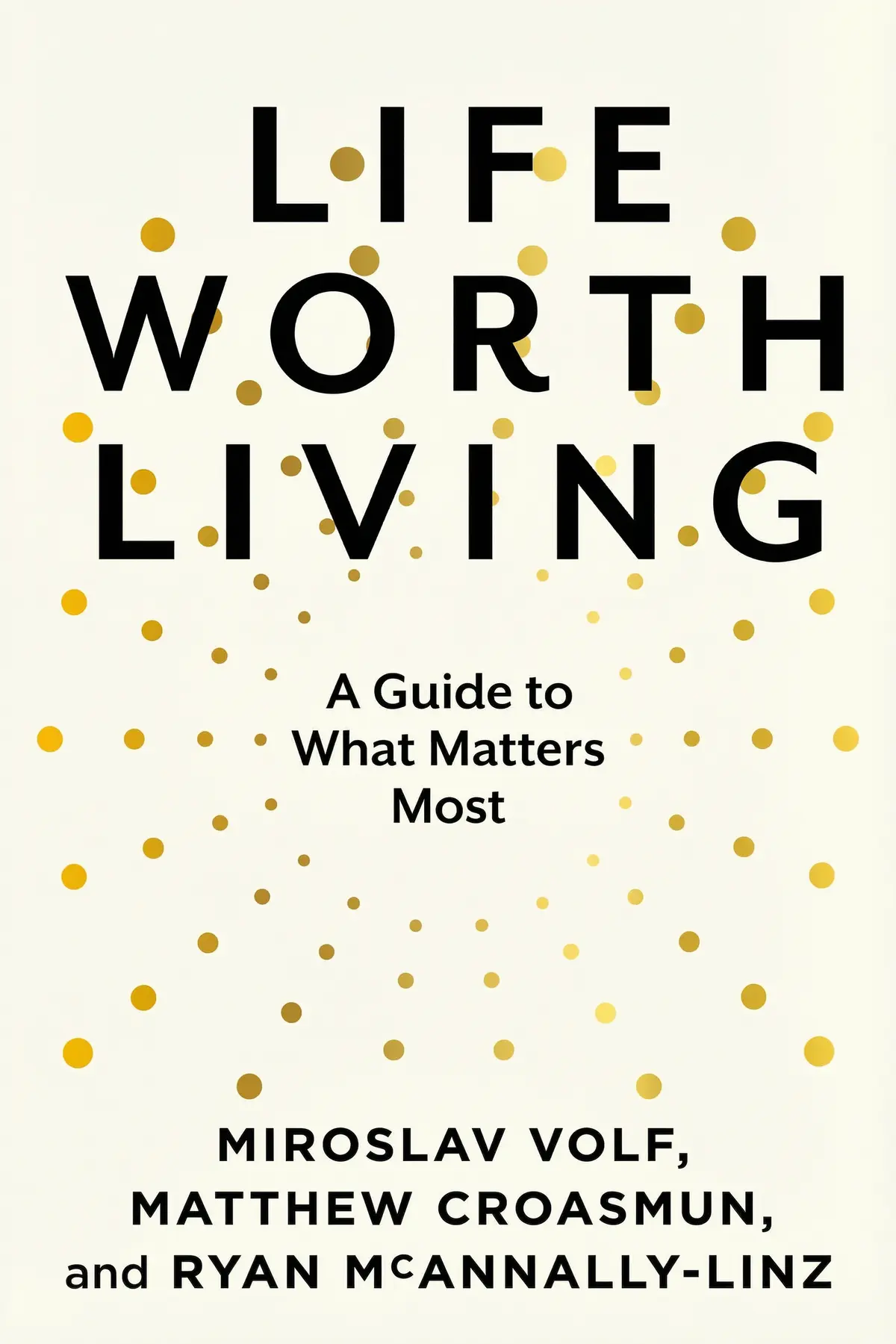
Life Worth Living addresses the most profound question any of us can ask: What makes a life truly flourishing? Rather than offering a single, prescribed answer, it draws upon a diverse array of perspectives—from the ancient wisdom of the Buddha and the teachings of Abrahamic faiths to the modern insights of social programs and existential literature. The book serves as a guide for navigating the tension between what we merely want in the moment and what is actually worth wanting. It challenges listeners to look beyond the superficial definitions of success—like wealth or fame—and instead focus on responsibility, the role of suffering, and the importance of community. By synthesizing these varying viewpoints, the book provides a practical yet deep roadmap for aligning one’s daily actions with their highest ideals.
Miroslav Volf is a professor of theology at Yale Divinity School and the Director of the Yale Center for Faith & Culture. He has authored or co-authored many books on religion and compassion, including The End of Memory and the award-winning Exclusion and Embrace. Matthew Croasmun is a lecturer at Yale College and Director of the Life Worth Living Program at the Yale Center for Faith & Culture. He authored The Emergence of Sin and co-wrote For the Life of the World. Ryan McAnnally-Linz is an Associate Director of the Yale Center for Faith & Culture. He co-authored The Home of God and Public Faith in Action with Volf.
Listeners describe the work as stimulating, and one notes that it functions as an excellent primer on moral and ethical topics. The prose also earns praise, with one listener highlighting that the text was authored by three Christian theologians. Furthermore, listeners believe the book offers a solid return on investment. On the other hand, opinions on clarity are varied, as one listener found it difficult to read.
Wow, this was exactly the existential kick in the teeth I needed this year. The authors do an incredible job of taking 'The Question' and breaking it down into manageable, yet deeply challenging, pieces. I loved how they wove together voices as diverse as Robin Wall Kimmerer, C.S. Lewis, and the Dalai Lama. It’s rare to find a book that feels both academically rigorous and deeply personal at the same time. The discussion on how our understanding of death gives agency to our life really stuck with me. If you’re willing to do the work, this book will change how you view your daily responsibilities.
Show moreAfter listening to the audio version narrated with such care, I feel compelled to start a discussion group for my friends. The way the authors explain complex ideas like utilitarianism and the 'middle way' of Buddhism is so accessible. I especially appreciated the stories and examples that illustrated how these ancient ideas apply to modern life. It’s a great book for college-aged people, though I think even high schoolers could get a lot out of the sections on community. This is one of those rare books that actually provides a roadmap for flourishing. It is truly an invaluable guide for anyone seeking a more meaningful existence.
Show moreThis book doesn't just ask what you want, it asks what is actually worth wanting in the long run. The concept of 'The Forest' of responsibility really resonated with me, especially the idea that we are accountable to more than just ourselves. I found the contrast between the 'will to power' and utilitarian ethics to be a brilliant way to spark internal debate. Even though the authors are theologians, the book feels inclusive and deeply rooted in our shared humanity. It’s the kind of text you want to keep on your bedside table to revisit whenever life feels aimless. Truly a masterclass in moral philosophy for the modern age.
Show moreEver wonder what actually makes a life worth living? This book uses a fascinating deep-sea dive metaphor to help you move past reflexive actions into true self-reflection. I particularly loved the 'Smokey the Bear' analogy for responsibility—it’s such a clever way to frame our duties to ourselves and the higher power. Personally, I found the chapters on pleasure and pain to be the most provocative, especially the contrast between Oscar Wilde and the Buddha. Some parts are a bit slow, but the overall journey is worth the effort. It really forces you to ask what is worth wanting instead of just what you want.
Show moreFinally got around to reading this after hearing about the famous Yale course it’s based on. The writing is incredibly thought-provoking, especially how it balances perspectives from three Christian theologians while remaining fair to non-Christian traditions. Frankly, I expected it to be a bit more evangelistic, but it stays remarkably ecumenical and open-minded throughout. It’s a great introduction to moral imagination for anyone who feels stuck in the daily grind. My only minor complaint is that the middle sections on various philosophies can feel a little rushed. Still, it’s a wonderful resource for anyone looking to build a life around what matters most.
Show moreThe section on the Ignatius examen was the highlight of the whole experience for me. This book doesn't just leave you with abstract theories; it provides actual tools like daily prayers and reflection rituals to put ideas into action. I’ve been looking for a way to integrate more mindfulness into my routine, and the five-part review process is very helpful. Not gonna lie, some of the philosophical summaries are a bit simplified, especially when they tackle heavyweights like Nietzsche. However, as a guide for living rather than just a history of thought, it succeeds brilliantly. It would be a fantastic choice for a church book group.
Show morePicked this up because I’ve spent my whole career in STEM and realized I hadn't touched a philosophy book since college. The truth is, this serves as a decent, high-level survey of how different religions and schools of thought approach 'The Question.' I appreciated the inclusion of figures like Maimonides and Bentham alongside more modern voices. However, the survey style means you never really dive deep into any one tradition. It’s a good starting point for moral discourse, even if it feels a bit repetitive by the end. Not exactly life-changing, but it certainly stirs the imagination for a little while.
Show moreWhile the writing style is certainly clear and the authors are obviously brilliant, I think I’m just the wrong age for this. Look, this book essentially walks you through a popular Yale course aimed at twenty-somethings trying to find their path. As a seventy-year-old, I’ve already made most of the big decisions this book asks us to contemplate. The sections on responsibility and 'The Forest' are interesting, but they feel more like a refresher than a revelation. It is good value for money if you need a structured way to think about ethics, but older readers might find it a bit elementary.
Show moreAs a student who had to read this for a class, I found the core message incredibly repetitive and basic. The central premise seems to be that what you do in your day makes up your life, which feels like a 'duh' moment. Truth is, the book tries to give a broad overview of so many different philosophies that it ends up watering all of them down. Most of my classmates admitted they didn’t actually finish the readings and just copied off worksheets. It might be good for sparking a classroom discussion, but as a standalone read, it’s uninspiring and doesn’t offer anything new. Blegh.
Show moreI really wanted to like this, but I simply could not get through it. Honestly, it feels way too much like a dry classroom textbook rather than a guide for the general reader. I made it about halfway through the chapter on the Stoics and just felt completely lost in the jargon. Phrases like 'Agency' and 'The Way' are tossed around without enough grounding for someone reading this solo. To be fair, the authors are clearly experts, but the prose is just too dense and boring for a casual Sunday afternoon. I tried for about 75 pages and gave up because it felt like a chore rather than an inspiration.
Show morePico Iyer
Alcoholics Anonymous World Services
William B. Irvine
Daniel Goleman
Nigel Warburton
John Rawls
AUDIO SUMMARY AVAILABLE
Get the key ideas from Life Worth Living by Miroslav Volf, plus 5,000+ more titles in English and Thai.







