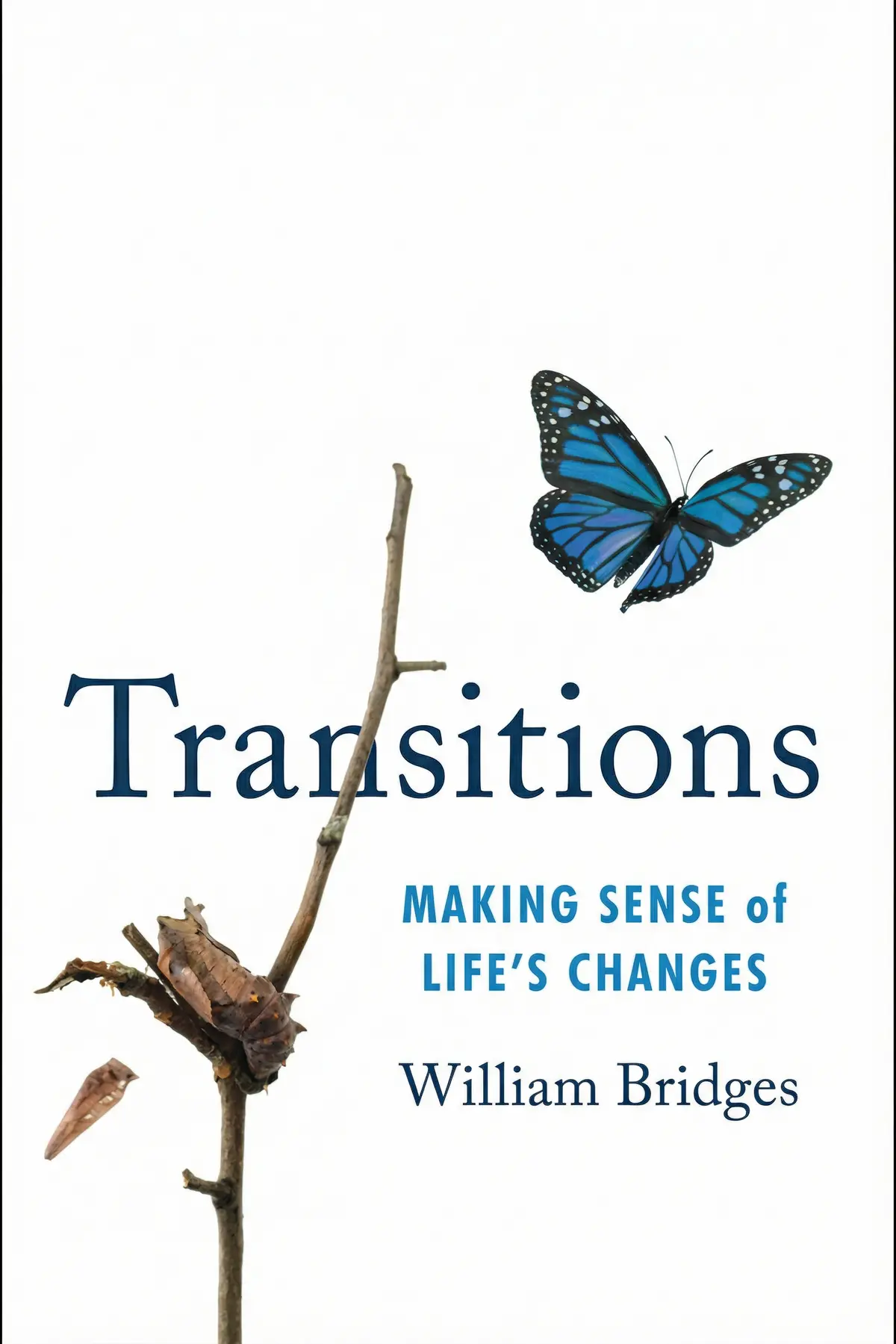
Transitions: Making Sense of Life's Changes
William Bridges
Discover how to navigate the human side of organizational change. This guide explains the psychological phases of transition, helping leaders guide their teams through endings, uncertainty, and successful new beginnings.
1 min 39 sec
Every leader eventually faces the daunting task of guiding a team through significant change. Perhaps it is a merger, a shift in remote work policy, or a total overhaul of the company’s tech stack. On paper, the plan looks perfect. The spreadsheets are balanced, the deadlines are set, and the logic is undeniable. Yet, when implementation begins, something goes wrong. People are hesitant, productivity dips, and the atmosphere becomes thick with tension. What happened?
Most organizational failures don’t stem from a bad plan, but from a fundamental misunderstanding of the human heart. There is a massive difference between change and transition. Change is external; it is the new state of affairs. Transition is internal; it is the psychological reorientation that every individual must undergo to accept that new state. If you don’t manage the transition, the change simply won’t stick.
In the following segments, we are going to walk through the essential stages of human transition. We will look at why people often resist progress, not because they are difficult, but because they are grieving. We will explore the ‘neutral zone,’ a confusing middle ground that is surprisingly ripe with creative potential if handled correctly. Finally, we will see how to launch a new beginning that actually lasts. By the end of this journey, you’ll have a map to navigate the turbulent waters of organizational life, ensuring your team doesn’t just endure change, but actually transforms because of it. Let’s look at how to bridge the gap between where your organization is now and where it needs to be.
1 min 51 sec
Understand why logical plans often fail by ignoring the internal human experience. Learn to distinguish between external shifts and the internal reorientation required for success.
1 min 55 sec
Explore the cautionary tale of a major brand’s failed expansion to see how neglecting individual identity and culture can lead to massive financial losses.
2 min 02 sec
Learn why the first step of any successful change is helping people say goodbye. Discover how to identify and validate the losses your team feels.
1 min 51 sec
Discover the hidden potential in the ‘messy middle’ of transition. Learn how to foster creativity and maintain stability when the old ways are gone but the new ones aren’t ready.
2 min 01 sec
Ensure your new vision takes root by providing clarity and purpose. Use a simple framework to answer the four most important questions on your team’s mind.
1 min 58 sec
Distinguish between daily improvements and fundamental organizational rebirth. Learn why deep renewal requires a different level of leadership and courage.
1 min 24 sec
Navigating the human side of organizational life is perhaps the most difficult task a leader can undertake. As we have seen, the secret to success lies in moving beyond the logistics of change and mastering the art of psychological transition. By recognizing that every new beginning must be preceded by a meaningful ending, you give your team the respect and space they need to let go of the past. By honoring the ‘neutral zone,’ you turn a period of confusion into a laboratory for innovation and growth.
True transformation occurs when people feel they have a clear purpose, a vivid picture of the future, a solid plan, and a meaningful part to play. It requires empathy, patience, and a willingness to listen to the anxieties that change inevitably brings. Whether you are making minor operational tweaks or leading a total organizational renewal, the human element remains the constant variable.
As you move forward with your next big initiative, remember that you are not just managing a process—you are guiding people. If you can shepherd them through the psychological shifts with care and clarity, you won’t just achieve your strategic goals. You will build a more resilient, creative, and committed organization that is ready for whatever the future holds. The journey of transition is never easy, but when handled with wisdom, it is the most rewarding path a leader can take.
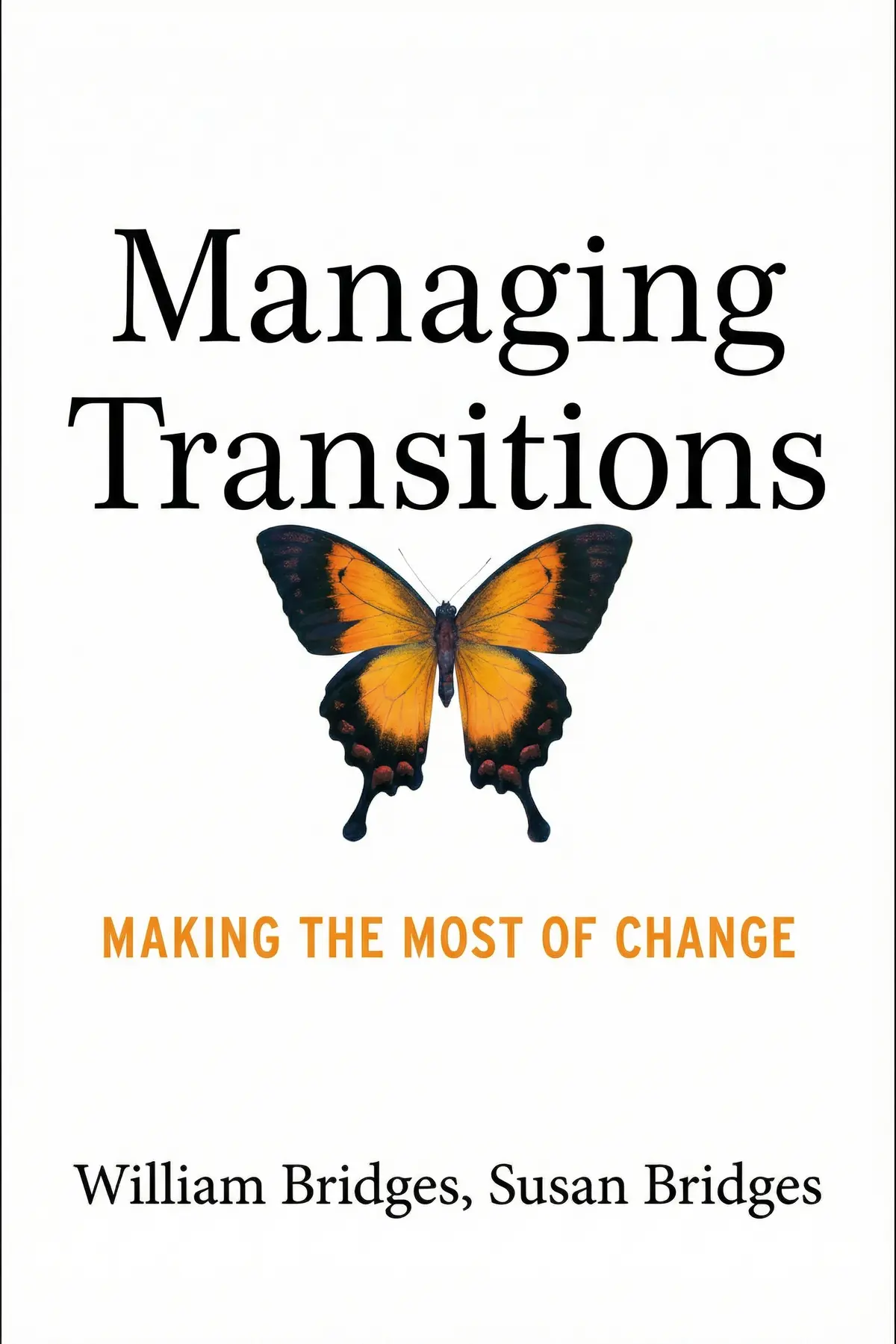
Managing Transitions explores the critical distinction between external change and internal transition. While change is situational—a new boss, a new policy, or a different office—transition is the psychological process people go through to come to terms with that new reality. Without addressing this human element, even the most logical business strategies often fail. This summary provides a roadmap for leaders to shepherd their organizations through the three key phases of transition: letting go of the past, navigating the confusing neutral zone, and finally launching a new beginning. By understanding the grief, anxiety, and creativity inherent in these stages, you can transform resistance into commitment. The promise of this book is a more resilient organization that doesn't just survive change but uses it as a catalyst for genuine renewal and long-term success.
William Bridges (1933–2013) was an American author, speaker, and organizational consultant who developed the influential Transition Model and wrote Transitions (1980) and Managing Transitions (1991). His widow Susan Bridges serves as president of William Bridges Associates and has co-authored updated editions of his works, including the 25th anniversary edition of Managing Transitions.
William Bridges
Listeners find the book informative and accessible, noting that the included case studies make it essential reading for leaders in business and organizational settings. They value its perspective on supporting people through transitions and the foundational background provided regarding the process of change.
As a director facing a major merger, I found this book to be an essential toolkit for surviving the chaos. Bridges makes a profound distinction between situational change and the psychological transition people actually experience. Most leaders focus on the new org chart, but the authors explain why we must honor the 'Ending' before we can ever hope to reach a 'New Beginning.' The section on the 'Neutral Zone' was particularly eye-opening for me. It gave me a name for that uncomfortable in-between space where productivity usually dips. I appreciated the practical advice on selling the problem rather than just the solution. To be fair, some of the corporate case studies feel a bit dated, but the human psychology described is timeless. If you are leading humans through any kind of upheaval, you simply cannot afford to ignore the emotional roadmap laid out in these pages.
Show moreIs it weird that I found a business book helpful for my divorce and personal life? Bridges and Bridges have created a masterpiece on the human experience of shifting from the known to the unknown. The focus on 'Ending, Losing, Letting Go' resonated with me deeply because it validates the sadness that often accompanies even positive changes. In a professional context, this is a must-read for anyone running a digital transformation. We often think a simple rollout plan is enough, but we forget the psychological realignments that need to happen. The authors remind us to communicate purpose, picture, plan, and part. It’s 70% communication and 30% strategy, a ratio most executives get backwards. This is an insightful, compassionate guide that I’ll be keeping on my desk for years to come.
Show moreFinally, a framework that recognizes humans aren't robots who just 'switch over' to new systems overnight! This book is a goldmine for anyone trying to navigate the chaos of a shifting workplace. The authors emphasize that you can't skip the neutral zone, which is where most innovation actually happens. I’ve recommended this to several colleagues who were struggling with staff morale during a recent restructure. It really changes your perspective on resistance; you stop seeing it as a problem to be crushed and start seeing it as a process to be managed. The case studies are informative, and the checklists at the end of the chapters make the theory easy to apply. If you’re in charge of people, just buy it. It makes the transition beast much easier to tame.
Show moreThe 'Neutral Zone' concept alone makes this worth the price of admission for any organizational leader. I've always struggled with why my staff stayed stuck in the past even after we implemented better systems. Bridges clarifies that change is just a shift in landscape, while transition is the internal process of re-patterning our identities. The writing style is very concise, reminiscent of Patrick Lencioni’s work, which I personally appreciate in a busy work week. I found the advice on creating a Transition Monitoring Team to be incredibly practical for our current digital transformation. My only gripe is that the book can be a bit repetitive, and some of the diagrams feel a little academic for a quick read. Still, it’s a foundational text that provides a much-needed vocabulary for the messy side of business growth.
Show moreAssigned this for a leadership seminar and was pleasantly surprised by how readable it actually was compared to other dry business texts. I expected a bore, but the authors use a lot of illustrative stories that keep the concepts grounded in reality. The distinction between 'change' as a destination and 'transition' as the first derivative of that movement is a brilliant way to look at management. It really highlights why 'change-addicted' leaders can be so dangerous to an organization’s long-term health. Truth is, I started applying the three-phase model to my personal life as well. The idea that you can't have a new beginning without a proper ending is something everyone should hear. I did notice the typos mentioned by other reviewers, which is irritating for a professional publication, but the content remains top-tier for anyone interested in organizational development.
Show moreLook, I’m usually allergic to corporate jargon, but Bridges manages to articulate what I’ve only ever felt on a gut level. He avoids the typical fluff and gets straight into the mechanics of how an organization moves through its lifecycle. The section on 'organizational renewal' was particularly relevant to my current role as a consultant. Understanding where a company sits between 'Dreaming the Dream' and 'Dying' helps you forecast how much time you have before the next major shift. In my experience, the biggest failure of leadership is the inability to let people overreact to change. This book gives you the permission to let that happen. It’s not a perfect book—it feels a bit 1980s and the editing could be tighter—but the framework is sturdy enough to support a lot of weight.
Show moreWhile the psychological insights here are genuinely helpful, the context feels stuck in a 1990s cubicle farm. I read the 3rd edition hoping for something reflective of the modern gig economy and remote work, but it still has a heavy 'old school' factory or government office vibe. The book excels at defining the 'Neutral Zone,' which helped me understand why my team was so stagnant during our recent software rollout. However, I was disappointed by the total lack of diversity in the historical examples and quotes. Every great thinker mentioned seems to be a white male from the previous century. It makes the book feel like a relic of the past, even if the core message about 'letting go' remains relevant today. It’s a solid framework, but it desperately needs a 21st-century makeover that includes international competition and diverse perspectives.
Show moreIf you work in a public sector or non-profit environment, you’ll need to do a fair amount of mental translation while reading this. It is very much centered on a corporate model, focusing on mergers, takeovers, and venture capital. I found myself skimming several sections that just didn't apply to my library setting. That said, the core idea that people react to losses rather than the change itself is a powerful takeaway. It helped me realize that our staff wasn't being 'difficult' about the new schedule; they were mourning their old routines. I just wish the book wasn't so homogenous. The lack of non-white or female voices in the historical quotes is glaring in 2024. It’s a useful tool for your leadership toolbox, but you’ll definitely want to supplement it with more modern, inclusive literature on the topic.
Show moreGreat content, but the proofreading in this edition is honestly abysmal. I found myself distracted by missing words and formatting errors that really shouldn't be there for a book with this many editions. There is a Latin quote about everything needing to be done at once that is missing its verb, which makes it read like a word salad. It’s a shame because the actual advice is quite good. The three-phase model is a simple, elegant way to orient yourself during a transition. I especially liked the advice on parading the past and not denigrating it. People need to feel that their previous work mattered before they can move on to the next thing. It’s a solid 4-star book trapped in a 2-star production. Read it for the wisdom, but be prepared for some irritating typos along the way.
Show moreMy company handed these out like candy during a round of layoffs, and frankly, it felt like a slap in the face. This book is written strictly for the people in power who are making the cuts, not for the employees whose lives are being upended. The authors talk about 'managing the transition,' but that’s cold comfort when you’re worried about your mortgage and healthcare. I tried to find something meaningful in the text, but the cynical tone of my situation made me roll my eyes at the suggestions to 'celebrate the past.' To make matters worse, the proofreading in this edition is surprisingly poor. There are several missing words and a butchered Latin quote that actually makes no sense as written. If you're a manager, you might find some strategy here. If you're an employee being 'transitioned' out of a job, save your time and look for a resume guide instead.
Show more
Joseph A. Maciariello

Deborah Gruenfeld
Mike Michalowicz
Hamilton Helmer

Margaret Heffernan
AUDIO SUMMARY AVAILABLE
Get the key ideas from Managing Transitions by William Bridges, plus 5,000+ more titles in English and Thai.