
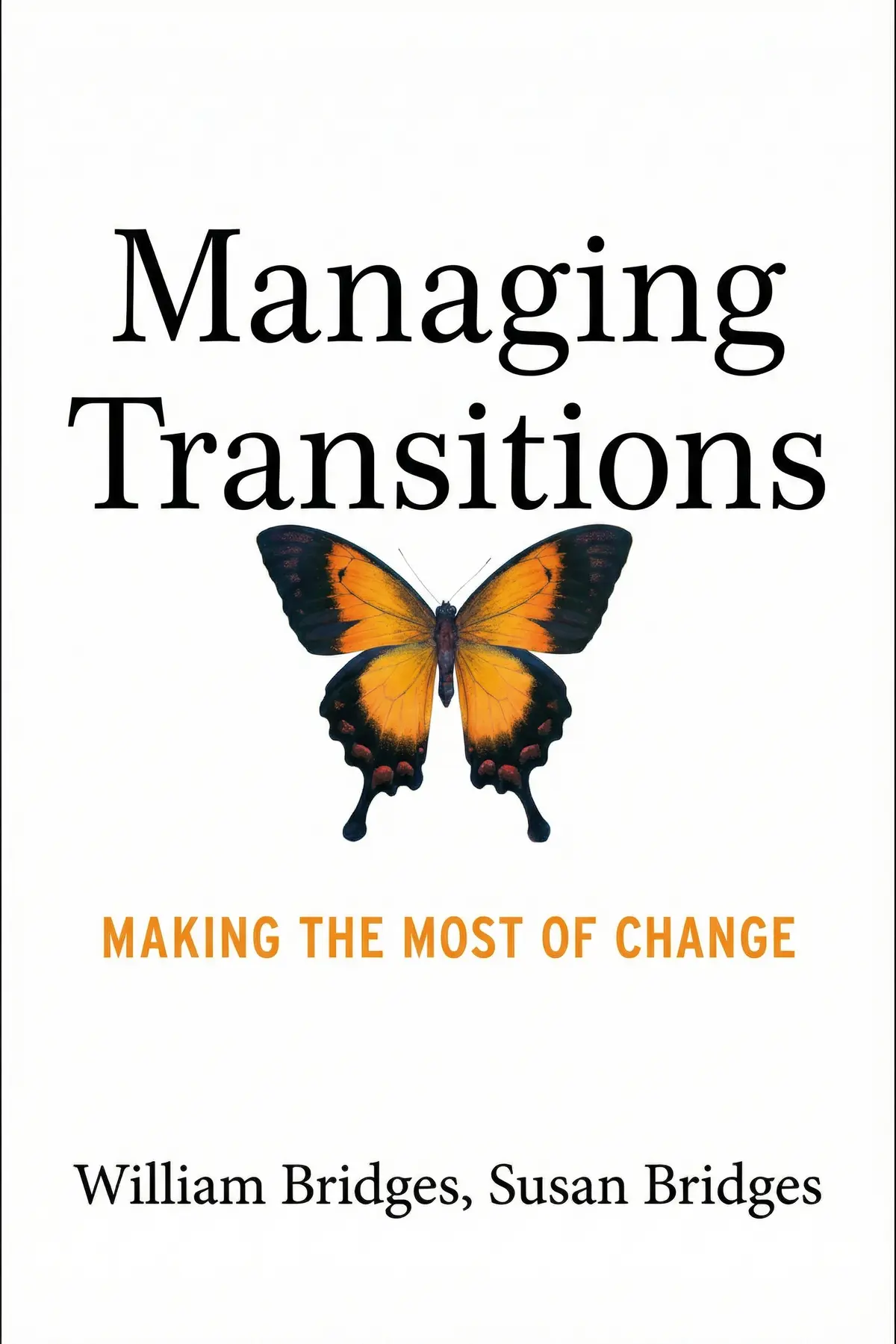
Managing Transitions: Making the Most of Change
William Bridges
Transitions provides a psychological roadmap for navigating life's major shifts. It details a three-stage process—endings, the neutral zone, and new beginnings—to help individuals turn periods of upheaval into opportunities for profound personal growth.
1 min 13 sec
Every life is a series of chapters, and the spaces between those chapters are often the most difficult to navigate. We often talk about change as if it is something that happens overnight—a new job starts, a relationship ends, or a child is born. But while the external event might be sudden, the internal adjustment is almost always a long, winding road. This internal journey is what we call a transition.
In our modern, fast-paced world, we are frequently encouraged to move on as quickly as possible. We are told to keep our heads up, stay busy, and jump right into the next thing. However, this haste often bypasses the very process needed for true growth. If we don’t allow ourselves to fully process the ending of one phase, we carry the baggage of the past into our future.
This exploration will guide you through the three vital stages of any transition: the ending, the neutral zone, and the new beginning. By understanding the purpose of each phase, you can learn to stop fighting against the current of change and start using it as a vehicle for transformation. We will see how honoring the slow process of letting go and sitting with the discomfort of the unknown can lead to a more authentic and purposeful life.
2 min 25 sec
Discover why an external shift in your circumstances is not the same as the internal work of adjusting your identity and mindset.
2 min 31 sec
Explore the multi-layered process of saying goodbye to the past, from symbolic withdrawal to the uncomfortable feeling of being lost.
2 min 33 sec
Understand why the quiet, seemingly unproductive gap between the old and the new is actually a sanctuary for transformation.
2 min 27 sec
Learn to recognize the subtle, internal cues that signal a genuine new beginning and how to move forward with intentionality.
1 min 15 sec
Navigating the transitions of life is not about avoiding change, but about mastering the art of the internal shift. By recognizing the three distinct phases of transition—endings, the neutral zone, and new beginnings—you can transform what feels like chaos into a structured path toward growth.
Remember that every new start is preceded by a necessary end. Don’t be afraid to grieve what you are leaving behind, and don’t be ashamed of the time you spend in the ’empty’ middle. The neutral zone is not a sign of failure; it is a sign of preparation. It is the space where your new self is being formed. When the time is right, your inner intuition will provide the nudge you need to step into your next chapter.
As you move through your own transitions, be patient with yourself. Give yourself the grace to be lost for a while, and the courage to act when the path finally becomes clear. By honoring these natural cycles, you ensure that you don’t just move through life, but that you grow through it, arriving at each new beginning as a more authentic version of yourself.
Life is defined by constant change, yet most of us are ill-equipped to handle the internal shifts that accompany external events. This summary explores the groundbreaking framework developed by William Bridges, which distinguishes between situational change and psychological transition. While a change might happen in an instant, a transition is a slow, three-part process that requires us to let go of the old before we can truly embrace the new. Listeners will discover how to navigate the difficult first stage of any shift: the ending. From there, the guide explores the often-misunderstood 'neutral zone,' a period of apparent emptiness that is actually fertile ground for creativity and self-discovery. Finally, it explains how to recognize and nurture the subtle signs of a genuine new beginning. By understanding these stages, you can stop rushing through life's uncomfortable gaps and start using them to realign your inner self with your outer circumstances. This is an essential guide for anyone facing career changes, relationship shifts, or the natural milestones of aging.
William Bridges was a pioneering figure in the field of transitional psychology. He worked as an English professor until the mid-1970s when his interest in change and transition was piqued. After that, he worked in transitional management, as a consultant and workshop leader, supporting people and corporations through phases of transition.
William Bridges
Listeners find the guide highly applicable and simple to digest, offering deep perspectives. They also value the encouraging material, with one listener noting it is excellent for coping with life changes. Additionally, the approach to life's turning points is well-regarded, with one review emphasizing how it helps people think through various life changes.
Finally got around to reading this classic after years of hearing it mentioned in career coaching circles. Bridges manages to articulate that weird, floaty feeling between leaving a job and starting something new—what he calls the Neutral Zone. It’s incredibly validating to hear that being 'rudderless' isn't just okay, it's actually a necessary part of the psychological reorientation we all need. While some might find the prose a bit dated, the core three-phase model of Endings, the Neutral Zone, and New Beginnings provides a solid framework for anyone feeling stuck. I especially loved the reminder to be patient with the process because you can't rush the internal work. If you're currently in the middle of a big life shift, this is essential reading.
Show moreWow. This book found me at exactly the right moment as I’m navigating a divorce and a move across the country. I spent so much time trying to rush into a 'New Beginning' that I never gave myself permission to sit in the 'Endings' phase properly. Bridges writes with a calm, fatherly tone that makes you feel like it’s perfectly normal to feel confused and lost during major milestones. The book is easy to read and offers a psychological roadmap that I didn't even know I was missing. It’s not just about the big stuff like job loss; it’s about the subtle identity shifts that happen underneath. I’ve already recommended it to three friends who are also feeling a bit stuck in their own lives.
Show moreThe chapter on the myth of Psyche and Amor was the highlight of the book for me, illustrating the trials of transition in such a poetic way. It’s rare to find a book that blends literary humanities with practical psychological advice so seamlessly. Bridges reminds us that being in the 'Neutral Zone'—that time of feeling aimless and pointless—is where the real growth happens. I’ve read a lot of self-help, and most of it is about taking immediate action, but this book encourages the opposite: pausing and reflecting. It’s a gentle, wise companion for those of us who are tired of being told to just 'get over it' and move on. Truly an excellent resource for coping with the messiness of life.
Show moreTruth is, I think every adult should have a copy of this on their shelf for the inevitable moments when life flips upside down. It’s an internationally known classic for a reason—Bridges understands the human heart’s resistance to change better than most. The book is packed with great insights that help you navigate the psychological reorientation required to come to terms with a new reality. I found the section on 'New Beginnings' particularly motivational, as it helps you identify when you're actually ready to move forward. It’s simple, easy to read, and deeply profound if you’re willing to do the work. This book definitely helped me find my footing when I felt like I was losing my way.
Show moreAs someone who was recently assigned this by a manager during a corporate merger, I was initially skeptical of another corporate self-help book. However, the story of Eleanor Roosevelt’s personal transformation really struck a chord with me and gave the abstract concepts some much-needed humanity. The book distinguishes between 'change' (the external event) and 'transition' (the internal shift), which is a distinction most of us overlook. I found the practical advice on navigating the messy middle ground to be surprisingly grounded and easy to apply to my current team dynamics. My only gripe is the slightly awkward grouping of 'traditional cultures' which felt a bit generalized and out of touch. Overall, it’s a motivational guide that helps you think through the layers of your life changes.
Show moreEver wonder why you feel so miserable even when a 'good' change happens, like getting a promotion or having a baby? Bridges explains this through his three-stage model, emphasizing that every beginning starts with an ending. I found the analytical breakdown of the transition process to be very practical for my own self-reflection. It’s less of a 'rah-rah' motivational book and more of a quiet, scholarly look at how the human psyche adapts to new environments. I did find the pacing to be a bit sluggish in the middle chapters, but the epilogue really tied everything together beautifully. It’s a solid 4-star read for anyone who wants a deeper understanding of their own emotional reactions to life's inevitable shifts.
Show morePicked this up during a cross-country move when everything in my life felt like it was up in the air. Bridges does a great job of breaking down why we feel so rudderless when our environment changes, even if we chose that change ourselves. The book is practical and offers a clear way to categorize the different feelings that come with job loss or shifting relationships. I appreciated the insight that you can't have a new beginning until you've truly processed the ending. It’s a very grounding read that helped me lower my expectations for how fast I should be 'settled' in my new life. A very helpful tool for thinking through the stages of any major life transition.
Show moreTo be fair, there is some genuine wisdom buried in these pages, but the delivery is often quite dry and repetitive. I appreciate the author's focus on the psychological side of change rather than just the logistical steps, yet I felt he could have made his point in half the time. By the middle of the book, it felt like the same concepts were being recycled over and over again without adding much new meat to the bone. That said, the section on 'Endings' helped me identify exactly what I was grieving in my own career transition. It’s a helpful resource if you’re willing to skim through the slower parts to find the nuggets of gold. Not the most exciting read, but it serves its purpose.
Show moreFrankly, the content here is valuable, but the writing style is so bland that it’s hard to stay engaged for long periods. I agree with other reviewers that the prologue and epilogue cover about 80% of what you actually need to know. There is a lot of talk about 'traditional cultures' that feels a bit dated and lacks nuance, which took me out of the experience several times. However, the core message about the necessity of the 'neutral zone' is something I haven't seen addressed elsewhere, and for that alone, it’s worth a look. If you are in the middle of a massive change, you might find more value in it than I did while things are stable. It’s a decent book, just not a page-turner.
Show moreNot what I expected based on the rave reviews, and I found the experience more stressful than helpful. Perhaps I should have opted for a physical copy to annotate, because listening to the audiobook felt like a lot of words without much substance. Instead of feeling comforted, I found my anxiety actually increased as the author delved into the disorientation of the neutral zone. It felt like I was being told to sit in my depression rather than being given active steps to climb out of it. While I recognize the author is an expert, this particular style of self-reflection just didn't resonate with my current mental state. If you're already feeling fragile, be careful with this one as it can be quite heavy.
Show more
Richard Wiseman
William B. Irvine
Andrew D. Thompson
AUDIO SUMMARY AVAILABLE
Get the key ideas from Transitions by William Bridges, plus 5,000+ more titles in English and Thai.







