
24 min 14 sec
Messengers: Who We Listen To, Who We Don't, and Why
Messengers explores the hidden psychological factors that determine why we listen to some people and ignore others, focusing on how status, competence, and social connection override the actual content of a message.
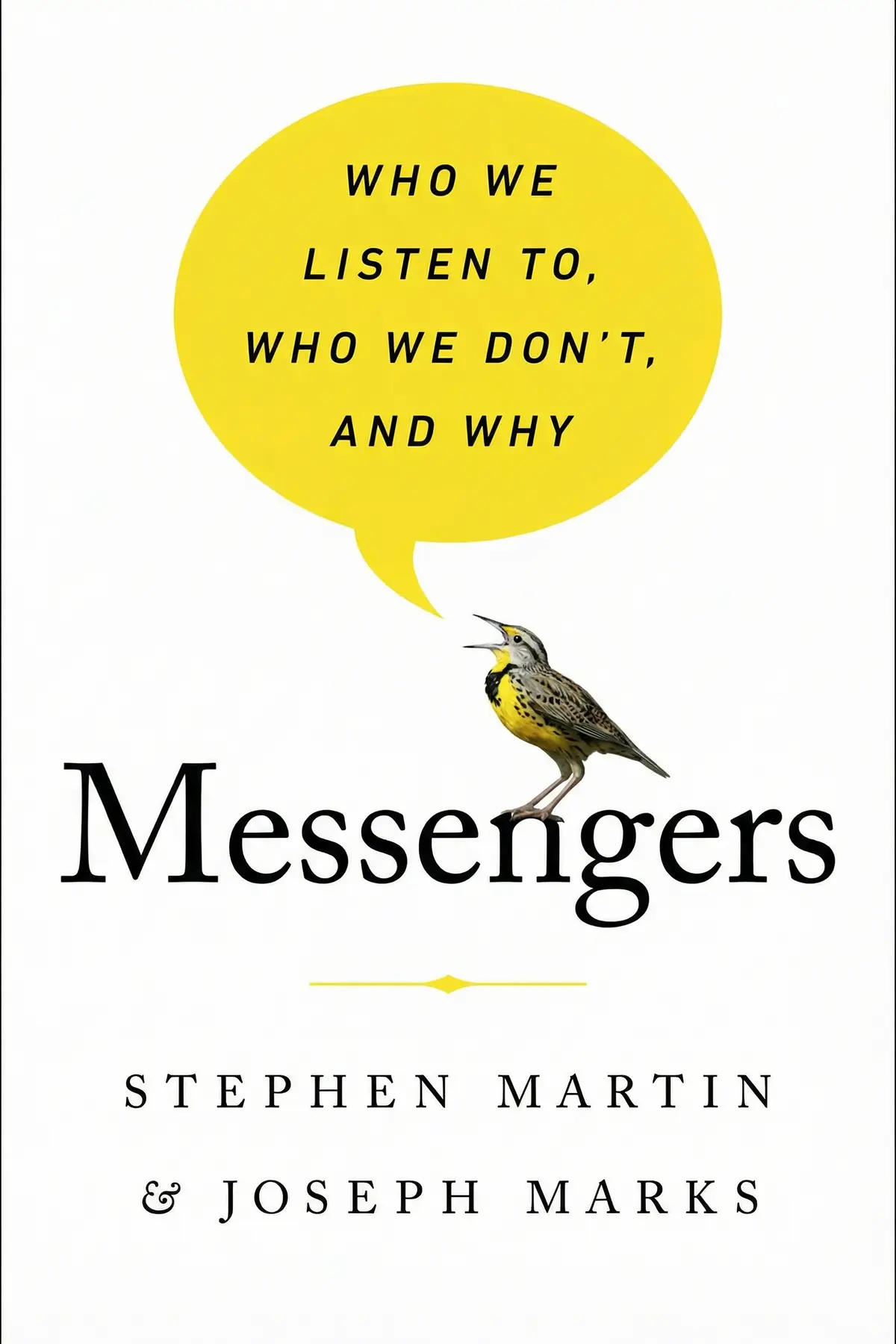
Table of Content
1. Introduction
2 min 04 sec
Think back to the year 2018. The global superstar Taylor Swift, known more for her chart-topping melodies than her political activism, decided to break her long-standing silence on public policy. With a single post to her massive Instagram following, she endorsed two Democratic candidates. The result was staggering: within just two days, over two hundred thousand people registered to vote. This sudden surge in civic engagement wasn’t sparked by a policy white paper or a televised debate. It was sparked by a musician. On the surface, it seems almost illogical. Why should a talent for songwriting make someone a credible guide for electoral choices?
This phenomenon is the heart of our exploration today. In a world overflowing with information, our brains have developed a series of rapid-fire filters. We often don’t have the time or the cognitive energy to dissect every argument we hear. Instead, we look at the person speaking. We look at their clothes, their face, their status, and their social standing. We make a snap judgment about the messenger, and if that person passes our internal test, we accept their message as if it were gospel.
In this journey through the psychology of human communication, we are going to look at why the person behind the podium often matters far more than the words they are saying. We will see how our evolutionary past has wired us to respond to certain cues—like dominance, attractiveness, and warmth—and how these cues can lead us toward wise decisions or, occasionally, into absurd errors. From the corridors of power in Washington to the simple interactions of a hair salon in Zimbabwe, the rules of influence are always at play. By the end of this summary, you’ll understand the secret mechanics of persuasion and learn how to navigate a world where who is talking is often the only thing people hear. We’re going to dive deep into the two main categories of messengers: those who command our respect through power and those who earn our trust through connection. Let’s begin by looking at how our minds make these lightning-fast assessments before we even realize we’ve done it.
2. Snap Judgments and the Power of the Delivery
2 min 35 sec
Discover why a best-selling journalist was more influential than the investor who actually predicted the 2008 financial crisis, and learn how quickly our brains judge a person’s character.
3. Socioeconomic Status and the Rule of Deference
2 min 13 sec
Explore how the car you drive or the clothes you wear can change how others treat you, and why we are culturally conditioned to respect the wealthy.
4. The Illusion of Competence and Authority
2 min 08 sec
Learn how simple symbols like stethoscopes or the shape of a face can trick our brains into perceiving authority, sometimes with disastrous results.
5. The Primal Pull of Dominance
2 min 24 sec
From the height of the US Senate to the world of dating apps, find out how assertive body language and a deep voice can signal power and command attention.
6. The Unfair Advantage of Attractiveness
2 min 23 sec
Explore why good-looking people are more likely to get hired and less likely to be convicted of crimes, and how our brains associate beauty with goodness.
7. Connection and the Power of Shared Identity
2 min 16 sec
Discover why we are more likely to trust people who share our birthday or our background, and how a hair-braiding program in Zimbabwe saved lives.
8. The Impact of Warmth and Benevolence
2 min 10 sec
Find out how being rude cost an oil company billions of dollars, and why a simple ‘stay safe’ can increase productivity and save lives.
9. Vulnerability as a Path to Relatability
1 min 56 sec
Why revealing your flaws can actually make you more influential, and how a movie about a talking pig changed the eating habits of a nation.
10. Trustworthiness and the Power of Consistency
2 min 12 sec
Learn the difference between being ‘right’ and being ‘reliable,’ and why we stay loyal to messengers who stick to their guns, even when they’re wrong.
11. Conclusion
1 min 53 sec
As we wrap up our exploration of Messengers, the overarching lesson is clear: we are far less rational than we like to believe. In a world of complex data and endless choices, our brains have opted for efficiency over accuracy. We use status, competence, dominance, and attractiveness as markers for whom to follow. We use connection, warmth, vulnerability, and trust as reasons to listen. These ‘hard’ and ‘soft’ traits are the invisible forces that shape our society, from the leaders we elect to the products we buy.
But understanding these forces gives you a dual advantage. First, it makes you a more self-aware consumer of information. The next time you feel a surge of confidence in a speaker, ask yourself: am I listening to the message, or am I just dazzled by the suit? Am I believing this because it’s true, or because the person saying it has a deep, resonant voice? By recognizing these shortcuts, you can start to peel back the layers of delivery to find the substance underneath.
Second, this knowledge gives you the tools to be a more powerful communicator yourself. You don’t need a million dollars or a perfect face to be an effective messenger. You can build influence by being consistent, by showing genuine warmth, and by finding common ground with those you wish to reach. You can command respect by projecting competence and reliability.
In the end, the most effective messengers are those who understand the balance between the ‘hard’ and the ‘soft.’ They know when to be the authority and when to be the friend. They recognize that while the message is the goal, the messenger is the key that unlocks the door. As you go forward, remember that your voice is about more than just your words—it’s about the person you choose to be in every interaction. Use that power wisely, and you will find that the world is ready to listen.
About this book
What is this book about?
Have you ever wondered why a celebrity's political opinion can move thousands of people, even when that celebrity has no background in policy? Or why we might follow a stranger across a busy street just because they are wearing a well-tailored suit? Messengers pulls back the curtain on the subtle, often irrational forces that dictate human influence. The book reveals that we don't just process information based on facts or logic. Instead, our brains use ancient shortcuts to evaluate the person delivering the news. Authors Stephen Martin and Joseph Marks categorize these influencers into two groups: hard messengers, who rely on status and dominance, and soft messengers, who win us over through warmth and vulnerability. By understanding these dynamics, the book promises to help you become a more effective communicator while teaching you how to look past the delivery to see the truth of the message itself.
Book Information
About the Author
Stephen Martin
Stephen Martin is the CEO of Influence at Work and directs an executive education program in behavioral science at Columbia University. He is a prolific author known for the bestseller Yes! 50 Secrets from the Science of Persuasion. Joseph Marks is an experimental psychology researcher at University College London whose work has appeared in major outlets like the New York Times and The Guardian.
Ratings & Reviews
Ratings at a glance
What people think
Listeners find that this work offers a stimulating exploration of behavioral psychology, even if some feel the depth of analysis is occasionally surface-level or relies too much on anecdotes. Nevertheless, many value the perceptive categorization of "hard" and "soft" messengers along with the examination of how qualities such as warmth, competence, and status shape our perceptions. Furthermore, the evidence-based writing provides actionable strategies for enhancing personal communication; one listener specifically points out that it gives useful guidance on utilizing body language and vocal tone to connect with others more effectively. They also remark that the book is quite revelatory, clearly clarifying why the individual conveying information is frequently prioritized over the actual content of the message.
Top reviews
Methinee
This book is a complete game-changer for anyone working in communications, marketing, or even just trying to be heard in a crowded office environment. The distinction between hard powers like dominance and soft powers like trustworthiness is explained with such clarity that it’s hard to put down. Not gonna lie, I started adjusting my own tone of voice and body language after finishing the chapter on charisma. The authors use a brilliant mix of historical examples, like Churchill’s leadership style, and modern data points to show how we are instinctively wired to respond to certain cues. It explains so much about our current political climate and why misinformation spreads so easily when delivered by a 'favored' messenger. It is an essential companion to books like 'The Status Game.' I’ll definitely be coming back to this one for a second read to really internalize the research on vulnerability.
Show morePatcharaporn
Wow, the chapter on 'vulnerability' really changed my perspective on how to lead my team at work. I always thought showing any sign of weakness was a negative, but Martin and Marks prove that when combined with competence, it actually makes you a more persuasive messenger. This book is packed with these kinds of counter-intuitive findings. The research-backed text offers practical advice that you can apply immediately, from adjusting your posture to understanding the tribal nature of how we connect with others. It's one of those rare non-fiction books that answers a question you didn't even know you were asking. Why do we ignore the truth when it's told by someone we dislike? Why does a low-pitched voice command so much respect? It’s all here. This is easily one of the most underrated books on human behavior I’ve encountered recently.
Show morePracha
Finally got around to reading this, and I’m already planning a second pass to take more detailed notes on the 'soft power' section. This book is much more than a guide on how to be a better communicator; it’s a mirror held up to our own biases. The way it explains our susceptibility to certain 'messengers' regardless of fact or fiction is both brilliant and terrifying. I loved the specific research on how doctors who are perceived as warm get sued less—it’s such a tangible example of these theories in action. Whether you’re a content creator, a leader, or just someone curious about human behavior, you need to read this. It sheds new light on the 'why' behind our social connections and tribal loyalties. It’s definitely a recommended read that I'll be gifting to friends this year.
Show moreWoravit
Ever wonder why we're so easily swayed by a confident speaker, even when they're talking absolute nonsense? Messengers provides a compelling dive into the behavioral psychology behind why the 'who' often trumps the 'what' in our daily interactions. The authors split the concept into hard and soft messengers, which I found to be a really helpful framework for understanding influence. Frankly, it’s a bit scary to realize how much we prioritize traits like height, socio-economic status, or even just a square jawline over actual data. While some of the research felt familiar if you've read a lot of Gladwell, the specific focus on 'soft' traits like vulnerability and warmth offered fresh insights. It’s a well-organized read that makes you second-guess your own instincts. I especially appreciated the sections on how we perceive competence based on physical appearance—it’s a wake-up call for anyone who thinks they are a purely rational decision-maker.
Show moreNing
After hearing a podcast interview with the authors, I picked this up to better understand why certain public figures command such intense loyalty despite contradictory facts. Messengers really delivered on that front. The breakdown of how we rapidly assess someone's socio-economic position and dominance within seconds of meeting them is eye-opening. Personally, I found the research on 'soft' messengers the most useful; it’s heartening to know that warmth and consistency can sometimes overcome the raw power of status. The book is deftly packaged and moves at a brisk pace, though I do agree with other reviewers that it can feel a bit light in the middle sections. Still, the insights into how we are manipulated by artful messengers are well worth the price of admission. It's a necessary manual for navigating our misinformation-heavy world.
Show morePang
Look, we all like to think we're rational beings who make decisions based on facts, but this book exposes that lie pretty effectively. The authors walk us through the many ways we are influenced by the messenger's warmth, charisma, and even their clothes. It’s a very timely read given how much we rely on influencers and 'experts' online these days. I found the section on how we respond to 'dominant' messengers particularly relevant to current events. The writing is clear and the examples are engaging, making complex psychological concepts easy to digest for a casual reader. My only minor gripe is that some of the sections on socio-economic status felt a bit drawn out. Overall, it’s an insightful and well-written book that effectively explains why we often value the person more than the message itself.
Show morePor
To be fair, I expected a bit more meat on the bones of this one given the academic credentials of the authors. The central thesis—that we judge the messenger before the message—is undeniably true and well-supported here, but the execution felt a bit anecdotal at times. It works perfectly as a light introduction to behavioral science, but if you’re looking for a deep, technical dive, you might find it a little superficial. I did enjoy the practical tips on how to project warmth and the importance of posture, though. It’s the kind of book that’s great for a long flight; it keeps you engaged with interesting stories about why certain leaders succeed and others fail, even if it repeats itself occasionally. It’s a solid 3.5 stars for me, primarily because it's so readable, despite the lack of groundbreaking new theories.
Show moreAva
The central premise—that the person delivering the message matters more than the content itself—is fascinating, but I found the pacing a bit uneven. At points, the book feels like a collection of interesting trivia rather than a cohesive reference work. Truth is, while I enjoyed learning about why we trust doctors more when they show warmth, or how babies react to attractive faces, the 'hard messenger' section felt a little repetitive. The authors do a great job of highlighting how we suspend rational thinking when faced with a high-status influencer, which is a vital lesson for today’s world. However, I wish there was more focus on how to combat these biases rather than just identifying them. It’s an insightful read for a general audience, but experienced students of psychology might find themselves skimming the more basic chapters.
Show moreNarut
Messengers offers a solid breakdown of why we listen to some people and ignore others, though it reads a bit like a textbook in the middle chapters. The authors are clearly experts, and they provide a ton of data points to support their claims about status, competence, and attractiveness. In my experience, the most interesting parts were about how we are fundamentally 'corrupted' by our instincts, like favoring attractive criminals or trusting people just because they share our birthday. It’s a bit cynical at times, but probably realistic. I think the book would have benefited from fewer anecdotes and more synthesis of the actual science. It’s a good book with simple points that are worth knowing, but I’m not sure it has much re-read value once you’ve grasped the main 'hard vs. soft' concept.
Show moreVilaiporn
Disappointingly, I felt like I had heard most of these stories before in other behavioral economics bestsellers. While the writing style is accessible and the organization is clear, it didn't offer the 'deep dive' I was hoping for after seeing the initial praise. Much of the research quoted, like the stuff on facial symmetry and dominance, feels like recycled material from older studies. I also found the tone a bit too 'business-lite' for my taste. Look, if you’ve never read a book on social influence, this is a fine place to start. But if you’re already familiar with the basics of how charisma and status work, there isn't much here that will surprise you. It’s informative in a very general sense, but it lacks the analytical depth required to be a truly transformative text.
Show moreFeatured in
Readers also enjoyed


59 Seconds: Change Your Life in Under a Minute
Richard Wiseman


A Liberated Mind: How to Pivot Toward What Matters
Steven C. Hayes

AUDIO SUMMARY AVAILABLE
Listen to Messengers in 15 minutes
Get the key ideas from Messengers by Stephen Martin, plus 5,000+ more titles in English and Thai.
- 5,000+ titles
- Listen as much as you want
- 7-day free trial
- Cancel anytime







