
12 min 31 sec
Metropolis: A History of the City, Humankind's Greatest Invention
By Ben Wilson
Explore the seven-thousand-year evolution of the city, from ancient Mesopotamia to modern megacities, revealing how urban life drives human innovation while presenting our greatest social and environmental challenges.
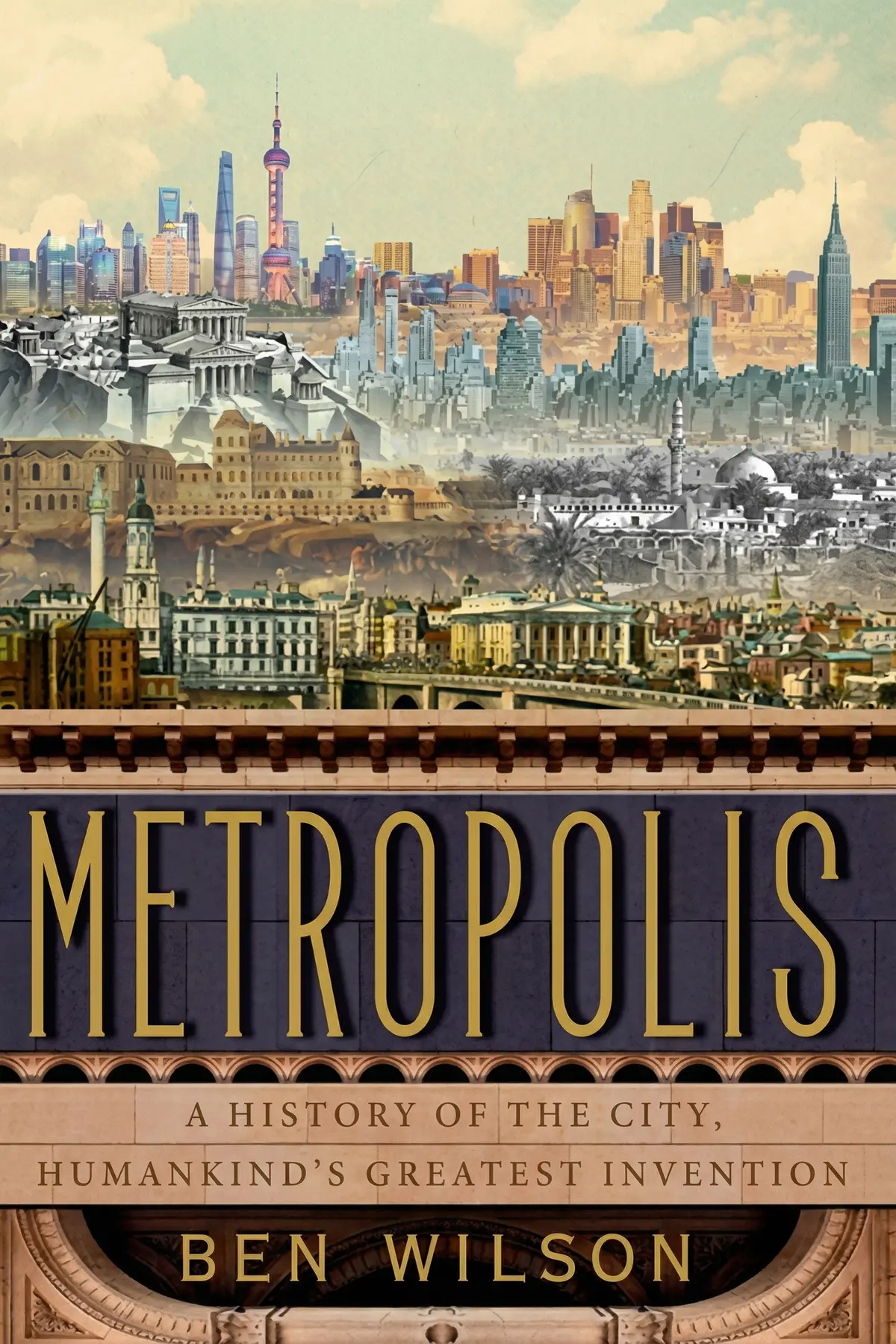
Table of Content
1. Introduction
1 min 23 sec
Have you ever paused to consider the sheer complexity of the city around you? Whether you live in a bustling metropolis or a quiet suburb, the urban environment is arguably the most successful and enduring invention of the human species. For over seven millennia, we have been conducting a grand experiment in how to live together in close quarters. This experiment began in the muddy floodplains of the ancient world and has now reached a point where more than half of the global population resides in an urban setting.
In this exploration of our urban history, we are going to look at the city not just as a collection of buildings and roads, but as a living, breathing laboratory. We will see how these concentrated hubs of humanity have acted as engines for everything from the invention of writing to the birth of modern capitalism and radical politics. But as we will discover, this progress has always come with a shadow. The story of the city is also a story of struggle—against disease, against inequality, and against the sheer chaos of overcrowding. By looking back at the triumphs and the disasters of past urban centers, we can start to see a blueprint for our own future. As we face the challenges of a warming planet and a shifting global population, the lessons hidden in the streets of the past have never been more relevant. Let’s begin our journey by looking at the fundamental power of the city and how it manages to survive even the most dire circumstances.
2. The City as a Crucible of Change
2 min 18 sec
Discover why urban centers act as the ultimate catalysts for human progress, transforming a small percentage of the population into a global force for invention and cultural evolution.
3. The Legacy of the First Metropolis
2 min 37 sec
Journey back to the marshlands of ancient Mesopotamia to witness the birth of Uruk, the world’s first true city, where monumental success met its first human costs.
4. Industrial Shocks and Social Rebirth
2 min 32 sec
Witness the terrifying rise of nineteenth-century industrial cities and the surprising way their inhabitants turned squalor into centers of community and radical change.
5. The Organic Future of the Megacity
2 min 23 sec
Look toward the horizon of the twenty-first century through the lens of Lagos, where the future of urban life is being written in the chaos of informal networks.
6. Conclusion
1 min 18 sec
The history of the metropolis is, in many ways, the history of humanity itself. From the moment the first mud bricks were laid in Uruk to the digital hum of modern-day Lagos, cities have been the stages upon which our greatest dramas have played out. They have given us the tools of civilization—writing, law, and science—and they have challenged us with our deepest social failings—inequality, squalor, and conflict.
As we move deeper into an era defined by rapid change and environmental uncertainty, the city remains our best hope. The throughline of this seven-thousand-year journey is clear: the city’s true power lies in its people and their ability to innovate through proximity. We have seen that cities are not just piles of stone and steel, but dynamic human ecosystems that can be reshaped to meet the needs of the time.
The lesson for us today is to embrace that urban dynamism. We must balance the need for organized planning with a respect for the grassroots creativity that makes city life so resilient. By fostering inclusive, adaptable, and green urban environments, we can ensure that the metropolis continues to be a forge for progress rather than a monument to division. The experiment of the city is far from over; in fact, its most important chapters may still be waiting to be written by us.
About this book
What is this book about?
Metropolis offers a sweeping historical narrative that frames the city as humanity’s most significant and influential invention. It takes listeners on a journey through time, starting with the very first urban settlements in the marshlands of ancient Iraq and moving through the industrial powerhouses of the nineteenth century to the sprawling, high-tech megacities of the modern era. The book examines the dual nature of urban existence: how density and diversity spark the fires of creativity, trade, and political radicalism, while simultaneously creating environments rife with inequality, disease, and social tension. By analyzing specific urban centers like Uruk, Manchester, Chicago, and Lagos, the book promises to reveal the underlying patterns of human civilization. It illustrates how cities function as laboratories for social and technological experiments that eventually reshape the entire world. Ultimately, it provides a framework for understanding our current urbanized reality and offers insights into how we might build more resilient, sustainable, and inclusive cities for a future dominated by climate change and mass migration.
Book Information
About the Author
Ben Wilson
Ben Wilson is an acclaimed historian who earned both his undergraduate and master’s degrees in history from the University of Cambridge. He has authored five books, including the Sunday Times best seller Empire of the Deep. Wilson’s historical insights have reached a broad audience through his contributions to major publications such as the Spectator, the Guardian, and GQ.
Ratings & Reviews
Ratings at a glance
What people think
Listeners find this an approachable and deeply researched title that delivers a thorough examination of human development through the ages. The audiobook also wins acclaim for its immersive chapters and urban-focused themes, as one listener points out its significance for contemporary and aspiring urban planners. On the other hand, the prose and ethical viewpoints draw a range of different responses from listeners.
Top reviews
Yaowaluk
Wilson manages to capture the frantic, pulsating energy of urban life in a way that few historians can. This book isn't just a dry timeline; it treats the city as a living organism that breathes, grows, and occasionally decays. I was particularly struck by the transition from the ancient streets of Uruk to the sprawling complexity of modern-day Lagos. The author’s unashamed enthusiasm for the 'greatest invention' of humankind shines through every page, making even the more technical aspects of urban planning feel vital. While some might find the thematic jumps a bit jarring, I loved the way he linked the coffee houses of London to the birth of global finance. It's an immersive, panoramic journey that made me look at my own neighborhood with entirely new eyes. If you’ve ever felt the magnetic pull of a metropolitan skyline, you need to read this.
Show morePornpimon
Ever wonder how the layout of a street or the availability of public water shaped your ancestors' lives? Metropolis answers these questions with an incredible amount of verve and fascinating anecdotes. I was particularly fascinated by the section on how migration and multiculturalism aren't just modern symptoms but have been the lifeblood of cities since the very beginning. The way Wilson connects the dots between ancient Harappa and the future 'smart cities' is masterful. It’s not just a book for history buffs; it’s a necessary text for anyone interested in sociology or urban design. The writing style is engaging and accessible, avoiding the dense jargon that often plagues this genre. I finished this feeling enlightened and genuinely excited about the future of our urban spaces, despite the challenges of climate change and overpopulation mentioned in the final chapters.
Show moreTum
The chapter on Rome’s public baths was so vivid I could almost smell the steam and the oils. Metropolis is a rare kind of history book that manages to be both intellectually rigorous and genuinely entertaining. I loved the focus on the 'working class schmoes' and how their daily needs for clean water and street food drove innovation just as much as the whims of emperors. Wilson captures the 'city as an organism' theme perfectly, showing how even the most planned cities eventually give way to the spontaneous impulses of their residents. It’s a brilliant reminder that cities are built by people, not just bricks and mortar. Whether he's discussing the coffee shops of Lisbon or the skyscrapers of Chicago, the author’s passion is infectious. This is a must-read for any urban dweller who wants to understand the historical DNA of their environment.
Show moreMingkwan
Wow, what an expansive and thought-provoking journey through human civilization. I was captivated by the idea that cities are clusters of knowledge and innovation that have driven every major leap in our history. Wilson’s writing is lively and packed with the kind of 'did you know' facts that make you want to interrupt whoever is in the room to share them. I particularly appreciated the final section on Lagos and the future of the 'megacity.' It’s easy to be cynical about urban sprawl, but Wilson finds the potential for robustness and vitality even in the most chaotic environments. The book is a celebration of human resilience and our innate desire to connect with one another in close quarters. It’s a thick read, but the short, thematic sections make it easy to digest in chunks. Highly recommended for fans of Sapiens or Prisoners of Geography.
Show moreDylan
As a lifelong urbanite, I found Wilson's exploration of city life deeply resonant and surprisingly thorough. The book excels when it dives into the specific cultural 'vibes' of places like Baghdad during its golden age of gastroculture and trade. Frankly, I learned more about the evolution of the public sphere from his chapter on Roman baths than I did in four years of college history. There are a few moments where the pacing slows down—Wilson does have a tendency to linger on certain details, like the minutiae of 19th-century Manchester, for perhaps a few pages too long. I also noticed some old-fashioned terminology like 'Dark Ages' that felt a bit out of step with modern scholarship. However, the sheer breadth of the research is staggering. It’s a lively, informative read that effectively argues why the city remains the center of the human experience.
Show moreSomrutai
Picked this up on a whim after seeing it mentioned in a review, and I’m mostly glad I did. The chapters are organized thematically—sex in Babylon, politics in Athens, skyscrapers in New York—which keeps the vast timeline from feeling overwhelming. Wilson has a gift for picking out the 'scintillating fact' that brings a dead city back to life. However, I agree with some critics that he airbrushes over the darker side of these 'miracles.' For example, the exclusion of women in Athenian democracy is barely a footnote. There’s also a distinct lack of focus on Tokyo and Edo, which seems like a massive oversight for a history of cities. Despite these flaws, the book provides a comprehensive and generally easy-to-read look at how our environment shapes our behavior. It’s well worth the time for the chapters on the Industrial Revolution and the rise of the suburbs alone.
Show morePla
Finally finished this massive tome and I’m impressed by the scope, even if the execution is a bit messy. Wilson’s 'organized digressions' are a double-edged sword; while they provide interesting context on things like lidos and pleasure gardens, they often distract from the main historical progression. Look, if you want a linear, academic history of urban planning, this might irritate you. But if you enjoy a more conversational, anecdotal style that jumps across time to prove a point, you’ll love it. The chapter on Los Angeles and the birth of the sprawl was a highlight for me, as it explained the psychological shift toward suburban living so clearly. It’s a book with its heart on its sleeve, clearly written by someone who loves the chaos of the streets. A solid four stars for the sheer amount of information and the lively, often beautiful prose.
Show moreKoi
Not what I expected, but in a good way! I thought this would be a dry architectural history, but it’s actually more about the sociology of urban life. Wilson covers everything from organized crime to male fashion in 18th-century London, which keeps the narrative feeling fresh and unpredictable. My only real gripe is that the book leans heavily on the Mediterranean and Western worlds. I would have loved more on the civil engineering miracles of the PRC or the ancient cities of the Americas. Still, for a Western-framed history, it’s exceptionally well-done. The author’s enthusiasm is the real engine here; he makes you feel the 'sensual pleasure' and the 'source of joy' that a well-functioning city can provide. It's a comprehensive look at where we've been and where we're going as a species. Definitely worth a spot on your shelf if you're interested in how we've shaped our world.
Show moreSavannah
In my experience reading global histories, the author's perspective usually dictates whether the book succeeds or fails. Here, Wilson’s perspective is unapologetically pro-city, which is fine, but it leads to a lack of balance. He glosses over the 'misery and degradation' that Tocqueville famously observed in Manchester, focusing instead on the energy and creativity. The truth is, the book is about 150 pages too long. The repetition in the first few chapters regarding social stratification and egalitarianism becomes tedious quite quickly. I also found the treatment of Japanese bath culture within a Roman context to be a bit lazy—it felt like it was shoehorned in without real understanding. It’s a decent enough book if you want a surface-level survey of many different cities, but it lacks the critical depth I was hoping for. Interesting facts, but a bit of a hot mess structurally.
Show moreValentina
This could have been an incredible collection of essays, but as a 400-page book, it is far too repetitive. I felt like I was reading the same chapter over and over again, specifically regarding the obsession with public baths. We get baths in Harappa, then more in Greece, and then twenty more pages on baths in Rome. It’s overkill. By the time I reached the middle, the lack of a strong, central narrative arc made the experience feel like a slog through a very long encyclopedia. To be fair, Wilson's research is deep, but his editor should have pushed for a much tighter structure. The book also feels heavily skewed toward the Western tradition, almost ignoring the massive scale of Soviet and Chinese urbanization except for some passing dismissals. It’s a frustrating read that masks a few gems of insight under mountains of redundant detail and a somewhat narrow worldview.
Show moreReaders also enjoyed
Alexander the Great
Philip Freeman
A History of Iran: Empire of the Mind
Michael Axworthy
A History of the World in 6 Glasses
Tom Standage

A Long Way Gone: Memoirs of a Boy Soldier
Ishmael Beah
A Splendid Exchange: How Trade Shaped the World
William J. Bernstein
AUDIO SUMMARY AVAILABLE
Listen to Metropolis in 15 minutes
Get the key ideas from Metropolis by Ben Wilson, plus 5,000+ more titles in English and Thai.
- 5,000+ titles
- Listen as much as you want
- 7-day free trial
- Cancel anytime







