
15 min 29 sec
Mindreader: Find Out What People Really Think, What They Really Want, and Who They Really Are
Mindreader explores the psychological undercurrents of human behavior, offering strategies to decode nonverbal cues and linguistic patterns to understand the hidden motivations, insecurities, and self-esteem levels of those around us.
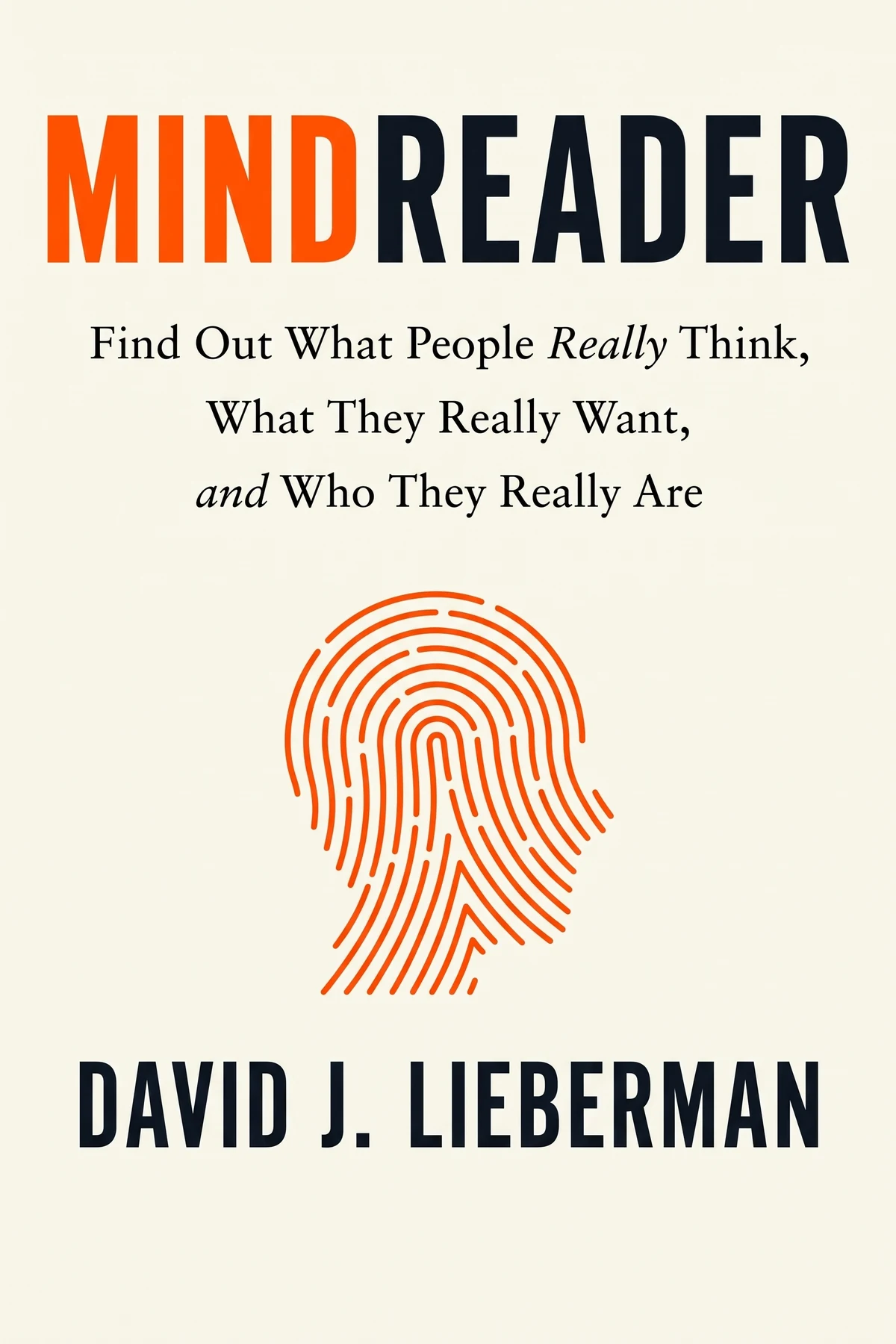
Table of Content
1. Introduction
1 min 28 sec
Imagine being able to step inside the mind of the person sitting across from you. Not just to guess what they are thinking, but to understand the very engine of their personality—the fears, the insecurities, and the hidden motivations that drive every word they say and every move they make. This is the world of high-stakes psychological analysis, and our guide is David J. Lieberman, a man who has spent his career teaching the most elite intelligence agencies in the world how to do exactly that. While many of us look at body language to see if someone is lying, Lieberman suggests we need to go much deeper.
In this exploration of his work, we are going to look at the psychological architecture that defines our interactions. We will discover that the behavior we often find most frustrating in others—their arrogance, their defensiveness, or their need for control—actually stems from a very specific internal struggle. The throughline here is the balance between the ego and self-esteem. By the end of this journey, you won’t just be looking for red flags; you will be developing a profound sense of empathy. You will start to see that the ‘difficult’ people in your life are often individuals in significant emotional pain, and their behaviors are merely defense mechanisms designed to protect a fragile sense of self. Let’s begin by looking at how our own internal states, specifically anxiety, can drastically change how we perceive and interact with the world.
2. The Tunnel Vision of Anxiety
2 min 42 sec
Discover how internal stress and high psychological stakes can unintentionally narrow our focus, turning our attention inward and making us less aware of our surroundings.
3. The Invisible Weight of Low Self-Esteem
2 min 32 sec
Explore the profound difference between situational confidence and core self-esteem, and learn why self-absorption is often a symptom of deep emotional pain.
4. The Pillars of Emotional Resilience
2 min 33 sec
Learn to identify the difference between those who face life’s challenges with balance and those who retreat into ego-driven escapism.
5. Anger as a Shield for Fear
2 min 24 sec
Understand the hidden mechanics of anger and how the ego uses it to provide a false sense of control and protect us from admitting our own vulnerabilities.
6. The Language of the Mind’s Narratives
2 min 36 sec
Learn to listen for the subtle verbal clues—from absolute judgments to narrative styles—that reveal whether a person views their life through a lens of hope or catastrophe.
7. Conclusion
1 min 14 sec
As we wrap up our exploration of David J. Lieberman’s Mindreader, the most important takeaway is that reading people is not about performing a parlor trick or finding a way to ‘win’ every social interaction. Instead, it is about developing a sophisticated lens through which to view the human condition. We have seen how anxiety can narrow a person’s world, how low self-esteem can masquerade as arrogance, and how the stories we tell ourselves determine our resilience.
The next time you encounter someone who is being difficult, defensive, or unkind, try to look past their immediate behavior. Ask yourself: is this person in emotional pain? Are they using anger to hide a deep-seated fear? Are they trapped in a contamination narrative? Remember, however, that human beings are complex. We all have days where we are anxious or ego-driven. The key to being a true mindreader is to look for the consistent, repeated patterns of behavior over time, rather than judging someone based on a single moment. By applying these insights, you can navigate your relationships with greater clarity, protect your own emotional well-being, and ultimately respond to the world with a much more powerful and grounded sense of empathy.
About this book
What is this book about?
Have you ever wondered what is truly happening behind the surface of a difficult conversation or an enigmatic gaze? Mindreader provides a masterclass in psychological observation, moving beyond basic body language to uncover the roots of human behavior. The book promises to equip listeners with the tools to look past superficial actions and identify the core emotional states driving them. By focusing on the relationship between ego and self-esteem, the text explains why certain people act out through anger, manipulation, or constant self-absorption. It reveals how anxiety narrows our perspective and how our choice of words serves as a window into our internal resilience. Ultimately, the book offers a roadmap for responding to challenging personalities with empathy and clarity rather than frustration.
Book Information
About the Author
David J. Lieberman
David J. Lieberman is a renowned psychotherapist and the author of several New York Times best sellers. His expertise in human behavior and deception detection has led him to provide specialized training for elite government agencies, including the CIA, the FBI, and the NSA. He also consults for a wide range of clients, from government negotiators to Fortune 100 executives.
Ratings & Reviews
Ratings at a glance
What people think
Listeners find this work deeply insightful, as it improves their ability to interpret and understand people. Beyond being clear and straightforward, the material is accessible enough that one listener suggested it warrants several read-throughs. The guide is also viewed as highly practical, with one person pointing out its immediate use in everyday situations. Finally, listeners enjoy the entertaining delivery, including one listener who pointed to the poker insights as a particularly fun feature.
Top reviews
Art
Ever wonder why certain people just rub you the wrong way for no apparent reason? This book offers a piercing insight into how low self-esteem and ego drive almost every unpleasant interaction we have with others. Instead of just teaching you how to "catch" people, Lieberman explains the underlying emotional pain that causes someone to be manipulative or arrogant. I found the distinction between confidence and self-esteem to be a massive lightbulb moment for my personal relationships. Using these techniques helped me respond with empathy rather than anger when dealing with a difficult coworker last week. It’s rare to find a book that functions as both a tactical manual for lie detection and a profound tool for self-reflection. I've already recommended it to several friends who work in high-stakes management roles.
Show moreChatchai
After hearing about Lieberman's work with the FBI and NSA, I had high hopes for this, and it did not disappoint. The way he breaks down how anxiety narrows our perspective is something I’ve seen happen in real-time during stressful interviews. This book teaches you to look for the hidden clues of low self-esteem that manifest as arrogance or controlling behavior. It has fundamentally changed the way I interact with my family and colleagues because I can now see the fear behind their anger. The writing is incredibly clear and easy to understand, making complex psychological concepts accessible to a general audience. Not gonna lie, I’ve already read certain chapters twice just to make sure the tactics stick. It is easily one of the most useful self-help books I have picked up in years.
Show moreIvan
As someone who has always struggled to read between the lines, this book felt like a legitimate roadmap for social navigation. David Lieberman breaks down how we use language to hide our true intentions, particularly regarding the use of personal pronouns like "I" or "my." It is fascinating to see how someone filing a false police report might distance themselves from a "stolen" car by calling it "the vehicle" instead of their own. While I enjoyed the FBI-level insights into deceit, some of the technical sections made my eyes glaze over a bit. Truth is, you probably won't become a literal psychic after one read, but you will definitely start paying closer attention to how people frame their sentences. It's a solid, actionable guide for anyone looking to sharpen their social intuition without diving into outdated body language myths.
Show moreIsaiah
The chapter on pronoun usage was a total game-changer for how I listen to people during meetings and negotiations. I never realized how much we subconsciously reveal about our level of commitment or honesty just by how we structure our basic sentences. In my experience, the advice on spotting "absolutist" language—words like always, never, or totally—is incredibly accurate for identifying high-anxiety individuals. The writing style is clear and moves at a brisk pace, which I appreciated since I can't stand books that drone on forever. My only real gripe is that some of the scenarios felt a bit too focused on criminal investigations rather than everyday office politics. Still, the core principles are easy to implement in daily life if you're willing to practice. It’s a fascinating look at the subtext of human communication.
Show morePooja
Picked this up after seeing a recommendation on a poker forum, and it actually provided some fun insights into reading bluffs. While the book isn't specifically about gambling, the principles of game theory and emotional resilience are totally applicable to the table. Lieberman’s take on how people react under pressure helped me spot a few tells in my last home game, leading to some very satisfying wins. Beyond the fun stuff, the book dives into how we handle anxiety through escapism or values, which was unexpectedly deep. I did feel that the promise of "near-telepathic abilities" in the intro was a bit hyperbolic and over-the-top marketing. Regardless, it’s a highly entertaining read that offers a unique lens on human behavior. I’ll likely revisit a few chapters before my next big social event.
Show morePatcharaporn
To be fair, there is some very solid advice buried in here if you have the patience to dig through the occasionally dense terminology. The distinction between "contamination narratives" and "redemption narratives" was particularly helpful for understanding the chronic complainers in my life. It explains why some people see catastrophe everywhere while others find a silver lining even in traumatic events. I think this book is a must-read for anyone in a leadership position who needs to build a cohesive, healthy team environment. Some critics call this kind of profiling pseudoscience, but I found the observations on self-absorption and emotional health to be spot on. It’s a great tool for developing a more balanced perspective on why people do what they do. Just don't expect to master it all in a single afternoon.
Show moreWoravit
Look, this isn't going to turn you into a literal psychic overnight, despite what the title might suggest to some readers. What it does do, however, is provide a very effective framework for understanding the "why" behind human behavior. I particularly liked the section on how people with healthy self-esteem treat service workers versus how those with fragile egos behave. It's a great litmus test for character that I've started using in my own life when meeting new people. The book is short enough to hold your attention, and the audio version is particularly well-narrated if you prefer listening. While I found a few of the "game theory" examples a bit abstract, the overall message is incredibly valuable. It’s a smart, well-written guide that provides a lot of food for thought for the observant reader.
Show moreHenry
Lieberman clearly knows his stuff given his extensive FBI and military background, but the book feels a little uneven in its execution. I found the parts about pronoun usage and criminal profiling absolutely gripping, yet other chapters felt like a lot of filler that could have been summarized in a simple PowerPoint deck. Frankly, if you've read Talking to Strangers by Malcolm Gladwell, you might find some of these methods a bit problematic or overly simplistic for complex human interactions. Humans don't always fit into neat little boxes, and some of the "tells" mentioned here might lead to false positives if you're not careful. It’s worth a read for the psychological nuggets, but don't expect it to work perfectly in every casual conversation. It is a decent resource but requires a healthy dose of skepticism.
Show morePita
Mindreader serves as both a window into others and a mirror for yourself, but I struggled with the tone at times. There were sections that felt like they were written for a sociopath trying to learn how to fake empathy, which felt a bit icky. However, the information on how ego acts as a defense mechanism to hide our shortcomings was genuinely enlightening and gave me a lot to think about. I wish there were more practical exercises included rather than just lists of what different behaviors might signify. It is a bit too much "telling" and not enough "doing" for a book that markets itself as a manual for daily life. I'd give it a solid three stars because the insights are there, but the delivery could have been more engaging. It’s okay, just not the life-changing experience I was hoping for.
Show moreAraya
Not what I expected, unfortunately, and it felt more like a collection of anecdotes than a scientific study. I was looking for deep body language analysis, but instead, I got a lot of talk about pronouns and criminal profiling that didn't feel relevant to my life. The author makes some very lofty promises in the beginning that the rest of the book simply doesn't deliver on. Much of the content felt repetitive, and I honestly felt like I was reading the same three points over and over again. It’s very boring in parts, and I struggled to stay focused through the more "technical" descriptions of mental shortcuts. If you're looking for something quick and punchy, this isn't it. I’d suggest skipping this one and sticking to more modern, data-driven psychology books.
Show moreReaders also enjoyed
A Liberated Mind: How to Pivot Toward What Matters
Steven C. Hayes
Acting with Power: Why We Are More Powerful Than We Believe
Deborah Gruenfeld
Age of Propaganda: The Everyday Use and Abuse of Persuasion
Anthony Pratkanis


AUDIO SUMMARY AVAILABLE
Listen to Mindreader in 15 minutes
Get the key ideas from Mindreader by David J. Lieberman, plus 5,000+ more titles in English and Thai.
- 5,000+ titles
- Listen as much as you want
- 7-day free trial
- Cancel anytime







