

Abortion: Our Bodies, Their Lies, and the Truths We Use to
Jessica Valenti
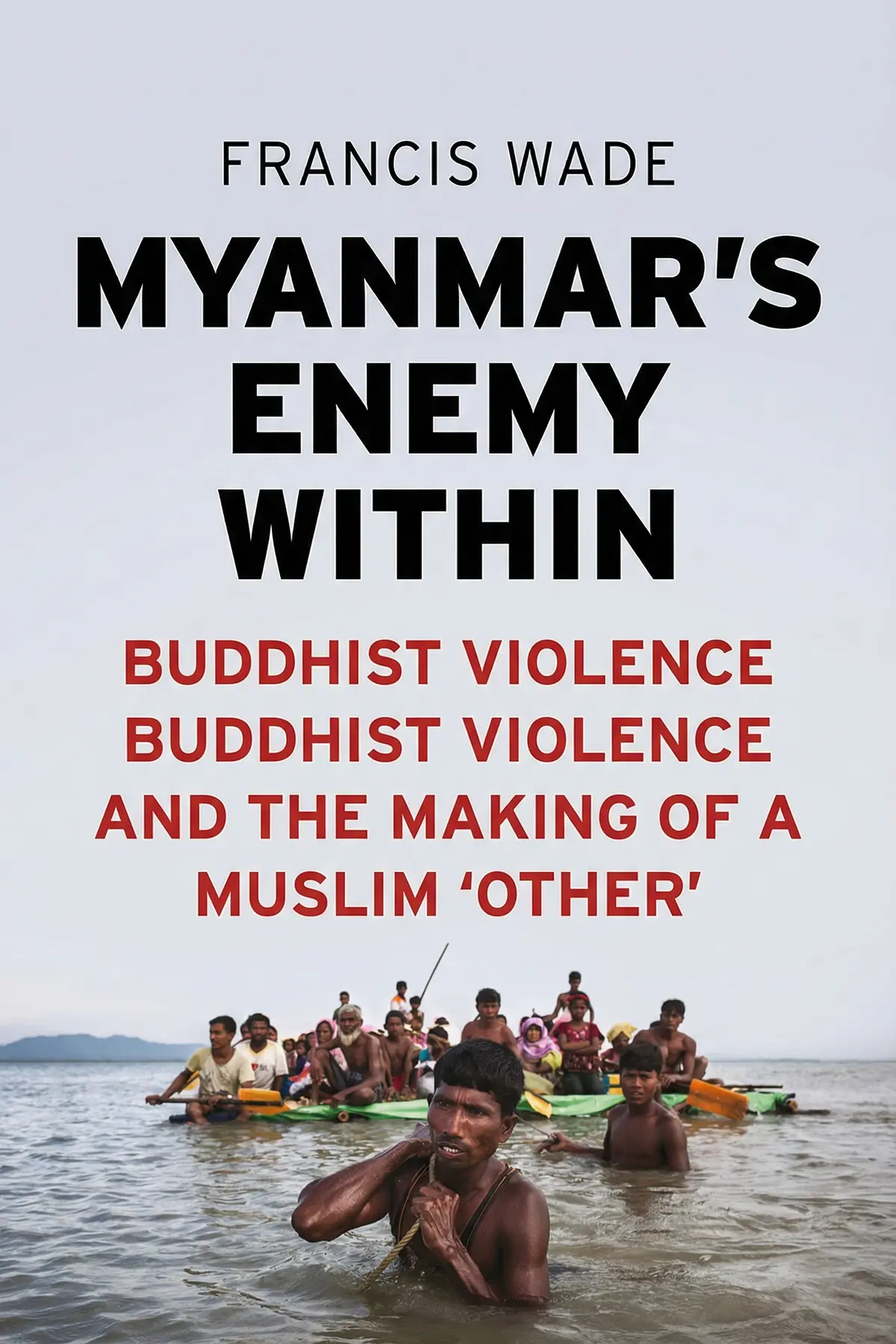
Myanmar's Enemy Within examines the tragic origins of the Rohingya crisis, revealing how historical colonial policies and modern political transitions fueled a devastating campaign of Buddhist nationalism against the country’s Muslim minority.
1 min 51 sec
For many years, the world looked at Myanmar through a very specific lens. It was a story that felt easy to understand: on one side, you had a nonviolent, spiritual population of Buddhists, led by iconic figures of peace; on the other, you had a cold, repressive military regime that had kept the country locked away from the rest of the world for decades. It was a classic tale of good versus evil, and when the military finally began to loosen its grip in 2011, the global community cheered. It felt like the dawn of a new, enlightened era for a nation that had suffered so much. We expected that democracy would naturally lead to equality and harmony.
But as the doors of the country opened, something unexpected and horrifying emerged from the shadows. Instead of a blossoming of tolerance, a brutal wave of violence began to sweep across the land. But this time, the aggressors weren’t just the men in uniform. The violence was being driven by the very people the world had cast as the victims of the old regime. Buddhist neighbors were turning on their Muslim neighbors, burning homes, and demanding the expulsion of people who had lived alongside them for generations.
This transition raises a painful question: what went so wrong? Why did the arrival of democracy seem to act as a catalyst for ethnic cleansing rather than a cure for it? To understand this, we have to look deeper than the headlines. We have to examine how identity is constructed in Myanmar and how the concept of the ‘enemy within’ was carefully cultivated over more than a century. We will explore the way colonial history, military paranoia, and the fears of a changing society converged to create a crisis that the world is still struggling to comprehend. This is not just a story about a single conflict; it’s a study of how a nation defines who belongs and who is cast out, and the devastating human cost of those definitions.
2 min 34 sec
Discover how the move toward freedom in 2011 inadvertently sparked a violent backlash against the Rohingya, turning a period of hope into a landscape of displacement.
2 min 33 sec
Explore how extremist rhetoric and newly uncensored media transformed isolated incidents into a perceived existential threat against the Buddhist faith.
2 min 35 sec
See how local tensions in Rakhine State were fueled by international events and social media, leading to a nationwide boycott of Muslim communities.
2 min 52 sec
Uncover how the British Empire’s economic policies and administrative borders created the very divisions that continue to haunt Myanmar today.
2 min 42 sec
Learn how the military dictatorship used the concept of ‘One Blood, One Nation’ to justify the suppression of diversity and the exclusion of minorities.
2 min 32 sec
See how a single piece of legislation redefined what it meant to be a citizen, effectively turning the Rohingya into stateless ghosts in their own land.
2 min 25 sec
Discover the shocking government program that emptied prisons to resettle Buddhists in Muslim-majority areas, a tactic used to rewrite the identity of a region.
2 min 28 sec
Examine the uncomfortable reality of why Myanmar’s pro-democracy icons, including Aung San Suu Kyi, failed to speak up for the persecuted Rohingya.
2 min 27 sec
Reflect on how the current crisis is the result of a long-term effort to rewrite Myanmar’s past and create a future based on exclusion rather than inclusion.
1 min 40 sec
The story of Myanmar’s descent into communal violence is a cautionary tale for the modern world. It shows us that the road to democracy is not always a straight line toward progress, and that freedom of speech, when planted in a soil of long-standing resentment and state-sponsored exclusion, can bear the bitter fruit of persecution. The Rohingya were not victims of a sudden outburst of hatred; they were the targets of a systematic, century-long process of dehumanization that began with colonial ‘divide and rule’ and ended with the legal and physical machinery of a modern state.
What we’ve seen is that national identity is a powerful, and often dangerous, construct. When a country defines itself by who it excludes rather than who it includes, it creates a permanent class of outsiders who can be blamed for every social and political ill. In Myanmar, the ‘Western Gate’ became a metaphor for a nation under siege, and the Rohingya became the symbol of a perceived invasion that had to be repelled at any cost.
As we look at the ruins of Nasi and the crowded displacement camps of Rakhine State, we are reminded that the work of building a just society goes far beyond holding elections or removing a dictator. It requires the hard work of confronting historical traumas and dismantling the laws and narratives that turn neighbors into enemies. The tragedy of the ‘enemy within’ is that the enemy was never a group of people crossing a border; it was the fear and intolerance allowed to grow within the heart of the nation itself. For Myanmar to find a way forward, it must eventually find a way to look at all its people and see not ‘others,’ but fellow citizens.
For decades, the global narrative surrounding Myanmar was a binary struggle between a peaceful, Buddhist population and a repressive military junta. However, as the nation moved toward democratic reform in 2011, a shocking wave of communal violence erupted, revealing a deeper, more complex conflict. This work explores why the transition to democracy did not bring peace, but instead unleashed a fervent Buddhist nationalism that targeted the Rohingya and other Muslim groups. Francis Wade investigates the structural roots of this animosity, tracing it back to British colonial 'divide and rule' strategies and the military's subsequent obsession with racial purity. The book explains how legal frameworks, such as the 1982 Citizenship Act, were used to systematically strip a segment of the population of their identity. Ultimately, it provides a sobering look at how even the most celebrated pro-democracy icons were caught in a political trap that prevented them from defending one of the world's most persecuted minorities.
Francis Wade is a British journalist best known for his reporting on Myanmar and Southeast Asia. His work has appeared in the Guardian, Al Jazeera, Asia Times Online, Foreign Policy, and the LA Review of Books. He was previously an editor and reporter for the Democratic Voice of Burma, a news organization founded by exiled dissidents from Myanmar.
Listeners find the book to be extremely educational, with one individual highlighting its thorough examination of Myanmar. The standard of writing earns praise from several listeners.
Finally sat down with this after the headlines faded, and it is a masterclass in investigative reporting on a heartbreaking topic. Wade provides a comprehensive discussion of Myanmar’s internal struggles that most Western media outlets completely ignored. The way he explains the 'enemy within'—how neighbors were turned against each other through state-sponsored fear—is absolutely haunting. Truth is, I hadn't fully grasped how much the opening of media controls actually allowed hate speech to proliferate among the Buddhist majority. The writing quality is top-notch, balancing raw emotional accounts from the Rohingya camps in Bangladesh with a sober analysis of the military junta's legacy. This isn't just a book about one country; it's a warning about how fragile social cohesion is everywhere. Truly essential reading for anyone interested in human rights.
Show moreStunningly written but incredibly difficult to stomach. The stories of everyday persecution in the final chapters really brought home the human cost of these political maneuvers. Wade has a gift for taking complex geopolitical shifts and making them feel personal. I found the sections on the rise of radical messages through social media particularly relevant to what we are seeing globally today. It’s a quick read in terms of pacing, but the weight of the subject matter stays with you long after you close the cover. My only minor gripe is the lack of a clear map to help visualize the specific villages mentioned, but that doesn't detract from the 5-star impact. Everyone should read this to understand how propaganda functions in the modern world.
Show moreGrabbed this after reading Bertil Lintner's work, and it serves as a fascinating, if sometimes flawed, companion piece. What Wade does differently is focus on the psychological impact of the 'divide-and-conquer' strategy on the populace. The interviews with people who lived through the riots are chilling and offer a perspective you won't find in academic texts. In my experience, most books on this topic are either too dry or too sensationalist, but this hits the sweet spot. It’s a comprehensive discussion that doesn’t shy away from the grim reality of the camps in Bangladesh. Even with the minor organizational issues, it remains one of the best books on the subject. A powerful, haunting, and necessary contribution to the literature on Myanmar.
Show moreAs someone who has followed the political landscape in Southeast Asia for years, I found Wade’s analysis of the Rakhine crisis deeply compelling. He manages to move beyond the superficial headlines to expose the military’s calculated 'divide-and-conquer' strategy that has fueled ethnic friction for decades. The book is remarkably well-researched, and it’s clear the author spent significant time on the ground conducting interviews. To be fair, the organization is a bit of a mess, as the narrative jumps chronologically in a way that can be disorienting for those not already familiar with the names and dates. However, the insights into how the transition to democracy actually empowered radical Buddhist nationalists are chilling. It is a dense, necessary read for seasoned Burma-watchers, though it requires patience to navigate the repetitive themes in the middle chapters.
Show moreThe historical deep-dive in the early chapters of this book is where Francis Wade truly shines. He connects the dots between British colonial 'othering' and the modern-day nationalism that has led to such horrific violence. Look, the transition to democracy is usually framed as a success story, but this book shows the dark side of that shift. I was particularly struck by the description of how the military redirected public anger away from the government and toward minority groups. While I agree with other reviewers that the organization is a bit scattered, the content itself is vital. It’s a sobering look at how nation-building can go horribly wrong when it’s built on the exclusion of a specific group. It definitely deepened my understanding of the conflict.
Show moreFrankly, it's rare to find a journalistic account that balances on-the-ground reporting with high-level political theory so effectively. Wade captures the paradoxical nature of group violence—how disenfranchisement leads to misplaced anger. I learned a great deal about the specific legal mechanisms used to strip the Rohingya of their citizenship, which was far more complex than I initially thought. The writing is clear and accessible, making it perfect for someone who isn't a regional expert but wants to understand the 'why' behind the crisis. There is some conjecture here and there regarding the military's motives, but given the closed nature of the junta, that’s almost unavoidable. It’s a solid, informative piece of work that humanizes a group often reduced to statistics.
Show moreAfter hearing so much about the Rohingya crisis on the news, I wanted a resource that went beyond the surface-level soundbites. This book delivered exactly that. It isn't just a play-by-play of the violence; it's a deep exploration of identity and what it means to belong to a nation. The author does a great job of explaining how the 'othering' process works. My only real critique is that it felt a bit like a collection of essays that didn't always flow into each other seamlessly. Still, the quality of the prose is excellent, and the insights into the Buddhist nationalist movement were eye-opening. It definitely challenged my assumptions about the country’s path to democracy. Well worth your time.
Show moreThis is an important book for the current moment, but I have mixed feelings about how the information is presented. On one hand, the middle sections provide a fascinating look at how the military manipulated the scarcity of resources to create horizontal violence. On the other hand, the text is incredibly repetitive, often restating the same historical points in every other chapter. Personally, I would have appreciated seeing more raw interview transcripts rather than the author’s interpretations of them. The ending felt a bit like a 'template' resolution, trying to find a silver lining in a situation that is overwhelmingly bleak. It works well as background reading for a layperson, but if you’ve already read work by Bertil Lintner, you might find some of this a bit redundant.
Show moreWhy does a book with such vital subject matter feel so disorganized in its execution? I really wanted to like this, but the structure is frustratingly non-linear, making it difficult to track the actual progression of the 2012 violence. Frankly, the author’s voice often drowns out the very interviewees we are supposed to be learning from. Just as a story becomes interesting, Wade pulls back into academic conjecture or personal opinion without enough hard evidence to bridge the gap. I also found it troubling that certain identities were exposed without clear safeguards; in a country as volatile as Myanmar, that feels reckless. While the historical context regarding British colonialism is solid, the book feels like a series of expanded journalistic articles rushed into a single volume. It’s informative, yes, but could have been much tighter.
Show moreWow, talk about a biased perspective. This book is a prime example of the 'Rohingya lobby' ignoring the nuances of the situation on the ground to push a specific narrative. Wade completely ignores the fact that Muslims in Myanmar are not a monolith; many are fully integrated into society and hold high positions in government. Most egregious is the total omission of the crimes committed by Rohingya militants against Buddhist villagers. By painting one side as purely innocent victims and the other as mindless aggressors, the author does a disservice to the complex history of Rakhine State. Not gonna lie, I found the tone condescending and the research one-sided. If you want the full picture, look elsewhere. This is misleading journalism at its worst.
Show moreJessica Valenti

Virginia Woolf

Yanis Varoufakis
Yuval Noah Harari


Jacinda Ardern
Pankaj Mishra

Johny Pitts
AUDIO SUMMARY AVAILABLE
Get the key ideas from Myanmar’s Enemy Within by Francis Wade, plus 5,000+ more titles in English and Thai.







