

13 min 53 sec
Narrative and Numbers: The Value of Stories in Business
Narrative and Numbers bridge the gap between creative storytelling and hard financial data, illustrating how the synergy of both leads to more accurate business valuations and smarter investment strategies.
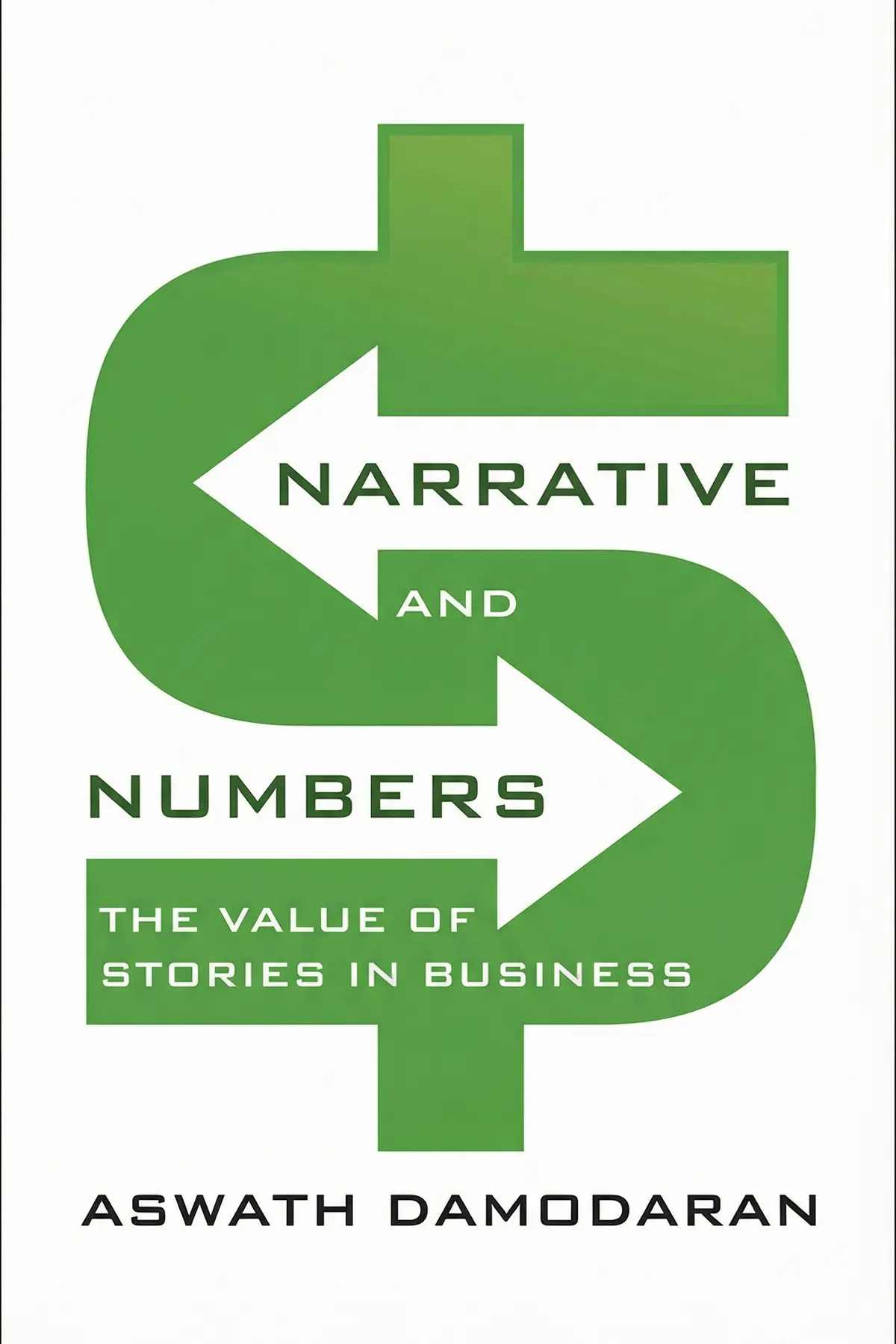
Table of Content
1. Introduction
1 min 27 sec
Have you ever wondered why some startups with zero profit manage to attract billions of dollars in investment, while established companies with steady revenue struggle to move their stock price? Or why a brand like Amazon can be valued far beyond the sum of its warehouses and delivery trucks? The answer isn’t just hidden in a line of code or a complex algorithm; it lives in the space between a story and a spreadsheet.
In our exploration of Narrative and Numbers, we are going to dive into the philosophy of Aswath Damodaran, a man who has spent his career at the intersection of finance and education. He suggests that the most successful businesses and investors aren’t just good at math, nor are they just charismatic dreamers. Instead, they are the ones who can bridge the gap between the ‘storytellers’ and the ‘number crunchers.’
This isn’t just a technical manual for Wall Street analysts. It’s a foundational look at how we perceive value. We will see how a narrative provides the ‘why’ behind the ‘what’ of the data, and how the data provides the necessary guardrails to keep a story from drifting into the realm of pure fantasy. Over the next few sections, we’ll look at the specific steps for turning a business vision into a concrete valuation, the psychological reasons why stories are so persuasive, and the rigorous tests you should apply to any investment opportunity to ensure it’s grounded in reality. By the end, you’ll have a new framework for looking at the business world—one where numbers and stories work together to reveal the true potential of an enterprise.
2. The Essential Marriage of Narrative and Data
1 min 56 sec
Discover why numbers alone are sterile and stories alone are dangerous, and how the most accurate valuations happen at their intersection.
3. Why Our Brains are Wired for Business Stories
1 min 52 sec
Explore the psychological power of narrative in the corporate world and how it can be used to simplify complex data and build trust.
4. The Blueprint for an Effective Brand Narrative
1 min 44 sec
Learn how to construct a business story that is both inspiring and credible by leveraging universal themes and rigorous research.
5. Navigating the Hidden Biases in Financial Data
1 min 43 sec
Understand why numbers aren’t as objective as they seem and how to manage the risks of false certainty in valuation.
6. Tailoring Your Story to Drive Investor Value
1 min 47 sec
See how different types of business narratives, from growth stories to turnarounds, shape how investors perceive and price a company.
7. The Three 'P's of Story Validation
2 min 06 sec
Master the rigorous three-step test of possibility, plausibility, and probability to distinguish between a visionary plan and a financial fantasy.
8. Conclusion
1 min 18 sec
In the end, the world of business isn’t a battle between numbers and stories, but a partnership. We’ve seen how stories provide the emotional fuel and the visionary roadmap that numbers simply can’t generate on their own. We’ve also seen how numbers act as the ultimate truth-tellers, keeping our feet on the ground when our imaginations want to take flight.
The takeaway from Narrative and Numbers is that value is a dynamic, living concept. A valuation is never ‘finished.’ It must be updated as new data comes in and as the market landscape shifts. To succeed as an investor or an entrepreneur, you must be willing to let your stories evolve. You must be humble enough to change your narrative when the data proves you wrong, and bold enough to stick to your vision when the numbers are just catching up.
As you move forward, remember to apply the three ‘P’s—possibility, plausibility, and probability—to every big claim you hear. Don’t let yourself be blinded by a great pitch, and don’t let yourself be bored into submission by a dry spreadsheet. Look for the connections. Look for the soul in the data and the logic in the dream. By mastering this balance, you won’t just be calculating a company’s price; you’ll be understanding its true worth and its potential to change the future. Whether you are building a brand or building a portfolio, let your narrative be your guide and your numbers be your guardrails.
About this book
What is this book about?
In the world of high-stakes finance, we often treat numbers and stories as two separate languages spoken by two different tribes. On one side are the number crunchers, who believe that spreadsheets hold the ultimate truth. On the other are the storytellers, who believe a compelling vision is what truly moves markets. Narrative and Numbers argues that neither side has the full picture. True business value is found at the intersection of these two disciplines. This summary explores how to transform a creative vision into a rigorous financial model. It breaks down the process of building a narrative that is not only inspiring but also grounded in market reality. You will learn about the tools used to stress-test business claims—possibility, plausibility, and probability—and how to use metrics like discount rates and terminal value without falling into the trap of false certainty. Whether you are an entrepreneur looking to pitch a startup or an investor trying to spot the next big thing, this guide provides a roadmap for balancing imagination with calculation.
Book Information
About the Author
Aswath Damodaran
Aswath Damodaran is a highly respected professor of finance at the NYU Stern School of Business. He has gained international acclaim not only for his deep expertise in valuation but also for his engaging and accessible teaching style. His dedication to education has earned him numerous accolades, including the prestigious NYU Distinguished Teaching Award. Beyond the classroom, Damodaran is a prolific writer, contributing many influential papers to the field of finance and authoring several books, including the well-regarded The Little Book of Valuation.
Ratings & Reviews
Ratings at a glance
What people think
Listeners find the book to be excellently written and value its lucid explanations, with one listener highlighting that it's incredibly easy to read. Furthermore, the text successfully merges storytelling with numbers, and listeners value the actionable takeaways, as one mentions it provides a good framework for understanding different types of companies. Ultimately, they view this as a significant resource for anyone with an interest in business.
Top reviews
Rod
Finally got around to reading this, and it is easily one of the most practical finance books on my shelf. Damodaran has a gift for taking the 'black box' of valuation and making it accessible through clear, structured thinking. Marrying the cold, hard numbers of a DCF with the qualitative narrative of a company’s future is a brilliant framework that actually feels actionable. I particularly enjoyed the case studies on Ferrari and Uber, as they show how the same set of data can lead to wildly different conclusions depending on the story you believe. While some might find his conservative assumptions frustrating, the truth is that his '3P' test—possible, plausible, and probable—is a necessary reality check for any investor. It is a well-written resource that provides a phenomenal bridge between financial journalism and accounting. Truly an important read for anyone trying to understand the 'why' behind the market price.
Show moreJoy
Wow, this was exactly the bridge I needed between my qualitative business intuition and the quantitative reality of finance. I’ve always respected Damodaran’s academic work, but this feels much more personal and conversational than a standard textbook. He successfully argues that the surge in big data has actually made good storytelling more important, not less. The way he breaks down the 'Big Market Delusion' is particularly relevant for today’s tech-heavy market. It’s an incredibly easy-to-read guide that doesn't shy away from the fact that valuation is an art as much as a science. I found the feedback loop concept in Step 5 to be a great reminder to stay humble and open to new information. If you want to move beyond just plugging numbers into a template, this is an essential resource. It really brings the concepts to life through real-world examples.
Show morePenelope
After hearing the 'Dean of Valuation' speak on various podcasts, I had high hopes for this book, and it did not disappoint. It is a phenomenal resource that effectively combines the art of storytelling with the science of DCF modeling. The 3P test (Possible, Plausible, Probable) is such a simple but powerful tool for filtering out investment hype. The book feels incredibly easy to read despite the complexity of the subject matter. Damodaran is a 'teacher first,' and his desire to help the reader understand the feedback loop of valuation is evident on every page. He doesn't just give you a formula; he gives you a way of thinking. Whether you are a startup founder trying to raise capital or a public market investor looking for an edge, this book provides the practical insights needed to navigate today's markets. It is truly an important resource.
Show moreThongchai
Honestly, this is the most useful thing Damodaran has written for the average investor. It moves away from the pure academic theory of his textbooks and into the real-world application of how we perceive value. The concept that every number in a spreadsheet should have a story behind it changed how I look at my own models. It’s well-written, clear, and focused on the drivers of value like cash flow and risk. The examples of Alibaba and Amazon provide excellent context for how narratives evolve over time. While some might find it familiar if they already follow his work, having the entire framework in one cohesive book is invaluable. It’s a great addition to my mental models and a very rewarding read for anyone serious about business.
Show moreNarong
As someone who has struggled with valuation spreadsheets for years, this book provided the missing piece of the puzzle. The central premise is that a valuation without a story is just a math exercise, and a story without numbers is just a fairy tale. Damodaran’s 5-step process for converting a narrative into value drivers is incredibly helpful and surprisingly easy to read. In my experience, the section on 'The Better Mousetrap' and 'The Disruptor' models helped me categorize my own portfolio companies more effectively. My only minor gripe is that the writing can feel a bit dense in the middle sections when he dives deep into the quantitative mechanics. However, the insights on how narratives must shift as a company ages are worth the price of admission alone. It’s a solid framework that adds a layer of discipline to the often-chaotic world of stock picking.
Show moreSelin
The chapter on the life cycle of a business really stuck with me because it explains why investors often talk past each other. Early on, it's all about the story; as the company matures, the numbers take the driver's seat. Damodaran’s writing is clear and structured, though occasionally it leans into the academic side. I appreciated the discussion on the limitations of different investor types, specifically how 'pure' quants often miss the forest for the trees. The book provides a great checklist of issues to consider when doing your own research. While I found some of the valuation examples a bit dated, the underlying logic is timeless. It’s a very didactic form of teaching that ensures you actually learn the 'how' rather than just the 'what.' Definitely a rewarding read for those willing to put in the mental effort to follow his logic.
Show moreKoi
Look, I’m no math whiz, but this book made me feel a lot more comfortable with the idea of intrinsic value. It’s a well-written guide that avoids getting lost in excessive jargon, focusing instead on the 'human' side of the numbers. I loved the idea that a company’s story should be bounded by the laws of physics and economics. It stops you from falling into the 'Eureka moment' trap where you assume a startup will just magically conquer the world. The structure is very logical: develop a hypothesis, test it, and then convert it into value. I did feel that some of the case studies were a bit dry, but they serve their purpose as templates. Overall, it’s a practical insight into a complex subject. It’s a must-read for any retail investor who wants to understand why a stock price might be moving against the fundamentals.
Show moreBook
Ever wonder why some startups get billion-dollar valuations with zero revenue? Damodaran breaks down how a compelling narrative can sustain a business in its early stages before the numbers catch up. I found his breakdown of the 'Disruptor' versus the 'Bully' models to be a fascinating way to look at market share and pricing power. The book is heavy on quantitative valuation, which is expected, but the effort to integrate qualitative 'scuttlebutt' is what makes it unique. My only criticism is that the tone can be a bit dry at times, and the Estonian translation (if you're reading that version) is apparently quite poor. However, the original English text is clear and offers a debuggable way to value any business. It provides a solid framework that I'll be using for my own investment analysis moving forward. Great addition to any finance library.
Show moreNong
Frankly, I expected a bit more fresh material from the 'Dean of Valuation.' If you are a regular reader of Damodaran’s blog, much of this book will feel like a retread of his previous posts and lectures. The core idea is valid—narratives drive the numbers—but the execution feels a bit repetitive after the first few chapters. He spends a lot of time on the theory of storytelling, yet the actual 'narratives' he provides for companies like Amazon or Alibaba are quite brief and mostly intuitive. To be fair, it is a well-structured book and great for someone who hasn't encountered his work before. But for long-time followers, it lacks the intellectual spark or 'newness' I was hoping for. It’s a good reference guide, but perhaps not the groundbreaking masterpiece the title suggests. Stick to his YouTube channel if you want the same information for free.
Show moreEvelyn
Not what I expected based on the title, which suggests a balanced look at storytelling and data. In reality, the 'narrative' side of this book is quite thin and lacks the depth of a true business strategy text. The author is clearly a 'numbers guy' trying to write about stories, and it shows. The end result reads more like an academic paper than a smooth business narrative. I found the examples—like the Uber valuation—to be bogged down by overly conservative assumptions that don't reflect how venture capital actually works. To be fair, the quantitative valuation parts are executed with his usual rigor, but if you’re looking for a book on the art of the pitch or strategic storytelling, this isn't it. It feels more like a blog compilation than a cohesive book. I’d recommend 'Measuring and Managing the Value of Companies' for a more professional approach.
Show moreReaders also enjoyed
7 Powers: The Foundations of Business Strategy
Hamilton Helmer

Alibaba: The House That Jack Ma Built
Duncan Clark


AUDIO SUMMARY AVAILABLE
Listen to Narrative and Numbers in 15 minutes
Get the key ideas from Narrative and Numbers by Aswath Damodaran, plus 5,000+ more titles in English and Thai.
- 5,000+ titles
- Listen as much as you want
- 7-day free trial
- Cancel anytime







