
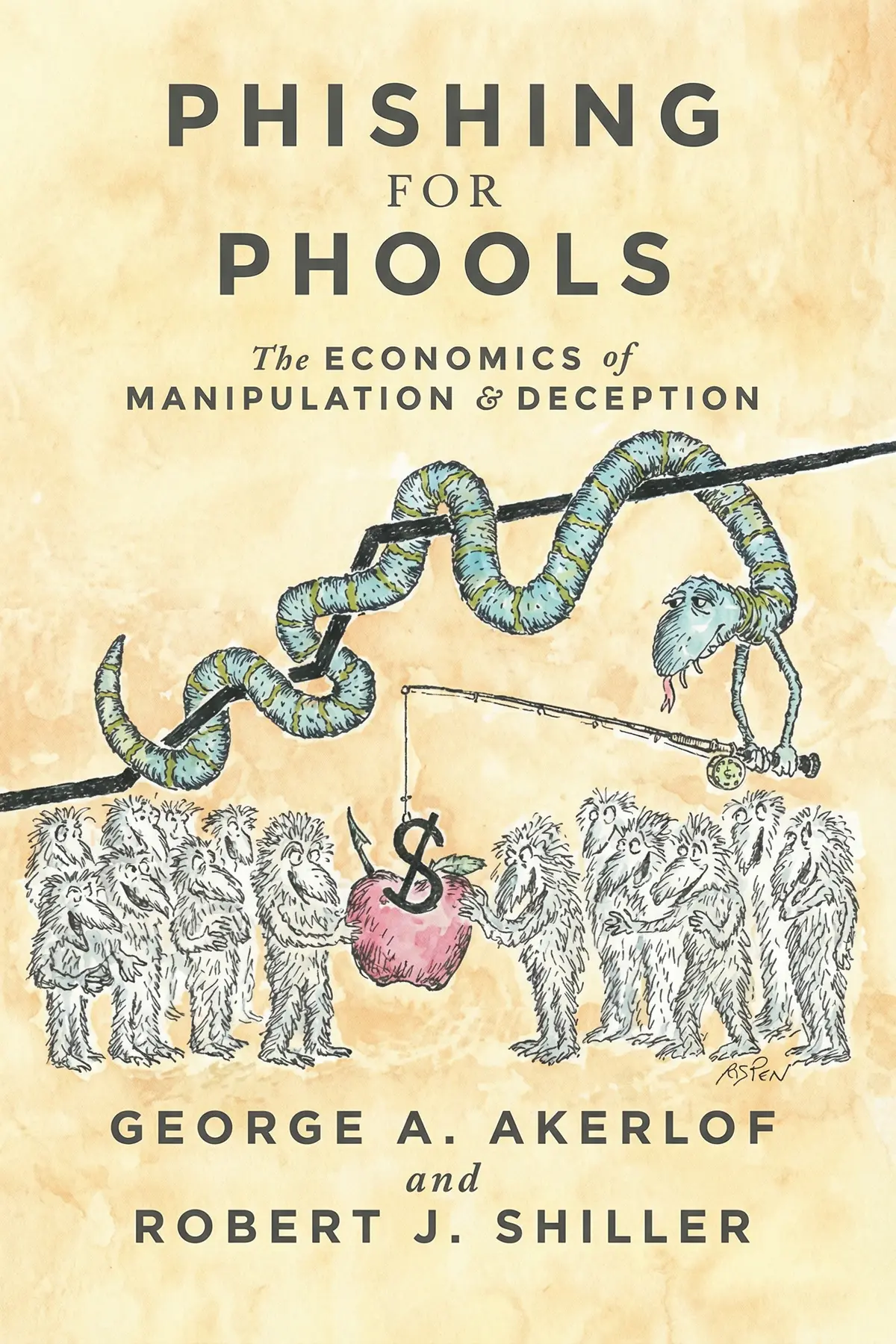
Phishing for Phools: The Economics of Manipulation and Deception
George A. Akerlof
A Nobel laureate explores the hidden forces behind market fluctuations, arguing that viral stories—not just numbers—drive major economic shifts. Discover how popular narratives act like biological epidemics to shape our financial world.
1 min 59 sec
When we think about the economy, most of us picture a world of cold, hard facts. We imagine rows of spreadsheets, flickering green and red numbers on a stock exchange monitor, and experts in suits discussing Gross Domestic Product or interest rate hikes. In this traditional view, the economy is a giant, complex machine governed by mathematical laws. If you want to understand where we are going, the logic goes, you simply need to look at the statistics. But there is a glaring problem with this perspective: it leaves out the human beings who actually make the machine run.
People are not just data points. We are creatures driven by emotions, biases, and, perhaps most importantly, stories. We live our lives through narratives, and when those narratives catch fire and spread through a population, they have the power to move billions of dollars, topple industries, and trigger global recessions. This is the core premise of our exploration today into Robert J. Shiller’s work. He argues that if we want to truly understand economic history—and more importantly, predict its future—we have to stop looking only at the numbers and start looking at the stories.
Narrative economics is a fresh way of interpreting the world. It suggests that collective myths, shared fears, and popular excitement are not just side effects of economic activity; they are often the primary cause of it. Over the next few sections, we are going to look at how stories go viral, why they behave so much like biological viruses, and how they create “constellations” of belief that can change the course of history. By the time we finish, you will see the financial world not as a series of sterile equations, but as a vast, shifting landscape of human storytelling that determines who gets rich, who goes broke, and how the global economy breathes.
3 min 07 sec
Discover why traditional statistics fail to capture the real drivers of market behavior and how collective beliefs can outweigh cold data.
2 min 59 sec
Uncover the striking parallels between viral diseases and economic stories, and learn how the mechanics of contagion apply to your wallet.
2 min 47 sec
Go beyond the blockchain to see why the story of Bitcoin—rather than its technology—turned it into a global phenomenon.
2 min 48 sec
Learn how stories don’t live in isolation, but cluster together to create powerful movements that can reshape national policy.
2 min 53 sec
Explore the psychological reason why we remember ‘the guacamole’ and how specific, visual cues can end an economic recession.
2 min 40 sec
Understand the recurring ‘plots’ of the financial world and how old stories like ‘Panic’ and ‘Crash’ continue to haunt modern markets.
2 min 59 sec
See how the memory of past events—like the World Wars—changes as the years pass, leading investors to act in surprising new ways.
2 min 38 sec
Discover how big data and social media tracking could give economists the tools to predict the next big financial surge or slump.
1 min 50 sec
As we wrap up our journey through the world of narrative economics, the most important takeaway is a shift in perspective. We have seen that the economy is far more than a collection of dry statistics or a series of predictable mathematical outcomes. It is, at its heart, a human drama. It is a world where a mystery about a digital creator can build a trillion-dollar industry, where a sketch on a napkin can change national tax policy, and where the memory of a green dip on a white carpet can influence a jury’s sense of reality.
Robert J. Shiller’s work reminds us that we are all participants in these stories. Every time we share a rumor about a housing bubble, get excited about a new technology, or panic about a headline, we are contributing to the narrative contagion that moves the global market. The “throughline” of this entire exploration is that stories are just as real and just as impactful as interest rates or GDP. They follow the same patterns as viral diseases, growing and fading in predictable cycles.
Moving forward, the challenge for economists, policy-makers, and even everyday investors is to become better “readers” of these stories. Don’t just look at the ticker tape; listen to what people are saying at the dinner table and what is trending on your feed. Ask yourself: what is the story here? Is it a perennial narrative of panic? Is it a new constellation of beliefs? By recognizing the power of the narrative, you can gain a deeper understanding of why the world behaves the way it does. You can learn to see through the hype, stay calm during the panics, and navigate the complex, storytelling-driven world of modern finance with greater clarity and confidence.
Have you ever wondered why financial markets occasionally spin out of control or why certain investment crazes take over the world despite a lack of logical backing? This exploration into Narrative Economics challenges the traditional view that statistics alone govern our financial reality. Instead, it posits that the stories we tell—the viral ideas that spread through social circles and news cycles—are the true engines of economic change. By examining the intersection of psychology, history, and finance, this summary reveals how collective beliefs function like contagious diseases. From the rise of Bitcoin to the dark days of the Great Depression, you will see how narratives of panic, confidence, and futuristic promise dictate whether people spend or save. The book promises a new framework for understanding the economy, shifting the focus from dry spreadsheets to the vibrant, often irrational human stories that actually move the needle of global wealth.
Robert J. Shiller is a Nobel Prize-winning economist and the author of the New York Times best-seller Irrational Exuberance, among many other titles. He is Sterling Professor of Economics at Yale University and a frequent contributor to the New York Times.
George A. Akerlof
Listeners find this work to be both perceptive and thoroughly documented, especially enjoying its analysis of economic stories and its attention to behavioral economics. In addition, the book is commended for its overall worth, with one listener highlighting that it surpasses typical economic textbooks. Nevertheless, the ease of reading and stylistic quality draw varying opinions; some find it a remarkable piece, while others suggest it becomes challenging to follow after the first 200 pages. Several listeners also mention that the information tends to be repetitive.
Shiller has a way of making complex ideas feel incredibly relevant to our daily lives, and this book is no exception. By bridging the gap between epidemiology and finance, he shows how viral stories—or 'narratives'—actually move the needle on market trends more than we realize. I was particularly fascinated by the section on the SIR model of viral spread; it's a refreshing departure from the usual dry utility curves found in academic texts. While some might find the heavy reliance on ProQuest data a bit dated, I think it adds a layer of historical rigor that is often missing from modern behavioral finance. The chapters on Bitcoin and the Laffer Curve really highlight how a catchy story can override objective reality. It is a brilliant, out-of-the-box look at the human element of the economy. This is essential reading for anyone trying to understand why the world feels so irrational right now.
Show morePicked this up looking for a different perspective on market cycles, and Shiller delivered a masterpiece. The core argument—that we need to study economic narratives like a doctor studies an epidemic—is a game-changer for the field. I found the SIR model appendix particularly useful for understanding the mechanics of how a story like 'technological unemployment' can go dormant for decades and then suddenly flare up again. It’s a deeply insightful look at how human irrationality and 'thought-memes' create the reality we trade in every day. Some people complain that the data is just word counts, but that’s the point: measuring the reach of a story is the only way to quantify its impact. It encourages the kind of out-of-the-box thinking that traditional, rigid economic theory desperately needs. If you’re a fan of behavioral finance, this is a must-have for your shelf. It’s well-researched and incredibly timely.
Show moreFinally got around to reading this and it’s a total game-changer for understanding how public sentiment shifts. Shiller’s comparison of Bitcoin’s popularity vs. the actual technical utility of RSA cryptography is a perfect example of why narratives matter more than facts in the short term. The book is an incredible reservoir of anecdotes that make you realize how often history repeats itself. Not gonna lie, some of the academic sections on the SIR model are a bit heavy, but the chapters on the nine perennial narratives are pure gold for anyone interested in sociology or psychology. It goes way beyond traditional textbook economics and actually looks at how people talk and think in the real world. Despite being a bit repetitive toward the end, the core message is too important to ignore. It's an insightful, unique, and deeply researched book that will change how you view the news.
Show moreEver wonder why certain economic ideas just won't die even when they are proven wrong? Shiller’s exploration into 'narrative constellations' provides a compelling answer to that question. I loved the connection between behavioral economics and the way stories thrive on human interest, identity, and even patriotism. The history of the Laffer Curve napkin was a highlight for me, even if it’s a bit apocryphal. To be fair, the book is quite a dense read and could have used a more aggressive editor to trim the middle sections. It definitely starts to feel a bit samey after the first 200 pages when he dives into the nine perennial narratives. However, the insight that 'truth is not enough to stop false narratives' is a vital lesson for our current era of misinformation. It’s well-researched and gives you a lot to chew on, even if it isn't always a page-turner.
Show moreAs an investor who follows behavioral finance, I found the historical anecdotes here refreshing and thought-provoking. Shiller’s focus on how 'narrative constellations' work together to produce economic outcomes is a much more realistic way of looking at the world than the old-school models. The book is definitely well-researched, though it requires a lot of patience. I gotta say, the chapter on the etymology of 'boycott' was one of the most interesting things I’ve read all year. However, I do agree with other reviewers that the book becomes hard to read after the first 200 pages. He tends to hammer the same point over and over again without adding new layers of depth. Despite the dry writing style, the value of the 'epidemiology' metaphor is too high to ignore. It’s a solid 4-star book that probably could have been a 5-star long-form essay.
Show moreLook, this isn't your standard economic textbook with dry charts and utility curves, and that is exactly why I liked it. Shiller is trying to bridge two very different worlds—the social science of storytelling and the hard numbers of finance. Personally, I found the discussion of how narratives like 'AI taking our jobs' have been around since the 1800s to be eye-opening. It provides a much-needed historical context for the panics we see in the news today. The truth is, most economists ignore the human element, and Shiller is brave for trying to quantify something as nebulous as a 'story.' It’s not a perfect book; the data mining can feel a bit simplistic, and the pace is definitely slow in the middle sections. But the overall insight is profound enough that I’d recommend it to anyone who wants to understand the 'why' behind major market shifts.
Show moreTo be fair, the first half of this book is brilliant, but it really starts to drag once you hit the third section. Shiller is a Nobel laureate for a reason, and his intuition that stories are a primary driver of economic behavior is almost certainly correct. However, this book struggles to advance that theory into something actionable or scientifically robust. He spends so much time on word-of-mouth contagion and historical newspaper snippets that he forgets to provide a clear path for how we should actually analyze these narratives today. Is it cause, effect, or just a correlate? The book doesn't quite answer that. It’s a fun topic filled with incredible anecdotes, but the lack of double-blind studies or modern network science references makes it feel incomplete. It’s worth a read for the unique perspective, but be prepared to skim through the repetitive bits in the latter half.
Show moreThe core argument that we need to study narratives like a virus is compelling, but the book itself is a bit of a slog. Look, Shiller has some amazing ideas here about how stories thrive on attachment and repetition, but he isn't the best storyteller himself. The structure is a bit messy, and I found myself getting lost in the long-lasting narratives of Part 3. He makes a great case for why 'truth isn't enough' to stop a bad story, yet he doesn't give much advice on how to actually fight these contagion events. I appreciated the deep dives into the gold standard and bimetallism, though they felt a bit disconnected from modern concerns at times. It’s an okay read if you’re a policy wonk or a history buff, but the average investor might find it too academic and repetitive. Not what I expected given the hype around the release.
Show moreWhile the premise of stories driving markets is fascinating, the execution here left me cold. My biggest gripe is the methodology; using absolute counts of substrings from ProQuest search results as primary evidence feels like a 'Grandpa discovering the computer' moment. He compares Bitcoin mentions to RSA algorithm mentions to prove popularity, but ignore that one is a consumer-facing meme and the other is a technical backbone. Where is the normalization of data? In the 1950s, the volume of media was tiny compared to the 80s, so raw numbers are basically meaningless. Furthermore, the prose is quite repetitive, and the 'propositions' offered—like how epidemics can be big or small—are so vague they border on useless. I really wanted to like this because I respect Shiller's work in behavioral economics, but this felt like a collection of cherry-picked anecdotes rather than a rigorous new framework. It lacked the crispy mental models I expected.
Show moreFrankly, this was a massive disappointment from a writer I usually admire. Shiller is a smart guy, but he is a boring writer and a poor explainer in this particular volume. He claims there is a need to understand narratives, but then he offers almost no credible evidence beyond 'look how many times this word appeared in a 1920s newspaper.' The reliance on absolute numbers from ProQuest is a major red flag for anyone who understands data science or even basic history. He completely ignores the work of Dawkins on memetics or any recent literature on network science, which is a bizarre omission for a book about contagion. By the time I got to the part about building a database of sermons to predict recessions, I realized this was more of a collection of hunches than a serious academic work. It’s repetitive, lacks structure, and doesn't offer any real predictive power. I’d skip this one.
Show more
Andrew Ross Sorkin
Ha-Joon Chang

Niall Kishtainy
William J. Bernstein

Yanis Varoufakis
AUDIO SUMMARY AVAILABLE
Get the key ideas from Narrative Economics by Robert J. Shiller, plus 5,000+ more titles in English and Thai.







