
17 min 42 sec
Phishing for Phools: The Economics of Manipulation and Deception
Economics Nobel laureates George Akerlof and Robert Shiller explore how free markets naturally encourage deception. Learn how phishing manipulates your choices in everything from credit cards to healthcare and politics.
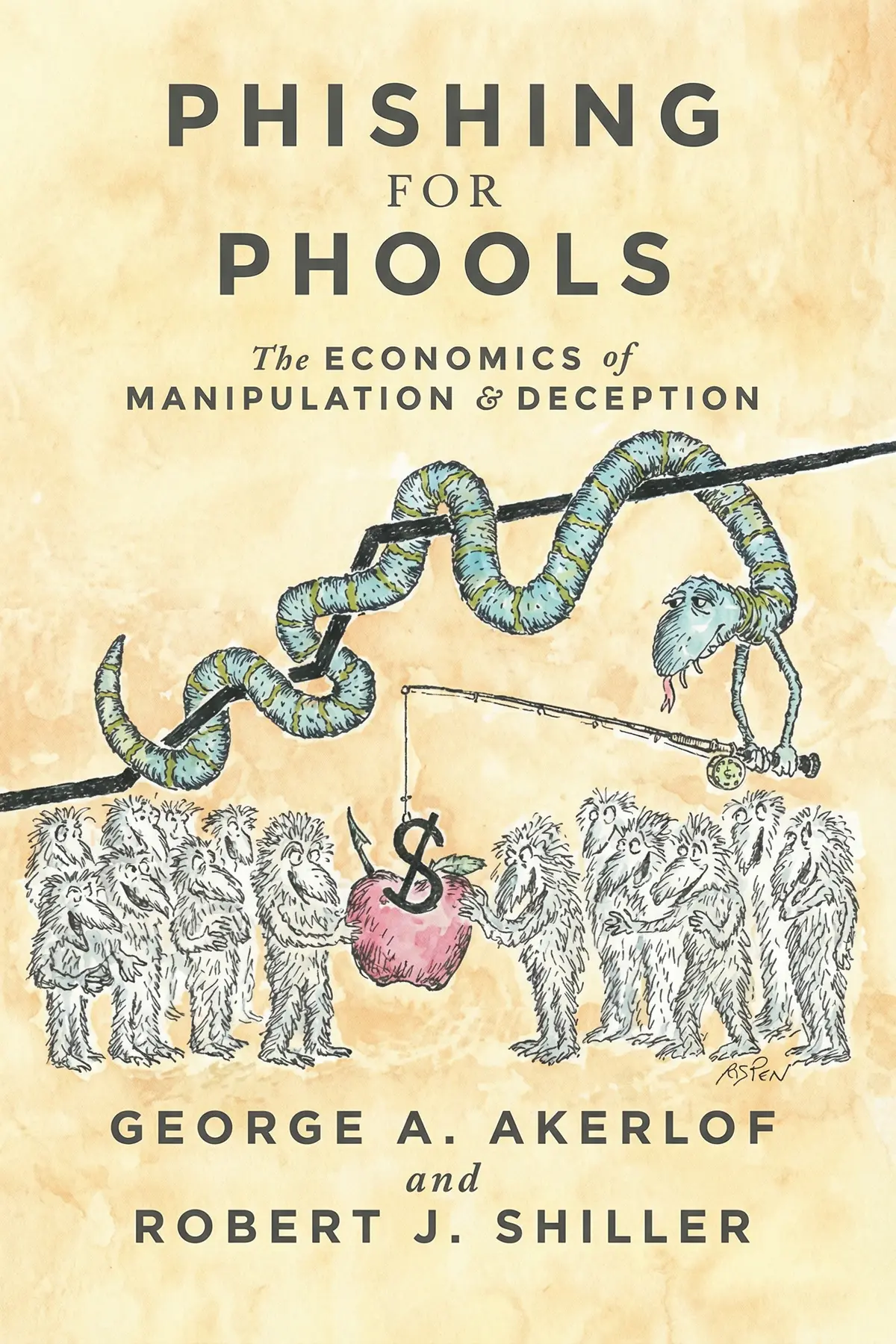
Table of Content
1. Introduction
1 min 45 sec
Think about your last trip to the grocery store. Maybe you went in for just a gallon of milk and a dozen eggs. But as you walked through the sliding doors, you were greeted by the scent of freshly baked bread, colorful displays of seasonal fruit, and a maze of aisles that seemed to stretch on forever. By the time you reached the checkout counter, your basket was full of things you never intended to buy. You might feel like you made those choices freely, but as Nobel laureates George Akerlof and Robert Shiller argue, you were likely caught in a very clever trap.
In the world of economics, we are often told that the free market is a beautiful system where supply meets demand and everyone acts in their own best interest. But there is a darker side to this story. Because the market is driven by profit, it doesn’t just provide what we need; it also provides whatever it can convince us to buy. This is the heart of what the authors call phishing for phools. In this context, a phisherman is anyone who uses deception or psychological manipulation to get you to do something that benefits them more than it benefits you. When you fall for it, you become the phool.
This isn’t just about small-time scams or shady internet emails. It is a fundamental feature of our economic system. From the way our cities are designed to the way our financial markets are regulated, the pressure to phish is constant. Over the next few chapters, we will explore how this dynamic shapes our lives, fuels financial crises, and even influences our health and politics. Most importantly, we’ll look at how we can recognize these hooks and what society can do to protect itself. Let’s dive in and see how the market really works behind the scenes.
2. The Reality of Market Manipulation
1 min 44 sec
Traditional economics assumes humans are perfectly rational decision-makers, but the pressure of the free market forces companies to find and exploit our psychological weak spots.
3. Strategic Design in the Supermarket
2 min 00 sec
Retailers use subtle environmental cues and strategic product placement to guide your behavior and encourage impulsive spending without you even realizing it.
4. The Trap of Reputation Mining
1 min 56 sec
A trusted brand name is a valuable asset, but it can be ‘mined’ for short-term profit by selling low-quality products to unsuspecting, loyal customers.
5. How Stories Shape Our Spending
1 min 35 sec
Advertising works by grafting new narratives onto our internal thoughts, using emotional language to bypass our logical thinking processes.
6. The Invisible Influence of Plastic
1 min 39 sec
The shift from cash to credit cards has fundamentally altered how we perceive cost, making it easier for us to spend more than we intend.
7. Political and Pharmaceutical Deception
1 min 38 sec
In fields like healthcare and government, complexity is often used as a tool to keep the public uninformed and easily manipulated.
8. The Dark Side of Innovation
1 min 51 sec
Not all technological or business breakthroughs are beneficial; many are designed specifically to exploit our psychological vulnerabilities.
9. Protecting Ourselves through Standards and Law
1 min 54 sec
While phishing is a natural part of the market, we are not helpless; government standards and legal frameworks serve as vital shields for the public.
10. Conclusion
1 min 40 sec
The world of the free market is far more complex than a simple exchange of goods and services. As George Akerlof and Robert Shiller have shown us, it is a landscape filled with hidden hooks and clever phishermen waiting to turn us into phools. The pressure to generate profit ensures that manipulation will always be a part of the economic equation. Whether it is the layout of a grocery store, the complexity of a financial bond, or the emotional pull of a well-crafted advertisement, we are constantly being nudged to make choices that serve someone else’s bottom line.
However, understanding that we are being phished is the first step toward reclaiming our agency. When we recognize the narratives being pushed on us, we can pause and ask if a purchase truly aligns with our long-term goals. We can be more mindful of how we pay for things, opting for cash when we want to keep our spending in check. We can also appreciate the vital role that regulations and consumer protection laws play in our daily lives. These aren’t just ‘red tape’; they are the essential barriers that prevent the market from becoming a free-for-all of deception.
To put this into practice, start small. Next time you find yourself reaching for an impulsive purchase or feeling the tug of a ‘limited-time offer,’ take a breath and look for the hook. By becoming more aware of the phishing tactics around us, we can navigate the market with our eyes wide open, making choices that are truly our own. The market will always try to phish, but you don’t have to be a phool.
About this book
What is this book about?
This summary explores the provocative idea that free markets are not just engines of efficiency, but also breeding grounds for manipulation. While traditional economics assumes we make rational choices, authors George Akerlof and Robert Shiller argue that profit-seeking leads businesses to exploit our psychological weaknesses. They call this phishing, where phishermen lure phools into spending more, eating worse, or supporting policies against their own interests. The narrative moves from the aisles of your local grocery store to the boardroom of major financial institutions. You will discover how reputation mining contributed to the 2008 financial crisis and why even the most intelligent consumers fall for the storytelling used in advertising. Beyond identifying the problem, the summary highlights how heroes like government regulators and courageous individuals have fought back to create standards and laws that protect us. It’s a wake-up call to look past the invisible hand and see the invisible hooks that shape our modern world.
Book Information
About the Author
George A. Akerlof
Nobel laureate George A. Akerlof is an economist and professor at Georgetown University. He was awarded the Nobel Prize in economics in 2001. Nobel laureate Robert J. Shiller is the Sterling professor of economics at Yale University. He was awarded the Nobel Prize in economics in 2013. Shiller is the author of the bestselling book, Irrational Exuberance.
Ratings & Reviews
Ratings at a glance
What people think
Listeners find this book to be an essential read for consumers, noting that its strong insights are reinforced by plenty of examples. The work also earns praise for its depth in behavioral economics and its storytelling, with one listener specifically noting its clear explanation of the financial crisis. Conversely, there are varied reactions to the clarity and writing style; some consider the text well-composed while others take issue with it, and while some find the content simple to follow, others characterize it as too elementary.
Top reviews
Ratthapong
This is a wake-up call that every consumer needs to read right now. We are constantly being "phished," and this book provides the intellectual armor needed to see through the manipulation of big corporations. Personally, the most eye-opening part was the analysis of how pharmaceutical companies influence doctors; it’s terrifying to see how deep the deception goes. The narrative quality is excellent, making complex economic theories feel like a high-stakes detective story. The authors don't just point out the problems; they help you understand the systemic reasons why markets fail to protect us. It’s rare to find a book by Nobel laureates that is this readable and practical. I’ve already started changing the way I look at marketing and "free" services online after finishing this. A must-read!
Show moreDimitri
Finally got around to reading this, and I’m so glad I did! It’s a masterful breakdown of how the "invisible hand" can sometimes lead us right off a cliff. The authors provide a wealth of examples, from the deceptive tactics used in the 2008 recession to the subtle ways supermarkets are designed to make us overspend. What I loved most was the narrative style; it felt like having a conversation with two very wise mentors. They make a compelling case that regulation isn't just about stopping fraud, but about balancing the inherent tendencies of the market to "phish" for suckers. It’s an empowering read that has made me a much more conscious participant in the economy. This should be required reading in every high school or college intro class.
Show moreJib
Wow, what a deep dive into the psychology of our modern economy. This book completely changed my perspective on the "freedom" of the free market. Akerlof and Shiller show that in a world where everyone is free to compete, someone will always find a way to compete by deceiving you. The chapters on the 2008 crisis were a standout for me, providing a clear and readable account of how systemic "phishing" led to a global meltdown. The authors' style is engaging and accessible without sacrificing the importance of their message. It’s a serious topic, and at times it can be upsetting to realize how much we’re being manipulated, but knowledge is power. I can't recommend this highly enough for anyone who wants to be a smarter consumer and a more informed citizen.
Show moreYuwadee
After hearing so much about the "rational actor" in economics, this book was a refreshing, if somewhat cynical, breath of fresh air. Akerlof and Shiller do a fantastic job of explaining why we shouldn't always trust the market to provide what's best for us. The way they break down the 2008 financial crisis through the lens of "phishing" made the complex world of derivatives and mortgage-backed securities much easier to grasp. Look, it’s not a perfect book—some sections on advertising felt a bit dated—but the central message is incredibly important. The authors successfully argue that deception is an inevitable part of a free market, not just a bug in the system. It’s a readable account that definitely makes you think twice about your next impulse purchase or investment.
Show moreLily
As a student of economics, I found the concept of "phishing equilibrium" to be a brilliant addition to my understanding of market dynamics. The authors challenge the traditional view that markets only satisfy legitimate needs, showing instead how they exploit human frailties for profit. I particularly appreciated the discussion on "sludge"—the little hurdles that make it hard for us to act in our best interest. The writing is clear, though I'll admit the tone can be a bit repetitive at times. To be fair, some of the examples involving tobacco and alcohol are well-known, but seeing them framed within a larger economic theory adds a lot of value. It's a great bridge between psychology and traditional finance, even if it skips over some of the deeper technical analysis I was craving.
Show moreLek
Ever wonder why you keep buying stuff you don’t actually need? Akerlof and Shiller explore this through the lens of "phishing for phools," showing how free markets aren't just efficient machines but also traps for our psychological weaknesses. While the examples involving tobacco companies and pharmaceutical giants were engaging, I felt the book lacked a certain academic rigor. To be fair, it’s a very accessible read, which is a plus for some, but I found the "phishing equilibrium" concept a bit under-explained. It’s a decent introductory text if you’ve never thought about how corporations manipulate consumer behavior, but it feels a bit light for a Nobel prize-winning duo. The middle section on the financial crisis dragged significantly, though the insights into credit card psychology were a nice touch.
Show moreOlivia
The authors seem to have missed the mark with their target audience. They claim to write for the general public, yet they oscillate between overly technical financial jargon and patronizingly simple examples like why Cinnabon smells good in malls. Not gonna lie, the section attacking the giants of advertising like David Ogilvy was particularly baffling; it felt like a moral crusade rather than an economic analysis. The core idea—that markets naturally produce deception—is interesting, but it gets buried under a mountain of superficial case studies. I was particularly frustrated by the lack of cohesive structure, as the book felt more like a series of disconnected essays than a unified argument. It’s not "wrong" per se, but it's certainly not the seminal work I was hoping for from such prestigious thinkers.
Show moreNoah
While the premise is interesting, the execution left me quite bored and unimpressed. I’ve been following the behavioral economics scene for a while, and this felt like a retread of every basic concept in the field without any fresh perspective. The authors spend nearly half the book on introductory fluff and conclusions that just repeat what was already said. Frankly, the chapter on "innovation" focusing on Facebook addiction was particularly weak and felt tacked on to stay relevant. I was looking for a rigorous critique of the "invisible hand," but instead, I got a laundry list of obvious observations about how ads work. It’s hard to recommend this when there are much better books on market manipulation and cognitive bias available. I struggled to finish it, which is rare for me with nonfiction.
Show moreNikolai
Total disappointment for anyone who has already read a single book on behavioral economics. I expected a deep dive from two Nobel laureates, but instead, I got a collection of anecdotes that felt like they were clipped from a mid-tier financial magazine. Truth be told, the chapters on the 2008 financial crisis added absolutely nothing that wasn't covered better in "The Big Short." The writing is repetitive, and the authors spend way too much time on introductions and conclusions rather than providing new data. If you’re a beginner, maybe you’ll find some value here, but for everyone else, it's just a waste of time. I found myself skimming the last fifty pages because the "phishing" metaphor was stretched so thin it practically became transparent. Skip this one and read some Kahneman instead.
Show moreValentina
Not what I expected from authors of this caliber. The book reads like a collection of Wikipedia entries on famous scams and marketing tricks, lacking any cohesive new theory. I found the arguments against advertising to be incredibly naive, almost as if the authors have never actually worked in a business environment. The truth is, most of the "phishing" they describe is just basic commerce that everyone already understands. Why waste 200 pages telling me that tobacco causes cancer or that people spend too much on credit cards? The pacing is sluggish, and the insights are as shallow as a magazine article. I’m honestly surprised this got so much praise from the economic community. It’s an oversimplified, patronizing mess that fails to deliver on its promising title.
Show moreReaders also enjoyed

Adults in The Room: My Battle With Europe’s Deep Establishment
Yanis Varoufakis
1929: Inside the Greatest Crash in Wall Street History--and How It
Andrew Ross Sorkin
23 Things They Don’t Tell You About Capitalism
Ha-Joon Chang

A Little History of Economics
Niall Kishtainy
A Splendid Exchange: How Trade Shaped the World
William J. Bernstein
AUDIO SUMMARY AVAILABLE
Listen to Phishing for Phools in 15 minutes
Get the key ideas from Phishing for Phools by George A. Akerlof, plus 5,000+ more titles in English and Thai.
- 5,000+ titles
- Listen as much as you want
- 7-day free trial
- Cancel anytime







