
21 min 05 sec
Negotiating the Nonnegotiable: How to Resolve Your Most Emotionally Charged Conflicts
Negotiating the Nonnegotiable explores the deep-seated identity issues that drive intense conflict. Daniel Shapiro offers a psychological framework for moving past emotional stalemates to find lasting reconciliation and peace.
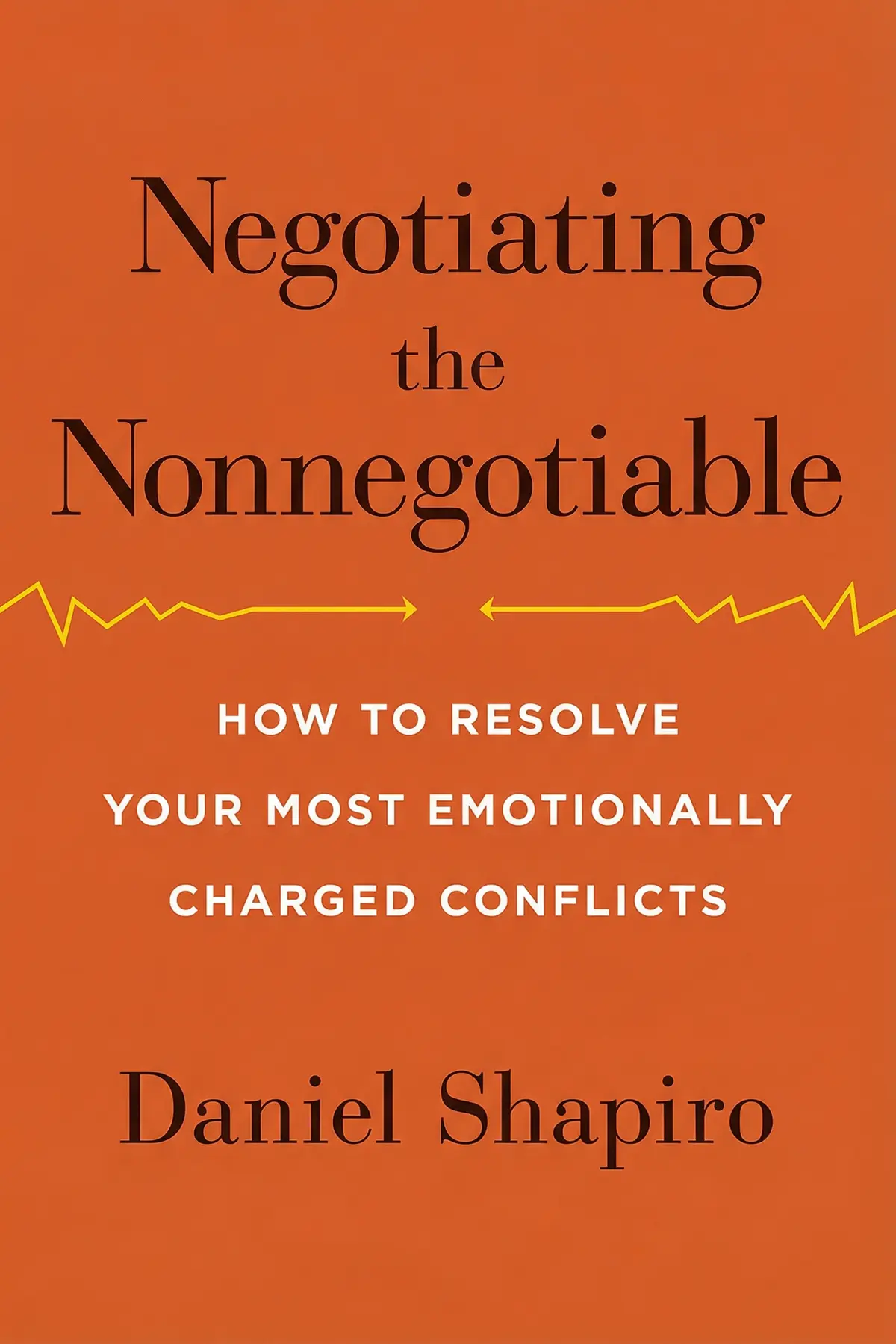
Table of Content
1. Introduction
2 min 08 sec
We have all been there. You are caught in a heated debate with a loved one, a colleague, or a friend, and suddenly it feels like you are hitting a brick wall. No matter how many logical points you make, or how much you try to appeal to their better nature, the argument just keeps circling back to the same painful place. You feel stuck, unheard, and increasingly frustrated. This isn’t just a disagreement about where to go for dinner or how to manage a budget; it feels like a battle for your very soul. This is what happens when a conflict becomes what Daniel Shapiro calls “nonnegotiable.”
Traditional wisdom tells us that if we can just be rational enough, or manage our emotions better, we can solve any problem. But if that were true, why do so many conflicts—from small family feuds to massive international standoffs—last for decades? The missing piece of the puzzle, as we will explore today, is identity. Our sense of who we are, where we belong, and what we value is the invisible force driving our most intense disagreements.
In this summary of Daniel Shapiro’s groundbreaking work, we are going to look at the hidden dynamics of the human mind that make conflict so difficult to escape. We’ll move beyond simple logic and raw emotion to see how our “tribal” instincts can lead us toward destruction even when we think we’re being reasonable. We will uncover the five primary traps that pull us into the abyss of conflict: the Tribes Effect, Vertigo, Taboos, the Mythos of Identity, and Pain.
More importantly, we will learn a new language for reconciliation. We’ll see how to dismantle the walls of self-righteousness and how to navigate the delicate process of mourning loss and granting forgiveness. By the end of this journey, you’ll have a roadmap for turning those impossible, emotionally charged standoffs into opportunities for genuine connection. The goal isn’t just to win an argument, but to reconfigure our relationships so that everyone involved can move forward with their dignity intact. Let’s dive in and discover why no conflict is truly beyond resolution.
2. The Hidden Dimension of Identity
2 min 20 sec
Traditional conflict resolution focuses on logic and emotion, but there is a third, more powerful factor at play that often goes ignored.
3. The Two Faces of Self: Core and Relational Identity
2 min 13 sec
Your identity isn’t a single, stagnant thing; it’s made up of two distinct parts that dictate how you view yourself and others.
4. The Magnetic Pull of the Tribes Effect
2 min 08 sec
When we feel threatened, our minds automatically shift into a divisive state that makes compromise feel like a betrayal.
5. Vertigo: The Emotional Black Hole
1 min 48 sec
In the heat of battle, we often lose our sense of time and perspective, becoming completely consumed by the argument.
6. The Invisible Boundaries of Taboos
2 min 06 sec
Every group has ‘no-go’ zones that protect its values, but these silent rules can become major obstacles to resolution.
7. Rewriting the Mythos of Identity
2 min 01 sec
We all carry internal stories that cast us as the hero or the victim, but these narratives often keep us locked in combat.
8. Moving Through the Pain: Mourning and Forgiveness
2 min 02 sec
Conflict always leaves scars, and unless we learn to process the emotional damage, we can never truly move forward.
9. The SAS System: A Practical Framework for Coexistence
2 min 19 sec
When identities are in direct opposition, there are three specific strategies you can use to find a path forward.
10. Conclusion
2 min 00 sec
In the end, the most important lesson of Daniel Shapiro’s work is that conflict is not a sign of failure, but a sign of our shared humanity. Our identities are precious to us. We fight so hard because we care so deeply about who we are and the values we hold dear. But when that care turns into a rigid ‘tribalism,’ we lose the very thing we are trying to protect: our ability to live a meaningful, connected life.
Resolving the ‘nonnegotiable’ requires a profound shift in perspective. It asks us to look inward and recognize the ways we get trapped by our own self-righteousness, our own narratives of victimhood, and our own ‘vertigo.’ It challenges us to stop seeing the people across from us as obstacles or enemies and start seeing them as individuals who are also trying to protect their sense of self. It is a call to move beyond the simple mechanics of ‘win-win’ negotiations and enter the deeper, more difficult work of identity-based reconciliation.
The next time you find yourself in the middle of a recurring argument, I encourage you to pause. Don’t reach for another logical argument. Don’t lash out in anger. Instead, ask yourself: ‘What part of my identity feels threatened right now? And what part of their identity are they trying to defend?’ By naming the invisible forces at play, you take the first step toward disarming the conflict.
Remember, the goal of negotiation isn’t just to reach a settlement; it’s to build a relationship where everyone feels seen and respected. It takes courage to mourn our losses, to question our personal myths, and to offer forgiveness. But as we have seen, the alternative—letting the ‘world’ end because we refused to bend—is a far greater tragedy. No conflict is truly nonnegotiable if we are willing to engage not just with our minds, but with our hearts and our identities. Start today by looking for the person behind the ‘enemy’ and the ‘us’ behind the ‘them.’
About this book
What is this book about?
We often think conflicts are about facts, money, or logic, but at their heart, they are usually about who we are. This book dives into the tribal mindsets that lock us into us-versus-them battles, making resolution feel impossible. It identifies five emotional traps—Vertigo, Taboos, the Tribes Effect, the Mythos of Identity, and Pain—that make negotiations feel nonnegotiable. By understanding the core and relational aspects of identity, readers learn to de-escalate even the most charged disagreements. Shapiro provides a step-by-step guide to recognizing these triggers and shifting from a mindset of adversarial combat to one of collaborative coexistence. The promise of the book is a path toward resolving the unresolvable by addressing the human need for meaning and belonging.
Book Information
About the Author
Daniel Shapiro
Daniel Shapiro founded the Harvard International Negotiation Program and is an associate professor of psychology at Harvard Medical School. He is also a consultant for Fortune 500 companies and various public institutions, and has created several conflict resolution initiatives in Asia, Europe and the Middle East.
Ratings & Reviews
Ratings at a glance
What people think
Listeners find that this work delivers useful advice and a superb look at interpersonal dynamics, making for a compelling experience. Furthermore, it serves as a fundamental manual for resolving conflict, with one listener emphasizing its methodical procedure for encouraging reconciliation. They also value its applicability to all couples and professional connections, and one listener mentions its scientific methodology.
Top reviews
Wichai
Picked this up after a particularly nasty fallout with my business partner that seemed impossible to resolve. I wasn't expecting a miracle, but Shapiro’s breakdown of the "tribal mind" actually gave us a common language to talk about what was going wrong. To be fair, some of the psychological stuff feels a bit deep, but it’s remarkably practical once you get past the academic jargon. The step-by-step process for fostering reconciliation isn't just for world leaders at some high-stakes summit; it works for regular people dealing with everyday friction. I found the section on "vertigo" especially relatable because it describes that feeling of being consumed by a conflict so perfectly. It’s a dense read, and you’ll probably need a highlighter to keep track of the different frameworks, but the ROI on your personal relationships is huge. This book provides a clear path forward when you feel completely stuck.
Show moreSelin
Ever wonder why you can't seem to reach a compromise with your spouse even when the solution seems obvious? This book answers that question by showing how our identities feel threatened during even the smallest, most mundane arguments. Personally, I think this is an essential guide for anyone in a long-term relationship or a high-stress job. Shapiro provides a clear, step-by-step process for navigating those "nonnegotiable" hurdles that usually end in a bitter stalemate. The way he frames "the lure of the tribal mind" explains so much about our current polarized world. Not gonna lie, it’s a bit academic in parts and the prose can be thick, but the payoff is worth the mental effort. It’s not just a book; it’s a manual for human survival in an era of constant friction and misunderstanding. Truly a must-read for everyone except sociopaths.
Show moreAey
This book should be required reading for every diplomat, corporate executive, and community leader. Shapiro’s approach to conflict resolution is nothing short of revolutionary because it tackles the emotional and spiritual dimensions that other experts usually ignore. In my experience, most negotiation tactics fail because they don't account for the "sacred issues" that people refuse to compromise on. This guide offers a scientific yet deeply humanistic way to bridge those gaps. The anecdotes about international mediation are fascinating, though I wish there were more concrete data on the long-term outcomes of his specific sessions. Regardless, the step-by-step process for fostering reconciliation is something I’ve already started using in my own department with great success. It completely changes the way you view your "opponents" and helps you see the shared identity beneath the surface of the conflict.
Show morePenelope
As someone who deals with contract disputes daily, I usually find negotiation books to be a bit repetitive and dry. This one feels different because it moves away from just "getting to yes" and dives into the messy human dynamics that make people stubborn. The scientific approach to how identity triggers conflict is fascinating, even if the author gets a little carried away with his own acronyms. Seriously, by the time I hit the REACH framework and the SAS system, my brain was a bit fried from the alphabet soup. However, the core advice on de-escalation is solid gold for high-pressure business environments. Frankly, it provides a much more nuanced overview of why we dig our heels in than most of the stuff I read in grad school. It is a helpful guide for anyone who wants to understand the hidden emotions driving the person across the table.
Show moreBee
Finally got around to finishing this, and I have mixed feelings despite the high rating I gave it. On one hand, the insights into "repetition compulsion" and how we get stuck in cycles of conflict are brilliant and immediately applicable. On the other hand, the writing style can be quite exhausting because of the sheer density of the information. There are just so many acronyms! I felt like I was studying for a medical exam by the time I reached the middle section. Still, the overarching overview of human dynamics is more sophisticated than what you find in standard self-help books. If you can push through the dense "gobbledegook," there are practical tips here that actually work in real-world negotiations. It’s a solid addition to the Harvard negotiation library, even if it is a bit wordy and focused on top-down nonsense at times.
Show moreSirinat
The section on 'vertigo' was a total game-changer for me. It’s that feeling when you’re so angry or consumed by a conflict that you lose sight of your own long-term interests, and Shapiro describes it perfectly. To be fair, the book is quite long and could have probably been a 50-page pamphlet without losing much of the core substance. He tends to ramble about "mythos" and "transcendent connections," which might turn off readers who want something punchy and direct. However, the practical tips for de-escalating heated conversations are genuinely useful for anyone. I’ve tried a few of his strategies during family dinners, and they actually helped keep the peace during some tricky political discussions. It’s a thoughtful, if somewhat bloated, exploration of why we fight and how we can finally stop the cycle of blame.
Show moreJoy
This is a must-read for anyone who feels stuck in a cycle of circular arguments that never seem to get resolved. Whether you're dealing with a difficult boss or a stubborn teenager, Shapiro’s insights into the "tribal mind" offer a genuine way out. Frankly, I found his breakdown of how we protect our identity more useful than the standard interest-based negotiation tactics taught in most corporate workshops. The book provides an excellent overview of the psychological barriers that prevent us from seeing eye-to-eye during a crisis. My only minor gripe is that some of the examples feel a bit banal and could be used to support almost any argument. Despite that, the core framework is robust and offers a clear path toward reconciliation and understanding. It’s a very engaging read for anyone interested in the social psychology of conflict resolution.
Show moreVipawan
The chapter on identity really made me stop and think about my own biases during arguments. Shapiro is clearly an expert, and his work at Harvard shines through in the way he structures his arguments with such authority. But I’ve got to say, the book feels padded with unnecessary filler. Do we really need twenty different frameworks with catchy names to explain the basic idea that we should empathize more? It gets quite repetitive about halfway through, and I found myself skimming the later chapters just to get to the point. Truth is, the five pillars of identity are great, but the rest of the proprietary systems—TCI, ACT, BAG—just complicate a message that is actually quite simple. It’s an okay resource for those new to the topic, but maybe borrow it from the library before committing to a permanent spot on your shelf.
Show morePop
I wanted to love this given the author's pedigree at Harvard, but it was a bit of a slog to get through. There is no denying that Shapiro understands human dynamics better than almost anyone in the field. However, the sheer volume of frameworks—the TCI method, the ECNI method, the REACH system—is just overwhelming for a casual reader. In my experience, you only really need one or two of these tools to make progress, and the rest feel like unnecessary filler designed to make the book look more academic. The content is repetitive, with every chapter essentially reminding you to empathize with the other person’s identity over and over. It’s not a bad book by any means, and the scientific approach to tribalism is very timely. I just wish it were more concise and less focused on creating a proprietary acronym for every single observation.
Show morePlernpiriya
After hearing so many good things about Shapiro's work, I was expecting something more evidence-based and less rooted in psychoanalytic fluff. Look, if I wanted to hear about how my childhood traumas are affecting my current political disagreements, I’d go to a therapist, not a negotiation expert. The book builds these massive theoretical structures on the ideas of Freud and Jung, which feels incredibly dated for a modern business book. He bounces from individual marital problems to international conflicts in Northern Ireland without acknowledging how different those scales really are in practice. It’s scientific malpractice to suggest that a nation’s history can be treated like a single person’s therapy session. If you like soft science and "sacred connections," you’ll love this, but if you want hard data and logical strategies, look elsewhere. I found the constant use of religious imagery and philosophical pablum more distracting than helpful.
Show moreFeatured in
Readers also enjoyed



AUDIO SUMMARY AVAILABLE
Listen to Negotiating the Nonnegotiable in 15 minutes
Get the key ideas from Negotiating the Nonnegotiable by Daniel Shapiro, plus 5,000+ more titles in English and Thai.
- 5,000+ titles
- Listen as much as you want
- 7-day free trial
- Cancel anytime







