AI 2041: Ten Visions for Our Future
Kai-Fu Lee
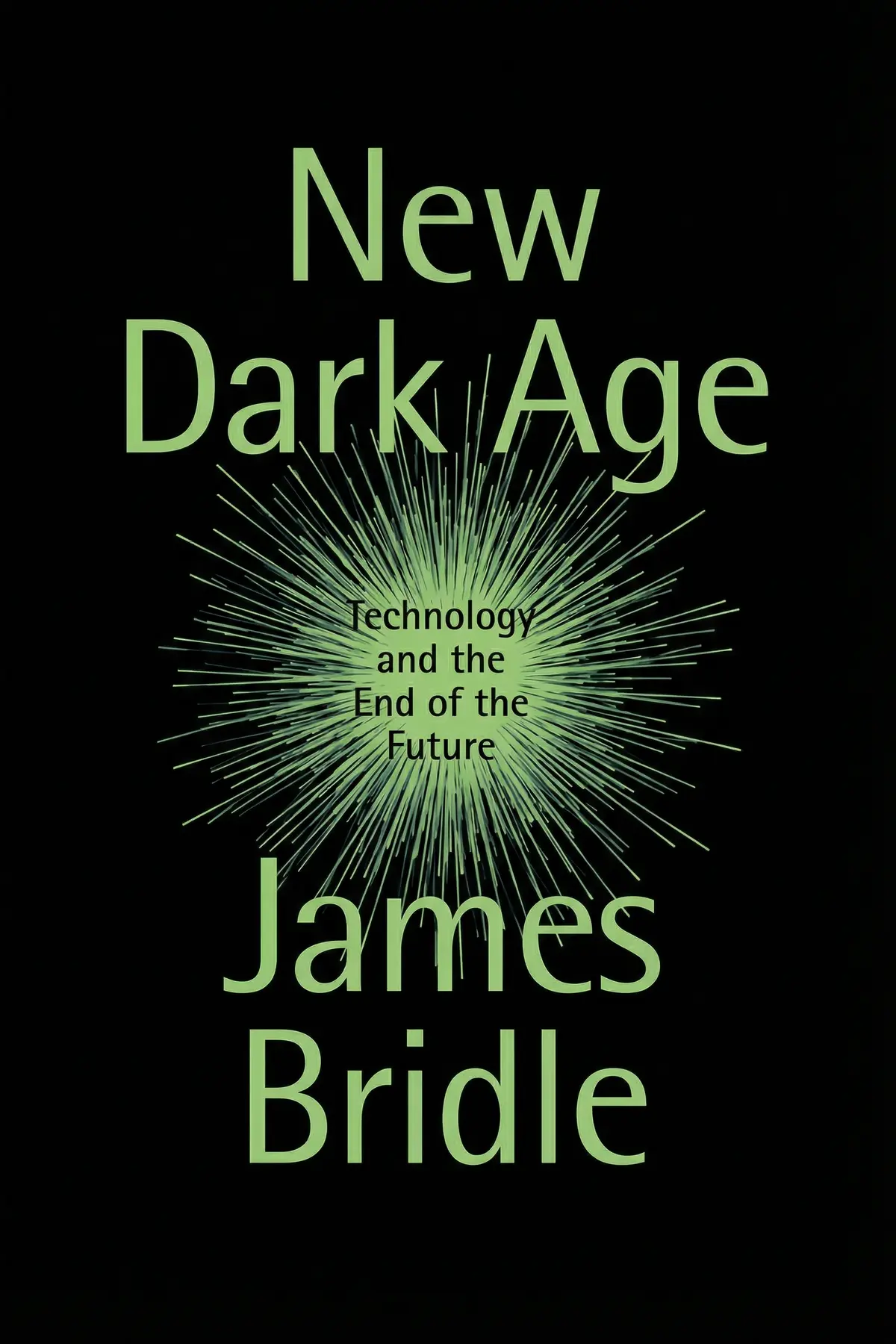
New Dark Age examines how our reliance on technology has paradoxically clouded our understanding of the world, leading to misinformation, inequality, and a disconnect from the physical realities of our planet.
1 min 56 sec
We often talk about the Information Age as if it were a beacon of enlightenment. We imagine that with the world’s knowledge just a few clicks away, we are becoming more informed, more connected, and more capable of solving the world’s greatest challenges. But look around, and the reality feels quite different. We see a world fractured by conspiracy theories, a climate in crisis, and a sense that we are losing our grip on the truth itself. This is the central paradox explored in James Bridle’s New Dark Age.
The title is a deliberate provocation. In historical terms, a ‘dark age’ isn’t just a time of ignorance; it’s a period where we have lost the records and the tools to understand what is happening. Bridle suggests that despite our massive data centers and high-speed networks, we are entering a modern version of this state. We are surrounded by more data than ever, yet we understand the world less and less. The systems we have built to simplify our lives have become so complex that even their creators can no longer fully explain how they work or why they make certain decisions.
In this summary, we aren’t just going to look at the gadgets in our pockets. We’re going to peel back the layers of the digital ‘cloud’ to reveal the physical cables, the military histories, and the carbon emissions that define our reality. We’ll explore why scientific progress seems to be slowing down even as our computers get faster, and how the algorithms designed to entertain us are inadvertently fueling social decay. Most importantly, we will examine the shift from ‘computational optimism’—the belief that technology will save us—to a more grounded, critical way of living with the machines we’ve created. This journey is about learning to see through the fog of the digital age and finding a way to act with meaning and purpose in a world that feels increasingly out of our control.
2 min 44 sec
Uncover how the pursuit of weather control and nuclear simulation laid the groundwork for the computers we use today, often hiding their true purposes behind public displays.
2 min 30 sec
The internet is not an ethereal concept; it is a massive physical infrastructure that consumes vast energy and is deeply vulnerable to the changing climate.
2 min 28 sec
Explore why the explosion of information hasn’t led to more breakthroughs, and how the ‘replication crisis’ is undermining our faith in scientific truth.
2 min 10 sec
See how the physical placement of servers and the use of algorithms in the workplace are concentrating wealth and stripping away human agency.
2 min 10 sec
Understand why AI is never truly neutral and how training computers on historical data risks making the injustices of the past permanent features of our future.
2 min 08 sec
Discover how governments use digital tools and archival secrecy to control the narrative of the past and monitor the present.
2 min 03 sec
Learn why the modern world’s overwhelming complexity drives people toward simple, often unhinged, narratives as a way to regain a sense of control.
2 min 11 sec
Uncover the disturbing world of automated YouTube content, where bots create surreal and violent videos for children to exploit advertising revenue.
2 min 03 sec
Challenge the idea that ‘making things visible’ is enough to fix them and learn why we must embrace complexity over easy computational answers.
1 min 41 sec
As we reach the end of this exploration into the New Dark Age, the picture might seem bleak. We’ve seen how our most advanced tools are rooted in military violence, how our digital habits are heating the planet, and how our reliance on data is eroding our ability to find common truth. But the goal of James Bridle’s work isn’t to drive us to despair; it’s to wake us up from a state of technological sleepwalking.
The ‘darkness’ of our age is not a lack of light, but an overwhelming glare of information that blinds us to what is actually happening. To find our way, we have to stop looking for a ‘reset’ button or a new app to fix our problems. Instead, we must reclaim our human agency. We need to look at the cables under our feet and the code in our pockets with a critical, questioning eye. We must recognize that technology is a choice—a choice about how we want to live, who we want to be, and what kind of world we want to leave behind.
The throughline of this journey is that more computation is not a substitute for more thought. In an era of automated bias and algorithmic noise, the most revolutionary thing you can do is to slow down, think deeply, and embrace the complexity of the world. We cannot calculate our way out of the challenges of the 21st century, but we can think our way through them. By acknowledging the limits of our machines, we can begin to rediscover the limitless potential of our own humanity. The new dark age is a challenge, but it is also an opportunity to build a future that is defined not by how much we know, but by how well we understand.
New Dark Age is an eye-opening exploration of the unintended consequences of our digital era. It challenges the long-held belief that more data leads to more clarity, arguing instead that we are entering a period of profound uncertainty and confusion. James Bridle takes us on a journey through the hidden histories of computation, from its military origins in weather control to the opaque algorithms governing modern finance and social media. The book promises to strip away the glossy veneer of technological progress to reveal a landscape where AI replicates human bias, surveillance is omnipresent, and our digital infrastructure is actively contributing to the climate crisis. It isn’t just a critique; it’s a call to action. Bridle urges us to stop viewing technology as a magic solution and start understanding it as a complex tool that requires critical thought and ethical oversight. By the end, listeners will gain a deeper perspective on how to navigate a world where information is abundant but true understanding is increasingly rare.
James Bridle is a multi-talented artist, publisher, and writer whose insightful commentary on technology has reached global audiences. Their work has been featured in high-profile publications such as the Guardian, Wired, Frieze, the Observer, and the Atlantic. With a unique perspective that blends technical knowledge with artistic critique, Bridle has become a prominent voice in the conversation about the future of the digital world. With New Dark Age, they further established their reputation as a critical thinker at the intersection of technology and culture.
Listeners find the book consistently thought-provoking. However, the prose style receives varied responses, as one listener describes it as engagingly-written while another considers it difficult to read. The level of analysis also generates mixed feedback, with some listeners praising its fantastic analysis while others observe little to no analysis.
Picked this up on a whim and was immediately floored by the riveting introduction. Bridle manages to articulate that gnawing feeling that our tools are no longer within our control or even our comprehension. The analysis of how 'computation thinking' flattens complex reality into simple, often dangerous binaries is some of the best social criticism I’ve read in years. I particularly appreciated the deep dive into how military intelligence and state power use digital shadows to hide their operations while exposing ours. It is a haunting, dense, and deeply necessary map of the territory we are currently lost in. Look, it’s a pessimistic book, but it’s an honest one that refuses to offer easy, techno-optimist solutions to systemic failures.
Show moreWow, this is a truly massive achievement in technological criticism. This is the first book I’ve encountered that successfully connects the dots between the digital world, state surveillance, and the physical reality of climate change. Bridle avoids the 'internet will fix everything' trap and instead provides a visceral look at how our infrastructure is literally gnawing at the planet. The way he describes data centers being threatened by rising sea levels serves as a perfect metaphor for our crumbling certainty. I found the writing to be incredibly engaging, almost like a high-stakes detective novel for the information age. Personally, I think the 'Optometrist Algorithm' section alone is worth the price of admission. It’s a dark read, but it’s illuminating.
Show moreAs someone who works in software, this book was an absolute gut punch to my professional world-view. Bridle moves beyond the 'distraction' narrative to explore the profound and higher-order problems of how we structure our collective reality. His analysis of how the 'cloud' hides the brutal conditions of warehouse workers and the environmental cost of our habits is chilling. While the lack of actionable solutions might frustrate some readers, the depth of the critique is where the true value lies. It’s rare to find a tech book that actually feels like a work of literature rather than a simple business manifesto. In my experience, this is essential reading for understanding why everything feels so chaotic right now.
Show moreDirect and uncompromising, 'New Dark Age' is a masterclass in modern systemic thinking. Bridle uses the metaphor of the cloud to describe a world where we are drowning in data but starving for actual wisdom. I was particularly struck by the sections on military drones and the way digital tools allow states to cloak their own operations. It’s a heavy, demanding read that refuses to hold your hand or offer a comforting list of tips to unplug at the end. Instead, it demands that we sit with the uncertainty and the 'cloudiness' of our current era. Gotta say, the link between carbon levels and human cognition was a terrifying highlight I won’t soon forget.
Show moreBridle takes the ubiquitous 'cloud' metaphor and flips it on its head, arguing that our abundance of data is actually blinding us. To be fair, some sections feel like a dense, exhaustive catalog of tech-induced woes, but the connection between meteorology and early computing is absolutely brilliant. I found the prose to be quite challenging. It requires a very slow pace to digest the heavier philosophical arguments which Bridle weaves throughout the narrative. This isn't just another Silicon Valley critique. Frankly, this is exactly the kind of uncomfortable analysis we need as algorithms start making more of our decisions for us in this strange, new era.
Show moreThe chapter on the history of computation and its roots in weather prediction changed how I view my smartphone forever. Bridle moves past the usual techlash tropes to show how our world is entering a flailing, confused epoch driven by forces we can't quite grasp. Some might find the writing style a bit opaque or overly academic, but the metaphors—like comparing data to atomic power—are incredibly sharp. My only real gripe is that he occasionally leaves neoliberalism off the hook, focusing perhaps too much on the software rather than the economic engines driving it. Still, it’s a fantastic analysis that demands your full attention. Not gonna lie, I had to reread several pages just to catch the nuances of his cloud hermeneutics.
Show moreAfter hearing so much about this, I finally dove in and found it to be a remarkably dense but rewarding critique of modern life. Bridle doesn't just blame Silicon Valley; he looks at how state power and finance capital have woven themselves into the fabric of our networks. The discussion on 'Eroom's Law' and the replication crisis in science was a total curveball that I didn't see coming, but it fit perfectly. Some parts are definitely a slog, and the author's dismissal of certain scientific fields felt a bit rushed and unearned. However, the overarching theme of 'cloudiness'—the idea that more information leads to less understanding—is a powerful lens for viewing today’s headlines. It's a solid four stars.
Show moreEver wonder if the internet is actually making us less capable of understanding the world? That’s the core question here, but the execution felt a bit uneven to me. The introduction promised a groundbreaking philosophical shift, yet much of the subsequent chapters felt like a repackaged blog series on surveillance and worker abuse. Personally, I think Bridle is a gifted thinker, but the book lacks a singular, cohesive theory to tie all these disparate threads together. I was hoping for something as transformative as Neil Postman, but instead, I got a fairly standard list of grievances against big tech. It’s certainly thought-provoking in spurts, though it occasionally gets lost in its own gloom.
Show moreFinally got around to finishing this, though I’ll admit I nearly gave up halfway through. The book is undeniably smart, but the writing style is so dense and academic that it often feels like a chore to get through. Bridle has a lot of interesting things to say about how technology obscures power, yet he frequently fails to acknowledge any of the actual benefits these tools provide. It's hard to take a critique seriously when it treats a GPS helping a taxi driver as a net negative for society. Truth is, there are some brilliant philosophical nuggets buried in here if you have the patience to dig for them. I just wish the author had spent more time on a coherent theory.
Show moreNot what I expected given the high praise I saw on social media. While the book starts with an incredible hook, it quickly devolves into a laundry list of tech-related problems without providing much new information. I already know that algorithms are biased and that Bitcoin mining is bad for the environment, so I was looking for a deeper synthesis. Instead, the narrative feels incredibly disjointed and bleak. The prose is often quite difficult to navigate, which makes the lack of a clear, central thesis even more frustrating to deal with for a reader. If you've read Zuboff or Lanier, you probably won't find much here that hasn't been covered more effectively elsewhere.
Show moreAUDIO SUMMARY AVAILABLE
Get the key ideas from New Dark Age by James Bridle, plus 5,000+ more titles in English and Thai.