
21 min 10 sec
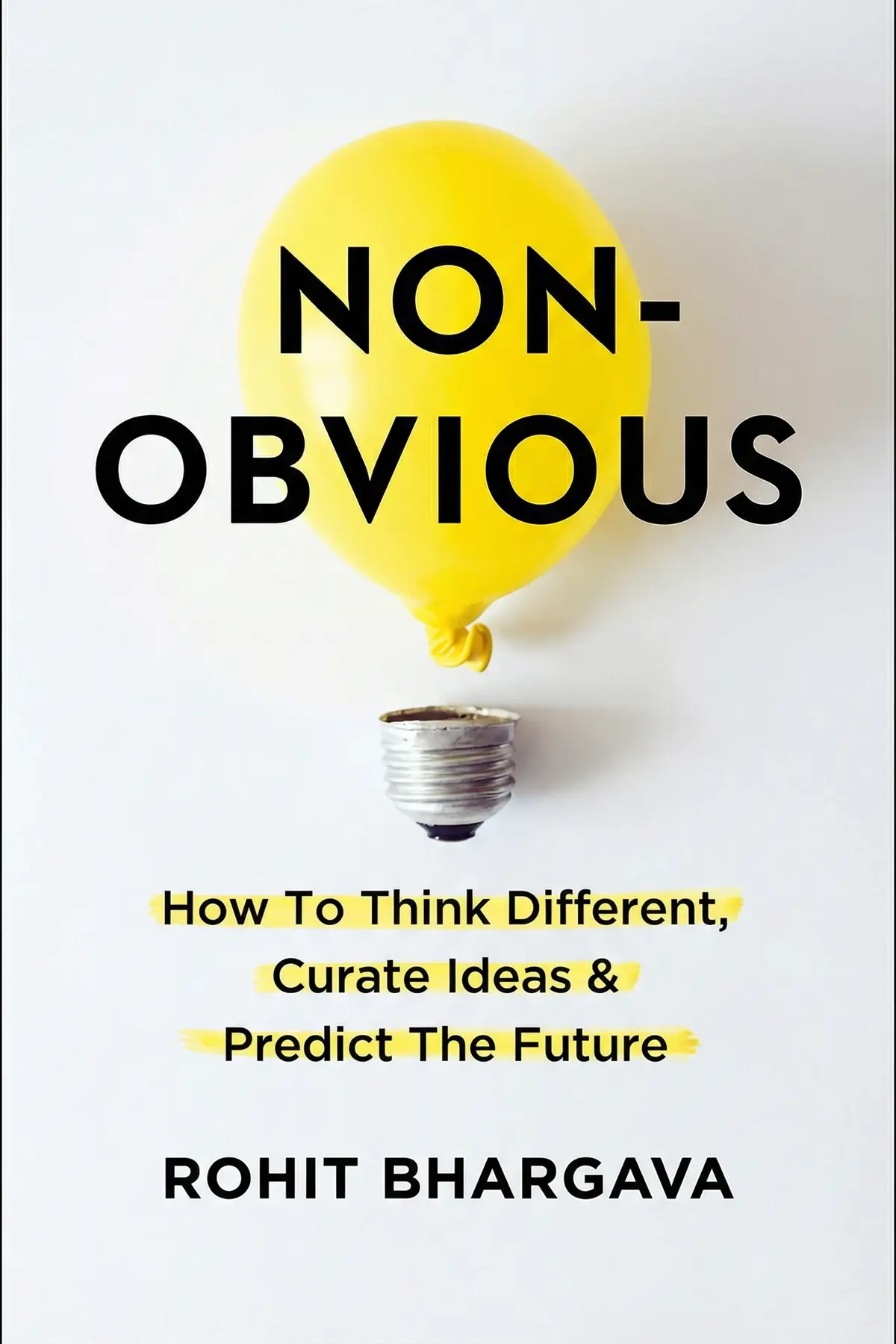
Non-Obvious Thinking: How to See What Others Miss
Non-Obvious Thinking provides a transformative framework for seeing hidden opportunities. Through the SIFT method, readers learn to declutter their minds, observe overlooked details, and turn conventional ideas into innovative breakthroughs.
Table of Content
1. Introduction
1 min 50 sec
Picture yourself in the high-energy atmosphere of Mexico City in 1968. Eighty thousand people are gathered in the Olympic stadium, their eyes fixed on the high jump finals. Most of the athletes look exactly as you’d expect: sleek, focused, and performing the traditional ‘scissors’ kick or ‘straddle’ jump that has been the standard for decades. Then, a student named Dick Fosbury steps up. He looks a bit different, even wearing mismatched shoes. But it’s his technique that shocks the world. Instead of jumping forward or sideways, he turns his back to the bar and flops over it. It looks clumsy, almost ridiculous—until he clears the bar at record-breaking heights.
That moment, which became known as the Fosbury Flop, didn’t just win a gold medal; it shattered the conventional wisdom of an entire sport. Fosbury wasn’t necessarily a more powerful athlete; he was a more creative thinker. He saw an opportunity to use physics in a way no one else had considered. This is the essence of what we are exploring today: the ability to see what everyone else is looking at, but notice what everyone else is missing.
In this summary, we’re diving into the principles of Non-Obvious Thinking. We will explore how to move away from the ‘obvious’ solutions that keep most people stagnant. We’ll follow a specific framework called SIFT—an acronym for Space, Insight, Focus, and Twist. By the time we finish, you’ll have a toolkit for breaking through mental clutter, uncovering deeper truths about the world around you, and applying a unique perspective to any challenge you face. Whether you are navigating a complex career move, trying to innovate in your business, or simply looking to sharpen your daily decision-making, the journey toward non-obvious thinking begins by learning how to intentionally step off the beaten path.
2. Creating the Mental Space for Innovation
2 min 09 sec
Discover how clearing physical and psychological clutter is the first step toward creative breakthroughs. If your mind is full of noise, there is no room for new ideas.
3. Reclaiming Focus Through Rituals and Risk
2 min 06 sec
Break free from the ‘autopilot’ of daily life by introducing small changes and intentional moments of quiet. Learn why a little bit of danger can actually sharpen your mind.
4. Uncovering Deep Insights Through Curiosity
2 min 03 sec
Shift your perspective from seeking simple answers to seeking stories. Learn how to ask the right questions to reveal what others miss.
5. Learning from Nature and Collaborative Futures
2 min 04 sec
Look beyond your own industry to find solutions in the natural world and through the eyes of diverse thinkers.
6. Focusing on the Essential Through the Power of Why
2 min 22 sec
Distill your ideas down to their most potent form. Learn how to identify the root cause of a problem and why ‘good enough’ is often better than perfect.
7. Embracing Constraints and Shifting Perspectives
2 min 04 sec
Learn why limitations are actually the secret sauce of creativity and how looking at things from a different angle can change everything.
8. Adding the Twist: Finding Your Unique Angle
2 min 17 sec
Innovation doesn’t always require a brand-new invention. Sometimes, it just takes a clever twist on an existing idea.
9. Defining Your Identity Through Un-Thinking and Argot
2 min 19 sec
Stand out from the crowd by defining what you are NOT and by creating a unique language for your ideas.
10. Conclusion
1 min 56 sec
As we reach the end of our exploration into Non-Obvious Thinking, let’s reflect on the journey we’ve taken through the SIFT framework. We began by realizing that the greatest successes often come from those who, like Dick Fosbury, are willing to defy tradition and look at a challenge from a completely new angle.
We learned that the first step, Space, is about clearing away the physical and mental clutter that prevents us from seeing clearly. Whether through the simple act of breathing or the practice of open-minded listening, creating this room is essential. From there, we moved to Insight, discovering that the most profound truths often hide in the stories people tell and the subtle non-verbal cues they provide. We saw how nature and diverse perspectives can act as powerful mirrors for our own problems.
Next, we explored Focus, the art of distilling our many insights down to their most potent form. We learned to ask ‘why’ five times to find the root of a problem and to embrace the constraints that force us to be more creative. Finally, we looked at the Twist—the ability to take a familiar idea and give it a unique spin, whether by flipping a convention, finding a third path, or defining ourselves by what we are not.
The throughline of all these ideas is intentionality. Non-obvious thinking doesn’t just happen by accident; it is a skill that you can cultivate by choosing to be more observant, more curious, and more courageous in your perspective. As you go back into your daily life, remember that the most valuable opportunities are often the ones that others are simply too busy or too conventional to see. By applying the SIFT method, you now have the tools to look at the world around you and find the brilliance that is hiding in plain sight. Take these principles, start small, and begin noticing the non-obvious paths that lead to your next great breakthrough.
About this book
What is this book about?
Have you ever wondered why some people seem to spot billion-dollar trends while others are stuck following the crowd? Non-Obvious Thinking explores the mindset and methodology behind identifying the insights that hide in plain sight. Using the SIFT framework—Space, Insight, Focus, and Twist—authors Rohit Bhargava and Ben DuPont demonstrate how anyone can move beyond conventional logic to find creative solutions in business and life. The book promises to sharpen your observational skills and provide a structured way to process the chaos of modern information. From the way high jumpers changed their sport to how vacuum cleaners were reimagined through industrial history, you will learn to look at the world through a new lens. It is an invitation to stop thinking like everyone else and start noticing what truly matters.
Book Information
About the Author
Rohit Bhargava
Rohit Bhargava is a best-selling author and keynote speaker known for his work on trends, innovation, and marketing. He’s written ten books, including Non-Obvious Megatrends, and has delivered talks in over 30 countries. Bhargava also teaches at Georgetown University and is the founder of the Non-Obvious Company and Ideapress Publishing. Ben duPont is a venture capitalist and entrepreneur, best known for cofounding yet2.com and Chartline. He spent over a decade in various management roles at DuPont before launching his own ventures. DuPont also serves as a director for several organizations, including Longwood Gardens and UrbanBound.
Ratings & Reviews
Ratings at a glance
What people think
Listeners describe the work as highly insightful and view it as essential reading. They value its perspective-shifting material, with one listener mentioning how it rips them out of their normal thought process. The book earns praise for its accessibility and narrative style, as one review emphasizes that every section provides a brief story.
Top reviews
Taw
Finally, a manual that actually forces you to look at the world through a different lens rather than just telling you to think outside the box. I was particularly struck by the section on Nunchi and the importance of reading the unspoken atmosphere of a room. It is a rare skill that the authors break down into something actually actionable for the average professional. The writing style is punchy and accessible. This makes it easy to digest a chapter during a morning commute or a quick lunch break. Ripping yourself away from standard maximizer tendencies to become a satisficer is a mental shift that has already reduced my daily stress. This isn't just a business book; it is a guide for navigating the noise of the modern world with actual grace and curiosity.
Show moreFatima
Wow, this book really ripped me out of my usual cognitive ruts and forced me to question my daily rituals. I never realized how much my morning routine was setting my brain on autopilot until I read the authors' take on habit-breaking. The Oasis Moments have become a non-negotiable part of my workday now, allowing me to find clarity amidst the constant digital noise. Each section offers a quick, punchy story that illustrates a complex point without getting bogged down in jargon or academic fluff. It is rare to find a book that is this readable while still delivering profound shifts in how you perceive your surroundings. If you feel like your creative well is running dry, this is the rainstorm you have been waiting for to fill it back up.
Show moreIngrid
Ever wonder why some people just seem to get things that everyone else misses? This book deconstructs that ability into a repeatable process that doesn't feel like a chore to learn. I particularly enjoyed the Option C strategy for avoiding binary thinking, as it has already changed how I approach conflict resolution in my personal life. The authors have a knack for finding the twist in mundane situations, making the world feel like a giant puzzle waiting to be solved. Not gonna lie, I was skeptical about another book on innovation, but the focus on reading the air and deep listening makes this feel much more human than its competitors. It is a delightful guide that I will be recommending to my entire department to help us stop being maximizers.
Show moreKenji
The concept of prebuttals alone made this worth the price of admission for my weekly team meetings. We often fall into the trap of arguing against things before they are even fully articulated, and this book gave us the language to stop that behavior in its tracks. I appreciate how Bhargava and DuPont don't just lecture. Instead, they provide a twist for every situation that feels both practical and slightly subversive. The section on getting your hands dirty really resonated with my leadership style. It reminded me that empathy comes from immersion, not just observation from afar. My only minor gripe is that a few of the anecdotes felt a bit dated, but the core lessons remain incredibly relevant. It is a refreshing take on innovation.
Show moreAnna
As someone who struggles with over-optimization, the chapter on being a satisficer was the slap in the face I needed to move forward on my current project. We are often taught that settling is a failure. The authors argue convincingly that good enough is often the key to maintaining focus and momentum. The book is filled with these little mental pivots that challenge the status quo of modern work culture. I found the un-whatever thinking exercise particularly useful for a branding workshop I ran last week. While not every chapter landed perfectly for me, the hit rate for useful insights was high enough to keep me highlighting every other page. It is a mindset-expanding read that actually offers tools to handle the friction of creative work.
Show moreCarlos
Rohit and Ben have structured this guide brilliantly, alternating between quick anecdotes and concrete implementation steps that anyone can follow. I've read a lot of futurist texts, but this one stands out because it emphasizes self-mastery as the foundation for better sense-making. The idea of reading the air or kuuki wo yomu was a highlight for me, as it bridges the gap between emotional intelligence and strategic observation. It is the kind of book you can open to any page and find a nugget of wisdom to apply to your day immediately. My only criticism is that the Enigmatology section could have been expanded, as it felt a bit rushed compared to the earlier chapters. Still, it is a must-read for anyone looking to sharpen their pattern recognition skills.
Show moreCooper
Picked this up because I enjoyed Bhargava’s previous work, but I found the non-obvious tag a bit of a stretch this time around. Look, the stories are engaging and the Oasis Moments concept is a nice reminder to slow down, but I didn't feel like my brain was truly being rewired. Some of the twists felt more like simple rebranding of existing brainstorming techniques rather than a totally new methodology. That said, the layout is beautiful and the illustrated table of contents makes it a great reference guide for when you are feeling stuck. It is a solid, quick read for a weekend. Just don't expect a total epiphany on every single page. It is good enough for a refresh, but it might not stick with you long-term.
Show moreAmy
While the illustrations and the table of contents are top-tier, the actual advice feels a bit thin in certain chapters. Truth is, I loved the idea of prebuttals and how they shut down dialogue, but other sections felt like they were just skimming the surface of complex topics. The authors have a great voice, and the book is certainly readable. However, I found myself wishing for more data-driven evidence to back up the anecdotes. It is a light, breezy read that would be perfect for someone just starting their journey into creative strategy or innovation. For seasoned professionals, many of these insights might feel like things you have already picked up through years of trial and error. It is a decent primer, just perhaps not the groundbreaking manifesto I expected.
Show moreChokdee
I wanted to love this because the Oasis Moments idea is beautiful, but the pacing felt uneven throughout the middle sections. In my experience, some of the non-obvious tips felt a little too similar to the obvious ones found in every other self-help book on the shelf. The chapter on nunchi was fascinating and felt truly original, but then the book would pivot back to advice about taking risks that felt a bit generic. It is a visually stunning book, and the think backwards problem-solving tip is definitely a keeper for my toolkit. However, I think the authors could have trimmed about fifty pages to make the impactful insights hit even harder. It is a helpful book, just not a revolutionary one.
Show moreJan
This felt like a collection of generic LinkedIn posts that were hastily assembled into a book format. To be fair, I was expecting deep psychological insights, but instead, I got a lot of common sense masquerading as revolutionary wisdom. The authors talk about being non-obvious, yet most of the advice—like taking breaks or listening more—is the definition of obvious. If you have read even two books on productivity or creativity in the last decade, you will likely find nothing new here. It honestly feels like the content could have been generated by an AI prompted to write quirky business advice. There are some cute stories, but the substance is lacking for anyone looking for serious intellectual rigor. This was a massive disappointment for me.
Show more
Readers also enjoyed



AUDIO SUMMARY AVAILABLE
Listen to Non-Obvious Thinking in 15 minutes
Get the key ideas from Non-Obvious Thinking by Rohit Bhargava, plus 5,000+ more titles in English and Thai.
- 5,000+ titles
- Listen as much as you want
- 7-day free trial
- Cancel anytime







