Non-Obvious Thinking: How to See What Others Miss
Rohit Bhargava
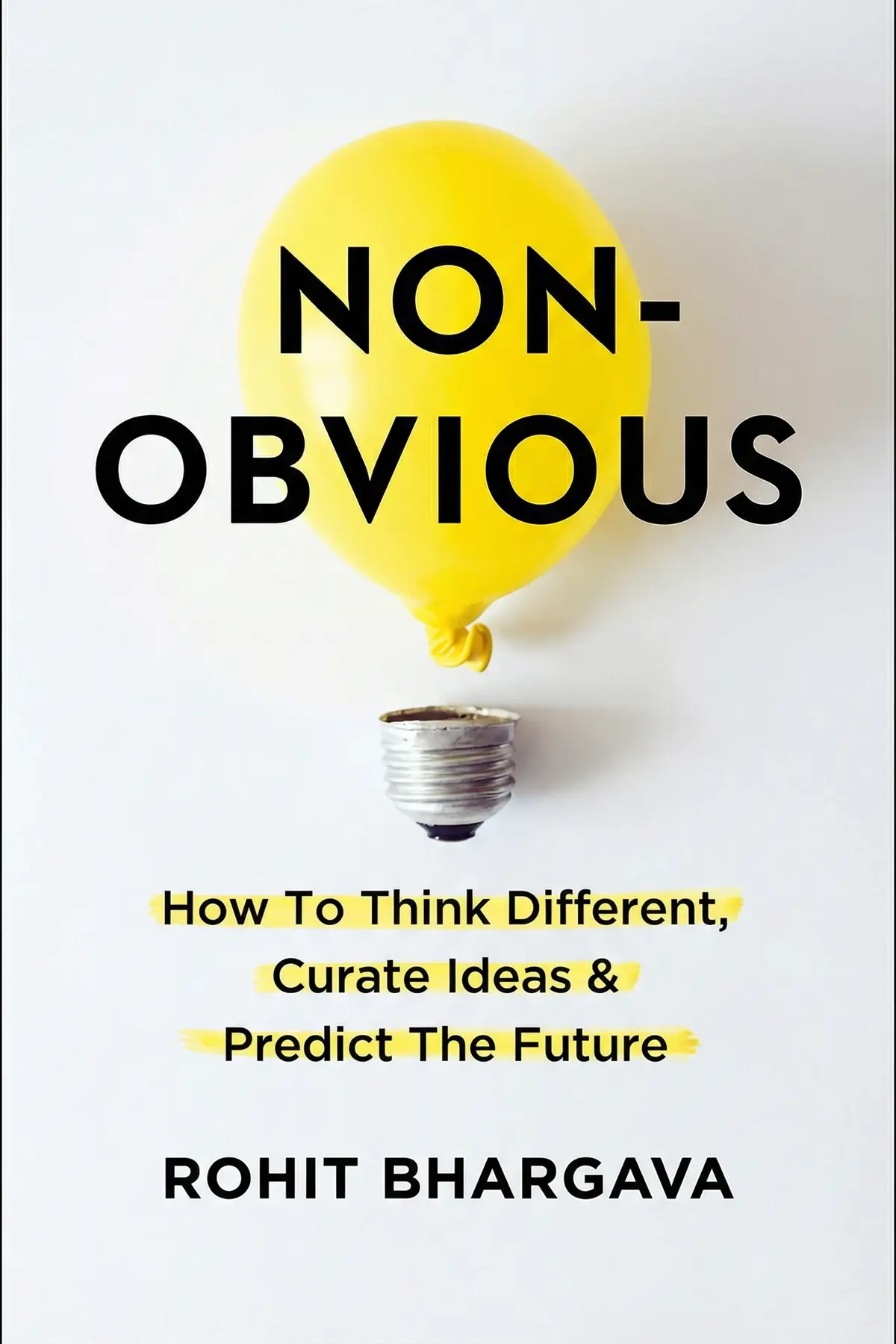
Non-Obvious explores how to identify hidden patterns and emerging trends by adopting a curator's mindset. Learn to see what others miss and predict the future through observation and creative analysis.
1 min 49 sec
In the mid-1960s, a science fiction show titled Space 1999 captivated audiences with a vision of a lunar colony established by the end of the century. At the time, with the space race in full swing, it seemed perfectly logical to assume that by the year 2000, humanity would be living among the stars. It was what most people would call an obvious prediction. It was a straight line drawn from the present into the future. Yet, as we know, that future never arrived in the way people expected.
This highlights a fundamental problem with how we try to anticipate what’s next. Most of us look at the surface-level noise of the present and assume it will simply get louder or faster. We see rockets, so we predict moon bases. We see cars, so we predict flying cars. These obvious predictions are almost always wrong because they fail to account for the complex, shifting undercurrents of human psychology, economics, and culture.
However, predicting the future isn’t an impossible task; it simply requires a different lens. Instead of looking for the obvious, we must learn to see the non-obvious. This is the art of trend curation. It is the ability to look at the world today and identify the hidden patterns that others are overlooking. It’s about understanding not just what is happening, but why it is happening and what those shifts imply for the years to come.
In this summary, we will explore the techniques used by professional trend spotters to cut through the noise. You’ll learn how to adopt the mindset of a curator, the specific five-step process for identifying trends, and a look at some of the actual cultural shifts that are currently reshaping our world. By the end, you’ll have a toolkit for staying ahead of the curve in both your professional and personal life, moving beyond guesswork to informed, strategic foresight.
2 min 05 sec
What if you could view the world through the eyes of a museum professional? Discover how moving from a collector to a curator changes how you interpret information.
2 min 38 sec
Finding a valuable trend is often compared to finding a needle in a haystack. Learn the systematic five-step process to build your own insights from the ground up.
2 min 10 sec
Success in trend-spotting isn’t just about the method; it’s about your personality. Why curiosity and even fickleness are your greatest assets.
1 min 55 sec
Insights are useless if they aren’t understood. Learn why slowing down to think and using poetic metaphors are keys to making your ideas stick.
2 min 01 sec
Identifying a trend is only half the battle. Learn how to use intersectional thinking and collaborative workshops to put your insights to work.
1 min 58 sec
From theme parks to the football field, discover how our desire for personal recognition and mental balance is changing the business landscape.
2 min 05 sec
Physical stores aren’t dying; they’re changing. Explore the shift toward reversible retail and why glanceable content is the new standard for attention.
1 min 53 sec
Why paying for laughter and private pizza parties with pop stars are the future of how we interact with the products we love.
1 min 18 sec
Predicting the future isn’t about having a crystal ball; it’s about having a better pair of glasses. As we’ve seen, the ‘obvious’ predictions—the ones that simply project today’s technology into tomorrow—are almost always destined to fail because they ignore the human element. To truly stay ahead, you must become a trend curator.
By adopting the Haystack Method, you can transform the way you process information. Start gathering widely, aggregating those ideas into clusters, and elevating them to find the hidden meanings. Give your insights a name and prove them with real-world evidence. But remember, the method only works if you cultivate the right mindset. Stay curious about the world, remain fickle enough to explore diverse industries, and be observant of the tiny details that others ignore.
As you move forward, look for the intersections between the trends we discussed—like the desire for everyday stardom, the need for mindfulness, and the shift toward microconsumption. Ask yourself: How do these shifts affect my work? How can I communicate my ideas with more elegance and thoughtfulness? The future belongs to those who can see the patterns before they become obvious. By training your mind to look deeper, you won’t just be ready for the future—you’ll be the one helping to shape it. Start building your haystack today, and keep your eyes open for the non-obvious.
In a world flooded with information, most people focus on the obvious, leading to shallow predictions and missed opportunities. Non-Obvious provides a structured framework for breaking out of this cycle. Rohit Bhargava introduces the concept of the "Trend Curator," someone who doesn't just collect data but synthesizes it to find deeper meaning. The book promises to transform how you view the world around you. By moving through the specific "Haystack Method," you will learn how to gather insights from diverse fields, connect seemingly unrelated ideas, and validate your findings. Whether you are a business leader looking for the next big market shift or an individual aiming to stay ahead of cultural changes, this guide offers the tools to think more critically and predict future shifts with greater accuracy.
Rohit Bhargava is an author, marketing and business expert and trend curator. He is also CEO and founder of the Influential Marketing Group, and a two-time TEDx speaker. Non-Obvious is his second bestselling book.
Rohit Bhargava
Listeners find the writing both clear and accessible, noting that it is packed with valuable insights and hands-on instructions. They particularly enjoy the stimulating take on innovative thought and spotting market trends, as one listener points out that it delivers the resources needed to become a trend curator. The book is also highly regarded for its practicality, with one listener highlighting its specific usefulness for business owners.
Finally got around to diving into this year's report, and it has quickly become my favorite way to kick off my professional planning sessions. The author's approach is truly refreshing and unique. He provides actual tools rather than just making vague predictions about the future. I found the sections on how to become a curator especially useful for my current role in digital marketing where everything moves at light speed. While some might find the 25-chapter structure a bit daunting, the brevity of each section makes it very easy to digest during a morning commute. This is definitely a book I will keep on my shelf for years.
Show moreHonestly, the framework provided for trend curation is worth the price of the book alone because it turns a mysterious skill into something manageable. Most books in this genre just tell you what is happening. This one actually shows you how to figure it out for yourself. It is incredibly thought-provoking and offers a wealth of information for anyone who needs to understand where their industry is headed next. I did find the sheer number of chapters a bit overwhelming at times. Despite that, the practical utility of the advice makes this a must-read for any serious entrepreneur or creative professional looking to sharpen their vision.
Show moreAs a small business owner, I am always hunting for strategies to stay ahead of the competition without spending a fortune on consultants. Frankly, this book serves as an excellent starting point for anyone looking to sharpen their creative thinking skills through practical, real-world examples. Bhargava does a fantastic job of breaking down how to spot patterns in everyday life. He successfully turns the act of trend curation into a repeatable process for the average reader. Some chapters felt more relevant than others, particularly the ones focused on consumer behavior and authentic marketing, yet the shift in mindset is well worth the time.
Show moreI've been following Rohit’s work for quite a while, and I appreciate how he translates complex market shifts into something approachable. The book is remarkably well-written, avoiding the dense jargon that usually plagues the entrepreneurship category, which makes for a very quick and enjoyable read. By providing a practical guide to spotting patterns, he empowers the reader to become a trend curator in their own right. My only real gripe is that some of the later chapters felt a bit rushed compared to the deeply insightful opening sections. Still, the overall focus on being more authentic in a digital world is a message that every professional needs to hear.
Show moreQuick read with some genuinely great content for anyone interested in marketing or the future of entrepreneurship. I can’t believe I didn’t pick this up earlier, especially given how much I struggle with staying relevant in a constantly changing industry where new ideas become obsolete overnight. The practical guides are excellent for any professional. Personally, I found the chapter on unperfection to be the most relevant to my current projects because it encouraged me to embrace brand flaws. While some sections are definitely stronger than others, the good parts are absolutely worth your time and will help you think much more creatively.
Show moreNot what I expected when I first saw the cover, but this book turned out to be a pleasantly surprising look at modern culture. Many of the insights regarding how we perceive authenticity in an increasingly automated world really hit home for me on a personal level. The truth is that many of us are tired of 'perfect' marketing, and Bhargava's call to embrace the imperfect is a welcome change of pace. While the book is quite long with 25 chapters, the easy-to-read style means you can breeze through it in a weekend. It provides a unique lens through which to view the world, even if some predictions feel dated.
Show moreThe chapter on unperfection and authenticity was the highlight of the experience for me because it challenged the way I view brand flaws. I gotta say, there is a powerful distinction between something being broken and something being intentionally imperfect to show its human side. While I appreciated that specific takeaway, other parts of the book felt a bit repetitive or perhaps a little too obvious for a book titled 'Non-Obvious.' It is an easy read with plenty of thought-provoking moments. However, it lacks the deep technical meat I usually look for in a business text. It sits comfortably in the middle for me—good, but not life-changing.
Show moreEver wonder if those 'experts' on the news actually know what they are talking about when they predict the next big thing? In my experience, most business books are just fluff. This one actually attempts to give you a methodology for seeing what everyone else misses. Look, not every trend mentioned here will be a 'eureka' moment, and some of them felt like things I had already seen on Twitter months ago. However, the value lies in the mindset of trend curation and learning how to connect disparate dots to form a larger picture. It is a solid read that offers enough utility to justify the purchase.
Show moreThis book had so much potential considering the rave reviews, but the truth is it suffers from a classic case of a good idea with poor execution. While the first three chapters provide a solid foundation for understanding modern curation, the remaining twenty-two sections felt like unnecessary filler. To be fair, I did find a few of the specific trends insightful. However, the writing style became increasingly difficult to navigate as the book progressed because the structure lacked a clear narrative to keep me engaged. I wanted to love it given the marketing hype, but it just didn't hold my interest until the very end.
Show moreAfter hearing all the hype about this being a Wall Street Journal bestseller, I went in with very high expectations that weren't entirely met. To be fair, the information provided is technically interesting, but the writing style felt a bit disconnected after the first few chapters. It felt like I was reading a series of separate articles rather than a cohesive book with a strong narrative arc from start to finish. I struggled to get through the middle portion because the pace slowed down significantly and the insights became less actionable. It is a decent resource for a broad overview, but don't expect it to provide a deep, technical masterclass.
Show moreAUDIO SUMMARY AVAILABLE
Get the key ideas from Non-Obvious by Rohit Bhargava, plus 5,000+ more titles in English and Thai.