
Noise: A Flaw in Human Judgment
Daniel Kahneman
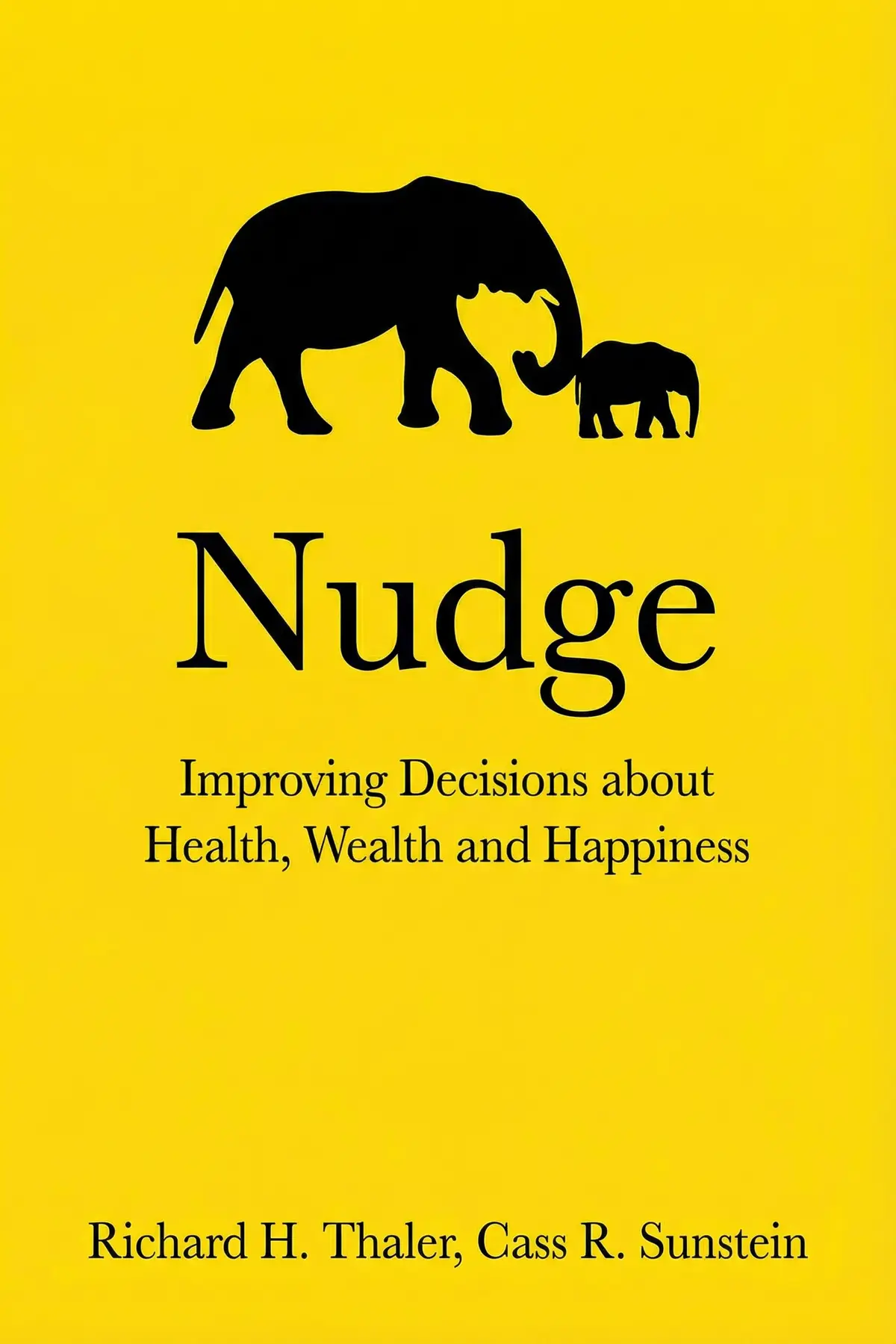
Nudge explores how subtle shifts in our environment, known as nudges, can significantly improve our decision-making. Learn how to design better choices for yourself and others without sacrificing the freedom to choose.
1 min 42 sec
Have you ever wondered why we often act as our own worst enemies? Most of us possess a clear vision of the life we want to lead. We envision ourselves as people who eat nutritious meals, save a responsible portion of our income for the future, and avoid harmful habits like smoking. However, when we look at our actual behavior, a different story emerges. We reach for the convenience of junk food, we procrastinate on financial planning, and we find ourselves stuck in cycles that contradict our long-term goals.
This discrepancy between our intentions and our actions is a core part of being human. We aren’t failing because we lack information; we are failing because the way we make decisions is fundamentally influenced by the world around us. These unwise behaviors aren’t limited to minor daily choices; they extend to major life events. We see people in the United States saving very little for retirement, despite knowing the risks of old-age poverty. We see individuals ignoring the need for an emergency fund until a car breaks down or a job is lost, at which point the irrationality of past choices becomes painfully clear.
The central throughline of this exploration is that while we are fallible, we are also influenceable. By understanding the science of how we choose, we can learn to steer ourselves—and our society—toward better outcomes. The goal isn’t to take away anyone’s freedom, but to recognize that no choice happens in a vacuum. Everything around us is a ‘nudge’ that either helps us or hurts us. By becoming more intentional about these influences, we can finally bridge the gap between who we are today and who we want to be in the long run.
1 min 41 sec
Why too much information can be just as paralyzing as too little when making big life decisions.
1 min 32 sec
How our brains alternate between fast gut reactions and slow logical thinking, and why that matters.
1 min 31 sec
The surprising reason why even bad-tasting food can lead us to overeat when we aren’t paying attention.
1 min 33 sec
How businesses can use our natural tendencies to keep us subscribed to services we no longer want or need.
1 min 27 sec
A look at how rearranging a simple environment can guide us toward healthier habits without taking away our freedom.
1 min 22 sec
The reason why doing nothing can sometimes be the best way to ensure you are saving enough for your future.
1 min 24 sec
Why we struggle most with decisions that don’t happen very often and how a little guidance can help.
1 min 31 sec
How you can use financial stakes and public commitments to finally stick to your hardest personal goals.
1 min 36 sec
The way that institutional reminders and public reporting can create positive change for the whole world.
1 min 40 sec
The core takeaway from our look at these behavioral insights is that human beings are fundamentally imperfect decision-makers. We are easily distracted by short-term rewards, overwhelmed by complex data, and prone to staying in a state of inertia. However, this doesn’t mean we are helpless. By embracing the power of ‘nudges’—those subtle changes in how choices are presented—we can significantly improve our lives and our communities without ever resorting to bans or mandates.
We’ve seen that we make our worst mistakes when we are operating on gut instinct in situations that require deep reflection, or when the world around us is designed to exploit our weaknesses. To counter this, we must become ‘choice architects.’ Whether you are a parent arranging a healthy pantry, a business owner setting up a retirement plan, or a government official designing public policy, you have the power to make the right choice the easy choice.
Remember that there is no such thing as a neutral design. Every environment pushes us in one direction or another. The question is whether that push is intentional and helpful. By using defaults, simplifying complex information, and creating personal accountability systems, we can navigate a world full of temptation and emerge healthier and more secure. The final lesson is one of empowerment: we can design a future where our daily actions finally align with our deepest aspirations, one small nudge at a time. Start by looking at the small defaults in your own life and ask yourself: where is this path leading me, and is it time to change the architecture?
Nudge examines the gap between how we think we make decisions and how we actually make them. Authors Richard H. Thaler and Cass R. Sunstein reveal that humans are not the perfectly rational calculators described in economic textbooks. Instead, we are prone to biases, gut-level impulses, and simple laziness. By understanding these human traits, we can implement choice architecture—the practice of organizing the context in which people make decisions. The book promises a framework for guiding people toward choices that improve their health, wealth, and happiness. It introduces the concept of libertarian paternalism: the idea that it is possible and legitimate for institutions to affect behavior while also respecting individual liberty. Whether it is a government designing a retirement plan or an individual setting up a gym routine, this book provides the tools to use subtle influences to achieve better long-term outcomes for everyone involved.
Richard H. Thaler (b. 1945) is a professor of Behavioral Science and Economics at the University of Chicago. Cass R. Sunstein (b. 1954) is a professor at Harvard Law School and serves as an advisor to president Barack Obama.
Daniel Kahneman
Richard H. Thaler
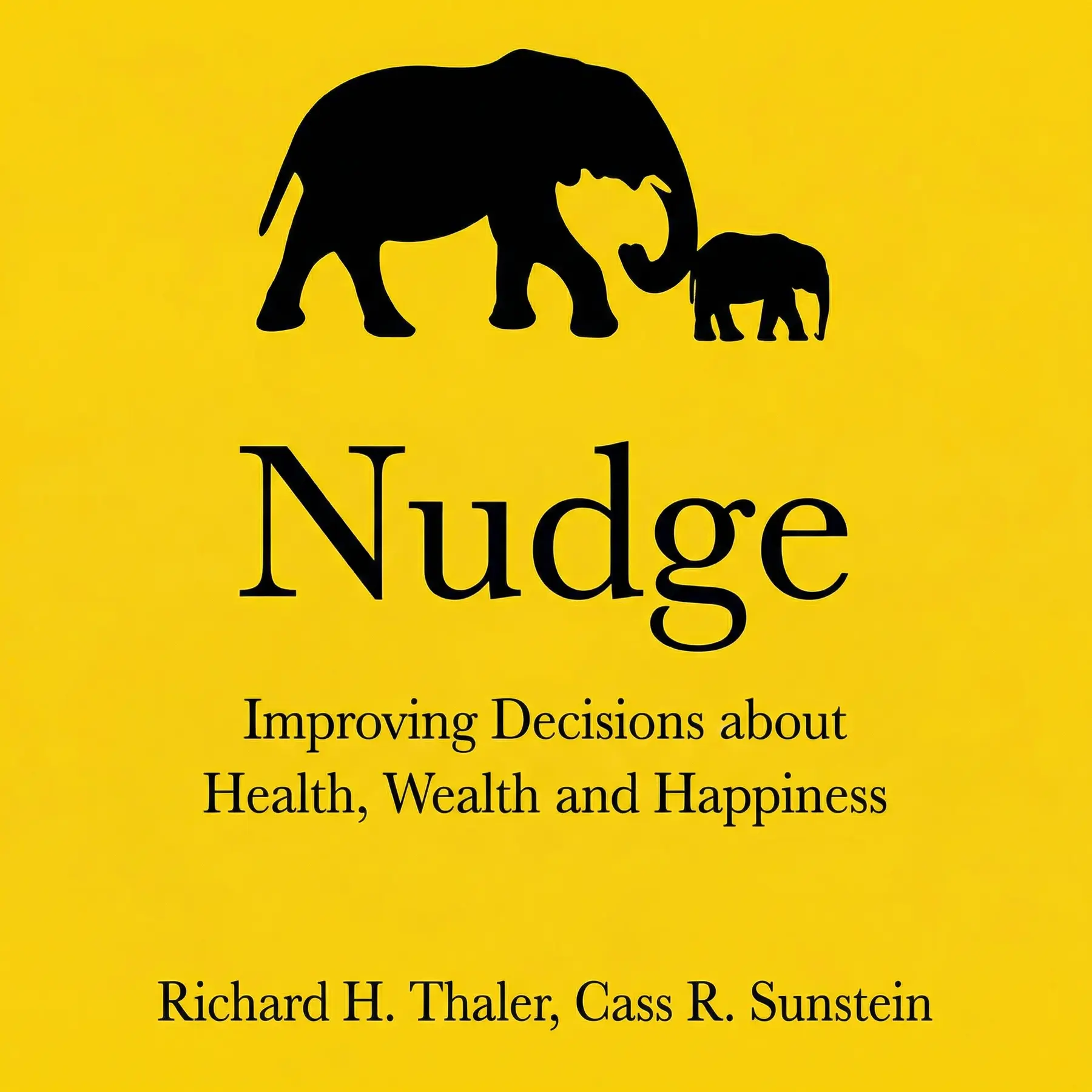
Listeners find this work both captivating and stimulating, featuring high-quality prose and useful real-world instances. They value the perspectives offered on choice architecture and human behavior, specifically the concept of libertarian paternalism. The text receives praise for being easy to digest; one listener mentions the possibility of reading it in separate parts, while another listener points out how every chapter centers on a unique concept.
This book is a masterclass in understanding how we make decisions. The concept of "choice architecture" is brilliantly illustrated through simple examples like a school cafeteria layout where fruit placement nudges kids toward better health. Thaler and Sunstein explain complex behavioral economics in a way that feels surprisingly accessible and practical. I found myself thinking about the "nudges" in my own life long after finishing the last chapter. While some sections are denser than others, the payoff is immense for anyone interested in psychology. It really highlights how small design changes can lead to huge societal shifts. Truly a fundamental read for understanding modern society.
Show moreThe chapter on "Save More Tomorrow" changed how I look at my own finances. Thaler and Sunstein show how we can outsmart our own procrastination by committing to future contributions to our retirement funds. It’s a brilliant example of a nudge that works because it understands human laziness and loss aversion. I appreciated the clear, distinct sections that make it easy to pick up and put down. Each chapter tackles a different real-world scenario, from marriage to environmental policy. It is a thought-provoking read that offers genuine solutions for our flawed decision-making processes. It makes you realize how often we are being steered by invisible hands.
Show moreEver wonder why you signed up for a subscription you never use or why you can't seem to save money? This book holds the answers. Thaler and Sunstein have crafted a mind-changing guide to how the world is structured to influence our every move. I found the section on "choice architecture" to be revolutionary for my own work in communications. The authors managed to take heavy topics like the 2008 financial crisis and make them relatable through a behavioral lens. It’s practical, insightful, and honestly, a bit scary when you realize how easily we are influenced by simple defaults. Essential reading for anyone who wants to regain control over their choices.
Show moreWow, I didn't expect a book about economics to be this readable. The authors present a fascinating case for "libertarian paternalism," which basically means setting up defaults that help people without removing their freedom. One of the most compelling parts was the discussion on organ donation and how simply changing a form’s default can save lives. My only gripe is that the middle sections drag a little bit when they dive into the weeds of US healthcare and retirement plans. If you aren’t American, those specific chapters might feel a bit irrelevant or dry. Still, the core ideas regarding human behavior are absolute gold.
Show morePicked this up for a book club and was surprised by how much debate it sparked. Even though several members didn't finish the whole thing because of the dense economic data, the discussion was incredibly lively. We spent an hour talking about whether the government should be in the "marriage business" at all, which was an unexpected turn! The writing is clear, but let's be real: some of the financial planning examples are tedious. However, the insight into how defaults shape our lives is too important to ignore. It’s a solid 4-star read for anyone in management, design, or policy work who wants to understand their audience better.
Show moreFinally got around to reading this updated classic and I can see why it’s making such a policy impact in the UK and USA. The authors provide a funny and remarkably clear exposition of why we constantly sabotage our long-term goals. Unlike many books that just point out our flaws, this one actually suggests remedies. I particularly enjoyed the analysis of loss aversion and how it applies to everything from energy bills to school choices. It’s analytical without being overly academic, though it does require some focus during the policy-heavy segments. A very rewarding read for the patient reader who wants to improve their choice architecture.
Show moreAfter hearing so many endorsements from big names like Obama and Cameron, I had high expectations for this "new international edition." To be fair, it’s a bit of a letdown because it remains stubbornly US-centric despite the branding. Most of the case studies focus on very detailed American insurance policies and financial structures that don't translate well to a global audience. The first third of the book is excellent and introduces the "Econs vs. Humans" concept clearly, but then it gets bogged down in policy minutiae. It’s worth a skim for the social psychology, but be prepared to skip the denser, more localized chapters if you live outside the States.
Show moreLook, I’ve been reading a lot of behavioral psychology lately, and Nudge falls somewhere in the middle of the pack for me. The logic is sound, and the research is clearly top-tier, but the execution feels a bit dated compared to newer titles. It’s essentially about how "Humans" aren't "Econs," and how "choice architects" can help bridge that gap. While the organ donation and 401k examples are classics, they’ve been discussed so much in other media that they didn't feel fresh. It’s a good foundational text, but it probably won’t blow your mind if you're already familiar with the field. I'd recommend it as a reference rather than a page-turner.
Show moreNot what I expected for a runaway bestseller, but it has its moments. The truth is that the core concepts are fascinating, especially the idea that there is no such thing as a "neutral" design. Whether you’re setting up a website or a lunchroom, you’re already nudging people somewhere. However, the authors' "libertarian paternalist" label feels like a bit of a contradiction that they never quite resolve to my satisfaction. I ended up skimming the later chapters on privatizing marriage and healthcare because they felt very specific to US law. It’s a "good-to-know" book, but maybe not a "must-read-every-word" book for everyone.
Show moreIs it just me, or is this book incredibly overrated? The central idea—that we can be "nudged" into better choices—is interesting but could have been summarized in a long essay. Instead, we get over 200 pages of repetitive anecdotes and a tone that feels a bit too "jokey" for the serious political power dynamics at play. It feels like a manual for making us more compliant "Rational Economic Men" rather than truly autonomous individuals. I found Predictably Irrational much more engaging and less patronizing. To be fair, the data on pension defaults is solid, but the rest felt like a stretch. It's too much fluff for one good idea.
Show more
William J. Bernstein
Deborah Gruenfeld
Anthony Pratkanis
Yanis Varoufakis
AUDIO SUMMARY AVAILABLE
Get the key ideas from Nudge by Richard H. Thaler, plus 5,000+ more titles in English and Thai.







