
14 min 42 sec
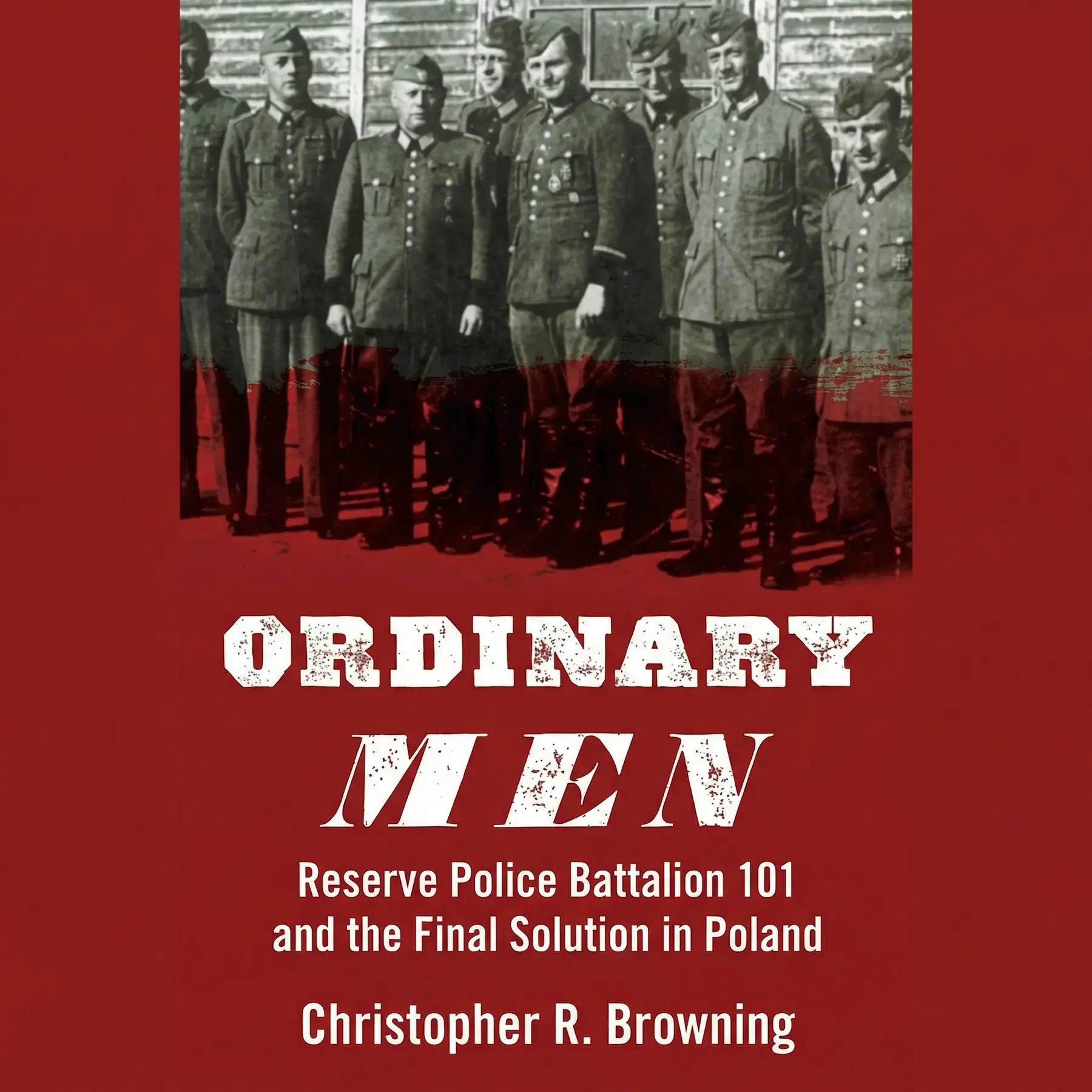
Ordinary Men: Reserve Police Battalion 101 and the Final Solution in Poland
This summary investigates the haunting transformation of Reserve Police Battalion 101, exploring how middle-aged German reservists with no military background became perpetrators of the Holocaust through social pressure and psychological conditioning.
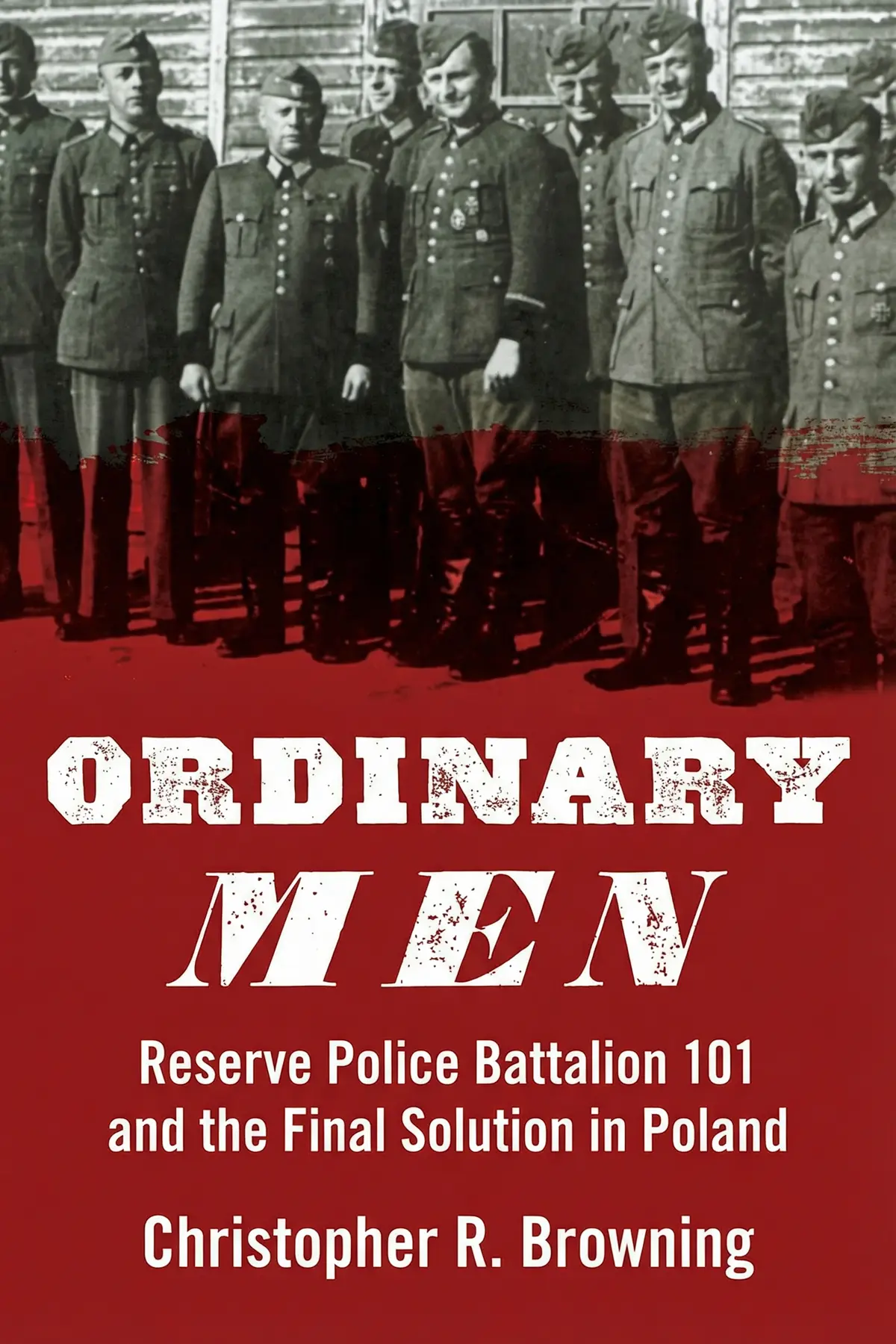
Table of Content
1. Introduction
1 min 41 sec
When we think about the perpetrators of the Holocaust, we often imagine fanatical ideologues—men who were deeply committed to Nazi doctrine from a young age. We picture a specific kind of monster. But the reality uncovered in Christopher R. Browning’s research presents a far more disturbing picture. It tells the story of Reserve Police Battalion 101, a unit composed of men who were, by every sociological metric, entirely unremarkable.
These were not young, indoctrinated soldiers. They were middle-aged men, mostly in their late thirties and early forties, who had grown up before the Nazi party rose to power. They were husbands, fathers, and workers from Hamburg, a city that was historically one of the least hospitable to the Nazi movement. Most of them came from working-class or lower-middle-class backgrounds, groups that were traditionally aligned with political movements like Social Democracy or Communism rather than the far right. They had no prior military experience and had not been hardened by the rigors of the front lines.
Yet, between 1942 and 1943, this specific group of five hundred men was responsible for the direct shooting of at least 38,000 Jewish people and the deportation of 45,000 more to death camps. How did this happen? How did a group of people who seemed so ill-suited for the role of executioner become efficient cogs in the machinery of genocide? Through this summary, we will explore the psychological and situational forces that reshaped these ordinary individuals into mass murderers. It is a journey into the darkest corners of human behavior, revealing the throughline of how routine, authority, and the pressure to belong can lead anyone toward the unthinkable.
2. The First Confrontation with Atrocity
2 min 05 sec
Discover the pivotal morning in Józefów when a commander’s tearful plea and an extraordinary offer to opt out of murder revealed the initial moral struggle of the battalion.
3. The Institutionalization of Genocide
1 min 39 sec
Explore how the Order Police were repurposed into tools for the Final Solution, bridging the gap between local policing and systematic mass extermination.
4. The Hardening Effect of Outsourcing Death
1 min 47 sec
Notice the shift in the battalion’s psychology as the direct burden of killing was shared with collaborators and removed by the use of death camps.
5. Individual Sadism and the Loss of Identity
1 min 59 sec
Examine how certain leaders within the battalion embraced cruelty, showing how an environment of sanctioned violence can cultivate individual sadism.
6. The Persistence of the 'Jew Hunts'
1 min 47 sec
See how the battalion transitioned into systematic hunting, making murder a mundane, daily routine that required no special orders to sustain.
7. The Pressure of Conformity and Authority
2 min 07 sec
Analyze the sociological drivers behind the battalion’s actions, from the fear of social isolation to the psychological weight of state-sanctioned orders.
8. Conclusion
1 min 37 sec
The story of Reserve Police Battalion 101 is not a comfortable one to hear, but it is a necessary one to understand. By the end of their deployment in Poland, this group of fewer than five hundred ordinary, middle-aged men from Hamburg had been responsible for the deaths of over 80,000 people. They were not uniquely evil; they were simply people who found themselves in a situation where the moral floor had been removed.
Their journey from the tearful hesitation of Józefów to the callous “breakfast” of the Jew hunts highlights the terrifying plasticity of human morality. It shows us that dehumanization, when backed by the state and reinforced by peer pressure, can turn almost anyone into a perpetrator. The men of the battalion were faced with choices, and while a small minority chose to resist, the vast majority chose to conform. They prioritized their social standing and their professional duty over the lives of the thousands they murdered.
The throughline we must take away is a warning. We should not look at these men as an alien species or a product of a defunct era. Instead, we must recognize the “ordinary” qualities they possessed. Their motivations—the fear of being an outcast, the habit of obeying authority, and the ability to rationalize violence—are universal human traits. The real challenge is to create societies and personal moral compasses that are strong enough to withstand these pressures. If ordinary men could become mass murderers, we must all ask ourselves what we are doing to ensure that we would choose differently. The legacy of Battalion 101 is a call to vigilance, reminding us that the line between a citizen and a killer is often thinner than we dare to imagine.
About this book
What is this book about?
Ordinary Men examines one of the most chilling questions of the twentieth century: how do normal, middle-aged people with no prior history of violence become willing participants in genocide? This investigation follows Reserve Police Battalion 101, a unit of German order police stationed in occupied Poland during the height of the Holocaust. Unlike the fanatical SS often depicted in history, these men were older, working-class reservists from Hamburg, a city known for its political moderation. The book promises a deep psychological and historical autopsy of their transformation. It moves from their first horrific assignment in the village of Józefów to the systematic "Jew hunts" that followed. By analyzing their motivations—ranging from the pressure of peer conformity and the weight of authority to the gradual desensitization caused by routine violence—the narrative reveals the uncomfortable truth that the capacity for such atrocities resides within the "ordinary" structures of human society and psychology. It offers a sobering look at the thin line between a peaceful citizen and a perpetrator of mass murder.
Book Information
About the Author
Christopher R. Browning
Christopher R. Browning is the professor emeritus of history at the University of North Carolina at Chapel Hill. In 2006, he was elected a Fellow of the American Academy of Arts and Sciences. He won the National Jewish Book Award three times, including for Ordinary Men in addition to The Origins of the Final Solution and Remembering Survival.
Ratings & Reviews
Ratings at a glance
What people think
Listeners find this account gripping and excellently crafted, noting that the meticulously documented research provides fresh perspectives on historical moments. They value its worth as a teaching tool for history students and its deep reflections on human nature. The storytelling draws varied responses, with some finding it interesting while others find it disturbing.
Top reviews
Titiluck
This book should be required reading for anyone interested in the darker corners of human psychology. Browning meticulously reconstructs the actions of Reserve Police Battalion 101, showing how regular middle-aged men became executioners. It’s not just a history of the Holocaust; it’s a study of conformity and peer pressure. Truth is, the most frightening part isn't the brutality, but how relatable these men's social anxieties feel. They weren't monsters by nature, just followers. The writing is clear and avoids unnecessary sensationalism while remaining deeply impactful. I found the analysis of the Józefów massacre particularly haunting because it highlights that these men actually had a choice to step away. While the subject matter is grueling, the insight into the 'banality of evil' is indispensable for understanding our own capacity for violence.
Show moreVipawan
As a psychology student, I was fascinated by how Browning integrates the Milgram experiment and Zimbardo’s prison study into his historical analysis. He provides a nuanced look at why RPB 101 acted the way they did, moving beyond the simple 'they were just following orders' excuse. Look, the fact that their commander, Captain Trapp, offered them a way out is the most damning piece of evidence in the whole book. Most didn't take it because they didn't want to look 'weak' in front of their comrades. It’s a brilliant exploration of social dynamics. The prose is academic yet accessible, making complex sociological theories easy to grasp through the lens of specific historical events. Truly one of the most sobering books I've ever read about the human condition.
Show moreHemp
Christopher Browning doesn't pull any punches in this historical masterclass. He takes us through the 'pre-industrial' phase of the Holocaust, where the killing was done face-to-face rather than in gas chambers. These were middle-aged guys, many with families back in Hamburg, who just... did it. They went from village to village, rounding up people and shooting them in the woods. The most striking thing is the 'routinization' Browning describes—how quickly mass murder became just another day at the office. The level of detail regarding the battalion's structure and the specific orders they received is impressive. It’s a harrowing look at what humans are capable of when they stop seeing others as human. Essential reading for any history buff.
Show moreYam
Terrifyingly relevant even decades after it was first published. Browning shows that the line between 'normal' and 'monster' is much thinner than we like to believe. The focus on the 500 men of RPB 101 provides a micro-history that explains the macro-tragedy of the Holocaust better than many broader overviews. I was particularly struck by the stories of the few men who did refuse—it shows that there was always a choice, however difficult it might have been to make. The truth is, this book isn't just about the past; it’s a warning about the future and the dangers of blind conformity. If you want to understand the psychological machinery of genocide, start here. It’s a tough, brutal read, but absolutely necessary.
Show moreYuki
Wow, this was a heavy one to get through. Browning looks at a group of German 'ordinary men' who weren't even particularly pro-Nazi, yet they ended up slaughtering thousands. Personally, I found the descriptions of the initial shootings in Poland to be incredibly graphic and hard to stomach. It’s one thing to read statistics, but it’s another to read about how these men felt physically ill after their first massacre. The book dragged a bit in the middle with the repetitive nature of the battalion's movements, but the concluding chapters on the psychological factors are brilliant. Not gonna lie, I felt pretty sick reading about the 'routinization' of mass murder. It’s a necessary read, but definitely not for the faint of heart or those looking for a light history.
Show moreAir
Ever wonder what you would do if you were placed in an impossible moral situation? This book suggests that most of us would probably fail the test. Browning traces the descent of Reserve Police Battalion 101 from regular citizens to seasoned killers with terrifying precision. The chapter on the Józefów massacre is particularly enlightening because it shows the initial hesitation of the men before they became desensitized. I appreciated how the author didn't just label them as 'monsters' but tried to understand the social mechanics of their actions. My only gripe is that the book focuses so heavily on this one unit that I wonder how applicable these findings are to the SS or more fanatical groups. Still, it’s a thought-provoking and deeply unsettling piece of work.
Show moreFort
After hearing about the Goldhagen controversy, I finally decided to read Browning’s take. It’s a much more balanced and convincing argument in my opinion. He shows that you don't need 'eliminationist' anti-Semitism to get regular people to participate in genocide. The peer pressure and the fear of social ostracization are enough. The book is incredibly well-documented, using interrogation records from the 60s to piece together the battalion’s timeline. To be fair, the writing can be quite clinical, which creates a strange distance between the reader and the atrocities being described. Some might find that helpful, but I found it a bit jarring given the subject matter. Overall, it’s an essential text for understanding how the Holocaust functioned on the ground level.
Show moreOscar
These weren't SS fanatics or brainwashed teenagers. They were bakers, clerks, and dockworkers who were too old for the front lines. That’s what makes this book so chilling. I’ve read a lot of WWII history, but focusing on the 'Order Police' gave me a totally different perspective on how the Final Solution was carried out in rural Poland. Browning’s style is very matter-of-fact, which somehow makes the events even more disturbing. I did think some of the sections on the specific legal proceedings in the post-war era were a little dry compared to the rest of the narrative. However, the core message about the power of the group over the individual is something I’ll be thinking about for a long time. It’s a powerful, sobering book.
Show moreWorawit
It’s hard to 'like' a book like this, but I appreciate the research that went into it. The truth is, the book gets very repetitive after a while. I understand that the author is trying to show the routine nature of the killings, but the endless lists of towns and dates started to blur together for me. To be fair, Browning is a great historian, and his argument about the 'banality of evil' is compelling. I just felt that some of the psychological conclusions were a bit speculative since he’s relying on post-war testimonies where the men had a clear motive to lie. It’s an important contribution to Holocaust literature, but be prepared for a very dry, albeit disturbing, academic style.
Show morePhimwan
I had to put this down several times and frankly couldn't finish the last few chapters. The level of graphic detail regarding the execution of children and the elderly by firing squad was just too much for me. I get that it’s history and we shouldn't sugarcoat it, but I felt like the brutality was almost voyeuristic at points. In my experience, I didn't find the 'ordinary men' thesis particularly groundbreaking—we’ve known about peer pressure for decades. If you are sensitive to descriptions of extreme violence against civilians, I would suggest skipping this one. It’s well-researched, sure, but I don't think I gained enough new insight to justify the emotional toll it took on me.
Show moreReaders also enjoyed

A History of Iran: Empire of the Mind
Michael Axworthy

A History of the World in 6 Glasses
Tom Standage
A Long Way Gone: Memoirs of a Boy Soldier
Ishmael Beah


A Splendid Exchange: How Trade Shaped the World
William J. Bernstein
A Spy Among Friends: Philby and the Great Betrayal
Ben Macintyre
AUDIO SUMMARY AVAILABLE
Listen to Ordinary Men in 15 minutes
Get the key ideas from Ordinary Men by Christopher R. Browning, plus 5,000+ more titles in English and Thai.
- 5,000+ titles
- Listen as much as you want
- 7-day free trial
- Cancel anytime







