
11 min 29 sec
Portfolios of the Poor: How the World’s Poor Live on $2 a Day
This summary explores the surprisingly complex financial lives of people living on less than two dollars a day, highlighting their sophisticated management skills and the social networks that sustain their survival.
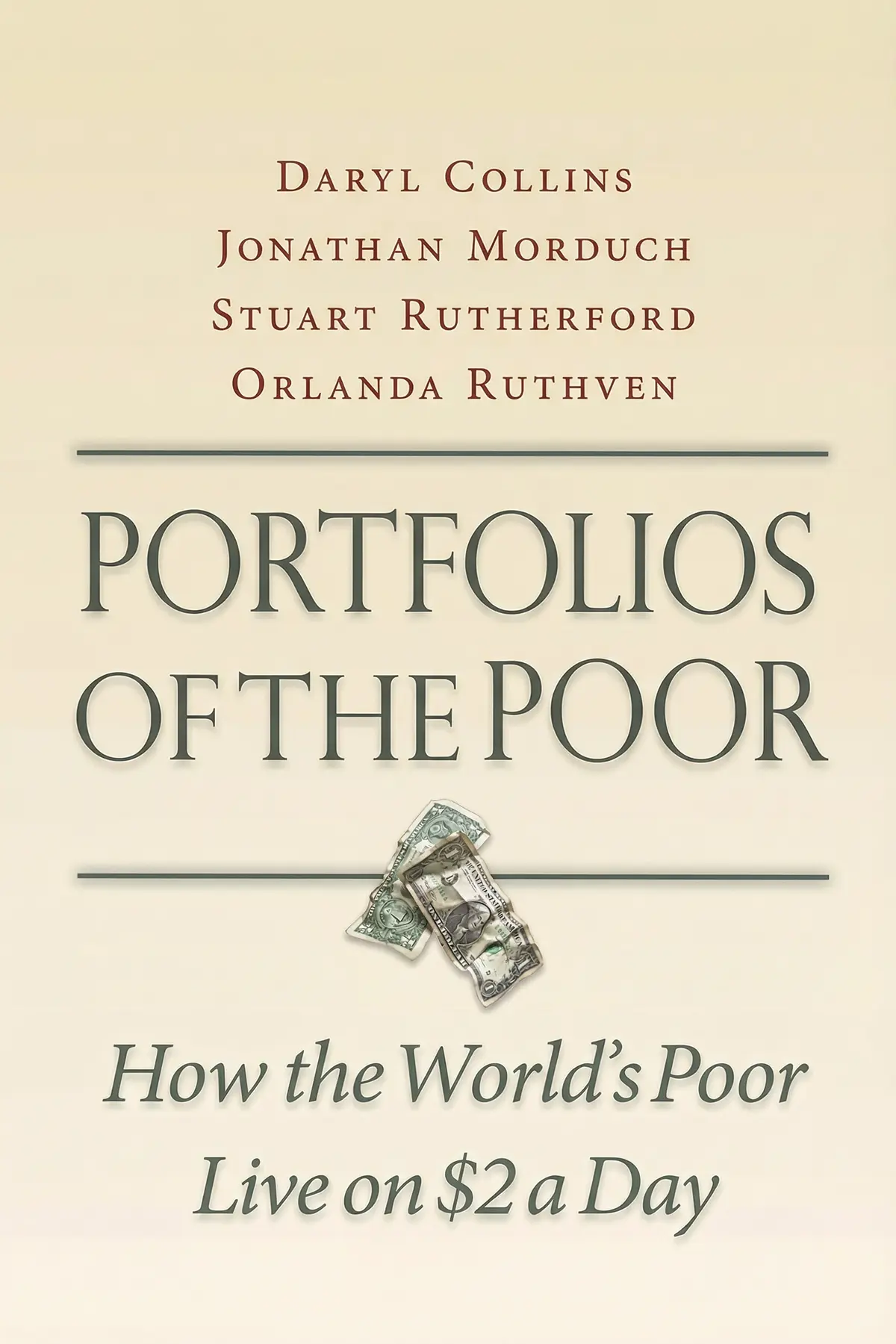
Table of Content
1. Introduction
1 min 39 sec
Think for a moment about the last time you saw a television commercial or a social media post for a global charity. You likely saw images designed to pull at your heartstrings: hungry children, dilapidated housing, and people who look entirely dependent on the kindness of strangers. For many of us in the developed world, this is our primary window into extreme poverty. We see the poor as a monolith—a group of people waiting for a helping hand to lift them out of a desperate situation.
But what if that image is only a tiny, distorted part of the story? What if the people we often think of as charity cases are actually some of the most sophisticated and disciplined financial managers on the planet? This perspective shifts the entire conversation from pity to respect.
In the following chapters, we are going to dive into the reality of what it means to live on less than two dollars a day. We’ll move past the statistics and into the daily ledgers of families in Bangladesh, India, and South Africa. You’ll discover that the problem isn’t just a lack of money; it’s the incredible difficulty of managing money when it arrives in unpredictable spurts. We will explore the complex social safety nets that poor communities build for themselves and why the tools we take for granted—like a simple savings account—can be the most powerful weapons against poverty. The throughline here is agency: the idea that poverty is not a lack of character or intelligence, but a lack of reliable financial infrastructure and predictable cash flow.
2. The Art of the Tiny Budget
2 min 10 sec
Explore why surviving on just a couple of dollars a day requires more financial discipline and foresight than managing a middle-class salary.
3. Social Credit and Reciprocity
2 min 03 sec
Discover how the poorest communities use unwritten social contracts and mutual aid to replace the formal banking systems they lack.
4. The Flaw in Global Poverty Metrics
1 min 51 sec
Understand why common phrases like a dollar a day fail to capture the true struggle of the poor and how these averages can be misleading.
5. Security and the Role of National Institutions
2 min 04 sec
Learn why a simple bank account can be more revolutionary than a donation, providing the security needed to turn survival into investment.
6. Conclusion
1 min 42 sec
As we wrap up this look into the financial diaries of the world’s poorest, the most important takeaway is a fundamental shift in perspective. We have seen that poverty is not a lack of effort or a lack of intellect. It is a constant, high-stakes battle of financial management. The people living on the edge of the global economy are not waiting for us to solve their problems; they are already working every single day to solve them through social cooperation, tiny savings, and immense discipline.
What they need from the rest of the world isn’t just our pity—it’s our respect and the right tools. By understanding that their lives are shaped by income volatility rather than just low totals, we can support initiatives that provide safety and reliability. This means advocating for better local banking, supporting micro-finance institutions that prioritize the borrower’s needs, and pushing for policies that treat the poor as the active economic agents they truly are.
Here’s an actionable closing thought: the next time you think about global poverty, try to look past the images of desperation. Instead, think about someone like Hamid. Think about the creativity required to manage a household on pennies. If you ever have the chance to visit a developing nation, take the time to see the local markets and the small businesses. Don’t just look at what people lack; look at what they are building with the little they have. When we stop seeing the poor as victims and start seeing them as partners in their own development, we can finally create a world where everyone has the tools they need to flourish.
About this book
What is this book about?
Portfolios of the Poor offers a ground-breaking perspective on global poverty by looking at the actual balance sheets of the destitute. Rather than viewing the poor as passive recipients of aid, the authors use financial diaries to show that those at the bottom of the economic ladder are actually savvy financial managers. They must navigate incredible volatility, often without access to formal banks or stable salaries. The promise of this study is a more effective way to think about aid and development. It moves away from the one-size-fits-all approach of international NGOs and toward solutions that provide what the poor actually need: safety, reliability, and professional financial tools. By understanding how a family in Bangladesh or South Africa manages a few cents a day, we can create systems—like micro-savings and local banking—that offer a real path toward stability. This is not just a book about struggle; it is a book about the resilience and intelligence required to survive in an economy of scarcity.
Book Information
About the Author
Daryl Collins
Daryl Collins is a senior associate at Bankable Frontier Associates and holds degrees from the London School of Economics. Co-authors Jonathan Morduch, Stuart Rutherford, and Orlanda Ruthven are all respected experts in the field of economics, with a particular focus on international development and microeconomics.
Ratings & Reviews
Ratings at a glance
What people think
Listeners find the work both accessible and enlightening, with one individual noting its specific utility for those in the development field. They value the book's perspective on handling finances, describing it as essential, and one listener emphasizes how those in poverty are actually remarkably sophisticated in their financial habits.
Top reviews
Amelia
This book completely upended my assumptions about global poverty. Instead of viewing the poor as passive victims, the authors use 'financial diaries' to reveal a world of incredible financial sophistication. We see families in India and South Africa juggling loans, savings clubs, and informal lenders with more discipline than most people I know in the West. It turns out that living on two dollars a day requires constant, active money management rather than just a hand-to-mouth existence. Truth is, the unpredictability of their income is a bigger hurdle than the low amount itself. While it gets a bit technical with the data tables, the insight into how they handle lifecycle events like weddings or emergencies is invaluable. This is essential reading for anyone who wants to understand how the world actually works.
Show moreMeen
Wow, I had no idea how much mental energy goes into surviving on two dollars a day. This book shatters the myth that people are poor because they don't know how to handle money. In reality, they are managing complex portfolios involving family loans, neighborhood lenders, and various savings clubs. Look, the level of discipline required to save for an education or a home while your income is completely unpredictable is just staggering. I loved how the authors explained that interest on short-term loans is often viewed more as a convenience fee than an annual percentage rate. It really changed how I think about the role of the moneylender in these communities. This book provides a deeply human perspective through a very rigorous, scientific lens. It is eye-opening and deeply humbling.
Show moreDiego
Ever wonder how families in the global south manage to save for a wedding while earning pennies? This book provides the answer through a meticulous study of financial diaries. It’s fascinating to see the variety of instruments people use, from gold jewelry to neighborhood savings groups. The authors do a great job of explaining the triple whammy of poverty: low incomes, irregularity, and the sheer unpredictability of when money will arrive. Frankly, the sophistication of these households puts my own budgeting to shame. The book is well-structured and the case studies in the appendix help ground the data in reality. It’s an essential bridge between high-level economic theory and the actual lived experience of billions of people. Highly recommended.
Show moreRatchanee
The level of detail captured in these financial diaries is staggering. By following 250 families for a full year, the authors have created a masterpiece of economic sociology. They show that the poor are constantly triaging their finances, making difficult choices between immediate needs and long-term stability. What struck me most was how much they value reliability over cost—they would rather pay more for a loan they know they can get than wait for a cheaper one that might never arrive. The truth is, this book changed the way I look at every impoverished person I see. It replaces pity with a profound respect for their resilience and ingenuity. While it is a bit of a dense read, the insights stay with you long after you’ve finished the final chapter.
Show moreKanokporn
As a student of development economics, I found the methodology here absolutely fascinating. The authors don't just rely on top-down statistics; they got into the weeds with year-long interviews to track every penny. Frankly, it’s a refreshing change from the usual World Bank reports that focus only on Purchasing Power Parity. The book highlights how the poor are often frustrated by the low quality of the financial tools available to them. My only gripe is that the prose can be quite dry and repetitive in the middle chapters. It definitely feels written for practitioners rather than a general audience. Still, the data-driven approach provides a much-needed reality check for those designing microfinance interventions. It’s a dense read, but one that offers a profound look at the financial portfolios of the world's most vulnerable.
Show moreSuwit
After hearing about 'Portfolios of the Poor' for years, I finally sat down with it. The central premise is simple but profound: the poor are active, savvy managers of their meager resources. The book tracks families in three very different regions—India, Bangladesh, and South Africa—and finds surprising similarities in their financial strategies. Personally, I found the sections on 'pushing' and 'pulling' money to be the most insightful parts of the text. It explains why a family might take a loan even when they have savings, which seems counterintuitive until you understand their need for liquidity and reliability. The writing is clear, though it lacks a bit of flair. It’s a solid, academic look at a topic that is usually treated with far too much sentimentality and too little data.
Show moreMilk
If you work in the non-profit sector, this should be required reading. The authors argue that the poor don't just need cheap loans; they need flexible and reliable financial tools that match the irregular flow of their lives. It's a massive wake-up call for development professionals who try to impose Western-style financial structures on communities where they just don't fit. Not gonna lie, some parts of the book are quite repetitive, especially when they are explaining the diary method. But the insights into how people use money-keepers and informal clubs are gold. It really drives home the point that poverty isn't just a lack of cash, but a lack of stable infrastructure. It’s an intellectual exercise that demands you rethink everything you thought you knew about aid and micro-lending.
Show moreGun
To be fair, this reads more like a government report than a narrative, which made it a bit of a slog. I was hoping for more personal stories about the individuals in Bangladesh and India, but the book prioritizes data sets and balance sheets. While the core message—that the poor are sophisticated money managers—is powerful, it feels like it could have been a long article rather than a full book. The authors repeat their main points frequently, which makes the pacing feel sluggish. However, I did appreciate the appendix where they show the actual household balance sheets. It's an important study, but you have to be really interested in the mechanics of finance to stay engaged throughout the entire thing. If you’re looking for a page-turner, look elsewhere, but for data nerds, it’s a goldmine.
Show moreNoppadol
Gotta say, some of the revelations here feel pretty obvious if you’ve ever lived paycheck to paycheck or struggled with a low income. The idea that poor people have to be good at managing money because they have so little of it isn't exactly a shocker. However, the book is significant because it proves this point with hard data to an audience that often ignores the obvious. The authors’ style is professional and precise, which I respect, but it lacks the emotional resonance of other books on poverty. It’s more of a reference work than a book you’d read for pleasure. I appreciated the detail, but I found myself skimming the technical recommendations for microfinance institutions toward the end. Useful, but definitely dry.
Show moreMadison
Not what I expected at all. I picked this up thinking I would get a glimpse into the daily lives and struggles of people across different cultures. Instead, I got hit with a barrage of technical analysis on interest rates and microfinance models. In my experience, a book about people should feel human, but this felt clinical and detached. The authors are clearly experts, but the writing style is painfully bland, almost like reading a textbook for a class you didn't sign up for. They spend so much time on the 'how' of money movement that the 'who' gets completely lost in the spreadsheets. If you are a microfinance professional, you’ll probably love the technicality, but for a casual reader interested in global issues, it’s just too dry to recommend.
Show moreReaders also enjoyed

All About Love: New Visions
bell hooks

Adults in The Room: My Battle With Europe’s Deep Establishment
Yanis Varoufakis

A Biography of Loneliness: The History of an Emotion
Fay Bound Alberti
A Force for Good: The Dalai Lama's Vision for Our World
Daniel Goleman
1929: Inside the Greatest Crash in Wall Street History--and How It
Andrew Ross Sorkin
AUDIO SUMMARY AVAILABLE
Listen to Portfolios of the Poor in 15 minutes
Get the key ideas from Portfolios of the Poor by Daryl Collins, plus 5,000+ more titles in English and Thai.
- 5,000+ titles
- Listen as much as you want
- 7-day free trial
- Cancel anytime







