
18 min 57 sec
Same as Ever: A Guide to What Never Changes
Explore the timeless principles of human behavior that remain constant despite a changing world. Learn how focusing on what never changes can help you navigate uncertainty, risk, and personal happiness.
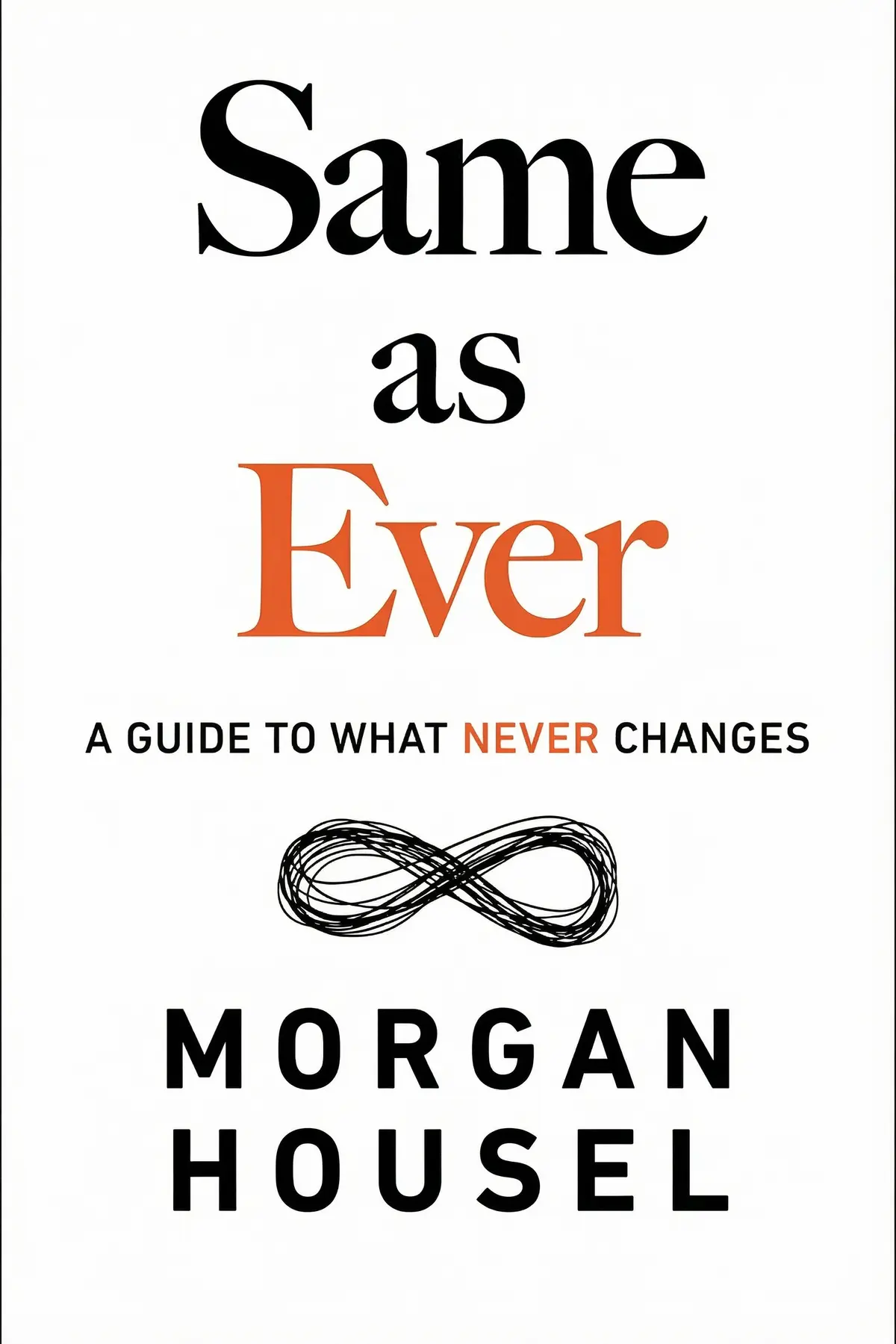
Table of Content
1. Introduction
1 min 32 sec
If you look at the headlines lately, it feels like the ground is constantly shifting beneath our feet. From global health crises to the rise of transformative technology, the world seems to move at a breakneck speed that leaves many of us feeling anxious and unprepared. We spend a tremendous amount of energy trying to figure out what’s coming next, often hoping for a crystal ball that can tell us which industry will rise, which leader will fall, or which crisis will strike. But here’s the problem: we are notoriously bad at predicting the future. We focus so much on the things that change that we completely overlook the things that stay the same.
This is where we find our true advantage. While the tools we use and the names on the ballot change, the way humans react to fear, greed, and uncertainty is remarkably consistent. If you could travel back a thousand years and talk to someone about their anxieties or their desires, you’d find that the core of the human experience hasn’t moved an inch. By understanding these timeless psychological drivers, we can find a sense of stability in the chaos.
In the following minutes, we aren’t going to look for a map of the future. Instead, we’re going to look at the compass of the past. We will explore why the most important events in history often hinge on a single gust of wind, why our greatest risks are usually the ones we haven’t even thought of, and why the secret to a happy life might be as simple—and as difficult—as managing your expectations. This is a journey through what never changes in a world that never stops moving.
2. The Fragility of History
2 min 30 sec
Discover how the course of the entire world can be altered by a single random event and why predicting the future is essentially impossible due to life’s inherent randomness.
3. The Invisible Nature of Risk
2 min 09 sec
Uncover why the most dangerous threats are the ones we fail to imagine and why resilience is a better strategy than precise prediction.
4. The Happiness Trap of Rising Expectations
2 min 19 sec
Learn why getting what you want doesn’t always lead to satisfaction and how the gap between reality and expectations defines your well-being.
5. The Seduction of Certainty
2 min 11 sec
Discover why we prefer confident liars over cautious truth-tellers and how to embrace probability over the false comfort of guarantees.
6. Why Stories Outperform Statistics
2 min 11 sec
Learn why the human brain is wired for narrative rather than data and how the best story, not the best facts, often determines the winner.
7. The Power of Compounding and the Speed of Destruction
2 min 16 sec
Understand the asymmetry between growth and decay, and why being like the tortoise is more effective than being like the hare.
8. The Lens of Individual Experience
2 min 05 sec
Explore why people see the world so differently and how understanding their personal history can help you build empathy and resolve conflict.
9. Conclusion
1 min 44 sec
As we wrap up this exploration of the constants in our world, it’s worth reflecting on the central message: the world is always changing, but human nature is same as ever. We can’t predict the next pandemic, the next market crash, or the next political revolution with any real certainty. Those things are driven by a chaotic mix of randomness and hidden risks that defy our best efforts to map them out. However, we can predict with absolute certainty how people will feel when those things happen. We know they will be afraid, we know they will seek out stories that make sense of the chaos, and we know they will react based on their own unique histories.
By focusing on these timeless patterns, you can build a life that is more resilient and more satisfying. You can stop chasing the impossible goal of perfect prediction and start focusing on broad preparedness. You can stop letting your rising expectations rob you of your happiness and start appreciating the reality you have worked so hard to build. And perhaps most importantly, you can start looking at the people around you with a little more grace, knowing that their “irrational” beliefs are often just the scars of their own experiences.
The next time you feel overwhelmed by the news or anxious about the future, take a deep breath and remember the wind on the East River in 1776. Remember that history has always been a messy, unpredictable series of near-misses and lucky breaks. The tools in our hands might be new, but the hearts in our chests are the same ones that have beat for millennia. If you can understand what never changes, you will never be truly lost, no matter how much the world shifts around you.
About this book
What is this book about?
Same as Ever is a deep dive into the historical and psychological constants that govern our lives. While we often obsess over the next big technological shift or political upheaval, the most important drivers of our reality are the behaviors and emotions that have remained unchanged for centuries. This guide explores why human nature is the ultimate predictor of the future, even when specific events remain a mystery. Through a series of compelling narratives—ranging from Revolutionary War battles to modern financial bubbles—the book illustrates how randomness, the power of storytelling, and the trap of rising expectations shape our world. The promise of this summary is to help you shift your focus toward these enduring truths. By understanding the common denominators of human experience, you can build a more resilient mindset, manage your personal satisfaction more effectively, and make better decisions in an unpredictable environment.
Book Information
About the Author
Morgan Housel
Morgan Housel is a prominent financial journalist, investor, and advisor known for his insightful analysis of human behavior and finance. He has been recognized for his excellence in journalism as a two-time winner of the Best in Business Award from the Society of American Business Editors and Writers. Currently, he serves as a partner at the Collaborative Fund, where he applies his deep understanding of market dynamics. Housel gained international acclaim as the author of the blockbuster book The Psychology of Money, which explored the emotional and psychological aspects of financial decision-making. His work continues to influence how people think about wealth, risk, and the unchanging patterns of life.
Ratings & Reviews
Ratings at a glance
What people think
Listeners find the work deeply insightful, with one listener pointing out a rare knack for turning intricate theories into actionable advice, and they enjoy its accessible nature, which keeps them engaged. The author's prose is well-received, and listeners treasure its timeliness, with one labeling it a "handbook of absolutely useful timeless knowledge." By linking fascinating tales to every lesson, the book is viewed by listeners as a valuable purchase. Pacing earns varying opinions; some describe the text as succinct while others sense a lack of cohesion, and the content’s authenticity similarly triggers a range of responses.
Top reviews
Fatima
Morgan Housel has this incredible knack for taking the complex gears of human history and making them feel like simple common sense. Same as Ever isn't about predicting what the world will look like in 2050, which is a relief because most forecasters are wrong anyway. Instead, he focuses on the 'sturdy perennials'—those human traits like greed, fear, and overconfidence that never go out of style. The chapter on risk was particularly eye-opening for me, especially the idea that the biggest dangers are the ones we never see coming. Look at the Titanic or the 2008 crash; we always prepare for the last war instead of the next surprise. While some might find the short, punchy chapters a bit disjointed, I found the pacing to be perfect for a busy schedule. This is a handbook of absolutely useful timeless knowledge that I’ll likely revisit whenever the world feels a bit too chaotic.
Show morePrasarn
Picked this up on a whim and now I can't stop thinking about the concept of 'pessimistic planning but optimistic dreaming.' In a world that seems to be changing at breakneck speed, there's immense comfort in realizing that some things remain constant. Housel doesn't just tell you things; he shows you through vivid stories, like the inventor of chess and the rice grains. This book acts as a lens that helps you zoom out and see the bigger picture of the human condition. Frankly, it’s one of those rare reads that actually reduces your anxiety about the future because it gives you a solid foundation to stand on. The writing style is captivating and keeps you hooked from the first page to the last. It’s a must-read for anyone who wants to make better sense of the news and their own life choices.
Show moreJom
As someone who spends most of their day obsessing over market trends, Housel’s perspective on what never changes is a much-needed breath of fresh air. He argues that we are better off focusing on what we can control and ignoring the unpredictable 'black swan' events that knock us off our feet. The storytelling is top-notch, especially when he discusses how progress is usually a 'drunken stumble forward' rather than a smooth line. It is a reminder that the future is uncertain, but human nature is the one thing we can always count on. This book is a practical guide that distills complex psychological principles into actionable knowledge. I found the pacing to be concise and the chapters were just the right length to keep me engaged. If you want to develop better frameworks for understanding the world, this is worth every penny.
Show moreBird
The chapter on the 'invisible' boogeyman of risk is worth the price of admission alone. I love how Housel points out that we always overlook the things that actually end up changing history. The dead outnumber the living fourteen to one, and ignoring their accumulated experience is a mistake we make every single day. This book is a masterclass in distilled wisdom and storytelling. It’s fast-paced, insightful, and incredibly readable for anyone interested in why humans do what they do. I didn't find it to be a 'dump of notes' at all; rather, it felt like a carefully curated gallery of human behavior. Every story connected back to the central theme in a way that felt organic and meaningful. It’s the kind of book you buy for yourself and then immediately buy five more copies of for your friends.
Show morePrayoon
Finally got around to finishing this today, and my immediate reaction was to flip back to page one and start taking notes. After the massive success of 'The Psychology of Money,' I was worried this might be a 'sophomore slump,' but Housel proves he's one of the best storytellers in the game. He manages to distill massive concepts from thinkers like Dalio and Greene into digestible, engaging narratives that actually stick in your brain. Truth is, we spend so much time obsessing over how the world is changing that we forget to study the things that are permanent. This book acts as a much-needed anchor, reminding us that envy, greed, and the human response to uncertainty are constants. The writing style is conversational yet profound, making it feel like you're getting advice from a very smart friend. I’ve already started re-evaluating my long-term savings after reading his section on compound growth.
Show moreChanida
While I absolutely loved 'The Psychology of Money,' this sequel felt slightly different in its execution. To be fair, Housel is an artful storyteller who can make even a dry historical anecdote feel like a thriller. The book is essentially a collection of seemingly smart articles that explore human behavior through a very wide lens. I enjoyed the focus on why we should plan like a pessimist but dream like an optimist, as it’s a framework that actually helps with daily decision-making. However, there were moments where it felt like a dump of notes rather than a fully cohesive narrative. Some of the ideas are repeated from his blog, and if you’ve read a lot of Nassim Taleb, you might find the insights a bit familiar. Still, the way he distills these concepts into bite-sized nuggets of wisdom makes it a worthwhile read for anyone looking to sharpen their filters.
Show moreRoydao
Ever wonder why we keep making the same dumb mistakes century after century? This book dives deep into the psychology of people, arguing that while our technology changes, our basic hardware remains identical to our ancestors. Housel uses fascinating 'what if' scenarios, like imagining a world where Al Gore won in 2000, to show how much chance dictates our lives. It’s a bit humbling to realize how much of our success is just being in the right place at the right time. Personally, I found the advice to keep the horizon long and not take up as much debt as you think you can handle to be the most practical takeaway. The book does feel a bit repetitive in the middle sections, and the themes bleed together a little too much. Despite that, the core message is solid and it’s a great reminder to focus on the invariants.
Show moreDao
Following up a massive hit like his previous work is a tall order, but Housel mostly sticks the landing here. The book reminds us that while the world is constantly changing, our reactions to risk, opportunity, and scarcity are the same as they were hundreds of years ago. I particularly enjoyed the dry wit he sprinkles throughout the text, like the quip about experience charging expensive tuition. To be fair, some of the anecdotes come from longer-form content and the paraphrasing misses some of the original nuance. You might get more out of reading the primary sources if you have the time, but Housel is such a skilled writer that he makes the summary version more entertaining. It’s a great 'handbook' for building a better filter for the news and the constant noise of the modern world.
Show moreAiden
Is it a good book? Yes. Is it groundbreaking? Not really. Look, I appreciate Housel’s writing style and his ability to land a joke even when discussing serious topics like the 2008 financial crisis. He has a way of making you feel like you're chatting with a wise friend over coffee. However, the book leans very heavily on a Western-centric view, and I found myself craving more concrete action steps. A lot of the 'lessons' felt like barely insightful platitudes that could be easily argued against depending on the context. It’s an enjoyable read for a flight or a weekend, but it lacks the profound 'aha' moments that made his previous work so special. It’s essentially a summary of ideas from Greene, Dalio, and Ridley, which is fine as a refresher but feels a bit like a greatest hits album rather than new material.
Show moreMan
Not gonna lie, I felt like I was reading a high-quality blog post that just wouldn't end. After the brilliance of his first book, this one feels more like a collection of disparate notes than a cohesive guide. The truth is, if you've read Taleb or Matt Ridley, you’ve already seen these arguments made with much more nuance and depth elsewhere. Housel is undeniably a gifted storyteller, but the anecdotes here feel cherry-picked to fit a specific narrative. Every chapter seems to end with a forced segue that tries to link unrelated historical events together. It’s fine if you want a few smart-sounding talking points for a cocktail party, but don't expect a rigorous examination of human behavior. The content is so surface-level that it becomes almost worthless for anyone already familiar with these thinkers. I’d recommend skipping this and going straight to the original sources he quotes so frequently.
Show moreReaders also enjoyed
A Liberated Mind: How to Pivot Toward What Matters
Steven C. Hayes
Acting with Power: Why We Are More Powerful Than We Believe
Deborah Gruenfeld
Age of Propaganda: The Everyday Use and Abuse of Persuasion
Anthony Pratkanis
AUDIO SUMMARY AVAILABLE
Listen to Same as Ever in 15 minutes
Get the key ideas from Same as Ever by Morgan Housel, plus 5,000+ more titles in English and Thai.
- 5,000+ titles
- Listen as much as you want
- 7-day free trial
- Cancel anytime







