

20 min 50 sec
Structures: Or Why Things Don't Fall Down
Explore the hidden forces that keep our world standing. This guide breaks down the engineering principles of stress, strain, and material science, revealing why structures—from cathedrals to kangaroos—don't simply collapse.
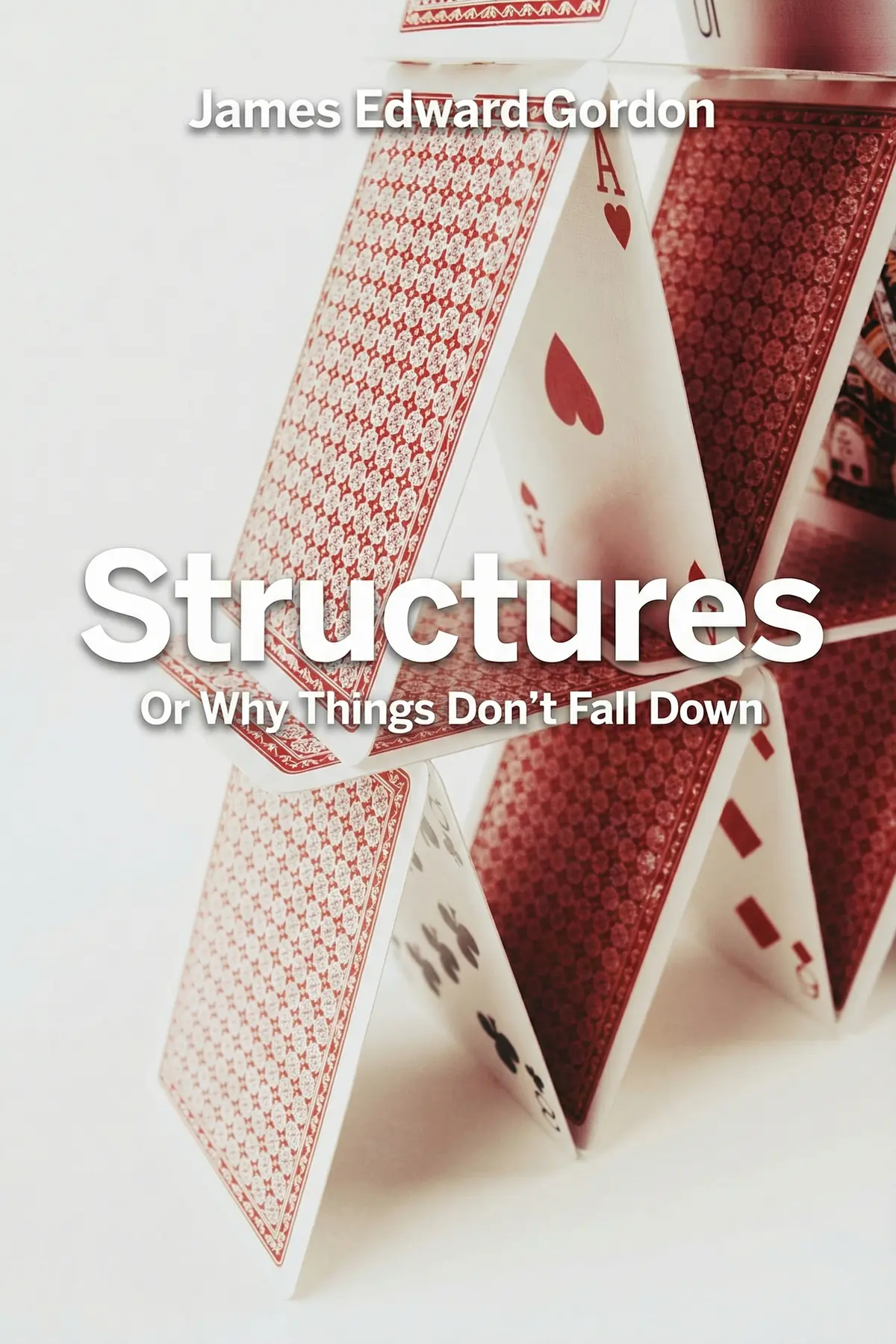
Table of Content
1. Introduction
1 min 37 sec
Every time you walk across a bridge, enter a high-rise building, or even sit on a wooden chair, you are placing your trust in the silent science of structures. We often take the stability of our physical world for granted, assuming that things stay upright simply because they are solid. But underneath the surface of every material—whether it’s the steel in a skyscraper or the timber in a roof—there is a constant, invisible struggle of forces. There are atoms being pulled apart, molecules being squeezed together, and energy being stored and released in ways that dictate whether a structure will endure for centuries or collapse in an instant.
In this journey through the world of structural engineering, we’re going to look at the ‘why’ behind the stability of our environment. We’ll see how nature has mastered these principles over millions of years of evolution, creating resilient biological structures like trees and bones, and how humans have spent the last few centuries trying to catch up. By understanding the concepts of stress, strain, and the clever use of components like beams and arches, we can begin to see the world through the eyes of an engineer.
The throughline of our exploration is simple but profound: every structure is a conversation between the loads it carries and the materials it’s made of. When we understand the rules of that conversation, we can build things that not only defy gravity but withstand the unpredictable tests of time and nature. So, let’s begin by looking back at how we first started to decipher these rules, starting with a famous scientist who had to find a new career after a brush with the authorities.
2. The Evolution of Structural Science
2 min 28 sec
Discover how a clash with the Church led a famous astronomer to lay the groundwork for modern engineering and material science.
3. Defining Stress and Strain
2 min 27 sec
Go beyond the psychological meaning of stress to understand the physical forces that pull at the very atoms of our world.
4. Tension and the Phenomenon of Creep
2 min 16 sec
Learn how materials ‘learn’ to handle weight over time and why your blood vessels don’t just keep growing forever.
5. The Strength of Compression
2 min 01 sec
Ancient builders knew a secret about stability that allowed their cathedrals to stand for a thousand years without modern math.
6. The Invention of the Beam
2 min 07 sec
How a simple horizontal support changed architecture and why a horse’s backbone is more like a roof than you think.
7. The Danger of Cracks and Localized Stress
2 min 07 sec
Explore why a tiny notch in a piece of metal can be more dangerous than a large, clean hole.
8. Shearing and Atomic Failure
2 min 01 sec
What actually happens at the molecular level when a material gives up? It’s a dance of breaking bonds and sliding layers.
9. Metal Fatigue and the Science of Safety
2 min 14 sec
Learn why machines can break even when they aren’t overloaded, and how engineers ‘test to destruction’ to keep us safe.
10. Conclusion
1 min 32 sec
We live in a world defined by the invisible interplay of forces. From the moment Galileo turned his gaze from the stars to the strength of materials, we have been on a quest to understand why the physical world stays upright. We’ve seen that ‘strength’ isn’t just about being tough; it’s about the relationship between stress and strain, and how materials like stone, steel, and even bone handle the constant push and pull of their environment.
Through our exploration, we’ve learned that compression offers the stability of the ages, while tension allows for the flexibility of life and the efficiency of modern machinery. We’ve seen how the invention of the beam liberated architecture and how nature used that same principle to design the skeletons of animals. Most importantly, we’ve realized that failure is often a localized event—a tiny crack or a repeated cycle of fatigue—that can bring down even the mightiest creation if it isn’t understood and managed.
The lesson for us is to look at our surroundings with a new sense of wonder and scrutiny. Structures are not just static objects; they are dynamic systems in a state of constant equilibrium. Whether you are building a simple bookshelf at home or just marveling at a bridge on your morning commute, remember that everything stays standing because of a delicate, calculated balance. By respecting the laws of physics and the limits of materials, we can continue to build a world that is not only functional and beautiful but, above all, safe.
About this book
What is this book about?
Have you ever wondered why a massive stone bridge stays upright while a simple stack of blocks topples over? Or why a thin rope can hold a heavy weight while a thick piece of glass might shatter? In this exploration of structural engineering, we dive into the fundamental physics that govern every object around us. This summary explains the intricate balance between tension and compression, the revolutionary role of the beam in architecture, and the invisible battles taking place at an atomic level. By examining both man-made marvels and biological wonders, you will discover how materials respond to loads and why things eventually break. You'll learn about the historical shifts in how we think about safety, from the early experiments of Galileo to the modern science of metal fatigue and probability. The promise of this journey is a newfound appreciation for the silent, sturdy world we inhabit, providing you with a mental toolkit to understand the strength and fragility of everything from skyscrapers to the very bones in your body.
Book Information
About the Author
James Edward Gordon
James Edward Gordon stands as a foundational figure in the discipline of materials science. Throughout a distinguished academic career, he authored several highly regarded books that bridged the gap between complex engineering and public understanding. His contributions to the field were recognized with prestigious accolades, including the British Silver Medal from the Royal Aeronautical Society and the Griffith Medal of the Materials Science Club.
Ratings & Reviews
Ratings at a glance
What people think
Listeners consider this work a superb conceptual look at fundamental engineering principles, utilizing an intuitive method to explain how structures work. The prose is skillfully written, with one listener mentioning it targets non-experts lacking a scientific education, and listeners value the light mathematical load and genuine humor found in the text. Although some listeners deem it highly accessible, others view it as a challenging volume.
Top reviews
Pat
This book is essentially the holy grail for anyone wanting to understand why the world stays upright without needing a PhD in physics. Gordon writes with a level of wit and clarity that reminds me of Richard Feynman's best work, turning dry engineering concepts into genuine entertainment. I particularly loved the breakdown of Young's modulus and how he explains the way materials store energy through the lens of history and nature. To be fair, he spends quite a bit of time poking fun at the French, but it all adds to that 'charming British professor' persona. You will walk away looking at every bridge and skyscraper with a newfound, slightly terrified respect for the invisible forces at play. It is rare to find a technical book that feels this conversational.
Show moreTanawan
Ever wonder why a sausage always bursts length-ways instead of around the middle? Gordon answers that specific question with the kind of intuitive logic that makes you feel like an accidental genius. The truth is, the book avoids drowning you in calculus and instead focuses on the conceptual 'feel' of structures like Greek temples and ship hulls. I found the section on crack propagation and Griffith's critical length to be absolutely gripping, which is a weird thing to say about a book on materials. However, the prose can be a bit wandering at times, and he occasionally gets distracted by his own anecdotes about historical engineering failures. It is an excellent bridge between layperson curiosity and professional expertise, though some sections definitely show their 1970s roots.
Show morePui
Picked this up after seeing it recommended as a must-read for understanding the physical world, and it did not disappoint. Gordon has a gift for making the complex mechanics of tension and compression feel like common sense. I was particularly struck by the discussion on how the human body functions as a structure, relying on sinews rather than just a rigid skeleton. The book manages to be incredibly readable while still providing enough technical meat to satisfy someone with a science background. It is filled with pure wit and a very specific kind of British humor that kept me turning pages long after I thought I’d be bored. If you want to understand why things don't fall down, this is the place to start.
Show moreTan
Wow. I never thought I would be this fascinated by a book about why bridges don't collapse or why ships break in half at the corners of doors. Gordon’s writing is a masterclass in making science approachable for the layperson without stripping away the wonder of the subject. I found the sections on the 'work of fracture' and how tough materials handle cracks to be genuinely life-changing for my perspective on the built environment. He writes like a grandfatherly professor who has seen it all and wants to share his best stories over a pint. While he is certainly opinionated about modern architecture, his passion for the 'new science' of materials is infectious. This is the kind of book that makes you want to go out and inspect every rivet you see.
Show moreBond
As someone who usually finds physics textbooks intimidating, I was pleasantly surprised by how accessible this conceptual overview turned out to be. The author uses just the right amount of math to ground his theories without making the reader feel like they're back in a high school classroom. I particularly enjoyed the chapters on biological structures and how nature solves engineering problems more efficiently than humans often do. In my experience, the book is best read slowly so you can absorb the way he connects historical ship-building to modern aviation. My only real gripe is that his British references can be a bit obscure for an international audience. Regardless, it is a brilliant introduction to the field that emphasizes intuition over rote memorization of formulas.
Show moreJack
Look, if you can get past the eccentric tone, there is a wealth of practical information here that you won't find in a standard manual. Gordon explains things like Poisson's ratio and the difference between stiffness and strength with a clarity that finally made the concepts click for me. I read this alongside some online lectures from the Great Courses, and Gordon’s anecdotal approach provided the perfect 'color' to the more rigid academic material. His observations on why the lintels of Greek temples crack while a gorilla’s ribs stay intact are nothing short of genius. It is a bit of a tough read in the later chapters when the stories take over, but the conceptual foundation it builds is worth the effort. It is a quirky, essential addition to any curious person's bookshelf.
Show moreNoi
Finally got around to this classic, but it felt like a bit of a chore to parse through all the dense 1970s prose. There are moments of absolute brilliance where a concept is explained perfectly—the sausage skin analogy is a classic for a reason—but they are spaced out by long-winded stories. To be fair, the math is minimal, but the formulas he does include often felt poorly integrated into the surrounding text. I found myself wishing for more diagrams and fewer historical tangents about Victorian engineering politics. It is certainly a unique book, and I learned a lot about how energy is stored in materials, but I wouldn't call it an easy or particularly organized read. It sits in a weird middle ground between a textbook and a memoir.
Show moreJames
After hearing about this book for years, I finally dove in and came away with a much deeper appreciation for the invisible stress trajectories all around us. The author does a fantastic job of illustrating why 'strong' doesn't always mean 'stiff' and how structures manage to survive catastrophic failures. I especially liked the exploration of ancient weaponry versus modern materials, which gave a great sense of historical evolution in the field. Gotta say, though, the writing is quite dense in places and reflects a very different era of academic communication that might not appeal to everyone. If you are willing to sit with his sometimes confusing prose, you will gain a level of intuition about the physical world that is rare to find elsewhere. It is a foundational text for a reason.
Show moreFort
Not what I expected given the high praise from tech moguls like Elon Musk. While the core information is fascinating, the actual layout of the book feels ironically disorganized for a title called 'Structures.' It often reads like a collection of late-night musings from a retired academic rather than a coherent guide to engineering. I appreciated the lack of heavy math, but sometimes his explanations were actually more confusing because they lacked a rigorous step-by-step approach. Frankly, the author’s tendency to drift into social commentary and his slightly condescending tone towards modern architecture rubbed me the wrong way. There are brilliant nuggets of insight regarding bird feathers and rib cages, but you have to sift through a lot of rambling to find them.
Show moreThanit
The chapter on pressure vessels was informative, but I honestly could not get past the author's incredibly dated and offensive social asides. Gordon represents that specific brand of elderly academic who thinks it is charming to make dismissive remarks about women and colonial history in a science text. While I appreciate the insights into why brittle materials fail, the constant distraction of his prejudices made it a very frustrating experience. The writing style is undeniably rambling and poorly structured, making it hard to follow the actual engineering logic at times. I have seen this recommended as a classic, but the technical content is buried under a layer of smugness that I found intolerable. You are better off watching a modern lecture series if you want to understand structural engineering without the baggage.
Show moreReaders also enjoyed


Alien Earths: The New Science of Planet Hunting in the Cosmos
Lisa Kaltenegger




A Life Decoded: My Genome: My Life
J. Craig Venter

A Planet of Viruses
Carl Zimmer
A Short History of Nearly Everything
Bill Bryson
AUDIO SUMMARY AVAILABLE
Listen to Structures in 15 minutes
Get the key ideas from Structures by James Edward Gordon, plus 5,000+ more titles in English and Thai.
- 5,000+ titles
- Listen as much as you want
- 7-day free trial
- Cancel anytime







