

20 min 48 sec
Survival of the Friendliest: Understanding Our Origins and Rediscovering Our Common Humanity
Survival of the Friendliest challenges the idea that evolution favors the most aggressive. It shows how cooperation, empathy, and social intelligence allowed humans to thrive and dominate the planet.
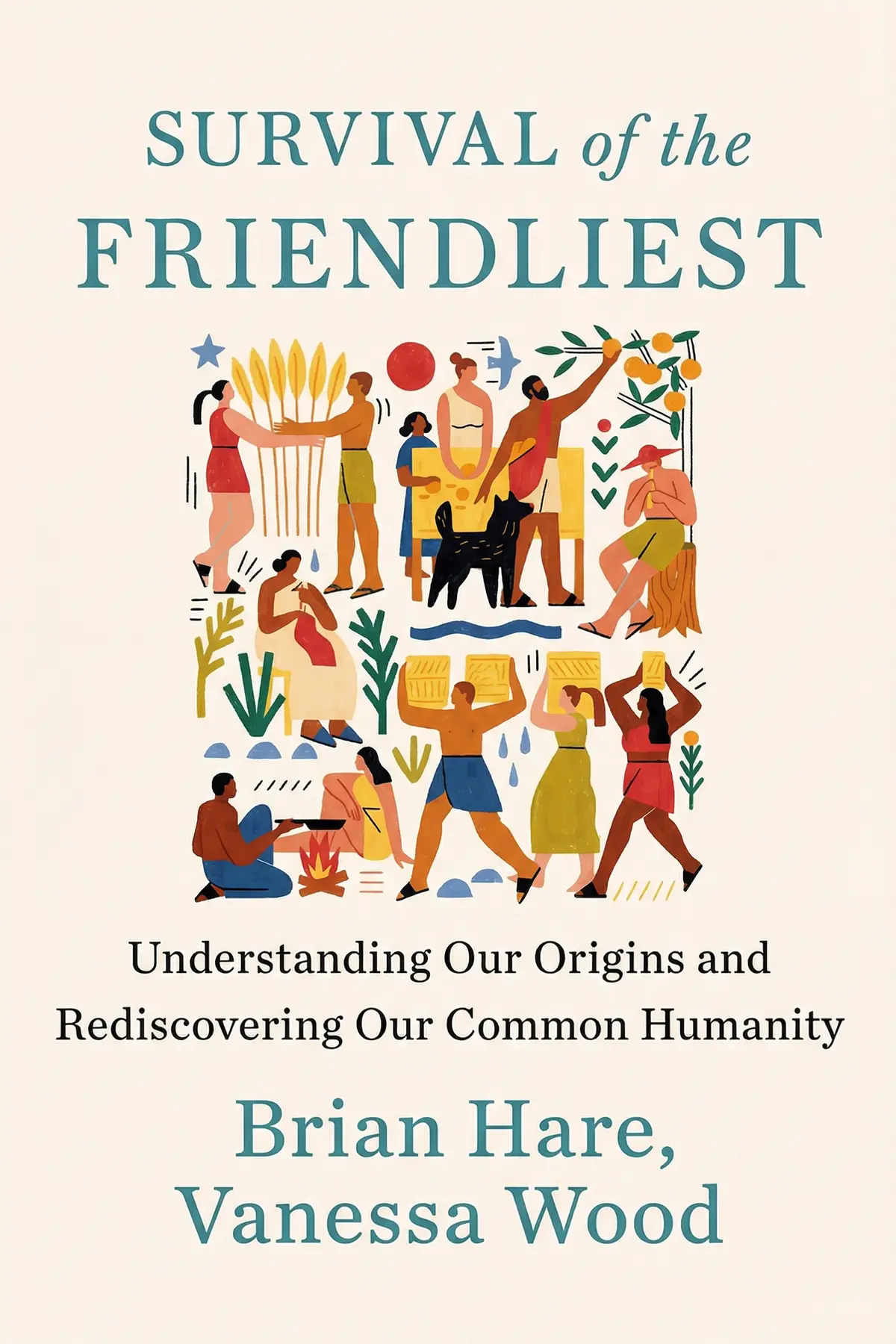
Table of Content
1. Introduction
1 min 38 sec
When we think about the story of life on Earth, we often default to a very specific, almost cinematic image. We picture a world of tooth and claw, where the biggest, strongest, and most aggressive creatures fight their way to the top of the food chain. We’ve been told for over a century that nature is a brutal competition defined by the phrase survival of the fittest. But what if we’ve been looking at the wrong map this whole time? What if the secret to our success wasn’t our ability to fight, but our ability to make friends?
This is the central premise of the work we’re exploring today. In this summary, we’re going to dive into a radical rethink of evolutionary history. We’ll see how our species, Homo sapiens, didn’t just stumble into dominance through brute force. Instead, we evolved a very specific set of social tools that allowed us to do something no other hominid could: coordinate, communicate, and cooperate on a massive scale.
We’re going to look at fascinating experiments involving Siberian foxes, the gentle social lives of our closest ape relatives, and the very physical changes in our own faces that signal a history of friendliness. We’ll also confront a difficult paradox: the very same biological mechanisms that make us so kind to our own people can also make us dangerously hostile to those we see as outsiders. By the end of this journey, you’ll understand how our past was shaped by the power of the group and how our future depends on our ability to extend that circle of friendship to the rest of the world.
2. The Power of Theory of Mind
2 min 25 sec
Humans possess a unique cognitive ability to understand that others have their own thoughts and intentions, a skill that serves as the foundation for all cooperation.
3. The Domestication of the Fox
2 min 17 sec
A decades-long experiment in Siberia revealed that breeding animals for friendliness triggers a cascade of unexpected physical and mental changes.
4. Lessons from the Bonobo
2 min 17 sec
Comparing chimpanzees and bonobos shows that a species can self-domesticate in the wild, trading aggression for a more peaceful, cooperative society.
5. Our Faces Tell the Story of Our Success
2 min 12 sec
Human physical evolution, including shrinking brow ridges and the whites of our eyes, reflects a long history of selecting for social cooperation.
6. The Chemistry of the Social Bond
1 min 55 sec
The hormone oxytocin acts as a biological glue that allows humans to form deep connections with people outside their immediate families.
7. The Dark Side of Friendliness
2 min 03 sec
The same biological mechanisms that promote internal group bonding can lead to the extreme dehumanization and aggression toward perceived outsiders.
8. Healing Division Through Contact
2 min 03 sec
Meaningful and casual interactions between different social groups are the most effective way to break down prejudice and rediscover common humanity.
9. Friendship as a Universal Value
2 min 04 sec
Our attitude toward animals and nature is a powerful predictor of our capacity for human empathy and social tolerance.
10. Conclusion
1 min 54 sec
As we look back at the broad sweep of human history, it becomes clear that the old mantra of survival of the fittest needs an update. We aren’t the masters of this planet because we were the most ruthless or the most aggressive. We are here because we were the friendliest. Our ancestors survived the ice ages and the competition with other hominid species because they found a way to trust each other, to share knowledge, and to build communities that were larger and more resilient than any seen before in nature.
Our biology is a testament to this journey. Our faces, our hormones, and our very brains have been shaped by the need for social harmony. We have evolved the extraordinary ability to step inside another person’s mind and see the world through their eyes. This is our species’ true superpower. However, we have also seen that this power comes with a significant responsibility. Our deep-seated loyalty to our own groups can easily turn into hostility toward others if we aren’t careful. The same biology that makes us capable of great love also makes us capable of great exclusion.
The path forward is one of conscious connection. We must recognize the tribal instincts that pull us apart and actively work to counter them with the empathy that brings us together. This means building cities that encourage interaction, protecting the rights of those outside our immediate circles, and fostering a sense of kinship with the entire natural world. By leaning into our innate friendliness, we can overcome the divisions of our modern age. The lesson of our evolution is simple but profound: our strength has always been, and will always be, each other. Let’s use that strength to build a world where everyone belongs.
About this book
What is this book about?
For generations, the concept of survival of the fittest has been misinterpreted as a celebration of the strongest and most ruthless. This book turns that notion on its head, arguing that our success as a species is actually rooted in our unique capacity for friendliness. By examining the evolutionary history of humans and other animals, it reveals that the most cooperative and social individuals are the ones who ultimately survive and pass on their genes. Through a blend of anthropology, genetics, and psychology, the authors explore how domestication—both of animals and ourselves—has shaped our biology and behavior. They explain the cognitive leaps that allow us to understand others' minds and the hormonal shifts that bond us together. However, they also address the darker side of this sociability, showing how our deep group loyalty can lead to the dehumanization of outsiders. Ultimately, the book offers a roadmap for rediscovering our shared humanity and using our innate friendliness to build a more tolerant and inclusive society.
Book Information
About the Author
Brian Hare
Brian Hare is a professor of evolutionary anthropology at Duke University's Center for Cognitive Neuroscience and co-author of The Genius of Dogs, a New York Times best seller. Vanessa Woods is a research scientist at the Duke Center for Cognitive Neuroscience, the co-author of The Genius of Dogs, and the author of her own title Bonobo Handshake.
Ratings & Reviews
Ratings at a glance
What people think
Listeners find this work both accessible and compelling, with one individual mentioning that it provides neuro-physiological and historical evidence to support its theories. The caliber of the writing is also well-regarded, and listeners appreciate the material centered on friendship, as one person points to the successful breeding of friendly foxes as an excellent example. Additionally, the high quality of information is valued, with one listener noting that the text is backed by extensive research.
Top reviews
Laor
Picked this up because I’ve always been skeptical of the 'nature red in tooth and claw' narrative that dominates evolutionary biology. Hare and Woods provide a compelling counter-argument, suggesting that our secret weapon wasn't brute strength, but our ability to cooperate with strangers. The sections on the Siberian fox experiments were particularly enlightening, demonstrating how selecting for tameness leads to a cascade of physical changes like floppy ears and curly tails. It makes you look at your own dog with a completely different perspective on how we shaped one another. While the transition into modern political theory felt a bit jarring at first, the underlying neurological evidence regarding oxytocin and social bonding tied it all together. This is a rare science book that manages to be both deeply researched and remarkably optimistic about our potential for connection.
Show moreDen
Ever wonder why dogs are so much more expressive than wolves, or why bonobos are so much more peaceful than chimpanzees? This book answers those questions by looking at the shared traits of domesticated species, eventually applying those same lessons to the history of Homo sapiens. I loved how the authors explained that our friendliness has a dark side: the same mechanisms that make us love our in-group also make us capable of dehumanizing outsiders. It’s a profound realization that explains so much of the cruelty we see in history and the news today. The prose is lively and fast-paced, making complex genetic theories feel like a casual conversation over coffee. It definitely changed the way I think about human progress and the importance of maintaining social bridges. This is essential reading for anyone trying to make sense of our current divided world.
Show moreChatchai
Finally got around to reading this and I’m genuinely blown away by how it connects biology to sociology in such a seamless way. The research into how we perceive and treat 'outsiders' explains so much about modern tribalism, yet the authors offer a path forward through increased contact and empathy. I found the sections on how we can 're-humanize' each other through shared experiences to be deeply moving and practically useful. The book is well-researched, with plenty of citations, but it never feels dry or academic; it’s more like a journey through our own history. Even the minor criticisms I have about the pacing are overshadowed by the sheer brilliance of the central thesis. If you’re looking for a book that provides a scientific basis for compassion, this is definitely the one for you. I’ve been recommending it to everyone in my book club.
Show moreChiw
Wow, what a fascinating dive into what actually makes us human and how we managed to become the last hominin standing. The authors argue that our ability to form large, cooperative networks was the key to our success, and they back this up with some incredible studies on animal cognition. I was especially captivated by the comparisons between wolves and dogs, showing how we selected for individuals who could read our social cues. It’s a beautifully written book that manages to handle complex topics like evolutionary fitness and dehumanization with both grace and scientific clarity. Even when discussing the darker aspects of our history, like war and genocide, the authors maintain a focus on how we can leverage our 'friendly' nature to build a better future. It’s a rare book that leaves you feeling both smarter and more hopeful about the world. Highly recommend!
Show moreRoongsak
The chapter on the Siberian fox experiments was worth the price of admission alone, as it offers a vivid look at how domestication works. I found the concept of human self-domestication—the idea that we essentially bred ourselves to be friendlier—to be a refreshing take on the standard 'survival of the fittest' trope. The authors do a great job explaining the physiological shifts that accompanied our social evolution, such as the white sclera in our eyes that help us track each other's gaze. To be fair, the second half of the book takes a sharp turn into contemporary politics that felt a bit more like an op-ed than a scientific treatise. I appreciated the sentiment, but the data felt thinner in those later chapters compared to the rigorous animal studies at the start. Still, it’s an engaging read for anyone interested in why we are the way we are.
Show moreLogan
As someone who spends way too much time thinking about social dynamics, this was a refreshing read that provided some much-needed biological context. The authors explore how neural crest cells and oxytocin levels influence our behavior, making a strong case for why 'friendliness' is actually a highly efficient survival strategy. I especially liked the comparison between humans and bonobos; it’s fascinating to see how a lack of aggression can lead to such sophisticated social structures. Look, there are moments where the book feels a bit repetitive, and the 'circle of friends' diagram in the later chapters felt a little simplistic for such a complex topic. However, the core message is powerful and the writing style is very approachable for a general audience. It’s a solid 4-star read that sparked several long discussions with my friends.
Show moreKanokporn
Frankly, it’s about time we stopped pretending that being 'ruthless' is the only way species survive, and this book does a great job debunking that myth. Hare and Woods present a wealth of information about how our ancestors outlasted other human species not because they were better hunters, but because they were better at sharing information. The historical perspective provided here is eye-opening, especially the bits about how we developed the capacity for collective innovation. I did feel that some of the neuroscience regarding oxytocin was slightly oversimplified, as that hormone can be quite a double-edged sword. To be fair, though, for a pop-science book, it strikes a good balance between technical details and broad storytelling. It’s a hopeful book that doesn't shy away from the darker parts of our nature, even if it occasionally feels a bit idealistic.
Show moreGift
This book left me feeling a bit conflicted by the time I hit the final page because the first half was so much stronger than the second. The initial exploration of dog evolution and the 'domestication syndrome' was absolutely fascinating and well-grounded in field research. But once the authors shifted their focus toward human sociology and current events, the narrative started to feel disjointed and unfocused. Truth is, they try to cover too much ground—from ancient hominins to modern democracy—without ever quite deciding if this is a science book or a social manifesto. The reliance on anecdotal evidence in the later sections undermined the scientific credibility established in the beginning. It’s an easy read and the central idea is intriguing, but I wish it had maintained the rigorous analytical tone of the early chapters throughout the entire project.
Show moreWittaya
While I appreciated the central thesis about friendliness being an evolutionary superpower, the execution felt a bit scattershot in the latter half. Personally, I was more interested in the animal experiments than the political commentary, which felt like it belonged in a different book entirely. The authors make some great points about how our eyes evolved to facilitate communication, but then they jump into a lengthy discussion of American politics that felt quite preachy. It’s a bit of a missed opportunity to dive deeper into the actual genetics of self-domestication, which was the most unique part of their argument. The writing is good, and I finished it quickly, but I’m not sure I’m totally convinced by their grand unified theory of human nature. It’s worth a read for the dog and fox stories, but take the social prescriptions with a grain of salt.
Show moreAria
Not what I expected from a book touted as a revolutionary look at evolution; frankly, it felt like a collection of cherry-picked data points. The authors lean heavily on the 'self-domestication' hypothesis, but they often ignore contradictory evidence that doesn't fit their specific 'friendliness' narrative. My biggest frustration was the use of outdated psychology studies, like the marshmallow test, which have faced significant replication issues in recent years. The writing is accessible, sure, but it borders on being condescendingly simple at times, skipping over the actual mechanical nuances of neurobiology. By the time it reached the section on modern political polarization, the book had completely abandoned scientific rigor in favor of partisan sensationalism. If you want a more balanced view of human nature and aggression, I would recommend sticking to Frans de Waal or Richard Wrangham instead.
Show moreReaders also enjoyed

A Life Decoded: My Genome: My Life
J. Craig Venter

59 Seconds: Change Your Life in Under a Minute
Richard Wiseman
A Planet of Viruses
Carl Zimmer

A Short History of Nearly Everything
Bill Bryson
A Thousand Brains: A New Theory of Intelligence
Jeff Hawkins
AUDIO SUMMARY AVAILABLE
Listen to Survival of the Friendliest in 15 minutes
Get the key ideas from Survival of the Friendliest by Brian Hare, plus 5,000+ more titles in English and Thai.
- 5,000+ titles
- Listen as much as you want
- 7-day free trial
- Cancel anytime







