
16 min 31 sec
Thank You for Being Late: An Optimist’s Guide to Thriving in the Age of Accelerations
Thomas L. Friedman explores how the convergence of technology, globalization, and climate change is accelerating the pace of life, offering a guide on how to adapt and thrive through reflection and community.
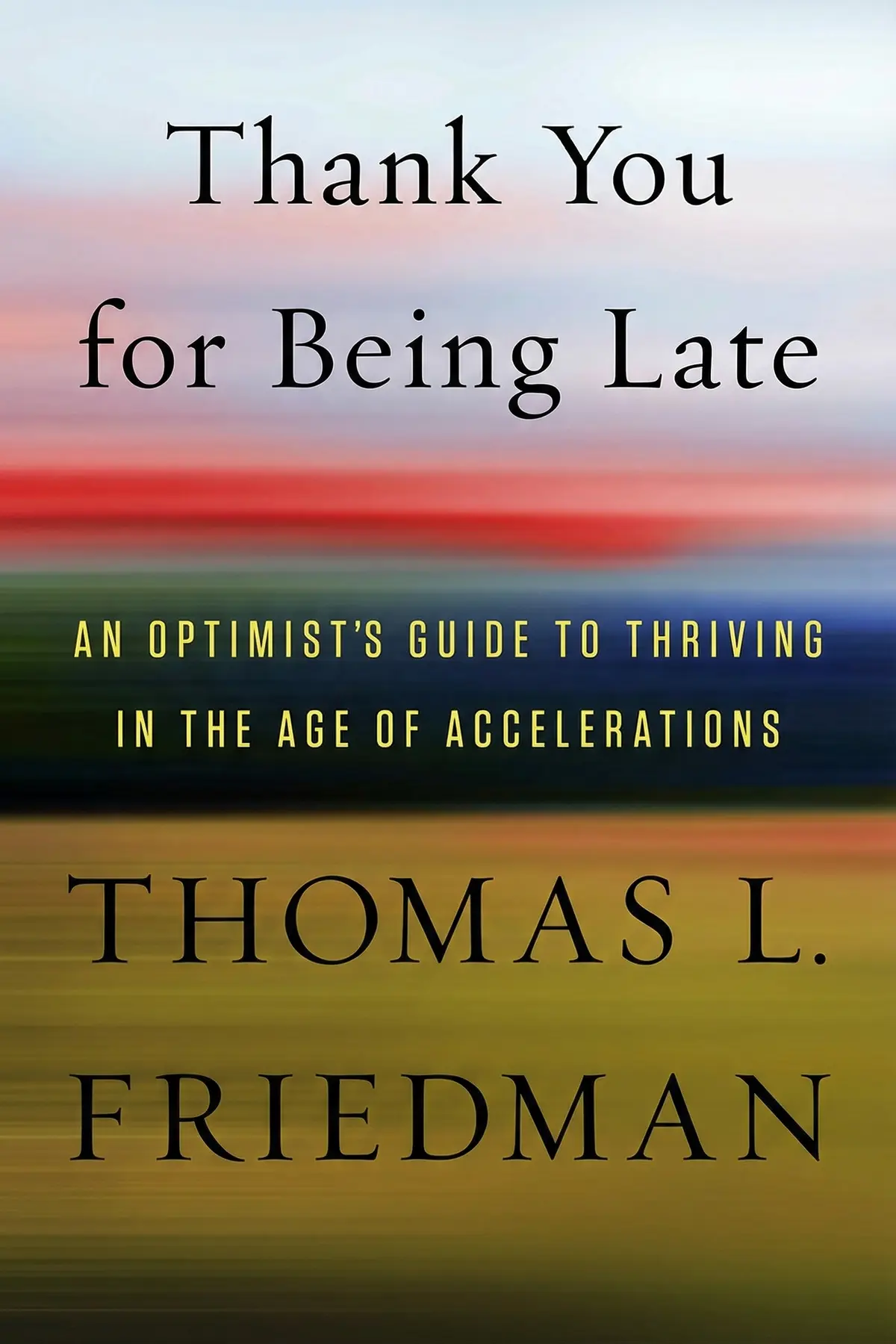
Table of Content
1. Introduction
1 min 53 sec
In our modern lives, there is a persistent feeling that the ground is shifting beneath our feet. We look at the gadgets in our pockets, the political headlines from across the globe, and the unpredictable patterns of the weather, and we often feel a sense of vertigo. It seems as though the world we knew just a decade ago has been replaced by something faster, louder, and infinitely more complex. This isn’t just an illusion or a trick of memory; it is a measurable reality. We are living through what could be described as the ‘Age of Accelerations,’ a period where the fundamental forces shaping human civilization are moving at a speed that often outpaces our ability to adapt.
In this summary, we are going to explore the insights of Thomas L. Friedman as he breaks down why everything seems to be happening at once. The title of his work suggests a counterintuitive approach to this chaos. Usually, being late is seen as a failure of discipline or a lack of respect for others. But Friedman found that when his colleagues or acquaintances were late for a meeting, it gave him a rare, unscripted moment to simply sit, think, and observe. This ‘found time’ became a sanctuary for reflection.
He realized that in an era where everything is accelerating, the most valuable thing we can do is intentionally pause. By slowing down, we can better understand the massive shifts occurring in technology, the marketplace, and Mother Nature. Through this exploration, we will see how these three forces are interconnected and why the year 2007 was a historical pivot point that changed the trajectory of our species. We will also discover that while these changes can be destabilizing, they also offer incredible opportunities for those who can find a way to stay balanced in the storm. The throughline of our discussion will be the transition from static stability to dynamic stability—learning how to stay upright while the world is in constant motion, much like finding your balance on a moving bicycle.
2. The Pivotal Year of 2007
2 min 11 sec
What if a single year could redefine the future of humanity? Discover why 2007 was the moment the world shifted into a higher gear.
3. The Infinite Reach of Moore’s Law
2 min 17 sec
Computing power is doubling at a rate that defies human intuition. Learn how microchips are driving every aspect of our lives.
4. The New Global Interconnectivity
2 min 19 sec
Globalization is no longer just about shipping crates. It’s about the invisible, lightning-fast flow of ideas and information.
5. The Accelerating Force of Nature
2 min 01 sec
Mother Nature is no longer a backdrop to human history; she is a primary driver of change. See how the climate is reaching its limit.
6. The Threat of Digital Isolation
1 min 48 sec
We are more connected than ever, yet more people feel alone. Explore the paradox of our hyper-connected modern society.
7. Building Resilience Through Community
2 min 14 sec
Can we find stability in a world of chaos? The answer might lie in our own neighborhoods and the power of local roots.
8. Conclusion
1 min 48 sec
As we have seen throughout this journey, the Age of Acceleration is not a temporary phase; it is the new permanent reality of human existence. The triple forces of technology, globalization, and climate change are feeding into one another, creating a feedback loop of change that can feel dizzying. We have moved from a time when we could afford to be static to a time that demands we be dynamic. We have seen how the year 2007 launched us into this new era and how Moore’s Law continues to shrink the time we have to adapt. We have also explored the heavy toll that these changes are taking on our planet and our social structures.
But the message of Thomas L. Friedman is ultimately one of hope. While the challenges are immense, so are the tools we have to solve them. The same technology that disrupts our jobs also gives us the power to collaborate across continents to solve global crises. The same global markets that create competition also allow for a unprecedented flow of life-saving ideas. The key to navigating this world isn’t to try and stop the clock—that is impossible. Instead, the key is to find our anchor in the things that don’t change: our need for community, our capacity for empathy, and our commitment to the common good.
The most important takeaway is the necessity of the pause. In a world that demands a response every second, the most radical and productive thing you can do is take a moment to reflect. By being ‘late’ for the frantic pace of the modern world, you give yourself the space to think clearly and act intentionally. So, as you move forward from this summary, try to find those moments of stillness. Put down the device, step away from the digital flow, and engage with the person standing right in front of you. It is through these simple, human connections that we will build the resilience needed to not just survive, but to truly thrive in this fast-moving age.
About this book
What is this book about?
The world is moving faster than ever before, and for many of us, it feels like we are struggling to keep our heads above water. This summary examines the core thesis of Thomas L. Friedman’s work: that we are living through a unique period of history defined by three simultaneous accelerations. These forces—technology, the global marketplace, and the natural environment—are reshaping how we work, how we communicate, and even how we relate to the planet itself. Friedman argues that the traditional methods of adaptation are no longer sufficient because the rate of change has surpassed our natural ability to keep up. However, rather than succumbing to anxiety, he provides a roadmap for finding stability. By understanding the origins of this 'Great Disruption' and leaning into the power of human connection and community, we can find a way to navigate this age of accelerations. The promise of the book is that by taking the time to pause and reflect—essentially 'being late'—we can gain the perspective needed to build a more resilient and meaningful future.
Book Information
About the Author
Thomas L. Friedman
Thomas L. Friedman is a highly respected journalist, reporter, and columnist who has been honored with the Pulitzer Prize three times. He currently serves as the foreign affairs columnist for the New York Times. Throughout his career, he has authored several influential books, including From Beirut to Jerusalem, The Lexus and the Olive Tree, and the international bestseller The World Is Flat.
Ratings & Reviews
Ratings at a glance
What people think
Listeners find this book consistently entertaining and immersive, praising the high quality of writing and the abundance of meaningful insights. It is frequently called thought-provoking, with one listener highlighting its ability to alter how people perceive the future, while others value the thorough information and its connection to modern happenings. Regarding the tempo, feedback is varied, with several listeners describing the organization as somewhat disjointed.
Top reviews
Riley
Finally got around to reading this and frankly, it changed how I view the morning news. Friedman explains that we are living through a period of "supernova" acceleration where human adaptability is struggling to keep pace with technological growth. The way he links Moore’s Law to social instability is nothing short of brilliant. I appreciated the optimism he maintains throughout the text, even when discussing daunting topics like environmental collapse or job displacement. It’s an engaging read that manages to be both incredibly informative and surprisingly emotional towards the end. Some might find his writing style a bit too conversational, but I found it refreshing compared to most dry, academic policy books. This is a must-read for anyone trying to make sense of the 21st century.
Show moreAhmed
As someone who struggles to keep up with the breakneck speed of current events, this book was a godsend. It provides a comprehensive framework for understanding the "three great accelerations" that are reshaping our planet right now. I was particularly struck by the section on Mother Nature and why we can no longer ignore the ecological costs of our progress. Friedman’s writing is exceptionally engaging, making even the most complex global market trends feel accessible and relevant to daily life. It’s a thought-provoking piece of work that encourages you to pause and reflect on where we are headed as a species. Even if you don't agree with every one of his policy suggestions, the sheer amount of insight packed into these pages is worth the price of admission.
Show moreBenjamin
This book should be required reading for anyone who cares about the intersection of public policy and technological growth. Friedman makes a brilliant case for why we need to move faster to keep up with the environment we've created. I loved the section on Mother Nature; it’s one of the few books that treats climate change as an integral part of globalization rather than a side issue. The "Thank You for Being Late" concept—using pauses to reflect—is a beautiful takeaway for our hectic lives. Personally, I didn't mind the Minnesota section as much as others did, as it grounded his grand theories in real human communities. It’s a comprehensive, visionary work that manages to stay grounded in common sense.
Show moreAnthony
Truth is, the Minnesota memoir at the end caught me off guard, but it ended up being my favorite part. After hundreds of pages about silicon chips and global markets, Friedman brings it all back to the importance of "anchors" and local community. He argues that the faster the world moves, the more we need those deep, human connections to keep us stable. This isn't just a book about gadgets; it's a book about how we survive and thrive as a society. The writing is top-tier, engaging the reader from the very first page with a mix of high-level theory and personal anecdotes. It changed my view of the future from one of fear to one of cautious optimism. If you're looking for a comprehensive guide to our confusing times, this is it.
Show moreWitthaya
Friedman has this uncanny ability to make you feel like you're having a deep conversation with a very smart, albeit slightly rambling, uncle. He synthesizes complex trends—technology, globalization, and climate change—into a cohesive narrative about why our current era feels so chaotic. I found the deep dive into 2007 particularly fascinating; it really was the year the foundation of our modern digital life was laid. However, the book isn't without its flaws. It feels about a hundred pages too long, and some of the anecdotes about his hometown in Minnesota felt a bit like a detour from the main thesis. If you can handle the occasional name-drop and repetitive point, it’s a stellar guide for understanding the "Great Acceleration." It forced me to rethink how I approach my own career in this fast-paced environment.
Show moreNadia
The chapter on the "Great Acceleration" really puts things into perspective for anyone feeling overwhelmed by the modern world. Friedman argues that we need to build "floors" under people rather than "ceilings," which is a powerful metaphor for social safety nets in a digital age. I found his analysis of the "Market" and "Mother Nature" to be incredibly relevant, especially given the current political climate. My only real gripe is that he can be a bit repetitive, hammering home the same points about 2007 over and over again. Despite the occasional bloat, the core ideas are robust and worth pondering. It’s a dense read, so take your time with it. The insight into how companies like Airbnb and GitHub changed the landscape of trust was particularly enlightening for me.
Show moreNoi
Ever wonder why the world feels like it’s spinning off its axis lately? This book offers a compelling explanation by weaving together threads of technology, global trade, and environmental change. It is an ambitious project that mostly succeeds in painting a picture of our interconnected reality. I especially enjoyed the discussion on "high-imagination" jobs and how we need to rethink education for the future. Friedman’s tone is generally positive, which is a nice change of pace from the usual doom-and-gloom futurist predictions. The pacing is a bit uneven, particularly when he dives into the minutiae of his childhood in Minnesota. Still, the overall message about the importance of human connection in an automated world resonated deeply with me.
Show morePetch
To be fair, I expected something a bit more focused given the author’s reputation for sharp analysis. The first half of the book is classic Friedman—insightful, data-driven, and genuinely eye-opening regarding the technological shifts of the last decade. He makes a compelling case for 2007 being a historical tipping point. But then the narrative shifts gears entirely into a nostalgic memoir about growing up in St. Louis Park, Minnesota. While his points about community and social capital are valid, the transition felt jarring and somewhat disjointed from the tech-heavy beginning. It felt like two separate books were mashed together without a strong enough bridge. I still learned a lot, but I spent a significant portion of the final chapters wondering when he’d get back to the point.
Show moreSumalee
In my experience, Friedman is best when he's connecting dots that other people haven't even seen yet. Unfortunately, in this volume, he seems to be rehashing a lot of common knowledge that has been circulating in tech circles for years. His obsession with the year 2007 is interesting at first, but it quickly becomes a repetitive crutch for the entire first half of the book. Not gonna lie, I found myself skimming through some of the more long-winded technical explanations. The writing style is undeniably polished and "universally popular," yet it lacks the "seminal" feel of his earlier works like The World Is Flat. It’s a decent primer for someone who isn't very tech-savvy, but more informed readers might find it a bit patronizing.
Show moreSirirat
Look, I wanted to love this, but it felt like a series of recycled New York Times columns stretched out into a bloated manifesto. Friedman spends an exhausting amount of time telling the reader that technology is moving fast—a point most of us figured out years ago. The constant name-dropping of CEOs and world leaders gets tiresome quickly, adding a layer of elitism that obscures his actual arguments. He treats the reader like they’ve been living under a rock, excitedly explaining basic concepts like the cloud or smartphone apps as if they were revolutionary secrets. The last third of the book is a meandering trip down memory lane that has very little to do with the "accelerations" promised in the title. It desperately needed a more aggressive editor to trim the fat and keep the message concise.
Show moreReaders also enjoyed

AUDIO SUMMARY AVAILABLE
Listen to Thank You for Being Late in 15 minutes
Get the key ideas from Thank You for Being Late by Thomas L. Friedman, plus 5,000+ more titles in English and Thai.
- 5,000+ titles
- Listen as much as you want
- 7-day free trial
- Cancel anytime







