
A Little History of Philosophy
Nigel Warburton
Discover a transformative approach to resilience and character through the teachings of Musonius Rufus. This summary explores how Stoic principles of self-discipline, equality, and practical action lead to lasting happiness and fulfillment.
1 min 55 sec
In the bustling streets of ancient Rome, amidst the political chaos and the rise and fall of emperors, a teacher named Gaius Musonius Rufus was busy redefining what it meant to live a good life. While many of his contemporaries were lost in the clouds of abstract theory, Musonius was grounded in the grit of everyday existence. He wasn’t interested in philosophy as a mere intellectual exercise; for him, it was a manual for survival, a way to navigate the inevitable storms of life with grace and strength.
Stoicism is a philosophy that has endured for centuries, finding its way into the hands of world leaders, soldiers, and everyday people seeking a bit of clarity. Its core appeal lies in its practicality. It asks us to look at the world, see it for what it truly is, and then act with purpose. But within the Stoic tradition, the voice of Musonius Rufus is particularly special. He focused on the idea that we should not fear or shy away from the difficult parts of life. In fact, he suggested that we should disdain hardships—not by ignoring them, but by recognizing that they lack the power to touch our inner character unless we let them.
In this exploration of his surviving lectures, we are going to look at the throughline of his thought: the idea that virtue is a practical skill that anyone can learn. We will see how philosophy can become the beating heart of a good life, how something as simple as what you eat can dictate your level of happiness, and why the Stoic way of living is actually the most natural path for a human being to take. By the end of this journey, you’ll understand why the pursuit of a virtuous character isn’t just a lofty goal for the elite, but a necessary practice for anyone who wants to find genuine, lasting peace. So, let’s dive into the world of this often-overlooked Stoic master and discover how his ancient lessons can offer a modern way to thrive.
3 min 02 sec
Discover why the true purpose of philosophy lies in our actions rather than our words, focusing on the essential divide between what we can and cannot control.
2 min 55 sec
Explore the idea that excellence is a practical ability that every human is naturally capable of developing through intentional practice.
2 min 56 sec
Learn why real-world practice is far more valuable than intellectual knowledge when it comes to mastering the art of living.
2 min 48 sec
Uncover the radical Stoic argument for why women are just as capable and deserving of philosophical training as men.
2 min 44 sec
Examine the surprising logic of why a life of discipline and virtue is actually less exhausting than a life of vice.
2 min 33 sec
Find out how your relationship with food can serve as a powerful training ground for developing the virtue of temperance.
2 min 30 sec
Understand the Stoic definition of living according to nature and how it leads to fulfilling our unique role in the universe.
1 min 44 sec
As we reach the end of our exploration into the teachings of Musonius Rufus, the central message remains as clear and as challenging as it was in ancient Rome: the good life is a practiced life. We have seen that philosophy is not a distant academic pursuit but a vital, daily exercise in using our reason to navigate the world. By distinguishing between what we can control and what we cannot, we reclaim our power and our peace of mind. We have learned that virtue is a skill that resides within all of us, waiting to be developed through consistent effort and real-world experience.
Musonius has shown us that the path of discipline is actually the path of least resistance in the long run. By choosing the simple diet, the honest conversation, and the courageous stand, we avoid the exhausting chaos of a life led by impulse and vice. He has reminded us that our capacity for reason makes us equal in our potential for excellence, transcending the social barriers of gender or status. Ultimately, to disdain hardships is to realize that the most important part of who you are—your character—is something that no external force can take away from you.
The takeaway for our modern lives is to start small but start now. Look at the challenges you face today and ask yourself which part of them you can actually control. Practice self-mastery in your smallest habits, whether it’s what you eat or how you respond to a frustrating email. Remember that every hardship is an opportunity to strengthen your ‘virtue muscle.’ By aligning your actions with your reason, you aren’t just surviving the day; you are fulfilling your true nature as a human being and building a foundation for a happiness that no amount of misfortune can destroy.
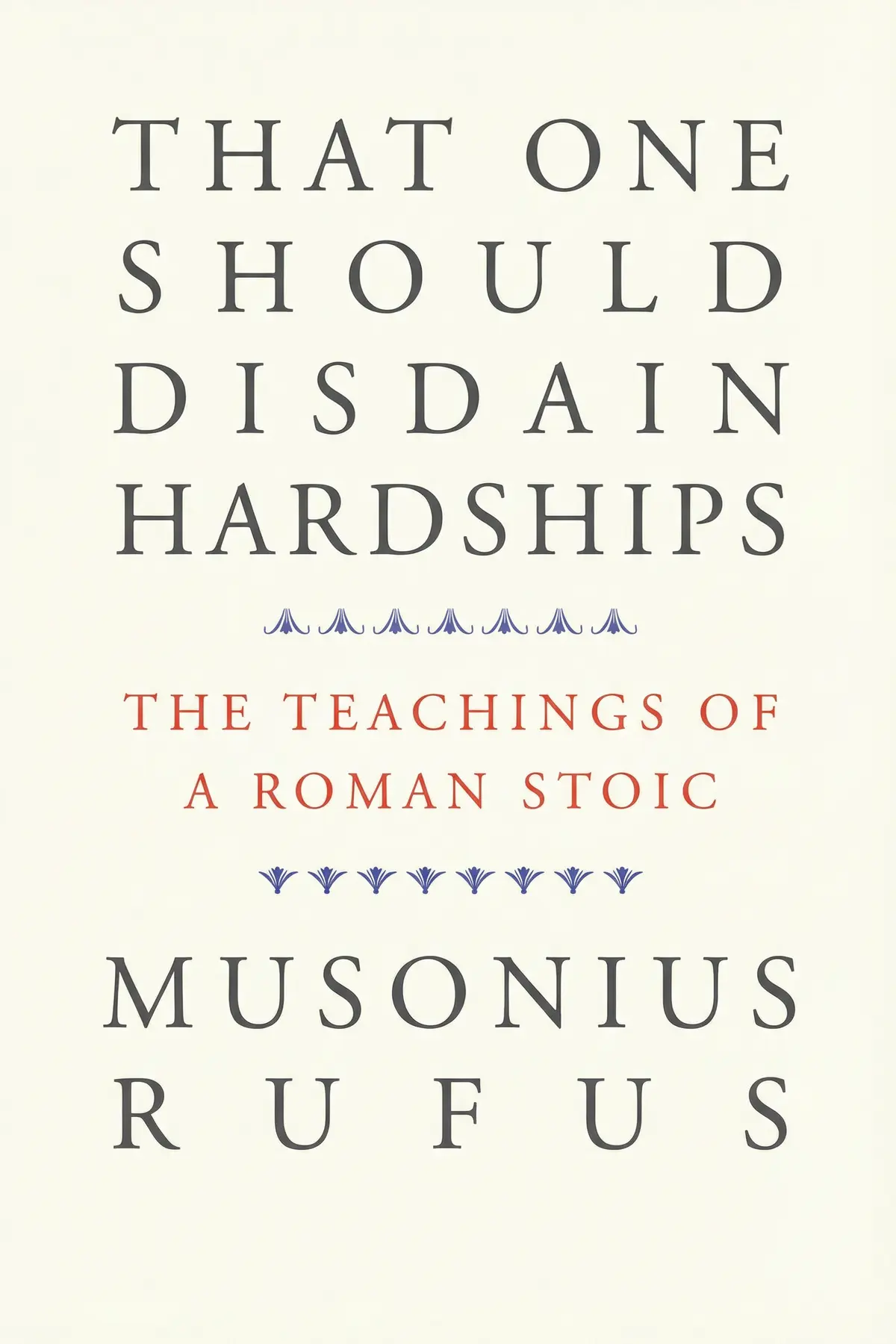
That One Should Disdain Hardships is an insightful exploration of the lectures given by Gaius Musonius Rufus, a prominent Roman Stoic whose work emphasizes the practical application of philosophy in daily life. Rather than focusing on abstract theories or complex logic, Musonius argues that philosophy is the art of living well. He provides a blueprint for developing virtue through self-discipline, a moderate lifestyle, and the cultivation of reason, suggesting that these are the only reliable paths to a happy and stable existence. The book promises a radical perspective on how we view challenges and personal growth. It covers topics ranging from the equality of men and women in intellectual pursuits to the importance of a simple diet as a foundation for self-mastery. By framing virtue as a skill to be practiced rather than a status to be achieved, Musonius offers timeless wisdom on how to align our actions with our true nature. This summary guides you through his most essential lessons, showing how to disdain the superficial hardships of life in favor of a noble, reasoned character.
Gaius Musonius Rufus was born around 30 CE in what is now the Lazio region of Italy, the heart of the expanding Roman Empire. During the reign of Nero, he became a renowned teacher in Rome and established himself as one of the first century’s most influential Stoic voices. His teachings focused heavily on ethics and the practical lived experience of philosophy. Musonius Rufus passed away around 101 CE, leaving behind a legacy of lectures that would profoundly shape the Stoic tradition.
Listeners view the book as vital for contemporary stoics, praising its pragmatic methodology. However, its accessibility draws mixed responses, with some listeners finding it a fantastic read while others remark that it is not an easy read.
After hearing so much about the Big Three Stoics, I finally decided to give Musonius Rufus a shot. It is refreshing to see a philosopher actually tell you how to live your life rather than just floating in the clouds of abstract logic. He gets into the absolute nitty-gritty of existence, from whether you should cut your hair to the vital importance of manual labor. Truth is, most modern self-help books are just watered-down versions of what Rufus was preaching thousands of years ago in Rome. Some might find his views on marriage and sex a bit restrictive, but there is something undeniable about his commitment to self-discipline. He argues that we must prepare the body as well as the mind, treating every day as a training ground for the soul. It’s a short read, but it carries a weight that stays with you long after the final page.
Show moreWow. This book hits like a cold shower at five in the morning. Rufus doesn't care about your excuses or your desire for a comfortable life because he knows those things weaken the spirit. He advocates for a Spartan-like upbringing where we embrace hunger, cold, and manual labor as teachers of virtue. It’s incredible how much of this resonates today, especially the idea that tilling the land is the most philosophical way to live. In my experience, we spend way too much time theorizing about 'the good' and not enough time actually practicing it. This volume is essentially a workout plan for your moral compass, stripping away the fluff of modern living. It’s not an easy read in terms of what it asks of you, but the clarity of his vision is breathtaking. Every person seeking to build resilience should have this on their shelf.
Show moreSpecifically, the lecture on why exile is not an evil changed my entire perspective on 'bad' luck. Musonius Rufus argues that our circumstances are just the raw material for our character, and he lived that truth through multiple banishments. There is a raw, lived-in quality to his words that you don't always get from philosophers who lived in ivory towers. He pushes for a life of radical simplicity, even suggesting that being a shepherd is the ideal philosophical occupation because it allows for reflection. Not gonna lie, it makes me want to quit my office job and move to a farm. The focus on 'doing' rather than just 'knowing' is exactly what I needed to hear right now. It’s a small book but it feels like a heavy anchor in a very chaotic world. It’s essential reading for anyone trying to navigate the hardships of the 21st century.
Show moreAs someone who has struggled with the 'instagrammification' of Stoicism, finding the source material for Epictetus was a revelation. This isn't about catchy quotes to put on a picture of a mountain; it's about the grit required to be a decent human being. Rufus is relentless in his pursuit of virtue, showing us that every small choice—what we eat, how we dress—is a moral act. I loved how he dismantled the idea that luxury makes us happy, proving instead that it only makes us more dependent and fragile. The text is lean and mean, with no wasted words or flowery metaphors to hide behind. It forces you to look in the mirror and ask if you are actually living your values or just talking about them. For anyone who feels like modern life is too soft, this is the perfect antidote. It’s a masterclass in ancient resilience that still feels fresh today.
Show moreMusonius Rufus isn't interested in your feelings; he’s interested in your character. While Epictetus (his most famous student) often focuses on internal mental states, Rufus is obsessed with the physical and social application of virtue. Personally, I appreciated the directness of his advice on things like diet and the dignity of farming, even if the prose is a bit dry at times. He challenges the idea that philosophy is just for the elite, famously arguing that women should be trained in the same virtues as men. That specific lecture was centuries ahead of its time, though he balances it with some very 'old school' views on sexual morality. The translation I read was clear and accessible, making it easy to digest these bite-sized lessons in one or two sittings. It serves as a great bridge between abstract theory and the actual hardships of daily life.
Show moreThe chapter on why women should also study philosophy is worth the price of admission alone. It’s fascinating to see a Roman voice defending the intellectual capacity of both genders so vehemently, even if his goal is just to make women better wives and mothers. Look, you have to take the cultural context into account when reading a man who lived two thousand years ago. His obsession with 'natural' living and avoiding the 'effeminate' trap of luxury is still relevant in our world of endless screen time and fast food. Sometimes his tone comes off as a bit preachy, which I suppose is the occupational hazard of being a Stoic teacher. I did find the structure a little repetitive toward the end, but the core message remains powerful. If you want a philosophy that demands action over contemplation, this is the one for you.
Show morePicked this up to see the roots of Epictetus’s thought and was surprised by how grounded it felt. Unlike the Meditations, which feel like a private conversation with one's own soul, these are lectures meant to change the behavior of students. Rufus is the ultimate pragmatist, focusing on the domestic sphere—marriage, family, and household management—as the true arena for virtue. Some of the sections are quite brief, almost like notes, but they pack a punch if you’re willing to sit with them. My only real gripe is that some of the logic feels a bit circular, assuming you already agree with his Stoic premises. To be fair, that’s a common issue with most ancient schools of thought. Still, for a short book, it provides a massive amount of food for thought. It’s definitely a foundational text for anyone serious about the Stoic path.
Show moreEver wonder what an ancient Roman conservative would sound like if he had a YouTube channel? Reading these lectures felt surprisingly like listening to a proto-Jordan Peterson, especially with the heavy emphasis on traditional marriage and avoiding luxury. To be fair, Rufus makes some excellent points about how we coddle ourselves with soft living and expensive food. However, I struggled with the rigidness of his prescriptions, which sometimes felt more like social dogma than liberating philosophy. While the 'internet stoicism' crowd will likely worship this text for its 'grit' and 'discipline,' I found the lack of nuance a bit frustrating. It’s an essential read for anyone wanting to see the roots of the Stoic tradition, but don't expect the poetic beauty of Marcus Aurelius. It’s more of a drill sergeant’s manual than a diary of the soul.
Show moreFrankly, I found this to be a bit of a mixed bag. On one hand, Rufus offers some very practical and noble advice about self-control and the vanity of wealth. On the other hand, his strict views on sex and marriage feel extremely dated and narrow-minded, even for a Stoic. He views anything other than procreative sex within marriage as a moral failure, which is a tough pill to swallow for a modern reader. The writing style is also quite repetitive, hitting the same notes about 'luxury' and 'hardship' over and over again. I understand that these were originally lectures, so some repetition is expected, but it makes for a slightly tedious reading experience. It’s an interesting historical document and offers a good contrast to Seneca’s more polished essays. I don’t regret reading it, but I won’t be revisiting it as often as I do Marcus Aurelius.
Show moreNot what I expected after loving the Socratic dialogues. Rufus seems to have an answer for everything, but the answers feel like simplistic mantras rather than profound explorations of the human condition. Where Socrates would spend hours defining justice, Rufus just tells you to be just and move on to the next topic. Frankly, it felt more like a collection of Instagram captions for the 'grindset' community than a serious work of philosophy. He tells you not to worry about death or how your hair looks, which is fine, but it lacks the intellectual struggle that makes philosophy interesting. Everything is so black and white here: either you are disciplined or you are corrupt. Life is usually lived in the grey areas, and Rufus has no time for those. It’s a fast read, certainly, but it left me feeling more annoyed than enlightened.
Show moreNigel Warburton
John Rawls
William B. Irvine

Friedrich Nietzsche
AUDIO SUMMARY AVAILABLE
Get the key ideas from That One Should Disdain Hardships by Musonius Rufus, plus 5,000+ more titles in English and Thai.







