
Nine Lives: In Search of the Sacred in Modern India
William Dalrymple
A historical exploration of how the East India Company, a private corporation, systematically dismantled the Mughal Empire to become a sovereign power through military force and financial exploitation.
1 min 42 sec
Imagine a world where the most powerful military force on earth is not a nation-state, but a private business. A world where a board of directors, sitting thousands of miles away in a London office, makes decisions that determine the life and death of hundreds of millions of people. This isn’t a dystopian fiction; it is the true history of the East India Company. In this exploration of the eighteenth century, we look at the breathtaking and brutal rise of a corporation that successfully executed a hostile takeover of an entire subcontinent.
The throughline of this story is the intersection of commerce and conquest. It is a chronicle of how the pursuit of profit can morph into a hunger for territory, and how a private entity can exploit the internal fractures of a fading empire to install itself as the supreme ruler. This journey will take us from the opulent courts of the Mughal emperors to the bloody battlefields of Bengal and the cutthroat boardrooms of London.
We will see how the Company transitioned from a small group of traders begging for permissions into a sovereign entity that dictated terms to kings. We will examine the strategic alliances, the technological edges in warfare, and the financial structures that made this unprecedented expansion possible. But more importantly, we will confront the consequences of this corporate rule—the pillaging of millennia of wealth, the engineered famines, and the cultural displacement that left scars on the Indian subcontinent that are still visible today. By the end of this summary, you will understand exactly how a country with only a tiny fraction of the world’s population managed to dominate a region four times its size, and why the legacy of the East India Company remains a chilling reminder of the dangers of uncontrolled corporate violence.
2 min 35 sec
Discover how a 16th-century English innovation in business set the stage for one of history’s most aggressive expansions into the East.
2 min 21 sec
The death of a powerful emperor leaves a massive power vacuum, inviting local rebels and foreign invaders to tear the empire apart.
2 min 27 sec
A childhood bully turned military tactician finds himself at the center of a high-stakes standoff in the province of Bengal.
2 min 03 sec
How a sudden monsoon and a calculated betrayal handed the keys of political power to a private business entity.
2 min 35 sec
Witness the moment when the Company gained legal control over the taxes of millions, turning an entire region into a corporate asset.
2 min 20 sec
When natural disaster meets corporate greed, the result is a humanitarian crisis and a financial shock that echoes in modern history.
2 min 22 sec
Go behind the scenes of a bitter power struggle between two top officials that nearly paralyzed the Company’s operations.
2 min 14 sec
Follow the heartbreaking journey of the last Mughal lion as he attempts to reclaim his throne, only to meet a gruesome end.
2 min 43 sec
Uncover the surprising role that Indian bankers played in funding the very army that would eventually subjugate their own country.
2 min 08 sec
From the last battles against the Marathas to the eventual fall of the Company itself, see how the British government finally took the reins.
1 min 52 sec
The rise and fall of the East India Company is more than just a historical account; it is a profound lesson in the dynamics of power. Over the course of less than fifty years, a single business transformed itself from a struggling trade venture into the sovereign ruler of 200 million people. This wasn’t achieved through a single grand plan, but through a series of opportunistic moves, strategic betrayals, and the relentless application of superior military technology and financial resources.
We have seen how the Company took advantage of ‘the anarchy’ that followed the decline of the Mughal Empire, using the chaos to establish its own order—an order built on the extraction of wealth and the suppression of local autonomy. From the decisive victory at Plassey to the institutionalized plunder of the Diwani, the Company’s primary goal remained the enrichment of its shareholders, regardless of the human cost. The devastating famine of 1770 and the blinding of Shah Alam serve as stark reminders of the brutality that can occur when profit is divorced from the responsibility of governance.
The final lesson of this history is the reminder that no entity, no matter how large or powerful, is immune to the consequences of its own actions. The Company’s greed eventually led to its own undoing, as its corruption and violence forced the British government to step in and take control. Today, as we navigate a world where global corporations often hold power comparable to nation-states, the story of the East India Company remains incredibly relevant. It challenges us to think about the limits of corporate influence and the necessity of holding powerful entities accountable for the impact they have on the world. The legacy of the Company is a warning from history: that the unchecked pursuit of profit can lead to a form of anarchy that benefits the few at the expense of the many, leaving behind scars that take centuries to heal.
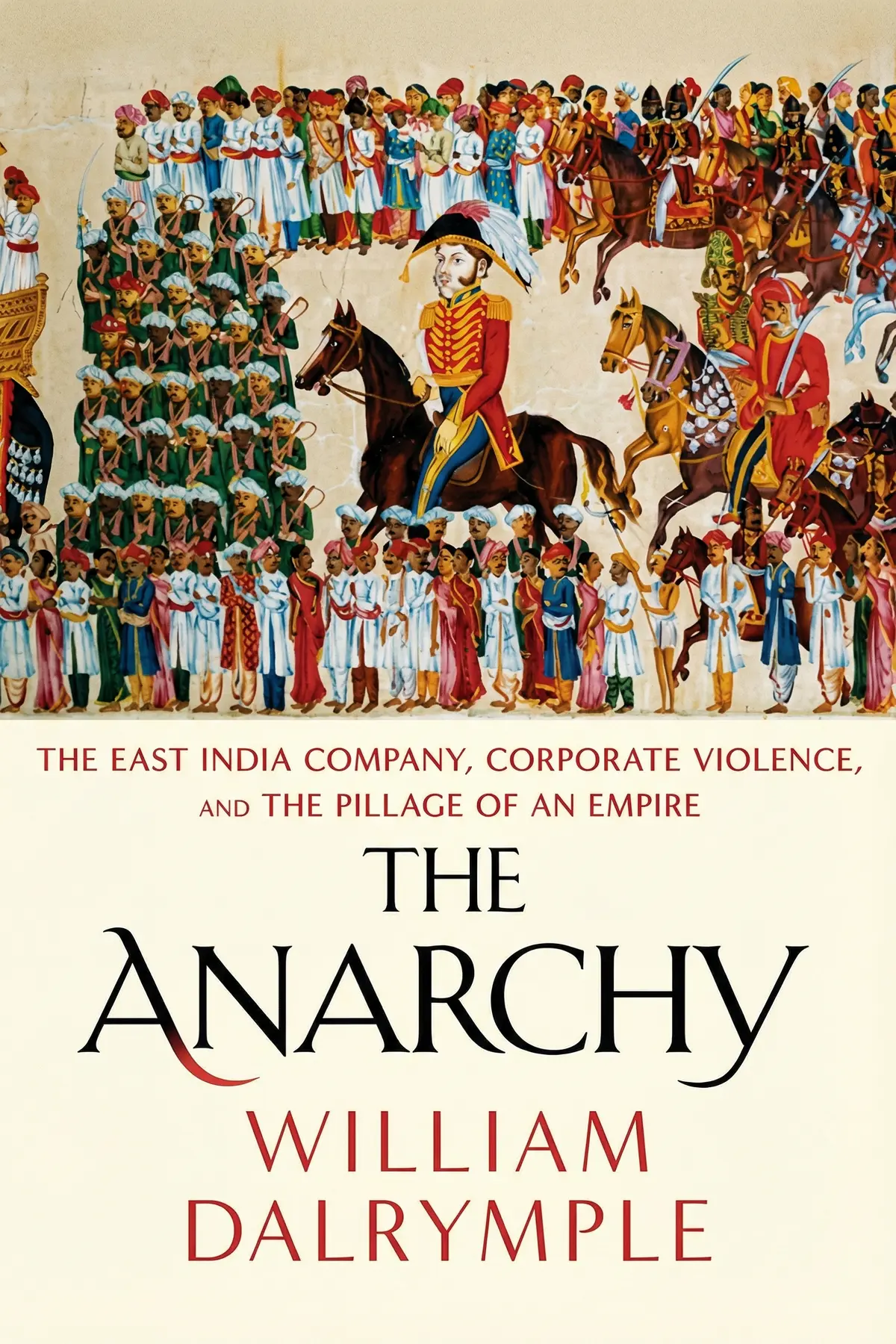
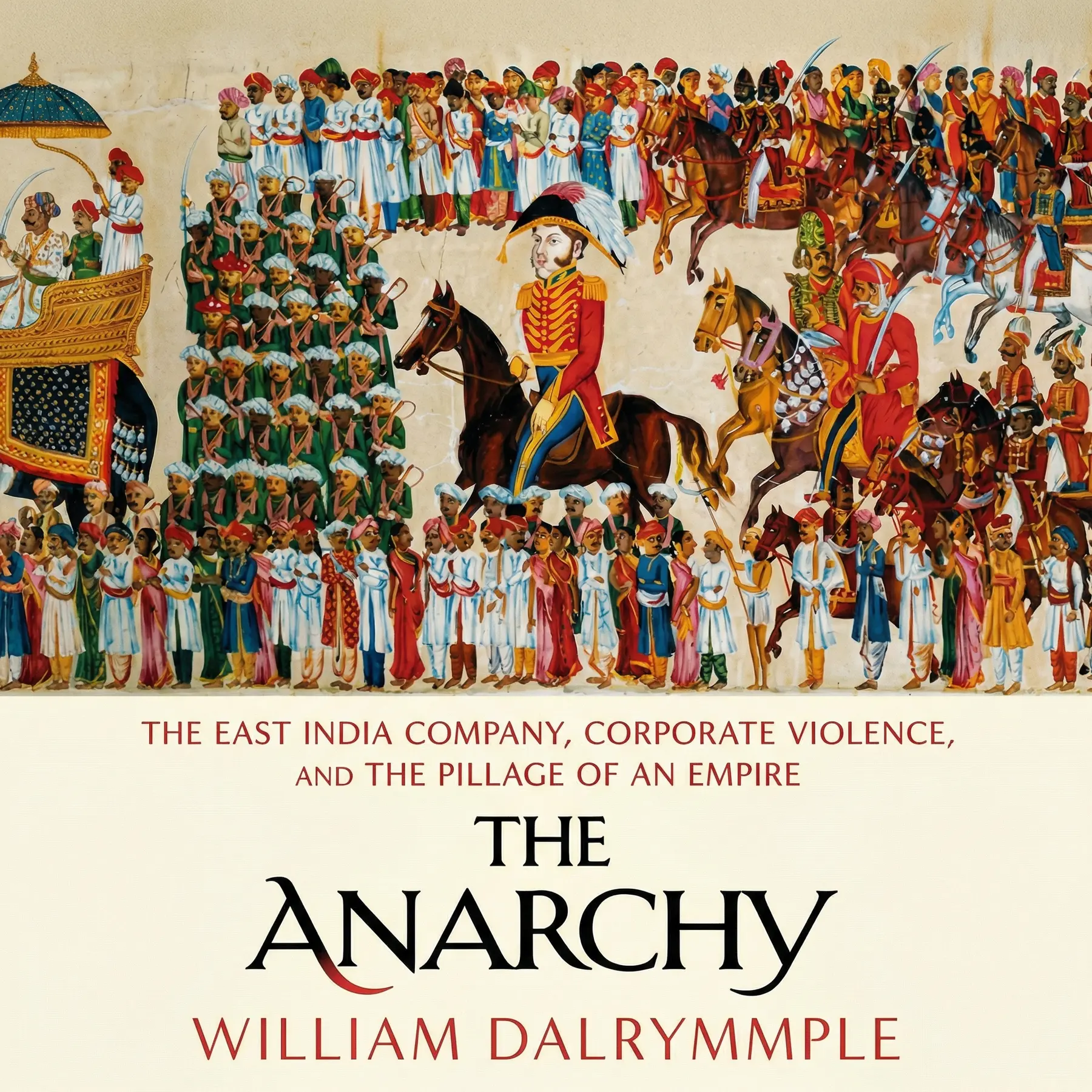
The Anarchy provides a detailed account of the East India Company’s transformation from a struggling group of London merchants into a militarized colonial power. It traces the trajectory of how a joint-stock entity managed to conquer the Indian subcontinent, focusing on the period between the decline of the Mughal Empire and the eventual takeover by the British Crown. The narrative explores the personalities and motivations of key figures like Robert Clive and Warren Hastings, alongside Indian leaders like Tipu Sultan and Shah Alam. It exposes the systemic violence, corporate greed, and strategic maneuvers that allowed the Company to seize control of an entire empire's wealth. The promise of the book is a cautionary tale about the dangers of unchecked corporate power and the devastating human cost of prioritizing profit over governance.
William Dalrymple is an acclaimed Scottish travel writer and historian whose work focuses on South Asia and the Middle East. In addition to writing over a dozen award-winning books, he has created TV series, curated museum exhibits and music compilations, and received honorary doctorates from three universities. He has lived in India on and off since 1989.
William Dalrymple
Listeners find this book to be a significant historical achievement that offers an in-depth chronicle of 350 years of India's past. They characterize the narrative as engrossing, accessible, and masterfully composed, with one listener remarking on how it renders a complicated era and setting quite approachable. Listeners value the work's perspective and nuance, with one review noting that it recounts events without dogmatic insistence on overarching historical narratives. The tempo of the book draws varied responses; some consider it gripping, while others feel it is monotonous.
As someone who has always been fascinated by the collapse of the Mughal Empire, this book felt like a revelation. Dalrymple manages to weave a narrative that is both academically rigorous and as gripping as any political thriller you might find at an airport. He meticulously documents how a single office in London, driven by nothing but cold-blooded corporate greed, managed to subjugate a subcontinental superpower through a mix of mercenary violence and financial manipulation. The description of Nader Shah’s sack of Delhi is particularly vivid, painting a picture of a city stripped of its soul. While the book is quite hefty, the prose remains fluid and accessible throughout. I especially appreciated how the author utilized Persian and Mughal sources to provide a perspective often ignored by traditional British accounts. It is a sobering reminder that the roots of modern global capitalism are buried deep in the blood-soaked soil of the 18th century. Truly an essential read for anyone trying to understand the modern world.
Show moreEver wonder how a small group of businessmen managed to conquer an entire continent with so few troops? This book provides the chilling answer. It’s a story of corporate brigandage that puts modern-day tech monopolies to shame. The East India Company didn't just trade; it looted, manipulated, and eventually nationalized an entire nation's wealth. The statistics are mind-boggling—how India went from a global manufacturing powerhouse to a country crippled by man-made famines. Dalrymple’s account of the Bengal famine of 1770 is heart-wrenching and essential for understanding the true cost of the British presence. The irony that the word 'loot' is of Hindi origin is not lost on the reader here. His writing style is remarkably fluid for such a dense subject, making the 350 years of history fly by. I loved the focus on the 'Jagat Seths' and how their financial backing shifted the scales of power. It’s a haunting, beautifully written masterpiece that everyone should read to understand the dark side of corporate history.
Show moreWow. Just wow. This is one of the most eye-opening books I have read in a decade. The sheer scale of the extraction—trillions of dollars in today's money—is almost impossible to wrap your head around. Dalrymple avoids the dry, dusty tone of many historians. He writes with a sense of moral urgency that kept me turning pages late into the night. The way he describes the EIC’s mercenary army, which eventually grew larger than the actual British military, is a stark warning about the privatization of warfare. The book highlights how sectarianism was often secondary to political survival, with Hindu Marathas and Muslim Mughals forming unexpected alliances. This nuance is often missing from modern debates. The descriptions of the 'Great Anarchy' are chaotic and bloody, yet the author never loses the thread of the narrative. It’s a heartbreaking story of a great civilization being picked apart by a corporation with no soul. Every student of history needs a copy of this on their shelf.
Show moreFinally got around to this massive tome and it's easily one of the most readable history books I've encountered in years. What sets it apart is the scrupulous use of indigenous sources, which provides a voice to those usually silenced in the Western canon. I loved the details about Sir Thomas Roe's failed embassy and the utter indifference of the Mughal court toward the 'foggy nation' of England initially. It highlights the immense wealth of India at the time, which we often forget today. The transition from trading spices to collecting taxes is explained with terrifying clarity. Gotta say, the portrayal of Robert Clive as a violent, unstable thug was particularly satisfying given how he's often lionized. The book manages to be both a grand epic and a detailed economic study. It’s a fascinating, if depressing, look at how corporate interests can override human life and national sovereignty. Highly recommended for fans of narrative non-fiction.
Show moreIn my experience, history is often written by the victors, but here we see the victims' voices finally emerging from the archives. This is a brutal, honest, and deeply researched account of how the East India Company systematically despoiled Bengal. The story of Ghulam Qadir’s revenge on the royal family was stomach-churning but necessary to show the true nature of the 'Anarchy' that the EIC exploited. Dalrymple doesn't pull any punches when describing the corporate brigandage that led to millions of deaths. The book successfully destroys the myth of a 'peaceful' British takeover. Instead, we see a landscape of constant betrayal, greed, and military aggression. Despite the heavy subject matter, the writing is beautiful and evocative. I found the analysis of how Indian financiers actually helped the British to be one of the most intriguing parts of the book. It’s a complex, multifaceted history that deserves every bit of its high rating. A masterpiece of storytelling and research.
Show morePicked this up after seeing it on several 'best of' lists and it certainly lives up to the hype for the most part. The way Dalrymple explains the rise of the East India Company as the first truly predatory multinational corporation is brilliant and highly relevant to today's world. Truth is, the history is dense and at times I felt the pacing slowed to a crawl during the exhaustive accounts of internal Maratha politics. However, the author’s ability to bring historical figures like Shah Alam and the duplicitous Robert Clive to life is unmatched. You can almost smell the gunpowder and the incense in the descriptions of the various courts. One minor gripe is that I wished for more focus on the Sikh Empire, but given the scope, I understand the focus on Bengal and Delhi. It's a massive work that makes a complex era very approachable for a layperson. Definitely worth the time if you have the patience for detailed military maneuvers.
Show moreThe chapter on the 'Shaking of the Pagoda Tree' is where the book really hits its stride for me. Dalrymple exposes the sheer rapacity of the EIC officers who returned to England as 'Nabobs' with unimaginable riches while Bengal starved. Look, the book is undeniably a substantial work of history, but it does require a serious commitment. At nearly 500 pages of text, it can feel tedious when it dives into the minutiae of every single skirmish between the various Nawabs. That said, the sensitive portrayal of the fading Mughal court is deeply moving. The author avoids the trap of a dogmatic narrative, showing instead how a fragmented India was vulnerable to a unified, sociopathic corporate entity. I found the parallels between the EIC and modern-day corporations that are 'too big to fail' to be absolutely terrifying. It's a vivid, often brutal account that doesn't shy away from the horrific human rights violations committed in the name of shareholder profit. Solid four stars.
Show moreDalrymple has a gift for making 18th-century geopolitical maneuvering feel like a high-stakes thriller. I was particularly struck by the tragic figure of Shah Alam, a man born to an empire but reduced to a puppet, eventually suffering the most horrific personal indignities. The book does a fantastic job of debunking the myth that the British 'civilized' India. Instead, it shows they dismantled a sophisticated capitalist organization to fuel their own Industrial Revolution. My only criticism is the lack of depth regarding the missionary influence and the later cultural destruction, though I suppose that falls outside the book's specific timeframe. The prose is elegant and the use of contemporary reports makes the history feel immediate. It's a grim episode, yet the author’s sensitivity to the culture and the period makes it a compelling journey. It definitely changed how I view the 'benevolence' of the British Raj. A very necessary corrective to traditional colonial history.
Show moreFrankly, I have mixed feelings about this one. On one hand, the research is clearly exhaustive and the author's passion for the subject shines through on every page. On the other hand, the pacing felt incredibly uneven during the middle sections where the military campaigns started to blur together. I found myself losing track of which Nawab was betraying which Vizier after a while. It’s a very character-driven account, which is great for readability, but sometimes the broader economic analysis gets lost in the colorful descriptions of courtly life. Also, while the book covers the rise of the EIC excellently, it ends rather abruptly around 1803. I was hoping for more on the 1857 uprising and the long-term impact on the Indian education system. It's a good introduction to the period, but it felt like it was trying to be a scholarly text and a popular history book at the same time, not always succeeding at the balance. It's worth reading, but be prepared for some dry stretches.
Show moreNot what I expected from a supposed work of history. To be fair, Dalrymple is a great storyteller, but I found his narrative to be incredibly selective and biased in its presentation of facts. He seems to go out of his way to whitewash the atrocities of certain rulers while painting others as mere warlords. For example, the glorification of Tipu Sultan felt very one-sided, ignoring his well-documented religious persecutions in Malabar and Coorg. The author relies heavily on specific sources like Ghulam Hussain Khan to push a certain narrative that feels more like historical fiction than objective analysis. It felt like he was cherry-picking anecdotes to fit a modern political agenda rather than giving us the full picture of the 'Anarchy' that preceded British rule. If you're looking for an unbiased account of Indian history, you might want to look elsewhere. It's well-written, but the historical 'facts' are often framed in a way that feels deceptive. I won't be reading his other works.
Show more
Michael Axworthy
Tom Standage

Ishmael Beah
William J. Bernstein

Ben Macintyre
AUDIO SUMMARY AVAILABLE
Get the key ideas from The Anarchy by William Dalrymple, plus 5,000+ more titles in English and Thai.







