Escape from Freedom
Erich Fromm
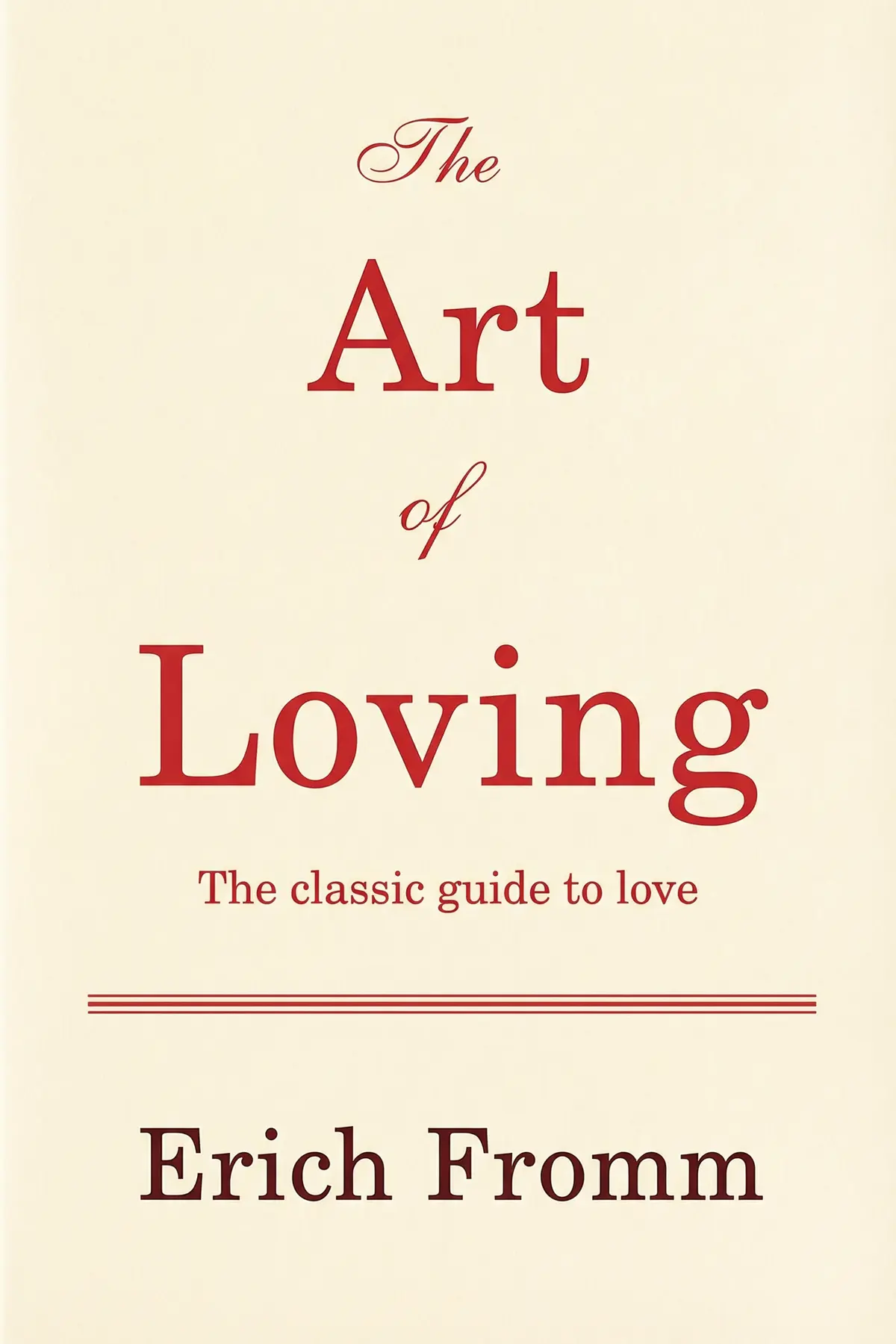
A profound look at love not as a random feeling, but as a conscious art form. This summary explores the discipline, theory, and psychological foundations required to truly master the art of loving.
1 min 27 sec
Whether we are watching the tragic romance of Romeo and Juliet or the sweeping drama of the Titanic, humanity has always been obsessed with the mystery of love. We treat it as an enigma, a lightning bolt of fate, or perhaps just a chemical reaction in the brain that we have no control over. But what if we have been looking at it all wrong? What if love isn’t something that simply happens to us, but is instead a skill that we must deliberately cultivate?
In this exploration of Erich Fromm’s timeless insights, we are going to challenge the common assumption that love is a lucky accident. Instead, we will look at love through the lens of a craftsman. Just as a surgeon or a musician must spend years mastering their craft, Fromm argues that the ability to love requires both deep theoretical knowledge and consistent, disciplined practice.
Throughout this journey, we will unravel the various layers of human connection. We will look at why modern society often makes it harder to love truly, and we will distinguish between the different forms of affection—from the unconditional bond between a mother and child to the complex dynamics of romantic and self-love. By the end of this session, you will see that the throughline of a meaningful life is not finding the right person to love, but rather developing the internal faculty to love. Let’s dive into how we can transform our understanding of this most essential human experience.
1 min 54 sec
Most people view love as a matter of finding the right object rather than developing a personal faculty. Discover why shifting your focus is the first step toward mastery.
2 min 16 sec
Love is more than a feeling; it is an active power. Explore the four essential elements that define a truly giving relationship: care, responsibility, respect, and knowledge.
2 min 11 sec
The way we are loved as children shapes our adult relationships. Learn the crucial differences between unconditional affection and love that must be earned.
2 min 24 sec
Love isn’t limited to romance. From brotherly solidarity to the spiritual love of God, explore the various ways the faculty of love manifests.
2 min 01 sec
Our economic system doesn’t just shape our wallets; it shapes our hearts. Discover how alienation and consumerism create a culture of pseudo-love.
2 min 07 sec
Mastering love requires the same dedication as any other craft. Learn the practical habits needed to transition from theory to real-world application.
1 min 20 sec
As we wrap up our journey through Erich Fromm’s classic insights, the central message is clear: love is not an elusive mystery that drops from the sky. It is a deliberate, active power that resides within each of us. We have seen that the struggle to find love is often actually a struggle to develop the capacity for it. By shifting our focus from being loved to the act of loving, we reclaim our agency.
Remember that love requires the four pillars of care, responsibility, respect, and knowledge. It demands that we integrate the unconditional acceptance of motherly love with the principled growth of fatherly love. And perhaps most importantly, it asks us to stand against the tide of a consumerist culture that tries to turn our most sacred connections into simple market exchanges.
True mastery comes down to the daily practice of discipline, concentration, and patience. It starts with the quiet courage to be alone with yourself and extends to the grand solidarity of brotherly love for all mankind. As you move forward, try to view your relationships not as a search for the perfect person, but as a continuous opportunity to practice your craft. Love is an art, and you are the artist. The more you give of yourself with intention and respect, the more vibrant and meaningful your world will become.
Have you ever wondered why love feels so fleeting or difficult to maintain? Erich Fromm suggests that our problem isn't a lack of luck, but a lack of skill. This exploration challenges the modern notion that love is something you simply fall into. Instead, it argues that love is a capacity we must develop, much like learning a complex musical instrument or becoming a master painter. By examining the psychological and social forces that shape our relationships, this guide provides a roadmap for moving from passive affection to active, creative love. It promises to shift your perspective from searching for the perfect person to becoming the kind of person capable of deep, meaningful connection across all areas of life, from family to faith. It is an invitation to view love as an action and a choice rather than a stroke of destiny.
Erich Fromm was a world-renowned figure whose work spanned psychology, sociology, and philosophy. Born in Frankfurt, Germany, to orthodox Jewish parents, he eventually fled the Nazi regime in 1934 to settle in New York. Throughout his career, he held prestigious professorships at universities such as Columbia and Yale. Fromm was a champion of humanistic, democratic socialism, and his insights into the human condition remain foundational in modern psychological thought.
Erich Fromm
Listeners find this work to be a superb classic that investigates the philosophical dimensions of love and human connection. They value the organized presentation of information and rank it among the premier self-help titles, with one listener noting how it breaks down love into comprehensible elements. Listeners characterize the book as both intriguing and enduring, while one review highlights how it parallels love to an art form.
Ever wonder why so many relationships fail despite having 'chemistry'? Erich Fromm provides a masterful answer in this slim but dense volume. He argues that love isn't a passive affect but an active power—one that requires discipline, concentration, and supreme patience. The truth is, we live in a capitalist society that encourages us to look for the perfect 'package' instead of developing our own capacity to love. I was particularly struck by his four pillars: care, responsibility, respect, and knowledge. These aren't just words; they are daily practices. While some readers get hung up on the mid-century terminology, the underlying spiritual and psychological insights are absolute gold. It’s easily one of the most important books I’ve ever picked up. It moved me from a place of seeking to a place of being.
Show moreFinally got around to reading this, and I’m kicking myself for waiting so long. This isn't your typical 'how-to' dating guide; it’s a deep philosophical exploration of the human condition. Fromm treats love as a craft, similar to music or painting, which requires lifelong dedication. I loved how he categorized different types of love—brotherly, motherly, erotic, and love of God. The way he describes 'standing in' love rather than 'falling' for someone is such a powerful shift in perspective. Not gonna lie, the prose is a bit academic, but the clarity of his thought is refreshing. He cuts through the romantic illusions of our time to show that love is actually a decision and a promise. It’s a short book, but you’ll find yourself highlighting almost every other sentence. It’s truly a classic for a reason.
Show moreWow. This book completely changed how I view my relationship with myself. Fromm’s insistence that self-love is the opposite of selfishness was a total lightbulb moment for me. We are so often taught that loving ourselves is vain, but Fromm argues that you cannot truly love anyone else if you don't love your own life and growth first. The writing is incredibly precise, breaking down complex emotional states into structured, comprehensible elements. It’s a timeless masterpiece that bridges the gap between Eastern philosophy and Western psychology. Even though it was written decades ago, his critique of how we 'consume' people like products feels more relevant today than ever before. I’ll be revisiting this one for years.
Show moreThis book completely reframes the way we think about affection. Instead of viewing love as something you simply 'fall into,' Fromm argues it is a disciplined art that requires practice and patience. I found his breakdown of 'giving' versus 'receiving' incredibly profound because it challenges our consumer-driven mindset where we treat partners like commodities. To be fair, you have to look past the 1950s gender roles and some of the outdated views on sexuality to get to the meat of the message. If you can ignore those dated psychoanalytic relics, the core philosophy is life-changing. It’s not a light read, but it offers a structured map for anyone tired of the shallow 'insta-love' culture of today. Fromm’s blend of psychology and existentialism makes this a timeless classic for anyone serious about self-growth.
Show morePicked this up after a bad breakup, and it was exactly the slap in the face I needed. Fromm doesn't coddle you with sweet platitudes about soulmates. Instead, he explains that our deepest human need is to overcome our 'separateness' and that we often fail because we are too narcissistic. I gotta say, the chapter on parental love hit home—especially the way he distinguishes between the unconditional nature of a mother's love and the conditional, earned love of a father. Some parts felt a bit dry, almost like a textbook or a whiteboard lecture, and the heavy focus on Marx and Freud might be a turn-off for some. However, the overarching message about love being a faculty rather than an object is brilliant. It’s a demanding read that asks you to be more conscious.
Show moreAs someone who usually avoids the self-help aisle, I found Fromm's analytical approach surprisingly refreshing. He doesn't offer quick fixes or 'hacks' for your love life. Instead, he demands that the reader cultivate discipline and concentration. The book is heavily influenced by his Freudian-Marxist background, which gives it a unique edge compared to modern fluff. He argues that we can’t truly love if we are alienated from ourselves and our work, which is a very relevant point in our current digital age. Personally, I found his section on 'the practice of love' to be the most useful, even if it was a bit brief. There’s a lot of talk about 'at-onement' and overcoming narcissism that really makes you look in the mirror. It's a solid 4 stars—great insights, just occasionally bogged down by its 1950s social perspective.
Show moreAfter hearing a friend recommend this several times, I decided to dive in. At first, it felt a bit like a 'white-board' book where someone just mind-mapped every possible type of love and padded it out. But as I kept reading, the depth of Fromm’s insight won me over. He tackles the existential dread of isolation head-on. The idea that love is an active power of the soul, rather than a lucky accident, is something I think everyone needs to hear. To be fair, his views on gender roles are a total product of 1956 and can be quite jarring for a modern reader. But if you can treat those parts as historical context, the rest of the book provides a beautiful framework for living a more connected life. It’s about being fully present and conscious. Truly a rewarding, if slightly dated, read.
Show moreThe chapter on the love of God was the highlight for me. Fromm’s distinction between knowing God through thought versus knowing God through the act of love was incredibly moving. He manages to weave together religious history, philosophy, and psychoanalysis without it feeling disjointed. Frankly, the book is a bit of a mixed bag because of its archaic stance on sexuality, which definitely clouds the 'radiance' of his other arguments. However, his core message about 'unity' and overcoming the prison of the self is just too good to ignore. It’s a rigorous book that challenges you to be a better person. If you're looking for a shallow romantic guide, look elsewhere. This is for people who want to understand the very essence of human connection and why we feel so alone.
Show moreThe central thesis is brilliant, but the execution is showing its age. On one hand, Fromm offers a scathing and necessary critique of how modern capitalism commodifies our relationships. He captures the tragedy of the 'personality market' perfectly. On the other hand, the book is riddled with heteronormative assumptions that are hard to ignore. It’s frustrating because his ideas on self-love being the prerequisite for loving others are so vital. Yet, he constantly retreats into these binary gender boxes that feel stifling. Is it worth reading? Yes, for the philosophical foundations of what it means to be a loving person. But you’ll need to do a lot of mental filtering to extract the wisdom from the outdated psychoanalytic hoopla. It sits in a weird middle ground between a dated self-help book and a profound psychological treatise.
Show moreI really wanted to like this classic, but the blatant sexism and homophobia made it a grueling experience. While Fromm occasionally hits on a beautiful truth about human separateness, those moments are buried under a mountain of essentialist nonsense. He insists on rigid archetypes for mothers and fathers that feel like caricatures from a black-and-white sitcom. Look, I understand it was published in 1956, but calling homosexuality a 'failure' is a hard pill to swallow in the 21st century. The writing is incredibly dense and often repeats the same pseudo-scientific Freudian ideas that have long been debunked. Frankly, if I have to read one more paragraph about the 'masculine' drive for penetration and the 'feminine' receptivity, I’m going to lose my mind. It’s a relic of its time, and not in a good way.
Show more
bell hooks
William B. Irvine
Nigel Warburton
John Rawls
Colin Ward
AUDIO SUMMARY AVAILABLE
Get the key ideas from The Art of Loving by Erich Fromm, plus 5,000+ more titles in English and Thai.