
21 min 31 sec
The Beginning of Infinity: Explanations That Transform the World
Explore the revolutionary idea that human progress is limitless. This summary delves into how scientific explanations and creative conjecture allow us to solve any problem and transform the cosmos through knowledge.
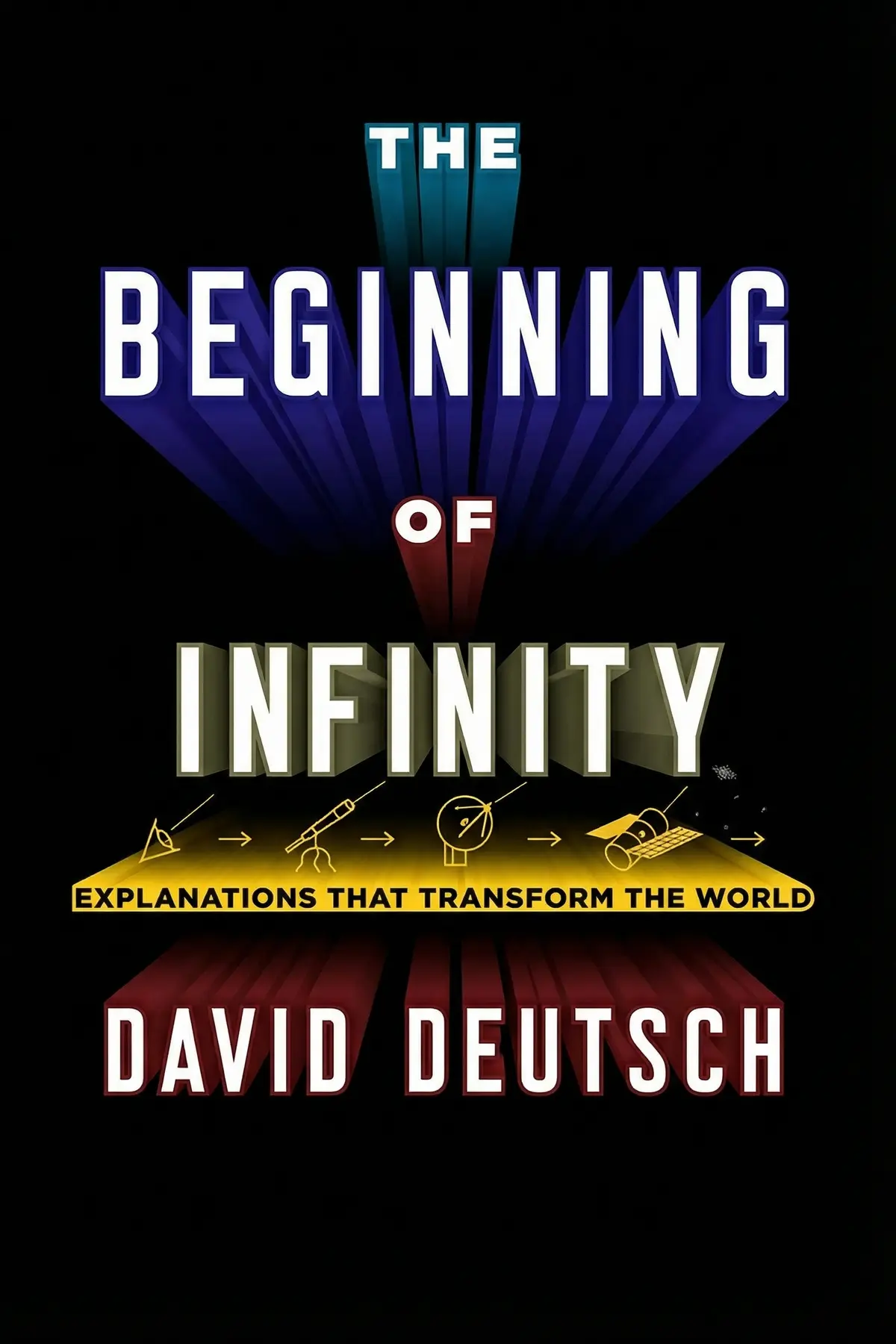
Table of Content
1. Introduction
1 min 53 sec
Imagine for a moment that we are standing at the base of a mountain so tall its peak is lost in the clouds. Most people look at this mountain and see a finished monument of nature, a fixed height that we might one day reach if we try hard enough. But David Deutsch suggests a completely different perspective. He argues that we aren’t climbing a mountain with a summit; we are on a journey that has no end. This is what he calls the beginning of infinity.
At the heart of this exploration is the power of explanations. We often think of progress as a series of lucky accidents or a slow accumulation of facts. However, the true engine of human advancement is our ability to create theories that explain the world around us. These aren’t just descriptions; they are transformative tools that allow us to reshape reality itself. Throughout this journey, we will look at how the shift from simply observing the world to explaining it changed everything for our species.
We will examine how our knowledge isn’t just a byproduct of what we see, but a creative act of the mind. We’ll look at the parallels between the way our DNA evolves and the way our ideas spread, and why some cultures flourish while others stagnate. We’ll even touch on the strange realities of quantum physics and the multiverse, all to show that the reach of human reason is potentially limitless.
This isn’t just a book about science; it’s a manifesto for a new kind of optimism. It’s a throughline that connects the way we solve everyday problems to the way we might eventually colonize the stars. By the time we’re done, the way you look at a sunrise, a gene, or even a simple joke will be fundamentally altered. We are entering an era where the only real boundaries are the ones we haven’t yet learned how to think past. Welcome to the beginning of an infinite journey.
2. The Creative Source of Knowledge
2 min 01 sec
Think your senses are the ultimate source of truth? Discover why what you see is often less reliable than the theories you build in your mind.
3. The Replication of Ideas and Genes
2 min 12 sec
Explore the fascinating parallel between biological evolution and the spread of human thoughts, and why the way ideas move is uniquely powerful.
4. The Divide Between Static and Dynamic Cultures
2 min 05 sec
Why do some societies stay the same for centuries while others change overnight? The answer lies in how they handle criticism.
5. The Power of Universal Systems
1 min 44 sec
Discover how small improvements in how we organize information can lead to a sudden, explosive jump in what humanity is capable of achieving.
6. The Limits of Group Decision-Making
1 min 56 sec
Is it truly possible to find a fair way for groups to make decisions? The answer might surprise you and change how you view democracy.
7. The Foundation of Rational Optimism
1 min 56 sec
Uncover why the most realistic way to look at the future is with profound hope, based on the fact that we don’t know what we’ll discover next.
8. The Cosmic Significance of Humanity
1 min 53 sec
Are we just ‘chemical scum’ on a tiny planet? Learn why our ability to create knowledge makes us a central force in the universe.
9. The Multiverse and the Reality of Quantum Theory
2 min 01 sec
What if every choice you made actually happened? Journey into the mind-bending reality of the multiverse as described by modern physics.
10. The Horizon of Unending Discovery
1 min 57 sec
Why the search for truth is never over, and why ‘final’ scientific laws are more like milestones than destinations.
11. Conclusion
1 min 53 sec
As we reach the end of this journey through the landscape of infinite knowledge, the throughline becomes clear: human progress is not a matter of luck, but a matter of choice and creativity. We have moved from a world where we were victims of our environment to one where we are its architects. This transition was made possible by one thing: our ability to seek out and create ‘good explanations.’
We’ve seen that our senses can be deceptive and that true understanding comes from the bold guesses we make and the rigorous ways we test them. We’ve explored how ideas replicate like genes, how the openness of our culture determines our success, and how the very laws of physics suggest a reality far more vast than we ever imagined. But perhaps the most important takeaway is the shift in how we view problems.
In a world that is often focused on limits—limitations of resources, of energy, or of human nature—David Deutsch offers a different path. He reminds us that problems are inevitable, but more importantly, problems are soluble. Every challenge we face today is a result of something we don’t yet know. This isn’t a cause for despair; it’s a call to action. It means that the solution to any ‘evil’ or obstacle is simply more knowledge.
To apply this to your own life, try adopting the stance of a rational optimist. When you encounter a hurdle, don’t ask if it’s possible to overcome it; assume it is, and start looking for the explanation that will show you how. Embrace criticism, seek out new ideas, and never stop questioning the status quo. We are living at the beginning of infinity. There is no peak to the mountain, no end to the journey, and no limit to what we can achieve as long as we keep searching for the next great explanation. The future is an open book, and we are the ones holding the pen.
About this book
What is this book about?
The Beginning of Infinity presents a profound shift in how we understand human history, science, and our place in the universe. It argues that the Enlightenment was not just a historical period, but the start of an infinite journey of discovery. By moving away from the idea that knowledge comes solely from our senses, author David Deutsch explains that we create reality through 'good explanations'—theories that are hard to change while still being testable. This summary covers the mechanics of how ideas and genes replicate, the difference between static and dynamic cultures, and why humanity is far more than 'chemical scum' on a lonely planet. It promises a new perspective on optimism, showing that all evils are essentially a lack of knowledge and that with the right explanations, we can overcome any obstacle, whether it is biological, social, or cosmic.
Book Information
About the Author
David Deutsch
David Deutsch is a highly influential researcher in the field of quantum physics. He lives and works in Oxford where he has been a visiting professor of physics since 1999. In 1998, Deutsch was awarded the Institute of Physics’ Paul Dirac Prize and Medal, one of the top awards for theoretical physics.
Ratings & Reviews
Ratings at a glance
What people think
Listeners find the book's original insights regarding explanations to be impressive, describing it as a profound intellectual achievement that provokes intense contemplation. Additionally, the content spans a wide array of subjects and provides a thrillingly positive outlook, ensuring it is essential for inquisitive minds. On the other hand, the ease of reading earns varied reviews, as some consider it accessible while others find it technically challenging in certain sections.
Top reviews
Owen
Finally finished this beast and my brain feels like it’s been through a gym workout. David Deutsch has crafted an intoxicatingly optimistic vision of the future where problems are inevitable but always solvable. The core idea that we are only at the beginning of an infinite journey of discovery is incredibly empowering. I specifically loved the 'Infinity Hotel' thought experiment because it made complex set theory feel intuitive. His definition of a 'good explanation' as something that is hard to vary really changed how I look at scientific claims. While some chapters on Many Worlds were technically dense, the overall message of rational optimism is a much-needed antidote to modern pessimism. It is an intellectual tour de force that demands your full attention.
Show moreSiraporn
David Deutsch has a way of making you feel like a genius and a toddler at the same time. The way he connects the Enlightenment to the jump to universality in digital systems like DNA is nothing short of masterclass. I was particularly fascinated by his refutation of the Precautionary Principle. He argues that staying static is actually more dangerous than progressing, which is a total flip from how we usually think about technology. To be fair, he is quite dismissive of other interpretations of quantum mechanics, calling them 'bad philosophy,' which might rub some experts the wrong way. However, for a layperson looking for a grand unified theory of how knowledge works, this is the gold standard. A truly mind-expanding experience.
Show moreKanchana
The jump to universality is probably the most mind-expanding concept I've encountered this year. Deutsch explains how simple systems, like the alphabet or ten numerals, suddenly gain the power to represent anything. It’s a beautiful way to look at human progress and the potential of our species. I loved the chapters on biology and how natural selection acts as a designer without an actual designer. The comparison between a stone and a watch was a great callback to Paley, but with a modern, scientific twist. Even when the physics got difficult, the underlying optimism kept me hooked. This book doesn't just give you information; it gives you a whole new framework for understanding the universe. It’s a must-read for any curious mind.
Show moreDimitri
This isn't just a book; it's a software update for your brain. The central thesis that all evils are due to a lack of knowledge is a bold, refreshing take in an era of doom-scrolling. Personally, I found the explanation of how quantum universes branch and merge to be the most lucid description of the multiverse I’ve ever encountered. Deutsch avoids the usual 'weirdness' tropes and instead focuses on the logic of fungibility. It’s a smart, hopeful read that makes you feel proud to be part of a species capable of creating such deep explanations. It’s not an easy read, and you might need to re-read certain paragraphs three times, but the clarity you gain is worth every second of effort.
Show moreDylan
Picking this up was the best decision I made for my commute this month. I was initially worried it would be another pop-science book full of fluff, but this is a serious, profound work. The discussion on 'Spaceship Earth' and why we shouldn't fear unsustainability was a complete revelation. Deutsch argues that we shouldn't try to preserve the status quo but instead keep innovating to solve the problems our innovations create. It’s a recursive, beautiful logic that fits perfectly with his view of infinite progress. Some of the talk about 'quantum jumps' and plasma was a bit technical, but the writing is generally clear enough to follow. This is one of those rare books that actually changes the way you perceive reality.
Show moreAkosua
Why did no one warn me about the Socrates and Hermes dialogue chapter? It was a bizarre, creative detour that actually worked surprisingly well to explain epistemology. This book covers everything from the evolution of numerals to the fall of the Easter Island civilization. Deutsch is clearly brilliant, though he does have a habit of using the word 'parochial' every other page. I found his take on 'reach'—the idea that a theory's power extends far beyond its original intent—to be the most compelling part of the work. Some of the physics went over my head, especially the bits about fungibility in quantum mechanics, but the philosophical payoff was worth the struggle. It's a deep, challenging read that will stick with me for years.
Show moreLuckana
As a history buff, I wasn't expecting a physics book to challenge my views on the Enlightenment so thoroughly. Deutsch’s distinction between static and dynamic societies is a powerful lens for looking at why some civilizations thrive while others collapse. I found the critique of the Easter Island culture quite jarring, but his point about the necessity of error correction was well-taken. The book is definitely an intellectual tour de force, though I did find some of his political takes a bit simplistic. He treats the first-past-the-post voting system as if it follows the same laws as quantum physics, which is a bit of a stretch. Still, the unique conclusions he draws about the power of explanations make this a highly rewarding read.
Show moreSaengdao
Ever wonder what actually makes a theory 'good'? Deutsch’s answer—that it must be hard to vary without losing its explanatory power—is a total game-changer for how I evaluate ideas. I appreciated his deep dive into the philosophy of science, even if he was a bit brutal toward instrumentalists. The book covers an insane amount of ground, from Greek philosophy to the future of AI. My only real gripe is that he dismisses Bohmian mechanics and other physics theories a bit too quickly. It felt a little one-sided at times, almost as if he was trying to win an argument rather than start a conversation. Regardless, the intoxicating optimism of the book is contagious. Definitely pick this up if you want to think deeply.
Show moreRotjanee
I have mixed feelings about this one. On one hand, the sections on the history of the Enlightenment and the nature of scientific progress are absolutely brilliant. On the other hand, the author's obsession with calling nuclear fusion 'transmutation' felt like an odd, unnecessary quirk. I also felt like the Star Trek analogies were stretched a bit thin in the later chapters. It’s a very dense book, and I’m not convinced that his argument for infinite progress isn't just a different form of inductivism, which he ironically spends the first chapter critiquing. There is a lot of meat here, but you have to chew through some very dry, repetitive prose to get to the good parts. It’s worth reading, but keep your skepticism handy.
Show moreWararat
Look, I wanted to love this, but Deutsch’s ego often gets in the way of the actual science. He spends a significant amount of time bashing 'instrumentalism' and the Copenhagen interpretation without giving them a fair shake. It felt less like an objective exploration of physics and more like a manifesto for his specific brand of Many Worlds theory. The writing is incredibly dry and often veers into rambling territory when discussing aesthetics and politics. I also found his denial of the force of gravity in General Relativity to be needlessly pedantic and confusing for the average reader. While the concept of 'reach' is interesting, the book is far too overreaching and arrogant for my taste. It was an exhausting slog that didn't deliver on its promises.
Show moreReaders also enjoyed

A Guide to the Good Life: The Ancient Art of Stoic Joy
William B. Irvine
A Life Decoded: My Genome: My Life
J. Craig Venter
A Planet of Viruses
Carl Zimmer
A Little History of Philosophy
Nigel Warburton
A Short History of Nearly Everything
Bill Bryson

A Theory of Justice
John Rawls
AUDIO SUMMARY AVAILABLE
Listen to The Beginning of Infinity in 15 minutes
Get the key ideas from The Beginning of Infinity by David Deutsch, plus 5,000+ more titles in English and Thai.
- 5,000+ titles
- Listen as much as you want
- 7-day free trial
- Cancel anytime







