
18 min 29 sec
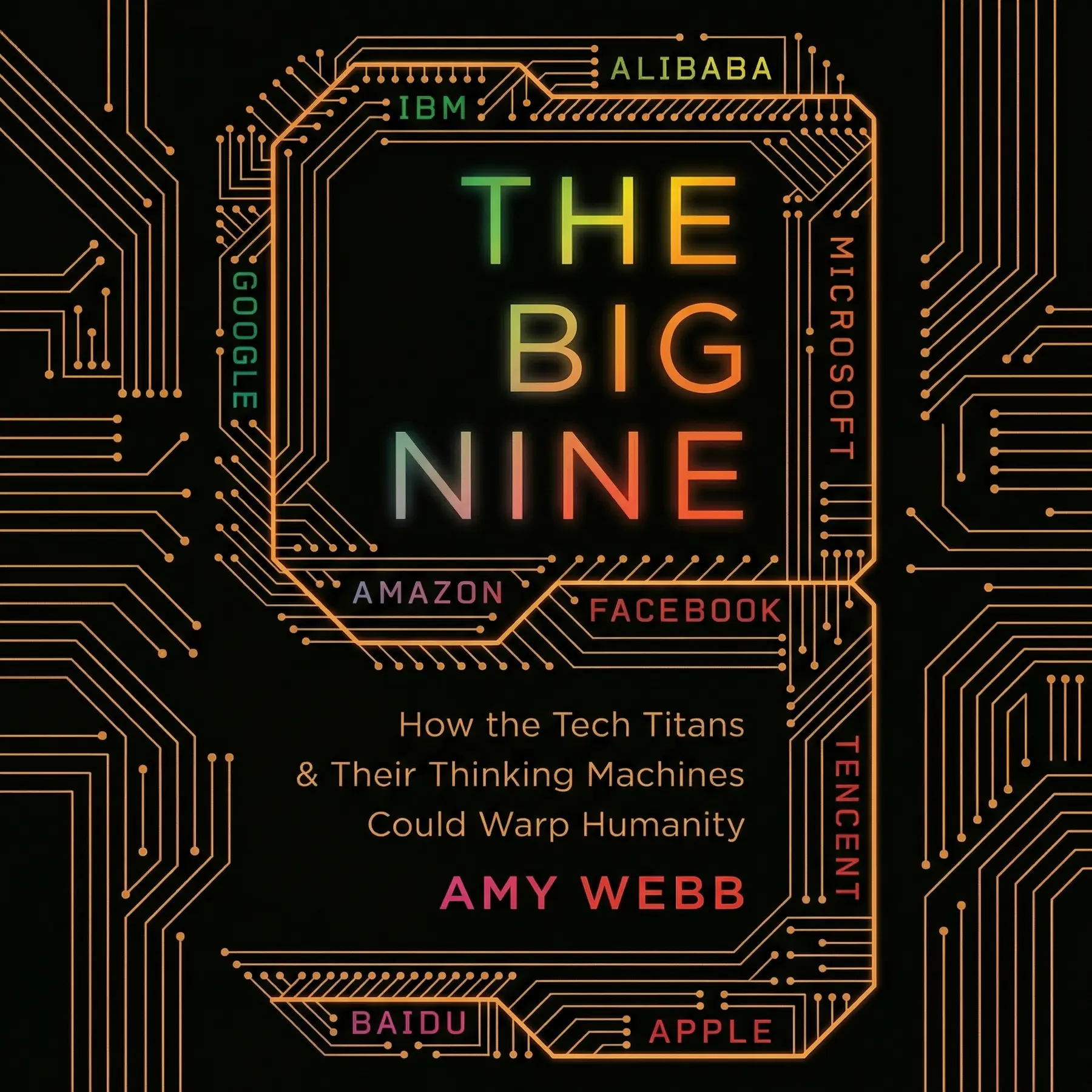
The Big Nine: How the Tech Titans and Their Thinking Machines Could Warp Humanity
By Amy Webb
The Big Nine explores how nine mega-corporations in the United States and China are steering the future of artificial intelligence, posing significant risks to democracy, privacy, and the global social fabric.
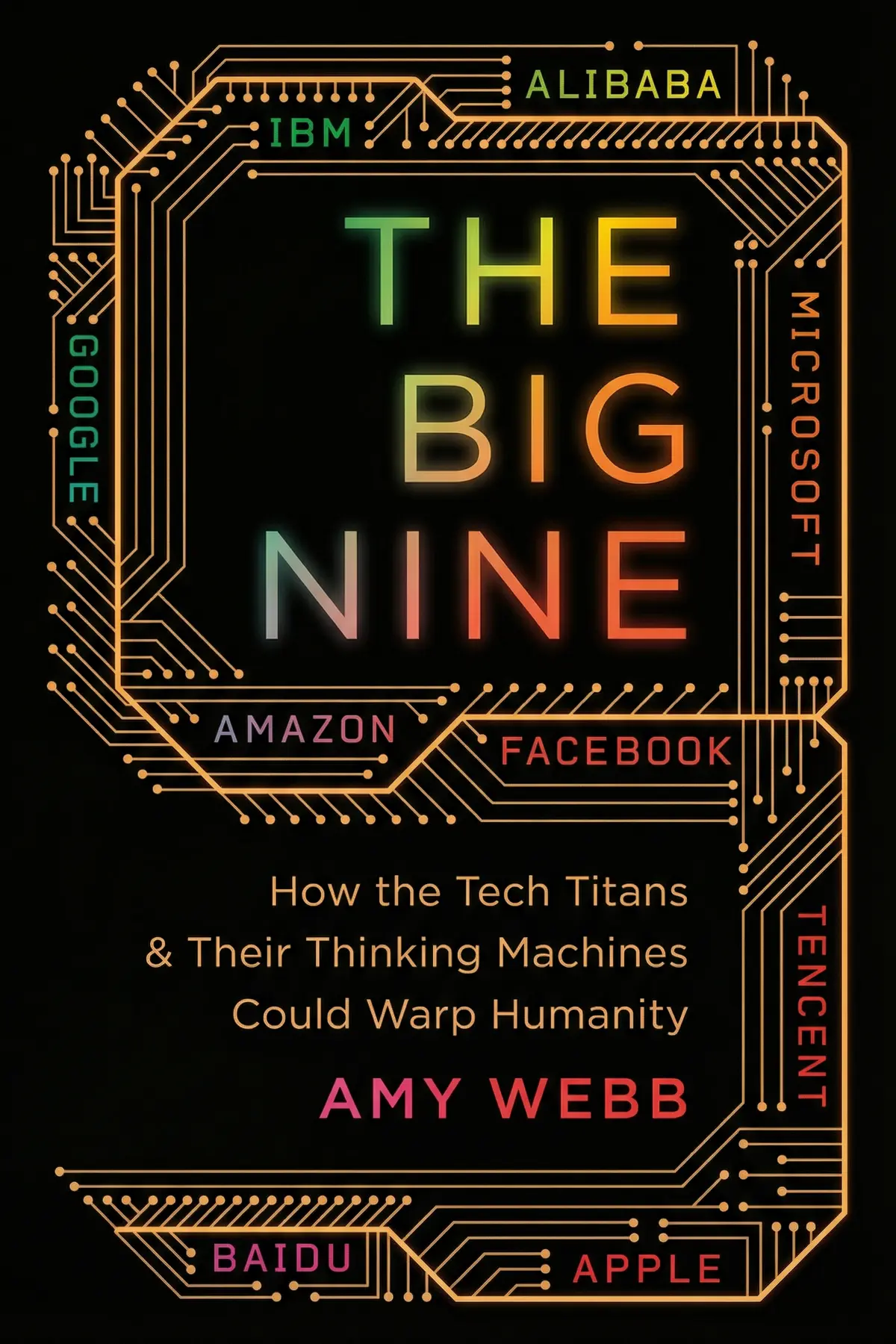
Table of Content
1. Introduction
2 min 05 sec
Imagine, for a moment, that the world’s most powerful technology isn’t being built by ‘humanity’ at large, but by a very small group of people working within just nine companies. This isn’t a science fiction premise; it’s the reality of our current era of artificial intelligence. When we talk about AI, we often focus on the gadgets—the voice assistants in our kitchens or the algorithms that suggest our next binge-watch. But Amy Webb argues that we need to look much deeper. AI is not just another tool; it is a fundamental shift in the way our world functions, akin to the discovery of electricity or the invention of the printing press.
The central premise of this exploration is that the future of this world-altering technology is currently resting in the hands of nine specific corporations, which Webb calls the ‘Big Nine.’ Six of these are based in the United States, and three are based in China. This concentration of power creates a massive vulnerability. Because these companies operate within specific economic and political systems, the AI they create reflects the values, biases, and goals of those systems. In the West, development is driven by the relentless pressure of quarterly earnings and market competition. In the East, it is driven by a state-mandated quest for national dominance and social control.
As we navigate this summary, we will look at how this divide happened, why it matters for your privacy and your children’s future, and what the world might look like if we continue down this path. We’ll explore the distinct personalities of these corporate giants and the geopolitical friction between the American and Chinese models of innovation. Most importantly, we will examine the different paths our future could take—ranging from a world of unprecedented prosperity to one where our very thoughts are managed by algorithms. This journey is about more than just technology; it is about the values we choose to program into the foundation of tomorrow. Let’s look at how these nine entities are rewriting the rules of human existence.
2. The G-MAFIA and the American Commercial Model
2 min 41 sec
Discover the six American giants dominating the AI landscape and the market pressures that force them to prioritize short-term profits over long-term human safety.
3. The BAT and China’s Sovereign Ambitions
2 min 28 sec
Explore the three Chinese powerhouses and how their integration with the state creates a powerful, surveillance-driven vision for the future of intelligence.
4. The Genetic Code of AI and the Problem of Bias
2 min 21 sec
Understand why the personal backgrounds of AI developers matter and how their unconscious biases are being ‘baked’ into the algorithms that run our lives.
5. The Failure of Global Cooperation
2 min 04 sec
See why our current international frameworks are failing to keep up with AI and why the lack of a ‘Global Alliance’ is a recipe for disaster.
6. Three Paths for the Future
2 min 36 sec
Contrast the optimistic, pragmatic, and catastrophic scenarios that await us depending on how we manage the Big Nine today.
7. The GAIA Proposal and the Path to Reform
2 min 28 sec
Discover the actionable solution to our AI crisis: a global alliance designed to steer technology back toward human interests.
8. Conclusion
1 min 46 sec
As we wrap up our look at the power and influence of the Big Nine, the overarching throughline is clear: the most important technology in human history is currently being developed in a way that is dangerously out of sync with long-term human interests. We have nine companies—driven by the competing pressures of the American market and the Chinese state—holding the keys to our collective future. This arrangement has created a foundation for AI that is riddled with bias, focused on short-term gains, and used as a tool for surveillance.
However, the story doesn’t have to end in a dystopian scenario. The core message of Amy Webb’s work is one of agency. We are still in the early stages of the AI revolution, and we have the power to change its trajectory. By demanding international cooperation, pushing for ethical standards, and supporting the creation of a Global Alliance like GAIA, we can move toward an optimistic future where technology augments our humanity rather than diminishing it.
Think about the world you want to live in thirty years from now. Do you want a world where your every move is predicted and manipulated by a corporate or state algorithm? Or do you want a world where AI helps us solve the greatest challenges of our time? The choice isn’t just up to the developers in Silicon Valley or the planners in Beijing. It’s up to all of us to demand a seat at the table. The Big Nine have started the conversation, but it is up to humanity to decide how it ends. Let this be the start of a more conscious, collaborative approach to building the mind of the future. We have the data, we have the tools, and now we must find the will to guide them toward the common good.
About this book
What is this book about?
This exploration of the technological landscape identifies the nine primary companies—the G-MAFIA in the United States and the BAT in China—that hold the keys to artificial intelligence. Amy Webb details how these entities, driven by vastly different motives of commercial profit and geopolitical control, are developing AI in ways that often ignore the long-term interests of humanity. The book promises a deep dive into the underlying structures of AI development, revealing how the current trajectory could lead to a fragmented and potentially dystopian world. It provides three distinct scenarios for the future, ranging from an optimistic collaborative era to a catastrophic collapse of personal agency. Ultimately, it offers a call to action for international cooperation to ensure AI remains a tool for human flourishing rather than a weapon of control.
Book Information
About the Author
Amy Webb
Amy Webb is a professor of strategic foresight at New York University’s Stern School of Business and the founder of the Future Today Institute, which conducts research on emerging technologies. As part of that research, she and her team have developed a data-driven method of forecasting the future, which she laid out in her Washington Post best-seller, The Signals Are Talking: Why Today’s Fringe Is Tomorrow’s Mainstream.
Ratings & Reviews
Ratings at a glance
What people think
Listeners describe the work as educational and elegantly composed, acting as a quality primer on AI advancements. The narrative style is well-received, and one listener points out the thorough examination of major technology firms. Its reliability earns high marks, as one listener mentions the grounded forecasts regarding upcoming developments. However, views on the personality portrayals and the political themes are divided among listeners.
Top reviews
Nongnuch
As a tech enthusiast who usually avoids the doomsday 'killer robot' tropes, I found Amy Webb's approach refreshing and deeply grounded. She brings her massive credibility as a professor and futurist to the table, providing a history of AI that goes way further back than the typical 1950s starting point. The way she breaks down the 'G-Mafia' versus China’s 'BAT' companies helps simplify a very complex global power struggle. I was especially gripped by her three future scenarios; they felt less like sci-fi and more like inevitable consequences of our current lack of strategy. This isn't just a book about gadgets; it is a serious look at the erosion of our humanity. Superb, balanced, and genuinely frightening in all the right ways.
Show moreZoey
Wow, the catastrophic scenario in Part II is going to haunt my dreams for a while. Amy Webb manages to take something abstract like 'artificial general intelligence' and turn it into a vivid picture of what our daily lives could look like in fifty years. I loved her point about how AI developers are building their own biases into the systems—it’s a wake-up call about the lack of diversity in the rooms where our future is being coded. The book is well-written, informative, and acts as a much-needed bridge between tech experts and the general public. We need our government leaders to read this immediately before the 'paper cuts' she describes turn into something much more fatal for Western civilization.
Show moreNarongrit
This should be required reading for anyone in policy or corporate leadership today. Webb is an expert at strategic foresight, and it shows on every page. She doesn't just point out the problems; she offers a structured path forward through her GAIA proposal. The way she connects 5G communication, the Belt and Road Initiative, and AI development into one cohesive geopolitical strategy is brilliant. It’s rare to find a book that is this informative without being overly academic or dry. Her writing is crisp and the pacing is excellent. If you want to understand why your personal data matters and how it’s being used as a resource for political gain, pick this up.
Show moreEleni
Finally got around to reading this, and the breakdown of how the 'Big Nine' tech giants operate is eye-opening. Webb argues that these companies aren't necessarily villains, but they are trapped by the demands of Wall Street, which leads to some pretty dangerous shortcuts in AI development. The chapter on the Social Credit System was particularly disturbing—the idea of your social standing being dictated by traffic tickets or heroic acts is peak 1984. I appreciated the specific 15-item prescription for action at the end, even if I think a global coalition like GAIA is a bit too idealistic for our current political climate. The writing is clear and authoritative, making it a great entry point for people who don't have a computer science degree.
Show morePornpimon
Webb makes a compelling argument about how a small group of like-minded people are essentially coding the future of humanity without enough oversight. It’s not just about 'killer robots'; it's about the steady erosion of our personal choices and the biases that get baked into the software we use every day. I found her perspective on the Trump administration’s lack of an AI strategy to be a bit politically charged, but her logic regarding the need for a national budget is hard to argue with. The book is a bit heavy on the 'China threat' rhetoric, but the details on the BAT companies (Baidu, Alibaba, Tencent) were fascinating. Overall, it’s a realistic and necessary look at the tech landscape that avoids the usual hysteria.
Show moreKaen
What struck me most was Webb's insistence that the 'Big Nine' aren't actually the villains of this story, but rather entities caught between profit and progress. Her storytelling style is engaging, and she manages to make complex topics like AGI feel accessible to the average reader. I particularly enjoyed the section on the lack of empathy in AI decision-making—it’s a crucial point that often gets lost in more technical books. While I found the catastrophic scenario a bit too bleak to be fully believable, the pragmatic scenario felt eerily plausible. The book is a bit formulaic in its structure, but the content is so important that I can overlook the 'school report' vibe. Definitely a book that will make you look at your smartphone differently.
Show moreMaya
Is China really the only 'bad wolf' in this scenario? While I learned a lot, the book is written from an aggressively US-centered perspective that feels a bit dated in its geopolitical outlook. Webb provides an excellent, well-researched history of AI in the beginning, and her professional expertise is obvious. However, the tone becomes increasingly alarmist regarding the Chinese 'Social Credit System' while being surprisingly soft on the corporate monoliths in Silicon Valley. I found the 'pragmatic' scenario quite chilling, yet I wish the book explored the European regulatory landscape more rather than just focusing on a US-China binary. It’s an informative read, but the truth is, the bias is hard to ignore.
Show moreTern
The first third of this book is a masterclass in AI history, but the rest felt like a sharp turn into speculative fiction. I appreciate Webb's expertise, and her description of the 'G-MAFIA' is a brilliant way to frame the corporate side of things. However, I struggled with the middle section where the book essentially becomes a series of 'what-if' stories. Some of the scenarios felt a little too far-fetched, like the bit about infrared saunas and noncompliance records. Look, I get the point she’s trying to make about a gradual loss of autonomy, but the storytelling felt a bit disjointed compared to the analytical strength of the opening chapters. It's a decent introduction to the topic, but it didn't quite live up to the hype for me.
Show moreBoy
Gotta say, I have mixed feelings about this one. On one hand, the information about the Social Credit System and the 'G-Mafia' is really well-researched and detailed. On the other hand, the author's solutions seem a bit pie-in-the-sky. Suggesting a global alliance for AI sounds great in theory, but in a world where we can't even agree on climate change, it feels a bit naive. The book is definitely informative and serves as a solid introduction to AI technology, but the second half loses steam with all the fictional scenarios. It’s a good conversation starter, even if I don’t agree with all of Webb’s conclusions or her somewhat US-biased perspective.
Show moreChamlong
Not what I expected from an NYU professor. While the subject is vital, the writing felt incredibly formulaic and clunky, almost like reading a 300-page school report. The author spends way too much time on imaginative future-casting in the middle section rather than sticking to the hard data I was hoping for. Frankly, it felt like she was filling space with fictional narratives instead of providing deep technical insights into how these algorithms actually function. I also felt the book ignored the rest of the world entirely to focus on a US-China rivalry. To be fair, the historical section was decent, but the rest was too speculative for my taste. My time would have been better spent elsewhere.
Show moreReaders also enjoyed
AUDIO SUMMARY AVAILABLE
Listen to The Big Nine in 15 minutes
Get the key ideas from The Big Nine by Amy Webb, plus 5,000+ more titles in English and Thai.
- 5,000+ titles
- Listen as much as you want
- 7-day free trial
- Cancel anytime







