
Abortion: Our Bodies, Their Lies, and the Truths We Use to
Jessica Valenti
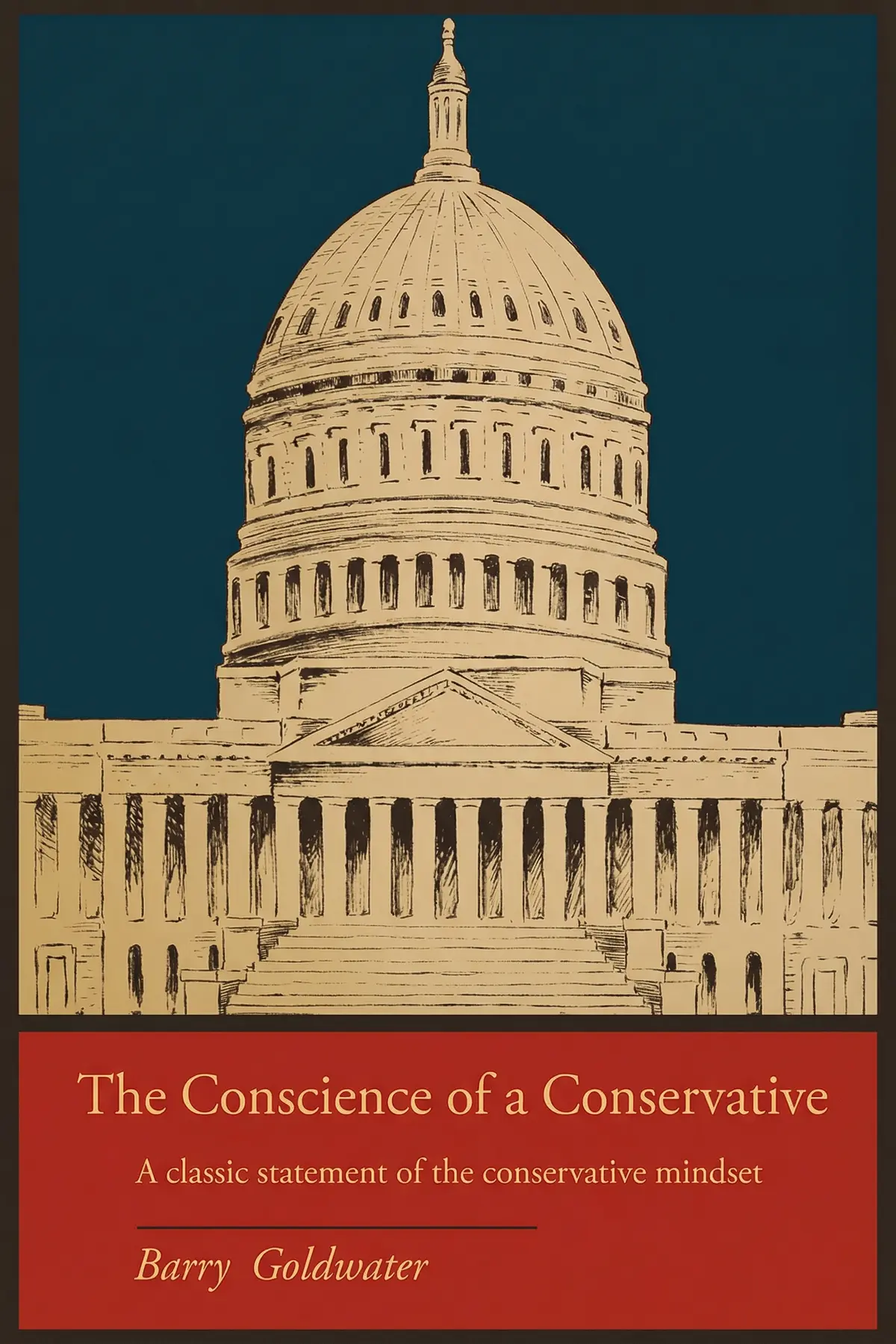
This foundational text outlines a vision for American politics based on limited federal power, individual sovereignty, and the protection of private property as the essential roots of human freedom.
1 min 55 sec
The 1960s are frequently remembered as a decade defined by a sudden and loud left-wing rebellion. When we look back at that era, the imagery that usually comes to mind is one of student radicals, the anti-war movement, and a cultural shift toward experimentation. But this common historical narrative misses a vital piece of the puzzle. While the left was indeed finding its voice, a parallel and equally powerful transformation was taking place on the opposite side of the political aisle. For years, the American right had felt adrift, even after the Republican party regained the White House in the early 1950s. Many traditionalists were disillusioned to find that the new leadership seemed just as comfortable with high state spending and economic intervention as their predecessors had been.
Enter Barry Goldwater, a senator from Arizona who felt that the movement had lost its way. He believed that the American people were, at their core, aligned with conservative values, but they needed a clear, principled articulation of what those values actually were. He saw a need to move beyond mere economic calculations and address the deeper moral and philosophical foundations of a free society.
In 1960, Goldwater published a manifesto that would fundamentally alter the trajectory of American politics. It wasn’t just a list of policy proposals; it was a call to return to first principles. This work provided the intellectual scaffolding for a movement that would eventually reclaim significant power and redefine the American political landscape for decades to come. As we move through this summary, we will explore the core pillars of this vision: the belief in the whole man, the sanctity of limited government, and the idea that true freedom is inseparable from personal responsibility. We will look at how these principles apply to the relationship between the states and the federal government, the role of labor unions, and the consequences of the modern welfare state. This isn’t just a historical artifact; it is a foundational text for understanding the modern conservative mindset and its enduring skepticism of centralized power.
2 min 30 sec
Explore why a truly conservative worldview must account for more than just material wealth, prioritizing the spiritual and unique nature of every individual.
2 min 46 sec
Understand how the separation of powers serves as a vital defense against the natural tendency of those in authority to expand their reach.
2 min 29 sec
Discover why local governance is more than just a legal detail, but a fundamental protection for personal liberty and tailored community solutions.
2 min 27 sec
Learn how the distinction between legal rights and social goals is essential for maintaining the constitutional balance of power.
2 min 21 sec
Examine the moral difference between voluntary cooperation and forced membership in the workplace, and why the right to choose is a vital freedom.
2 min 23 sec
Break down the relationship between personal income and liberty, and see why a flat tax is argued to be the only truly fair system.
2 min 29 sec
Analyze the shift from individual responsibility to state dependence, and how the pursuit of security can unintentionally undermine a nation’s character.
1 min 29 sec
As we reach the end of this exploration, the central throughline remains clear: the preservation of human freedom requires a constant and vigilant defense against the expansion of centralized power. The principles we’ve discussed—the focus on the whole man, the strict adherence to the Constitution, the respect for state sovereignty, and the protection of private property—all serve a single purpose. They are the guardrails that prevent a government of the people from becoming a government over the people.
The core message is that true conservatism is not about maintaining the status quo or protecting the interests of a wealthy few. It is about a profound respect for the individual’s right to live their own life, follow their own conscience, and bear the responsibility for their own choices. It is a reminder that every time we ask the government to solve a problem for us, we are giving up a piece of our independence.
In our modern world, where the state continues to grow and the complexities of life often tempt us toward collective solutions, these principles offer a vital perspective. They challenge us to look beyond the immediate promise of government-provided security and consider the long-term cost to our liberty. The ultimate goal is a society where the government is the servant, not the master; where power is kept as close to the people as possible; and where every individual has the freedom to pursue their own version of a meaningful and fulfilled life. By returning to these first principles, we can ensure that the conscience of a free people remains the guiding force of the nation’s future.
This book serves as a definitive manifesto for modern American conservatism, written during a pivotal moment of political transition. It seeks to reclaim the original intent of the United States Constitution by arguing against the expansion of the federal government into the daily lives of citizens. The text moves beyond simple policy debates to explore a comprehensive worldview that prioritizes the spiritual and economic independence of the individual over the creeping influence of the state. Listeners will discover a vigorous defense of states' rights, a critique of the modern welfare system, and an exploration of why voluntary association is superior to coerced participation in labor unions. The promise of this work is a clear-eyed return to first principles, offering a roadmap for those who believe that liberty is best preserved when the government remains small and power is kept close to the people. It challenges the mid-twentieth-century consensus that the state should solve all human problems, proposing instead that true human flourishing requires the freedom to fail, the freedom to succeed, and the responsibility to manage one's own life.
Barry Morris Goldwater was a prominent American politician who served five terms as a United States senator from Arizona, spanning the years 1953 to 1965 and later from 1969 to 1987. In 1964, he was selected as the Republican party’s nominee for president. Although his presidential campaign did not result in a victory, Goldwater is widely credited with igniting the resurgence of the conservative movement within the United States. He passed away in 1998, leaving behind a significant political legacy.
Listeners view this work as essential reading for all Americans and conservatives, commending its educational value in detailing conservative principles effectively. Furthermore, the text is lauded for being thoughtfully written and for its brief, manageable length of 123 pages. Many value the viewpoint offered in this foundational conservative work, and one listener highlights how it describes economics in plain English. Nevertheless, opinions on its current applicability vary; while some find the content still pertinent, others feel it has become somewhat dated.
Barry Goldwater’s 1960 manifesto remains a foundational text for anyone trying to understand the intellectual roots of modern American conservatism. While L. Brent Bozell Jr. did the heavy lifting on the prose, the message is purely Goldwater’s brand of rugged individualism. It’s an incredibly concise read—barely 123 pages—that strips away the political fluff to explain conservative philosophy in plain English. Personally, even if you disagree with his stance on the 'graduated tax' or states' rights, you have to admire the clarity of his conviction. He wasn't a demagogue looking for power; he was an idealist concerned with the 'spiritual' damage of welfarism. Some sections, particularly the hawkish views on the Soviet threat, feel like relics of a different age. However, the core argument regarding the constitutional limits of federal power is still the primary fault line in our current political debates. It is a must-read for anyone who wants a serious education in 20th-century political thought.
Show moreThis book should be required reading in every civics class because it explains the 'why' behind limited government without the usual academic jargon. I was struck by how much of our current economic debate was already laid out in 1960. Goldwater (or his ghostwriters) makes a compelling case for the flat tax, arguing that a graduated system is essentially a confiscatory tool designed to level society. It’s a slim volume, but it packs more punch than most 600-page political biographies I’ve waded through. The way he discusses the 'natural operation of the free market' in agriculture is especially illuminating, even if that ship has long since sailed in modern policy. Not gonna lie, the chapter on the Soviet threat is definitely dated, but his warnings about the 'culture of dependence' created by welfare programs still resonate. It’s a very informative look at a time when conservatism was about clear principles rather than just being 'anti-the-other-side.' Truly a classic.
Show moreEver wonder where the backbone of the Republican party went? Reading Goldwater makes you realize how much modern politicians have watered down their principles for the sake of polling. This is a bold, uncompromising defense of the individual against the 'collectivist' state. Goldwater explains economics and constitutional law in plain English, making a case for freedom that feels both moral and practical. I particularly appreciated the chapter on the farm problem; he was one of the few people willing to say that production should be left to the 'natural operation of the free market' instead of government subsidies. The book is beautifully concise and doesn't meander into personal anecdotes like modern political books do. It’s an informative, high-level look at what it actually means to be a conservative. If you want to understand the foundations of the Reagan Revolution, you have to start here. It is an absolute must-read for every American, regardless of their party.
Show moreFinally got around to reading this classic, and while some of it feels like a time capsule from the Cold War era, the core philosophy is surprisingly articulate. Goldwater presents a vision of government that is strictly limited by the Constitution, arguing that every federal intervention in education or welfare is a step toward 'collectivism.' To be fair, his refusal to support federal oversight in civil rights—specifically regarding Brown v. Board of Education—is a massive blind spot that makes parts of this book difficult to stomach today. He views 'states' rights' as a primary virtue, even when those rights were being used to disenfranchise entire groups of people. Despite that, the writing style is remarkably sharp and punchy. It doesn’t meander. You get a clear sense of why he was such a lightning rod for controversy during his presidential run. Whether you see him as a hero of liberty or a precursor to modern polarization, this book is essential for context.
Show moreAs someone who identifies as a moderate, I found Goldwater’s logic to be incredibly consistent, even if I couldn't agree with every policy proposal he put forward. The book is essentially a libertarian roadmap. He is obsessed with the idea that the federal government is constantly encroaching on the rights of individuals and states. Truth is, his warnings about the expansion of the 'welfare state' have proven prophetic in some ways, even if his solution of total federal withdrawal seems extreme. The writing is very accessible; he explains complex economic theories in a way that feels like a conversation across a kitchen table. However, his stance on education integration remains the most troubling aspect of the text. He tries to argue it as a matter of constitutional jurisdiction rather than morality, but that distinction feels hollow given the era. It’s a quick read, but one that requires a lot of mental processing afterward. It definitely helped me understand the DNA of the modern GOP.
Show morePicked this up after hearing it mentioned on a podcast and was surprised by how quickly I flew through these 120-odd pages. Goldwater is incredibly direct. He doesn't waste time with flowery introductions; he gets straight into why the 'graduated tax' is an affront to justice. I found his chapter on labor unions particularly interesting, especially his argument that union dues should always be voluntary. It’s rare to see a politician today speak with this much clarity and lack of 'spin.' To be fair, the final section on foreign policy is almost entirely obsolete now that the Soviet Union is gone, though his 'bristling attitude' toward international aid is still reflected in some modern 'America First' rhetoric. The book is a great primer for anyone who wants to understand the shift from Eisenhower-era moderation to the more aggressive conservatism of the 80s. It’s short, punchy, and intellectually honest about its goals, which I can respect even when the ideas feel a bit archaic.
Show moreFrankly, Goldwater’s defense of the individual against the 'collectivist' state is more relevant now than ever, even if his stance on integration is a major stain on his legacy. The prose is punchy and the chapters are short, which makes it an easy afternoon read. He hits all the major themes: taxation, labor, education, and the welfare state. While I think he was dead wrong about the federal government’s role in civil rights, his broader point about the dangers of centralized power is worth considering. He warns that once we trade our responsibility for 'security,' we lose the very essence of our character. In my experience, most people who criticize Goldwater haven't actually read his arguments in his own words. He wasn't a 'madman' as the 1964 ads claimed; he was a constitutionalist. The book is definitely dated in its focus on the Soviets, but the internal logic of his domestic policy is incredibly tight. It's a thoughtful, if controversial, piece of political history.
Show moreLook, we have to view this through the lens of 1960, or else most of the foreign policy advice seems absolutely reckless by today’s standards. Goldwater was a man of his time—a hawk in every sense of the word. I found the middle chapters on domestic policy to be much more thought-provoking than the 'Red Menace' rhetoric at the end. His critique of the welfare state as something that transforms a 'self-reliant spiritual being' into a 'dependent animal' is a heavy-handed but fascinating psychological take on economics. The book is famously ghostwritten by Bozell and Buckley, and you can definitely feel their stylistic polish in the prose. It’s far more readable than your average policy paper. However, the blatant disregard for federal civil rights enforcement is a massive hurdle for a modern reader. It’s a classic conservative treatise, but one that is marred by the racial politics of the mid-century. Useful for history buffs, but maybe less so as a practical guide for today’s world.
Show moreIt is hard to reconcile Goldwater’s talk of 'human dignity' with his blatant disregard for the federal role in protecting civil rights. This book was a frustrating experience because it masks exclusionary policies behind the high-minded language of individual freedom. Goldwater’s argument that 'integrated schools are not required' by the Constitution is a legalistic dodge that ignores the reality of state-sponsored tyranny in the South. Furthermore, his use of education statistics is clearly skewed; he throws around percentages that sound impressive but lack any real context regarding the quality of learning. The prose, likely polished by Buckley’s associates, is elegant, but the logic is often specious. He claims government handouts debase the individual, yet ignores how systemic poverty does the same thing. I expected to find a rigorous philosophical treatise, but instead, I found a manifesto that prioritizes the freedom of the privileged over justice for the oppressed. It’s a fascinating historical document, but its practical application was debunked decades ago.
Show moreThe fact that this is still considered a 'gold standard' for any political party is genuinely concerning given the flawed logic regarding education and social safety nets. Goldwater treats the federal government as a predator rather than a protector. His assertion that accepting help from the government is 'debasing' is an incredibly elitist take coming from a man who inherited a retail empire. Personally, I found his dismissal of the Supreme Court's authority on civil rights to be the most offensive part of the book. He hides behind the Tenth Amendment to justify leaving minority children in sub-standard, segregated schools. The statistics he cites regarding education spending are nonsensical and feel purposefully misleading to support a pre-determined conclusion. While the writing is clear and the book is concise, the content is a masterclass in how to use 'freedom' as a buzzword to maintain the status quo for the wealthy. It is an important read only if you want to see where these harmful arguments originated.
Show moreJessica Valenti

Yanis Varoufakis
Yuval Noah Harari
Jacinda Ardern
Pankaj Mishra
James Comey
Anthony Pratkanis

AUDIO SUMMARY AVAILABLE
Get the key ideas from The Conscience of a Conservative by Barry Goldwater, plus 5,000+ more titles in English and Thai.







