
18 min 45 sec
The Ellipsis Manual: Analysis and Engineering of Human Behavior
By Chase Hughes
Explore the sophisticated world of behavioral engineering and psychological influence. This guide reveals how to decode human patterns, master persuasion, and protect yourself from invisible manipulation tactics used in high-stakes environments.
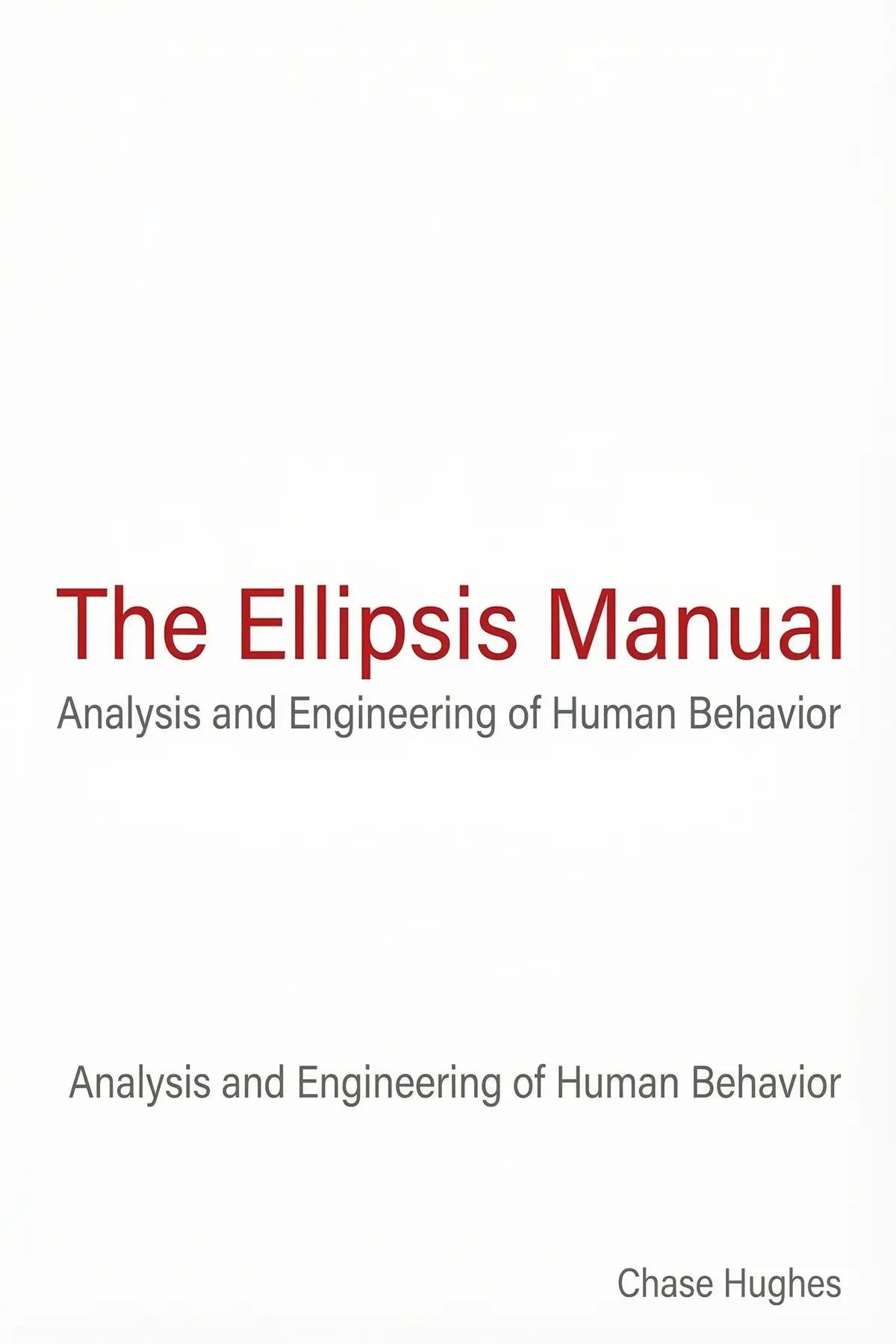
Table of Content
1. Introduction
1 min 57 sec
Have you ever walked away from a conversation feeling like you agreed to something you didn’t actually want to do? Or perhaps you’ve watched a charismatic speaker and felt an inexplicable pull toward their message, even if the logic didn’t quite hold up? These moments aren’t accidents of personality; they are the result of a subtle, invisible architecture of influence that governs much of our social world.
In our exploration today, we are diving into the complex and often startling world of Chase Hughes. Drawing from a career spent in the military and intelligence communities, Hughes has deconstructed the ways in which human beings can be analyzed and influenced. This isn’t about simple tricks or “mind games” in the way popular media portrays them. Instead, it’s about a systematic approach to behavioral engineering. It’s about understanding that every person is broadcasting a constant stream of data through their movements, their speech patterns, and their psychological triggers.
The core of this journey is the idea that we all have “hidden buttons” that can be pushed if someone knows where to look. By uncovering these patterns, we can learn to read people with surgical precision. But there is a deeper, perhaps more important reason to study these techniques: protection. We live in an era where our attention and our decisions are the ultimate currency. From the advertisements on our phones to the structure of political discourse, the methods of influence are everywhere.
Through this summary, we will walk through the mechanics of how our brains process information, how we can spot the truth behind the masks people wear, and how we can build a psychological fortress around our own minds. The goal is to move from being an unconscious participant in the world of influence to becoming an informed observer who can choose when to engage and when to resist. We’re going to peel back the curtain on how behavior is engineered, giving you the tools to see the world—and the people in it—with entirely new eyes.
2. The Unseen Mechanics of Choice
2 min 49 sec
Discover how our brains rely on hidden shortcuts that make us vulnerable to external direction without us ever realizing it’s happening.
3. Decoding the Human Billboard
3 min 02 sec
Learn to look past isolated gestures and decode the complex behavioral clusters that reveal a person’s true internal state.
4. Structured Strategies of Persuasion
2 min 53 sec
Uncover the sophisticated frameworks used to build rapport and guide behavior through a series of escalating psychological commitments.
5. Building Your Psychological Fortress
3 min 05 sec
Explore practical techniques to interrupt manipulation patterns and reclaim your decision-making power in high-pressure situations.
6. The Macro-Level Impact of Influence
3 min 03 sec
Examine how individual persuasion tactics scale up to shape entire societies, media landscapes, and belief systems.
7. Conclusion
1 min 56 sec
As we reach the end of our journey through the insights of Chase Hughes and the mechanics of behavioral engineering, the message is clear: influence is a constant, invisible force in our lives. We’ve seen how our brains rely on mental shortcuts that, while efficient, leave us open to direction. We’ve learned that our bodies are constantly broadcasting our true internal states, and that by reading these signals, we can see past the masks people wear. We’ve also explored the structured frameworks that professionals use to guide behavior and the ways these tactics can be scaled up to influence entire societies.
But the most vital takeaway is that you are not helpless. The ‘ellipsis’—that hidden space where influence happens—only remains powerful as long as it stays hidden. The moment you bring these techniques into the light of conscious awareness, their effectiveness begins to fade. By practicing the ‘pause,’ setting clear boundaries, and recognizing the patterns of persuasion in the world around you, you reclaim your decision-making power.
This knowledge is a tool, and like any tool, it can be used for good or ill. You can use it to become a more effective communicator, a better leader, and a more empathetic friend. You can use it to build trust and resolve conflict. But most importantly, you can use it to protect your own mind. In a world that is constantly trying to tell you what to think, how to feel, and what to buy, the greatest act of rebellion is to think for yourself.
Take these lessons with you. Start observing the baselines of the people you meet. Watch for the ‘clusters’ of behavior in your next meeting. And the next time you feel a sudden surge of urgency or a pressure to comply, remember to take those three seconds. Those three seconds are where your freedom lives. Thank you for listening, and may your choices always be your own.
About this book
What is this book about?
The Ellipsis Manual is an exhaustive deep dive into the mechanics of human behavior, profiling, and influence. It draws on techniques developed for the military and intelligence sectors to explain how the human mind can be read, directed, and even controlled. The book moves beyond basic body language tips, offering a comprehensive system for understanding how people tick at a subconscious level. It introduces complex concepts like the Behavioral Table of Elements and structured influence frameworks designed to bypass rational resistance. The promise of this work is twofold: empowerment and protection. By learning how to identify baselines, spot behavioral clusters, and recognize the architectural patterns of persuasion, readers can significantly enhance their communication and negotiation skills. More importantly, it serves as a defensive manual. In a world saturated with media manipulation, high-pressure sales, and social engineering, understanding these invisible forces is the only way to safeguard one's autonomy. Whether you are a leader, a negotiator, or simply someone looking to navigate social interactions with greater clarity, these insights provide the tools to see what others miss and resist what others cannot.
Book Information
About the Author
Chase Hughes
Chase Hughes is a military veteran and a leading authority in the fields of behavioral profiling and psychological influence. He is widely recognized for creating the Behavioral Table of Elements, a revolutionary tool used in interrogation and lie detection contexts. Since beginning his military service in 1998, Hughes has specialized in developing advanced methodologies for behavior analysis and psychological operations. He is the founder of Ellipsis Behavior Laboratories in Virginia Beach, where he provides innovative training for various high-level clients. His work also includes the discovery of Corrugation Programming techniques, which have applications in both government operations and therapeutic healing environments.
Ratings & Reviews
Ratings at a glance

What people think
Listeners describe this work as thorough and enlightening, with one listener highlighting how the content is organized across a timeline to facilitate mastery. Furthermore, they value its readability and instructional worth, noting its success in teaching manipulation methods while commending its perspectives on human behavior and overall impact. The material also earns high marks for being a worthwhile investment. On the other hand, opinions on the quality of the writing are divided among listeners.
Top reviews
Nit
This manual is an absolute deep dive into the darker corners of social psychology and human behavior. It provides a highly detailed framework for engineering human behavior in ways that feel both incredibly powerful and slightly terrifying to anyone who values their personal privacy. The author breaks down complex concepts into a manageable timeline. While the writing quality is mixed, the sheer volume of information on profiling makes it worth every penny. You really have to put in the work to see the results in real-life social interactions. Some sections on body language are a bit dense with acronyms, but the insights are undeniable. If you want to understand the mechanics of influence, this is the book for you.
Show moreBird
Finally got around to finishing this massive book, and the mastery timeline is its strongest feature. It teaches you how to produce predictable outcomes in social situations through very specific behavioral engineering techniques that are laid out in a logical, step-by-step manner. The insights into human behavior are deep. I appreciated the focus on daily practice rather than just collecting cool facts to tell friends. The body language section is especially informative if you can memorize all the different acronyms used. It is a great investment for anyone who is serious about learning the mechanics of social attraction.
Show moreKung
Look, if you can get past the dry writing and the weirdly formatted tables, you have a goldmine. The book offers incredible insights into human behavior that go far beyond what you usually find in standard psychology texts or the typical self-help guides found on most bestseller lists today. The section on behavior outcomes was scary. It is a highly effective guide for anyone who wants to master the art of social engineering. The gratitude exercises provide a surprisingly healthy foundation for what is otherwise a very intense manual. This is definitely one of those books that you will need to study and practice every day.
Show moreGiulia
Ever wonder if you are being played by every person you meet in a professional setting? This book offers a fascinating look at manipulation techniques, even if the general tone of the writing makes the reader feel somewhat uneasy about applying them in the real world. I found the rapport section to be quite useful. However, the author's claims about leading CIA operations seem a bit like fiction after a while. The formatting is quite inconsistent, which makes it harder to follow the main theory of the book. It is definitely educational, but it leaves you feeling like you need a shower after reading it.
Show moreChatri
Not what I expected, but it is certainly one of the most informative books on behavior. The author peppers in a lot of priming phrases from the very beginning that make the whole thing feel like a long infomercial for his private courses. I am still quite skeptical about some of the claims. Despite the sleazy vibe, the actual techniques for profiling personality are surprisingly effective in real life. The section on leadership feels very different in tone, almost like it was written by someone else entirely. It is a fascinating topic that would benefit from more coherent theories and better overall structure.
Show moreTom
Personally, I found that the investment in this manual paid off within the first fifty pages. The way it breaks down social magnetism and the skill of enjoying yourself is truly eye-opening, especially when you consider how rare it is for people to find genuine joy in mundane tasks. Hughes explains the science behind why that happens. While some techniques seem a bit sociopathic, the core lessons on gratitude are actually quite positive. The writing quality is a bit hit-or-miss, but the educational value is definitely there for me. I hope there is an audiobook version coming soon because the text is very dense to read.
Show moreLook
While some of the hand movements and Jedi mind tricks felt a bit over the top, the core profiling systems remain solid. The body language section requires a lot of cross-referencing because of all the abbreviations and acronyms that are scattered throughout the various chapters. It is a very detailed manual for professionals. For a regular reader, it can be a bit overwhelming and occasionally feels a little bit creepy. The author provides a great deal of information that you won't find in basic conversation books. It is a solid four-star read if you are interested in the darker side of human psychology.
Show moreHannah
As a professional in a corporate setting, I was hoping for something a bit more polished. The material is certainly detailed, but the blurry charts and poor formatting are a major distraction that prevented me from fully absorbing the more technical aspects of the profiling system. Chase Hughes uses way too many acronyms that are never properly defined for the average reader. The information on human needs is solid, but the rest feels like a collection of fragmented ideas. I think this would work much better as an in-person course with actual physical examples to follow. While it has value for money, the writing quality needs a serious professional edit to be great.
Show moreDiego
The information on human needs and locus of control is actually quite useful for fiction writers. I used the profiling charts to keep my characters consistent, which was an unexpected benefit of reading this manual instead of a standard craft book. However, the book is riddled with spelling and grammatical errors. The charts in the paperback version are nearly impossible to read due to the small, blurry font. It is a disturbing read at times, especially when it touches on topics like gaslighting and cults. I would recommend it for the insights into behavior, but take the pseudo-scientific parts with caution.
Show moreArnav
To be fair, the title should probably be changed to 'How to Be a Sociopath 101'. Most of these conversational methods feel incredibly unnatural and would likely make anyone come across as either a complete sociopath or someone who is trying far too hard to be manipulative. Most people would probably just walk away if you used these. The book is filled with pseudo-scientific claims about CIA training that are very hard to verify. It often feels like an over-hyped infomercial for a much more expensive training course. There is a lot of text here, but much of it is basic conversation skills dressed in jargon. I didn't find the 'never before made public' secrets that the marketing promised me.
Show moreReaders also enjoyed
Age of Propaganda: The Everyday Use and Abuse of Persuasion
Anthony Pratkanis



59 Seconds: Change Your Life in Under a Minute
Richard Wiseman
AUDIO SUMMARY AVAILABLE
Listen to The Ellipsis Manual in 15 minutes
Get the key ideas from The Ellipsis Manual by Chase Hughes, plus 5,000+ more titles in English and Thai.
- 5,000+ titles
- Listen as much as you want
- 7-day free trial
- Cancel anytime







