
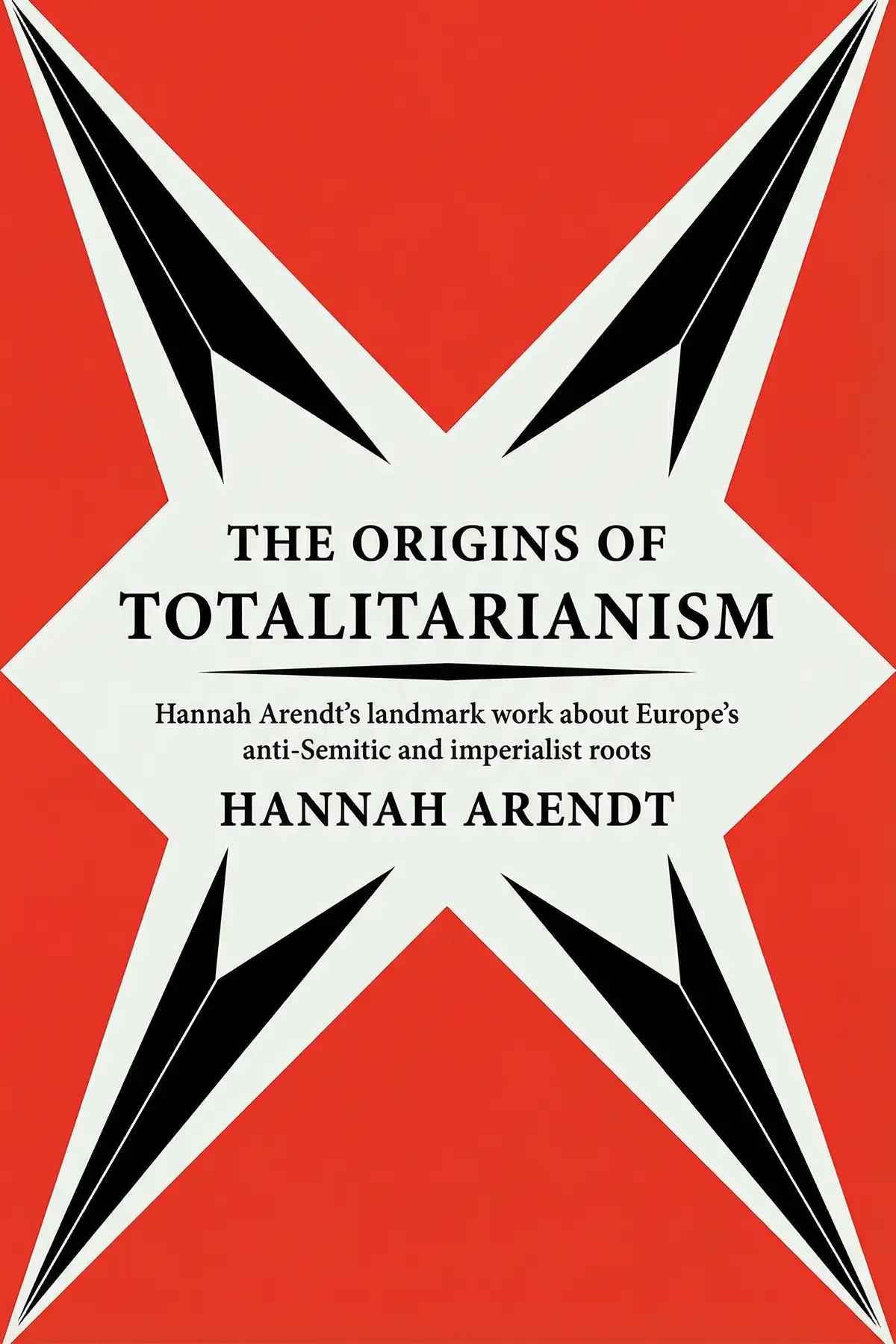
The Origins of Totalitarianism
Hannah Arendt
A profound exploration of the three fundamental human activities—labor, work, and action. Hannah Arendt examines how our modern focus on productivity and technology threatens the spaces for genuine freedom and political engagement.
1 min 56 sec
In a world that seems increasingly driven by data, automation, and the relentless pursuit of economic growth, it is easy to feel like a small gear in a massive, impersonal machine. We wake up, we work, we consume, and we sleep, often without stopping to ask what all this activity is actually for. Is our existence defined merely by our ability to produce and survive, or is there a higher level of engagement that we are missing? This is the central question at the heart of Hannah Arendt’s landmark work, The Human Condition.
Arendt invites us to step back from the frantic pace of modern life to examine the very foundations of human activity. She suggests that we have lost sight of a crucial distinction that once gave life its meaning: the difference between simply staying alive and actually living in a way that is distinctively human. By looking at how ancient civilizations viewed the world and comparing it to our current technological era, she reveals how we have slowly traded our freedom and our public voices for the comforts of productivity and private consumption.
Throughout this exploration, we will look at the three pillars of what Arendt calls the active life. We will see how the repetitive grind of labor differs from the creative permanence of work, and most importantly, how both are distinct from the power of action. This isn’t just a history lesson; it’s a philosophical wake-up call. It challenges us to reconsider how we spend our time and where we focus our energy. By the end of this journey, you’ll have a new framework for understanding your place in society and a clearer sense of why the spaces we share with others are the most important environments we can ever inhabit. Let’s begin by dismantling the hierarchy of the mind and the hand, and seeing why the active life is the true stage for human greatness.
2 min 19 sec
Discover why the things we do to stay alive are fundamentally different from the things we do to leave a mark on the world.
2 min 19 sec
Uncover how the disappearance of the public square has changed our ability to express our unique identities and influence society.
2 min 13 sec
Explore the concept of ‘natality’ and why our capacity to act is the only thing that can break the cycles of history.
2 min 20 sec
Understand how our modern focus on consumption has turned us into a society of laborers, even when we aren’t at work.
2 min 25 sec
Trace the impact of the scientific revolution on our sense of place and why looking at the Earth from a distance changed everything.
1 min 18 sec
As we reach the end of this journey through Hannah Arendt’s vision of the human condition, the message is clear: we are more than the sum of our biological needs and our economic output. While we must labor to survive and work to build a stable world, it is through action and speech that we truly define ourselves as individuals. The modern world, with its focus on consumption and its tendency toward alienation, constantly pulls us away from the public spaces where this action happens. It encourages us to retreat into the private comforts of the ‘social’ realm and to view our lives through the cold lens of productivity.
But the concept of natality reminds us that it is never too late to start something new. We have the power to reclaim the public square and to treat our interactions with others as the most significant part of our lives. By recognizing the difference between the tasks that sustain us and the actions that liberate us, we can begin to build a world that is not just efficient, but meaningful. The challenge for each of us is to find our voice, to step into the light of the public realm, and to participate in the ongoing story of humanity. In doing so, we ensure that the human condition remains a vibrant, unpredictable, and ultimately free expression of what it means to be alive.
The Human Condition is a seminal work of political philosophy that seeks to redefine what it means to live an active life in the modern world. Hannah Arendt distinguishes between three types of human activity: labor, which sustains biological survival; work, which creates an enduring human world of objects; and action, which is the unique way individuals express their freedom and individuality in the presence of others. Through a historical lens, the book explores how the ancient distinction between the private household and the public political sphere has been eroded by the rise of the social realm. Arendt warns that as we become a society of laborers and consumers, we risk losing the capacity for the very action and speech that make us truly human. The book promises to change how you perceive your daily tasks, your creative endeavors, and your role in the community, offering a roadmap for reclaiming a life of purpose amidst the pressures of a technological and bureaucratic age.
Hannah Arendt was a preeminent political theorist celebrated for her deep investigations into the nature of power, authority, and the roots of totalitarianism. Her influential career was marked by works like The Origins of Totalitarianism and Eichmann in Jerusalem, which challenged conventional thinking on political systems and human behavior. Her writings remain vital for understanding the complexities of the modern political landscape.
Hannah Arendt
Listeners find that this work offers compelling perspectives on our shared existence, with one review characterizing it as a philosophical historic scientific analysis. They consider the material highly worthwhile, with one noting that it leaves the audience contemplating life and modernity. However, the text draws mixed reactions regarding its density, as several listeners found it very difficult to grasp and lacking clarity.
This book is a masterclass in political theory that somehow manages to make the densest history feel like a natural evolution of thought. Arendt completely redefines the sphere of human activity through her concept of the vita activa, dividing our lives into labor, work, and action. While her vocabulary is incredibly precise, I found myself getting lost in the sheer magnitude of her historical knowledge. She moves from Ancient Greek property laws to the implications of modern physics with a speed that is both dizzying and impressive. The prose is undeniably difficult and requires a level of concentration that most modern readers aren't used to anymore. However, the reward for parsing her long, complex sentences is a profound understanding of how we've lost our sense of public self. It’s a stunningly intelligent piece of philosophy that remains urgent decades after it was first written.
Show moreEver wonder why our political words feel so hollow compared to the weight of our current tragedies? Arendt provides the most stirring answer I have found, arguing that power only exists when words and deeds are truly aligned. This book gave me a strange sense of hope because it suggests that every new birth brings the potential for something entirely unpredictable and new. In my experience, her sections on the 'plurality' of human life are essential for anyone trying to understand the fractured state of modern society. I found her writing style to be quite beautiful, even when it was challenging to follow. She treats the reader like an equal, never dumbing down her insights on how technology is slowly alienating us from our own planet. It is a demanding read, but it will change the way you look at every headline in the news.
Show moreThe chapter on slavery in antiquity was a total revelation for me and justified the entire price of the book. Arendt explains that the ancients didn't just have slaves because they were cruel, but because they believed labor was inherently beneath the dignity of a political being. This distinction between the private realm of necessity and the public realm of freedom is something we have completely lost in the 21st century. Her writing is precise and devoid of any real pretension, even though she is clearly operating on a higher intellectual plane than most. I loved the way she kneads together philosophy and history to show how we’ve become slaves to our own machines. It is a monumental achievement that requires a slow, careful reading to fully appreciate. Every page offers a quote that you’ll want to underline and save for later contemplation.
Show moreLook, this isn't a weekend beach read, but it's probably the most important thing you'll read this decade if you care about the future. Arendt captures the essence of what it means to be a person in a world that wants to turn us into mere functions of a system. I was particularly moved by her thoughts on 'natality' and the idea that every birth is a chance to start something new. It gives a sense of agency back to the individual in an era where we often feel like tiny cogs in a massive machine. The way she separates power from brute force is a distinction that more politicians need to understand today. It took me months to finish, but the stimulation it provided for my own thinking was invaluable. This is a book that demands to be lived with, not just read.
Show morePicked this up after hearing Arendt was an intellectual powerhouse, and while she definitely is, I had to parse every third sentence multiple times to get the gist. The way she contrasts the 'vita activa' with the life of the mind is brilliant and reveals so much about our current obsession with productivity. I particularly loved her deep dive into how Ancient Greeks viewed labor as something that actually enslaved the master to necessity. It’s a complete flip of how we usually think about historical progress and class systems. To be fair, her reliance on the Greek polis as a perfect standard can feel a bit narrow and dated at times. She doesn't always account for how much the world has changed since the days of Plato. Still, the breadth of her knowledge is staggering and her critique of modern consumerism is absolutely lethal.
Show moreArendt's exploration of how the telescope fundamentally shifted the human gaze from the earth to the universe is perhaps the most haunting part of this work. She tracks the way our scientific advancements have actually made us feel more isolated and less 'human' in the traditional sense. It’s a thick, academic text that demands your full attention, so don't expect to breeze through it in a single weekend. Personally, I found the middle sections on 'homo faber' to be a bit repetitive, yet they provide such a necessary critique of our 'jobholder society.' We have become a world of workers without a world of work to show for it. While the lack of a stated purpose in the introduction was confusing, the individual insights are worth the struggle. You will walk away from this book feeling like your brain has been thoroughly rewired.
Show moreAfter finishing this, I can't stop thinking about how we've basically turned ourselves into slaves of our own metrics and technological devices. Arendt saw this coming fifty years ago, and her warnings about the 'thoughtlessness' of the modern age are more relevant now than ever. She is an intimidating writer, certainly, but her insights into how we've traded our freedom for mere abundance are cutting and necessary. I did find her tendency to hold up the Ancient Greeks as an immortal standard a bit exhausting after a while. One has to recognize some level of contingency in human history that she occasionally ignores. But the sheer scope of her knowledge—from property rights to the telescope—is breathtaking to witness. If you have the patience to parse her prose, you will find a wealth of ideas that explain the mess we're in.
Show moreFrankly, I felt like I was sitting in a dimly lit bar at 3 AM trying to follow a conversation between people much smarter and much drunker than myself. There is no denying that Arendt is a genius, but the way she presents her ideas is incredibly disjointed and often feels totally inaccessible to the layperson. I spent more time Googling her references to Latin and German philology than I did actually absorbing her philosophical arguments. While I appreciated her distinction between the biological necessity of labor and the permanence of work, the lack of a clear 'so what' left me feeling frustrated. She tears down giants like Marx and Smith with ease but offers very little in the way of a concrete model for us to follow today. It’s an intimidating read that often feels like it's being intellectual for the sake of being intellectual.
Show moreTo be fair, the distinction between labor and work is brilliant, but the book lacks a cohesive roadmap or a final takeaway. I appreciate the intellectual rigor Arendt brings to the table, especially her ability to juggle five different languages in her footnotes. However, by the time I reached the end, I wasn't entirely sure what she wanted the reader to actually do with this information. Is she proposing a return to the Greek model, or just mourning its loss in the face of modern technology? The truth is, it’s a very frightening read because it paints such a bleak picture of our 'unthinking' modern condition. It’s definitely worthy of being read by anyone interested in political theory, but be prepared for some serious frustration. Her sentences can be incredibly long, and she often loses her point in a sea of historical asides.
Show moreNot what I expected given the hype, as the author seems to get lost in her own obscure classifications and endless, winding sentences. I really struggled to find a cohesive narrative thread through all the talk of Greek property rights and modern astrophysics. It felt less like a structured argument and more like a collection of very smart but disjointed observations that never quite land anywhere. Look, I understand she’s a giant of the 20th century, but the readability here is just abysmal for anyone without a PhD in philosophy. Every time I thought I understood her point about action, she would launch into another ten pages of Latin etymology. It’s obviously an important historical document, but as a piece of social theory, it felt remarkably out of touch with actual human life. I’m sure some find it stimulating, but for me, it was just a slog.
Show more
Yanis Varoufakis
Yuval Noah Harari
Jacinda Ardern
Pankaj Mishra
James Comey
Anthony Pratkanis
AUDIO SUMMARY AVAILABLE
Get the key ideas from The Human Condition by Hannah Arendt, plus 5,000+ more titles in English and Thai.







