
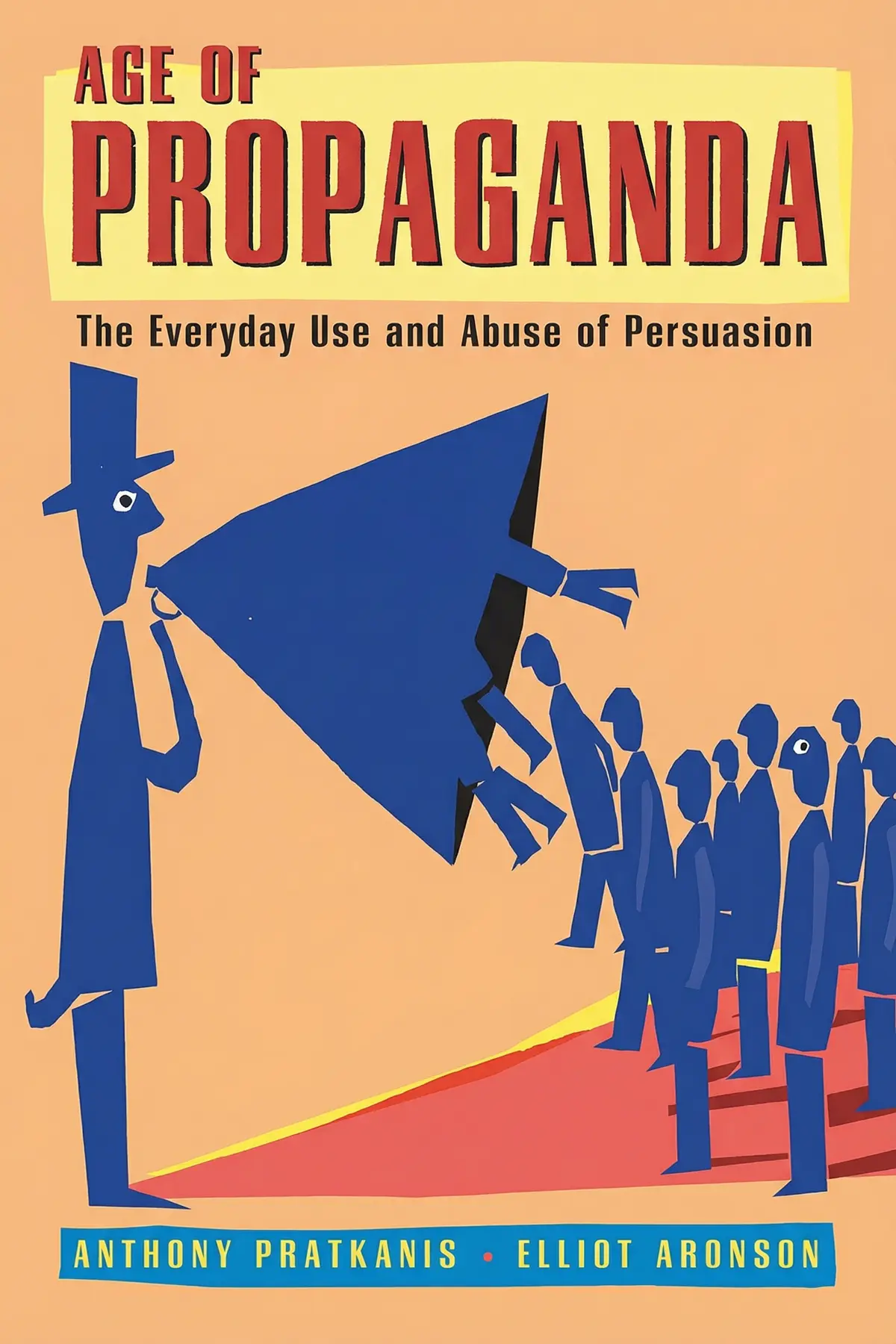
Age of Propaganda: The Everyday Use and Abuse of Persuasion
Anthony Pratkanis
Learn to navigate a world flooded with misinformation by understanding the psychology of bullshitting. This guide provides actionable tools to sharpen your critical thinking and resist the influence of unverified claims.
1 min 41 sec
It is a quiet, uncomfortable truth that every single one of us has engaged in bullshitting at some point. Perhaps you were at a dinner party and someone asked your opinion on a complex economic policy or a new scientific discovery. Rather than admitting you didn’t have the slightest idea what they were talking about, you likely offered a vague, confident-sounding response. You contributed to the noise. But while these small social moments might seem harmless, they are part of a much larger, more pervasive phenomenon that defines our modern era.
We live in an age where information travels at the speed of light, yet much of that information has no grounding in reality. We often pride ourselves on our ability to spot a fake or identify a scam, but the data suggests we are far more vulnerable than we think. There is a fundamental lack of clarity regarding what bullshitting actually is, why it has become so widespread, and the specific psychological purpose it serves in our social interactions.
In the following segments, we are going to pull back the curtain on the mechanics of misinformation. We will explore the vital distinction between someone who lies and someone who bullshits—a difference that is more significant than you might imagine. We will look at how high-stakes industries, from car sales to social media marketing, rely on our natural cognitive blind spots. Most importantly, this journey isn’t just about observing the problem; it’s about arming you with a specific set of tools. You will learn to recognize the common tactics of those who disregard the truth and develop the habits of mind necessary to resist them. By the end of this summary, you’ll understand how to navigate a world full of noise with a renewed sense of clarity and critical purpose.
2 min 05 sec
Explore why a bullshitter is often more dangerous than a liar by understanding their fundamentally different relationships with the truth.
2 min 27 sec
Discover how misinformation reshapes your memory and influences your future decisions long after the original claim has been debunked.
2 min 17 sec
Uncover why everyone, even experts, is susceptible to falling for nonsense and how your mood can make you a prime target.
2 min 00 sec
Learn about the social pressures and expectations that turn us all into occasional sources of misinformation.
2 min 13 sec
Identify the specific rhetorical strategies, from storytelling to pseudo-profundity, used to mask a lack of evidence.
2 min 26 sec
Transition from a passive listener to an active investigator by learning the specific questions that expose baseless claims.
1 min 57 sec
Understand how failing to ask the right questions makes you a participant in the spread of misinformation.
2 min 04 sec
Learn why calling out bullshit is a moral imperative and how intellectual humility can help build a more rational society.
1 min 39 sec
In a world that seems increasingly disconnected from factual reality, the ability to detect and confront bullshit is not just a useful skill—it is a vital necessity. Throughout this summary, we have explored the deep psychological roots of why people disregard the truth and why we are so often willing to let them. We’ve seen that bullshitting is defined by a fundamental indifference to reality, a trait that makes it even more insidious than a traditional lie. We have also examined the heavy toll this takes on our decision-making, our memories, and our society at large.
But more importantly, you now have a roadmap for resistance. You understand that bullibility is a universal human trait, but one that can be managed through awareness and the right habits of mind. By shifting your questioning from ‘why’ to ‘how’ and ‘what,’ by evaluating the motivations of those who speak, and by resisting the social pressure to have an opinion on everything, you can significantly lower your vulnerability to misinformation.
The final takeaway is one of responsibility. We cannot wait for others to clean up the information landscape. It starts with a personal commitment to intellectual humility and the courage to call out nonsense when we see it. As an immediate next step, try using fact-checking resources and primary sources whenever you encounter a claim that seems too good (or too bad) to be true. If you can’t find the evidence, don’t be afraid to ask for it. By working together to prioritize evidence over noise, we can build a future that is grounded in reason and common truth.
We are constantly submerged in a sea of half-truths, unverified claims, and outright nonsense. But why is there so much of it, and why are we so susceptible to believing it? The Life-Changing Science of Detecting Bullshit explores the fascinating psychological mechanisms that allow misinformation to thrive. It moves beyond the simple idea of lying to reveal how a total indifference to the truth can be even more damaging than a deliberate falsehood. This summary promises to transform you from a passive consumer of information into an inquisitive truth-seeker. You will discover why even highly intelligent people fall for scams, how social pressure forces us to speak on topics we don’t understand, and the specific rhetorical tricks used by influencers and politicians to bypass our critical faculties. By the end, you will have a practical framework for asking the right questions, evaluating evidence objectively, and helping to foster a more evidence-based culture in your personal and professional life.
John V. Petrocelli is a distinguished professor of psychology at Wake Forest University. His academic research focuses on complex areas of human cognition, including attitude strength, persuasion, and counterfactual thinking. He is particularly recognized for his scientific exploration of bullshitting and metacognition. His work has been widely published in prominent scientific journals, such as the Journal of Personality and Social Psychology. Beyond the classroom and laboratory, Petrocelli is a sought-after speaker who conducts keynotes and seminars focusing on evidence-based management, leadership, and effective communication.
Listeners describe the book as scientifically backed and accessible, making for an engaging and thought-provoking experience. They characterize it as a master class in critical thinking, while one listener points out how it delivers vital insights for recognizing misinformation.
Finally got around to reading Petrocelli's deep dive into why we're so 'bullible' and it was a master class in intellectual self-defense. It is fun, punchy, and grounded in experimental social psychology, making it feel far more substantial than your average airport self-help book. The author breaks down the psychology of why we believe nonsense even when the facts are right in front of our faces. I found the analysis of Bernie Madoff’s Ponzi scheme particularly gripping because it shows that intelligence doesn't protect you from a determined bullshitter. This book offers indispensable insights into the anatomy of misinformation that feel incredibly relevant in our current political climate. If you want to sharpen your critical thinking skills and stop being a victim of marketing spin, this is a must-read.
Show moreWow, I didn't expect a book about psychology to be this entertaining while still being so rigorously researched and logically sound. John V. Petrocelli has created a fun and interesting read that serves as an essential manual for navigating the 21st century. The stories about Bernie Madoff and the diamond industry are eye-opening and help illustrate the high costs of being too 'bullible.' I've already started using his techniques to ask more probing questions when I hear people making wild claims without any data. It’s a master class in critical thinking that feels accessible to everyone, regardless of their background in science. This should be required reading for every high school student before they are allowed to go out into the real world. This book is a rare gem that is both educational and genuinely enjoyable.
Show moreIn my experience, most self-help books are just fluff and anecdote, but this one provides indispensable insights into the actual anatomy of misinformation. Petrocelli offers a scientifically grounded framework that turns you into a human filter for the nonsense we see on TV and social media daily. I particularly loved the breakdown of why even smart people like Stephen Greenspan fall for Ponzi schemes; it’s a humbling reminder of our own cognitive biases. The book is easy to read and serves as an essential manual for anyone living in the 21st century. If you want to strengthen your critical thinking skills and stop being 'bullible,' this is the most important book you will buy this year. It is a master class in detecting the various ways people try to manipulate our perceptions and beliefs. Highly recommended for everyone!
Show moreEver wonder why people still think the Earth is flat or why Kyrie Irving’s podcast comments gained so much traction? Petrocelli uses these high-profile examples to illustrate how bullshit spreads like a virus when we stop prioritizing evidence. The book is scientifically grounded but remains very easy to read, which is a difficult balance for a social psychologist to strike. I appreciated the specific techniques offered for pushing back against people who are just 'talking out of their hats' without a care for the truth. Some chapters felt a bit repetitive, and the author's dismissal of the MBTI felt a little one-sided, but the overall message is vital. We need more people calling bullshit in their daily lives to restore some level of collective sanity. It's a solid 4-star read for anyone interested in the mechanics of persuasion.
Show moreAs someone who deals with marketing spin for a living, Petrocelli's distinction between lying and bullshitting is a total game-changer for my professional life. He explains that bullshitters aren't necessarily trying to deceive you; they just have a complete lack of concern for what is actually true. This explains so much about the modern world, from TED Talks to the way people try to sell you used cars. The book is packed with indispensable insights and provides a clear framework for identifying when someone is just trying to sound impressive. I did find the conclusion about 'modeling honesty' to be a bit simplistic, but the path to get there was fascinating. It's an interesting read that will definitely make you more skeptical of everything you see on social media.
Show morePicked this up during a long flight and found the insights into Bernie Madoff and Ponzi schemes absolutely fascinating and well-explained. The book does a great job of explaining the social costs of bullshit, specifically how it can actually be more dangerous than lying because it erodes our shared reality. Petrocelli’s writing is generally easy to read, although he does occasionally get bogged down in psychological jargon that might lose some readers. I loved the quote from Carl Sagan at the beginning; it set the perfect tone for the rest of the exploration. Even though I consider myself a skeptic, I realized I have several blind spots that make me susceptible to certain types of marketing. This is a very interesting read that offers a lot of practical value for anyone who wants to be a better thinker. Definitely worth the time for the insights alone.
Show moreThe 'fly scale' Petrocelli introduces early in the book was a clever concept, but its application felt inconsistent throughout the chapters. While I appreciated the master class in critical thinking, the academic prose occasionally became a bit dry and lacked the energy promised by the cover. To be fair, his distinction between a liar—who knows the truth—and a bullshitter—who simply doesn't care—is a profound insight for our current era of misinformation. However, for a book that prides itself on scientific rigor, the discussion of the MBTI felt like a missed opportunity to explore nuance. It’s a good, solid read if you want to sharpen your skepticism, but it lacks the punch of a true five-star classic. It's worth a look if you have a long flight, but don't expect it to revolutionize your entire worldview.
Show moreLook, I really wanted to like this, but the prose felt surprisingly dry and academic despite the provocative title and the constant swearing. While the distinction between a liar and a bullshitter is interesting, the author seems to skim over deep topics like Deepak Chopra and wine marketing without providing much new information. For readers who already consider themselves critical thinkers, there really isn’t a lot of ground-breaking material here to chew on. I was also pretty annoyed by the 'fly scale' graphics which felt inconsistent and more like a distraction than a helpful tool. It feels like a long academic paper that was forced into a trade book format with some added four-letter words to make it seem edgy. It’s not a total waste of time, but it definitely didn't change my life.
Show moreNot gonna lie, the discussion on nutrition in Chapter 5 really soured my opinion of the rest of the book's credibility. Petrocelli leans heavily into 'calories in/calories out' while ignoring significant research on metabolic adaptation seen in hunter-gatherer populations. It’s hard to trust a 'master class' in detecting nonsense when the author himself seems to be trudging through it in certain areas. To be fair, the sections on Bernie Madoff and real estate sales were engaging and provided interesting context on human gullibility. However, the tone shifts between academic jargon and over-the-top swearing, making it a very uneven reading experience overall. I appreciate the effort to promote critical thinking, but the author needs to be more careful about his own biases before lecturing others. It was an okay read, but I wouldn't recommend it over other logic books.
Show moreFrankly, this was a massive disappointment that felt like its own version of the very thing it claims to expose. The author frequently makes sweeping generalizations without providing the rigorous scientific evidence he demands from everyone else in the book. Specifically, the chapter on vaccines and autism only focuses on the Wakefield study, completely ignoring the much larger discussion regarding institutional transparency and risk assessment. I also found the excessive swearing to be jarring and unnecessary for what is marketed as a serious psychological study. To me, it felt like the author was trying too hard to be 'edgy' while delivering a very shallow analysis of complex issues. If you’re looking for a book that actually teaches critical thinking rather than just listing basic steps, you’d be better off looking elsewhere.
Show moreAnthony Pratkanis
Richard Wiseman


Steven C. Hayes
AUDIO SUMMARY AVAILABLE
Get the key ideas from The Life-Changing Science of Detecting Bullshit by John V. Petrocelli, plus 5,000+ more titles in English and Thai.







