
Age of Propaganda: The Everyday Use and Abuse of Persuasion
Anthony Pratkanis
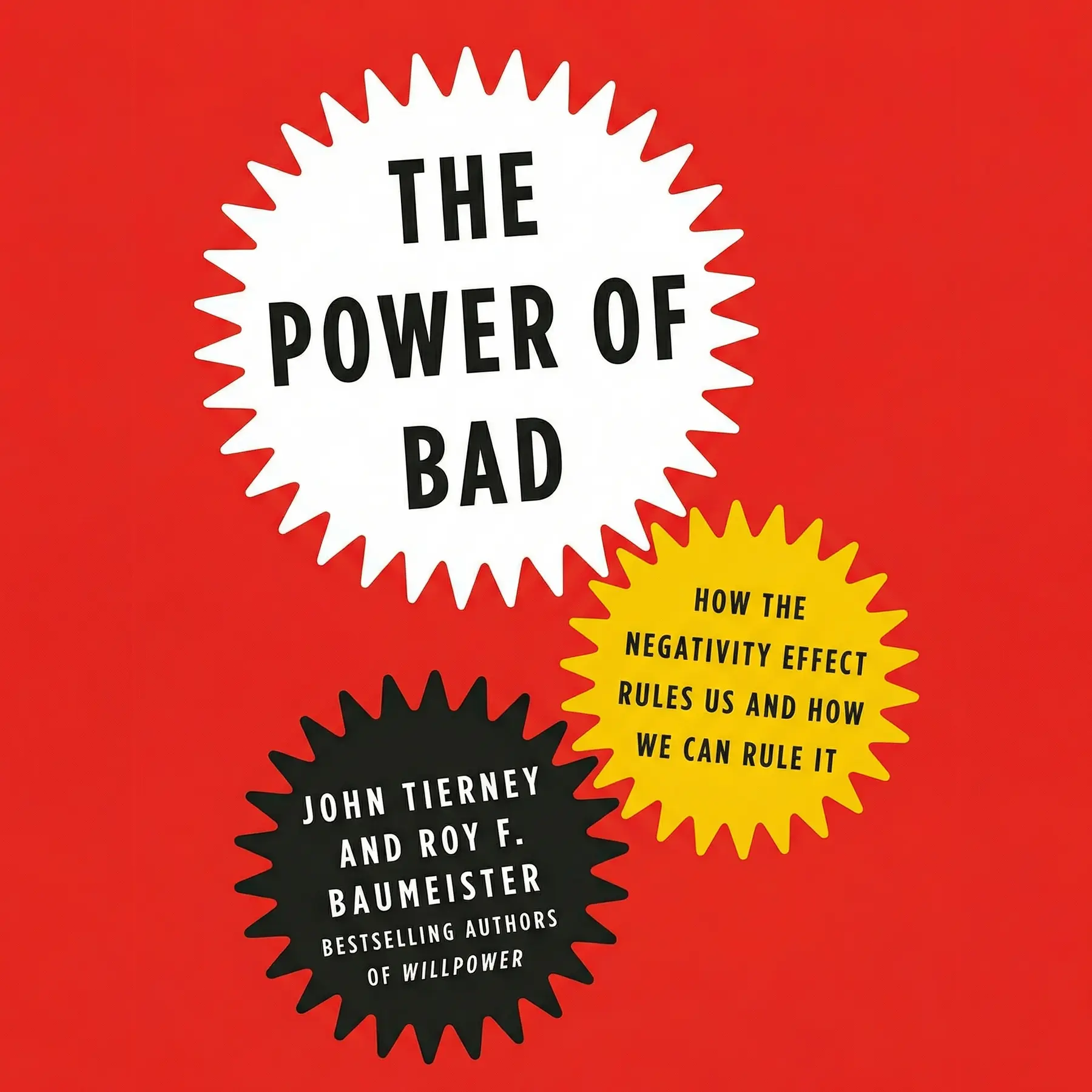
Explore the hidden ways negativity shapes human behavior. This summary reveals why bad experiences carry more weight than good ones and provides practical tools to overcome our innate evolutionary pessimism for a better life.
1 min 53 sec
Think back to the last time you received a performance review at work, or perhaps a long letter from a friend. Chances are, there were several paragraphs of praise, highlighting your strengths and celebrating your successes. But nestled in the middle of all that warmth was likely one small, pointed critique—a single observation about a mistake you made or a flaw you possess. Which part did you fixate on? If you are like the vast majority of people, that lone negative comment echoed in your mind for days, drowning out every compliment you received.
This isn’t just a personal quirk; it’s a fundamental aspect of the human condition known as the negativity effect. In their collaborative work, science writer John Tierney and social psychologist Roy Baumeister explore why our brains are seemingly hardwired to prioritize the bad over the good. This psychological gravitational pull affects everything from our romantic partnerships to our global outlook.
We often find ourselves trapped in a loop of remembering past embarrassments, obsessing over worst-case scenarios, and feeling overwhelmed by a media landscape that thrives on gloom. However, the authors argue that while this bias served a purpose in our evolutionary past—keeping our ancestors alert to predators and poisonous plants—it often works against us in the modern world.
Throughout this summary, we are going to look at the mechanics of this bias. We will discover the specific ratios of positivity required to keep a relationship afloat, the ways we can retrain our brains to handle irrational fears, and the reasons why the world is actually much better than your television would have you believe. By the end, you will have a toolkit for shifting your perspective, allowing you to acknowledge the bad without letting it rule your life. This is a journey toward rational optimism, learning to recognize when our internal alarm systems are overreacting and how we can steer ourselves back toward a more balanced, flourishing existence.
2 min 58 sec
Discover why a single bad day can outweigh several good ones and learn the specific mathematical ratio required to keep your relationships healthy and thriving.
2 min 54 sec
Learn why being a ‘good enough’ partner is often more effective than striving for perfection, and why eliminating bad traits matters more than adding good ones.
2 min 43 sec
Witness how a world-record skydiver conquered a common phobia and discover how you can use clinical techniques to silence your own internal alarms.
2 min 44 sec
Understand why the traditional ‘feedback sandwich’ often fails and learn a better way to deliver difficult news without triggering defensiveness.
2 min 32 sec
Explore the science of motivation and see why the fear of losing something is a much more powerful driver than the hope of gaining something new.
2 min 53 sec
Understand how one negative person can undermine an entire group’s performance and learn strategies to prevent social undermining from spreading.
2 min 40 sec
Learn how the ‘Peak-End Rule’ helps businesses survive in an age of online reviews where one negative comment can outweigh a dozen five-star ratings.
2 min 36 sec
Discover the ‘fading affect bias’—our brain’s natural ability to let bad memories go—and why humanity is more optimistic than we often realize.
2 min 54 sec
Learn to identify the ‘record-store effect’ and discover why the modern media landscape makes the world look much worse than it actually is.
1 min 35 sec
In the end, the ‘power of bad’ is a double-edged sword. It is an ancient survival mechanism that once kept us alive in a world full of physical threats, but in the modern age, it can become a source of unnecessary anxiety and social friction. We’ve seen how this bias can distort our relationships, amplify our fears, and color our perception of the entire world. However, by understanding the negativity effect, we can begin to neutralize its impact. We can aim for that 5-to-1 ratio in our marriages, focus on being ‘good enough’ rather than perfect, and use cognitive tools to handle our internal alarms.
One of the most effective ways to push back against the negativity effect is to cultivate what the authors call an ‘attitude of gratitude.’ This isn’t just a feel-good cliché; it is a strategic psychological practice. By consciously and repeatedly focusing on what is going well, you are training your brain to notice the ‘positive’ words in the dictionary of your life. It takes effort to overcome millions of years of evolutionary programming, but the reward is a life of rational optimism. You can acknowledge that bad things happen without letting them define your reality. As you move forward, try to be mindful of the ‘bad apples’ and the ‘crisis’ headlines, and remember to bank as much positivity as you can. When you balance the ledger of your life with intention, you’ll find that while bad is powerful, good is ultimately what makes life worth living.
Have you ever wondered why a single piece of criticism can ruin a day full of praise, or why the news always seems to focus on the brink of disaster? This summary dives into the concept of negativity bias, a powerful psychological phenomenon that colors our relationships, workplaces, and worldview. Drawing on the research of social psychologist Roy Baumeister and science writer John Tierney, you will learn the evolutionary roots of our focus on the bad and, more importantly, how to break free from it. The promise of this exploration is a more balanced life where you can leverage the power of the positive while mitigating the disproportionate impact of the negative. From maintaining the ideal positivity ratio in your marriage to navigating the alarmist headlines of the modern age, these insights offer a roadmap to rational optimism.
John Tierney is an acclaimed science journalist whose work frequently appears in the New York Times, where he wrote the popular column Findings. He is also the author of Willpower. Roy Baumeister is a distinguished social psychologist at the University of Queensland and a fellow at the Society for Personality and Social Psychology. His extensive research covers topics such as human motivation, identity, and the need to belong.
Listeners find this to be an engaging listen that offers profound observations on human behavior, with one listener mentioning it is supported by rigorous psychological research. The material is straightforward and easy to digest, and listeners enjoy how the authors integrate positivity biases throughout the chapters. Additionally, the quality of the insights is highly regarded; one listener emphasizes the helpful practical advice, while another views it as a fantastic behavioral guide for the year ahead.
Ever wonder why a single insult sticks with you longer than a dozen compliments? This book provides a brilliant behavioral roadmap for understanding that exact phenomenon. Tierney and Baumeister explain the 'negativity bias' in a way that is incredibly easy to understand, even if you aren't a psychology buff. I particularly loved the 'Rule of Four'—the idea that it takes four good things to overcome one bad one. Applying this to my marriage and my workplace has already started to shift my perspective. It’s a solid piece of research that doesn't feel like a dry textbook. While some might find the journalistic, punchy tone a bit much, I thought it kept the pace moving. This is the kind of information that stays with you long after you close the cover. It’s practical, insightful, and genuinely helpful for anyone trying to navigate a world that feels increasingly negative.
Show moreFinally, a psychology book that provides practical tips instead of just theorizing! Tierney and Baumeister have written an excellent behavioral roadmap that I’ve already recommended to my entire management team. The way they explain the power of 'bad' in relationships and business is eye-opening. We spend so much time trying to be perfect, but this book shows that simply avoiding the 'bad' is often more effective than striving for the 'extraordinary.' The positivity ratio is a game-changer for giving feedback to employees. The text is packed with brilliant insights into human nature, and the authors do a great job of making complex studies feel relevant to everyday life. It’s a refreshing change of pace from the typical self-help fluff. If you want to understand why your brain is wired to be miserable and how to fix it, buy this book. It is a solid read from start to finish.
Show moreThis book is essentially a toolkit for reclaiming your sanity. Truth is, I’ve been a fan of Roy Baumeister’s work for years, and John Tierney does a great job of translating heavy psychological concepts into something punchy and relatable. They explain how we’ve been evolved to overreact to threats, which was great for avoiding lions but is terrible for browsing Twitter. The chapters on relationships are particularly strong, offering a roadmap for how to handle conflict without letting one bad moment ruin everything. I loved the emphasis on 'low-stakes' positivity and how we can use it to build resilience. It’s an easy read that manages to be both intellectually stimulating and deeply practical. If you feel overwhelmed by the constant negativity of the modern world, this book will give you the perspective you need to step back and breathe. Highly recommended for anyone looking for a better way to live.
Show moreWow. I didn't realize how much my brain was being hijacked by the 'power of bad' until I read this. The authors do a fantastic job of showing how our natural instincts are being exploited by the media and politicians to keep us in a state of constant fear. The content is easy to understand and the examples—from marriage to business—are incredibly relatable. I particularly appreciated the tips on how to deliver criticism; it’s going to change how I talk to my kids and my coworkers. The book is a brilliant behavioral roadmap that focuses on how to leverage our biology rather than being a victim of it. Personally, I found the writing style to be engaging and fast-moving. It’s one of those rare books that is based on solid psychology research but feels as easy to read as a novel. It’s a must-read for anyone who wants to be more positive and productive.
Show morePicked this up after a recommendation from a colleague, and I found the 'Rule of Four' to be quite transformative for my personal interactions. The book is effectively a toolkit for reclaiming your sanity in an era of manufactured outrage and doom-scrolling. I appreciated how the authors wove positivity biases throughout the text, showing how we can consciously override our evolutionary hardwiring to fear the worst. The writing style is very accessible—it's punchy and fast-paced. However, I’ll admit I had to take some of the later chapters with a grain of salt. The sections on GMOs and nicotine felt a bit like unnecessary tangents that didn't quite fit the core psychological thesis. Still, as a guide for better decision-making and improving your mental health, it’s a very strong offering. It’s an excellent behavioral roadmap for the coming year if you want to stop letting 'bad' dominate your life.
Show moreAs someone who works in the service industry, the insights here regarding the 'bad apple' theory were worth the price of admission alone. We’ve all seen how one toxic employee can ruin a whole team, and this book explains the science of why that happens. The information quality is high, and the authors provide a lot of solid psychology research to back up their claims. I found the section on online reviews particularly meta and hilarious—it definitely made me think twice about how I frame my own feedback. The book isn't perfect; some of the chapters on social policy felt a bit out of place and biased toward a specific political worldview. However, the core message about the 4:1 ratio is incredibly powerful. It’s a quick, easy read that will definitely change how you view your daily interactions and the news cycle. It's a great tool for personal growth.
Show moreAfter hearing about this on a podcast, I decided to give it a go. The first half is absolute gold. The explanation of why we are so attuned to negative information is brilliant and really helped me understand my own anxiety. The 'Rule of Four' is a simple but effective concept that I've started using with my kids. That said, I did find the later sections on charter schools and the environment to be a bit one-sided. It felt like the authors were using their psychological thesis to push a very specific political agenda. They present Success Academy as a perfect model without acknowledging the valid criticisms from educational researchers. If you can read it with a critical eye and separate the solid psychology from the authors' personal opinions, there is a lot of value here. It’s a well-written, engaging book that offers some very useful behavioral strategies for the modern world.
Show moreWhile the science behind the negativity bias is undeniably solid, the book takes a weird turn toward the end that left me feeling conflicted. The early chapters on how we evolved to prioritize threats are fascinating and well-researched. I learned a lot about how to handle criticism and why 'bad apples' have such a disproportionate effect on groups. But then the authors start sounding like techno-optimists in the vein of Steven Pinker, dismissing valid environmental concerns as mere 'moral panics.' Frankly, the tone becomes a bit condescending toward anyone who worries about the future. They spend a lot of time on charter schools and de-emphasizing systemic issues in favor of individual mindset. It’s a mix of great psychological observations and some questionable social commentary. It's an easy read, and you can definitely find some useful tools here, but you have to filter out a lot of the authors' personal baggage to get to the good stuff.
Show moreLook, I really wanted to like this, but the moment the authors started diving into bio-babble about MRI scans and prefrontal lobes to explain away social issues, they lost me. It’s a very 'white male' perspective on global problems. The chapter on the 'Crisis Crisis' felt incredibly dismissive of real, systemic struggles like climate change and absolute poverty. To be fair, the psychological research on the negativity bias itself is interesting, but the authors use it to justify some pretty iffy political stances. Their glowing review of Success Academy charter schools felt like a marketing brochure rather than an objective analysis of educational data. It ignores the reality of how those schools select and retain students. If you can ignore the heavy-handed bias and the occasional 'just-so' evolutionary story, there are some decent tips on relationships. Otherwise, it’s a frustrating read that tries to simplify the world into a single solution.
Show moreNot what I expected. The book starts off strong with interesting psychological insights but quickly devolves into what I can only describe as privileged complaining. The authors seem to think that if we just stop focusing on the 'bad,' things like poverty and climate change will magically cease to be problems. As someone who works in environmental science, I found the 'Crisis Crisis' chapter to be dangerously simplistic. They dismiss global threats with a wave of the hand, citing absolute poverty statistics that ignore the lived reality of billions. Plus, the writing style is that annoying 'rollicking journalism' that values a good anecdote over nuanced data. I tired of the constant sporting examples and the pilot-in-trouble stories that every book in this genre seems to use. It’s a very American-centric, corporate-friendly view of the world that ignores systemic reality in favor of 'mindset' shifts. Disappointing.
Show moreAnthony Pratkanis
Richard Wiseman
Steven C. Hayes
AUDIO SUMMARY AVAILABLE
Get the key ideas from The Power of Bad by John Tierney, plus 5,000+ more titles in English and Thai.







