
1929: Inside the Greatest Crash in Wall Street History--and How It
Andrew Ross Sorkin
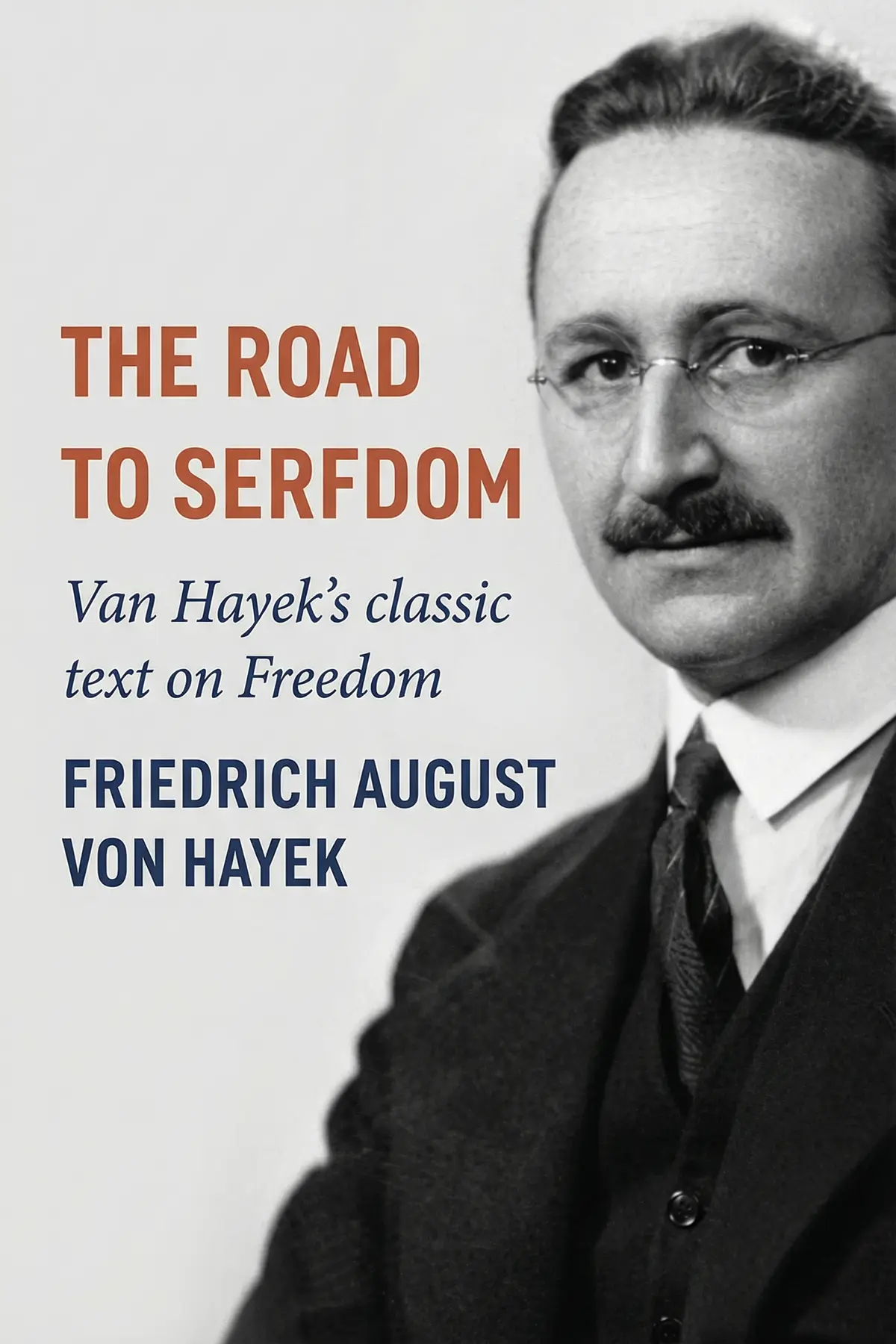
Friedrich August von Hayek examines how central economic planning inevitably erodes personal liberty. This classic political work warns that even well-intentioned socialism can lead democracies toward totalitarianism and the loss of individual rights.
2 min 08 sec
The year was 1944, and the globe was locked in the final, agonizing stages of the Second World War. On the Eastern Front, the Soviet Union was pushing back against the German forces with massive momentum. Meanwhile, in the West, the United Kingdom and the United States were meticulously preparing for the Normandy invasion. It was a time of impending victory for the Allies, a moment when the defeat of Nazi Germany seemed almost certain. Yet, in the midst of this anticipation, a brilliant economist and philosopher named Friedrich August von Hayek felt compelled to issue a chilling warning. He didn’t fear the military defeat of the Allies; he feared what they might become in the aftermath of their triumph.
Hayek, who would later be recognized with a Nobel Prize for his contributions to economics, looked at the landscape of the Western democracies and saw a disturbing trend. He noticed that the very nations fighting to end totalitarianism were beginning to adopt the economic structures that had given rise to it in the first place. He saw a growing appetite for state control and central planning—a system he believed was fundamentally incompatible with the survival of liberty. To Hayek, the path toward a socialist, planned economy wasn’t just a different way to organize trade; it was a slippery slope that led directly to the same brand of tyranny the world was currently bleeding to stop.
In this exploration of Hayek’s landmark work, we will trace the logic behind his deep-seated anxieties. We will examine why he believed that the erosion of economic freedom inevitably leads to the death of political freedom. We’ll look at how the machinery of a state-controlled economy forces a society to sacrifice the rule of law and individual choice, and why, in such a system, the most ruthless elements of society almost always rise to the top. By looking through Hayek’s eyes, we can better understand the delicate balance between government authority and the autonomy of the individual—a balance that remains just as critical today as it was in the shadow of World War II.
2 min 20 sec
Discover how the rise of oppressive regimes is often preceded by a gradual shift toward state-led economic management, rather than a sudden political coup.
2 min 21 sec
Explore why the popular association of socialism with increased personal freedom is a fundamental misunderstanding of how central planning actually functions.
2 min 16 sec
Learn why it is practically impossible to maintain a democratic system while simultaneously implementing a comprehensive national economic plan.
2 min 09 sec
Uncover the way economic control dictates the most personal aspects of our lives, from the jobs we hold to the homes we live in.
2 min 14 sec
Examine the disturbing social dynamics that ensure amoral and ruthless individuals often gain power in totalitarian systems.
2 min 13 sec
See how regimes maintain their grip on society through the manipulation of information and the creation of shared targets for hatred.
2 min 13 sec
Discover why Hayek believed that a return to individualist morals and free markets was the only way to ensure post-war prosperity and peace.
1 min 42 sec
In the end, the message of Friedrich August von Hayek remains a powerful testament to the necessity of vigilance. His work serves as a reminder that the road to serfdom is rarely paved with malicious intent from the start. Instead, it is built brick by brick through the desire for security, the hope for an engineered equality, and the belief that a central authority can manage the complexities of human life better than individuals can. Hayek’s core throughline is that economic freedom is not a luxury or a side-issue; it is the very foundation upon which all of our other liberties rest. When we trade that freedom for the promise of state-provided stability, we are inadvertently handing over the power to control our thoughts, our careers, and our very futures.
As we reflect on these ideas, the actionable takeaway is to recognize the value of a competitive system protected by the rule of law. It is the framework of neutral, predictable rules that allows us to live as independent agents rather than subjects of a planner’s whim. Hayek doesn’t argue for a world without any government, but for a government that focuses on maintaining the conditions for freedom rather than trying to dictate the outcomes of our lives. By valuing individualism, embracing personal responsibility, and remaining skeptical of the siren song of total state control, we can protect the democratic heritage that so many have fought to secure. The road to freedom is often messy and unpredictable, but as Hayek so eloquently argued, it is the only road worth traveling if we wish to remain truly free.
The Road to Serfdom is a seminal critique of collectivism and state-led economic planning. Written during the height of the Second World War, Friedrich August von Hayek addresses the dangerous parallels he observed between the rise of fascism in Germany and the growing enthusiasm for socialism in Western democracies like the United Kingdom and the United States. The book promises a deep dive into the mechanics of freedom, arguing that economic liberty is the essential foundation for all other personal and political rights. Hayek explores how the attempt to centrally manage a nation's resources necessitates a shift in power from the individual to a centralized authority, ultimately leading to a loss of the rule of law and the rise of a dictatorial state. Through this exploration, readers gain a better understanding of the value of competition and the inherent risks of abandoning individualist morals for collective security.
Friedrich August von Hayek (1899–1992) was an Austrian-born, British economist and a co-recipient of the Nobel Memorial Prize in Economics in 1974. He was a pioneer of monetary theory, a major proponent of classic liberalism and would later receive the Presidential Medal of Freedom in 1991.
Listeners find the material both enlightening and instructional, praising the clear style that examines economics through a human lens alongside thorough citations. Furthermore, they value its historical perspective and current importance, regarding it as a fundamental guide for social and political systems. Nevertheless, reactions to the ease of reading are varied; some believe it is an essential read while others struggle with the text. Pacing is another point of contention, as one listener characterized the progression as somewhat meandering.
Hayek’s masterpiece serves as a chilling reminder of how easily societies can slide toward authoritarianism under the guise of progress. The author captures the deep-seated frustration of classical liberals who witness collectivist policies being enacted despite overwhelming evidence of their historical failures. By focusing on the human side of economics, he illustrates that central planning isn't just inefficient; it is a direct threat to personal liberty. The prose is remarkably clear for such a dense subject, although the references to 1940s British politics require some focus to fully grasp. Truth is, his argument that centralizing economic power inevitably empowers a small elite remains terrifyingly relevant in our current era of government expansion. It is an essential roadmap for anyone trying to understand the delicate balance between the state and the individual.
Show moreEver wonder why the government's best-laid plans often crumble into bureaucratic nightmares? This book provides the answers by dismantling the myth that a few planners can successfully manage the complex needs of millions. Hayek’s distinction between democracy and socialism is particularly striking, noting that while both seek equality, one seeks it in liberty while the other seeks it in servitude. I found the historical context regarding Nazi Germany and the Soviet Union to be a sobering lesson for Western nations today. We often blame the free market for problems actually caused by federal meddling, and Hayek explains this irony with surgical precision. It’s an ultimate political guide that remains as fresh today as it was in 1944. Highly recommended for those who value individual autonomy over state-mandated outcomes.
Show moreAs someone who appreciates the deep roots of political theory, I found Hayek’s analysis of collectivism to be incredibly profound. He doesn't just attack socialism on economic grounds; he attacks it on moral ones, showing how the loss of economic control is the loss of all control. The way he traces the intellectual history of Germany to show how they moved toward totalitarianism is a masterclass in social observation. Personally, I think the most important takeaway is his explanation of how 'price signals' act as a vital information exchange that no central planner could ever replicate. Even if you don't agree with every libertarian ideal, the logic presented here is hard to ignore. It is a dense, educational journey that forces you to re-evaluate what 'freedom' actually means in a modern society.
Show moreThe distinction Hayek makes between democracy and socialism is profound and life-changing. He argues that socialism is the 'road to serfdom' because it requires the state to impose a single set of values on an entire population. Picked this up for a class but ended up reading it for pleasure because the insights into human behavior were so sharp. He explains that when the government tries to fix market problems, they often create new ones that are then used as excuses for even more control. It’s a vicious cycle that we see playing out in real-time today. This isn't just a book about economics; it’s a book about why the individual must always be the primary unit of society. Truly an educational masterpiece that provides a roadmap for preserving liberty.
Show moreTo be fair, I expected a dry economic treatise but got a gripping social warning that reads like a precursor to 1984. Hayek’s prose is surprisingly accessible, and he manages to make complex ideas about price signals and market anarchy feel intuitive. He shows that when we hand over economic decisions to 'experts,' we are essentially surrendering our right to choose our own paths in life. The book is filled with extensive references that show he wasn't just guessing—he lived through the collapse of Austria and saw the signs early. Not gonna lie, some of the chapters are quite heavy and require re-reading to catch the subtleties. However, the payoff is a much deeper understanding of why centralized power is always a recipe for disaster. It is a brilliant, essential work of political philosophy.
Show moreChoosing to read this during our current political climate was a massive eye-opener for me. Hayek’s thesis about how collectivism eventually leads to tyranny is argued with a level of logic that is hard to find in modern discourse. He captures the frustration of seeing the same mistakes being repeated over and over by people who think they can 'plan' prosperity. The book is educational and provides a historical context that is often missing from our news cycles today. I particularly appreciated his focus on the 'rule of law' as the only way to ensure true equality of opportunity for everyone. While the pacing can be a bit slow in the later chapters, the overall message is one of the most important things I've ever read. This is a must-read for anyone who cares about the future of a free society.
Show moreWhile I found some of the pacing a bit meandering in the middle chapters, the educational value of this book cannot be overstated. Hayek provides a rigorous defense of the free market that goes far beyond simple balance sheets. He dives into the psychology of power and how well-intentioned 'experts' can inadvertently dismantle the very freedoms they claim to protect. The writing is insightful and backed by extensive references that ground his theories in the harsh realities of post-WWI Europe. To be fair, his 'slippery slope' argument feels a bit hyperbolic at times, as if every social safety net is a direct door to the gulag. However, the core message about the 'rule of law' and individual opportunity is a necessary counterbalance to modern political trends. It’s a challenging but deeply rewarding read.
Show moreFinally got around to this classic after hearing it referenced for years by everyone from Milton Friedman to Margaret Thatcher. It’s surprisingly readable, though some sections on international order definitely feel like they belong to a different century. Hayek’s primary strength is his ability to show the logical progression from 'a little bit of planning' to total state control. He avoids insulting his opponents, instead choosing to highlight how their good intentions lead to disastrous results. My only real gripe is that the book can be repetitive, hammering the same points about individualism versus collectivism in every chapter. Still, the historical context of a man writing this while the world was at war adds a layer of urgency that makes the text feel vital. It’s a solid foundational text for any political library.
Show moreLook, this is clearly an important historical document, but it lacks the nuance I expected from such a highly-regarded thinker. Hayek seems to operate in a world of rigid binaries where you are either a radical individualist or a proto-fascist. He equates the British Labour party with the Nazis in a way that feels more like a political polemic than a serious academic study. The truth is, his definition of freedom is quite narrow, often ignoring how extreme competition can crush the very people he claims to be championing. I appreciated the clear writing and the extensive references, but the 'all or nothing' approach to economic planning feels dated. It's worth reading to understand the roots of neoliberalism, even if you find his conclusions to be somewhat alarmist.
Show moreFrankly, I found the scholarship here to be incredibly lazy and based on a fundamental misunderstanding of social democracy. Hayek spends the entire book conflating Nazism with any form of government intervention, which is a historical error of massive proportions. It’s a collection of 'slippery slope' fallacies that haven't aged well, especially considering that many European nations have adopted 'planning' without turning into totalitarian hellscapes. The tone is arrogant, suggesting that anyone who disagrees with his radical free-market anarchy is leading us toward serfdom. It’s a terrifying vision of a 'dog eat dog' world where the only thing that matters is money. I struggled to finish it because the logic was so one-sided and lacked any real-world nuance. Not recommended unless you want to see the birth of some very destructive economic ideas.
Show moreAndrew Ross Sorkin
James Comey
Ha-Joon Chang
Niall Kishtainy
Barack Obama
Masaji Ishikawa
AUDIO SUMMARY AVAILABLE
Get the key ideas from The Road to Serfdom by Friedrich August von Hayek, plus 5,000+ more titles in English and Thai.







