
18 min 48 sec
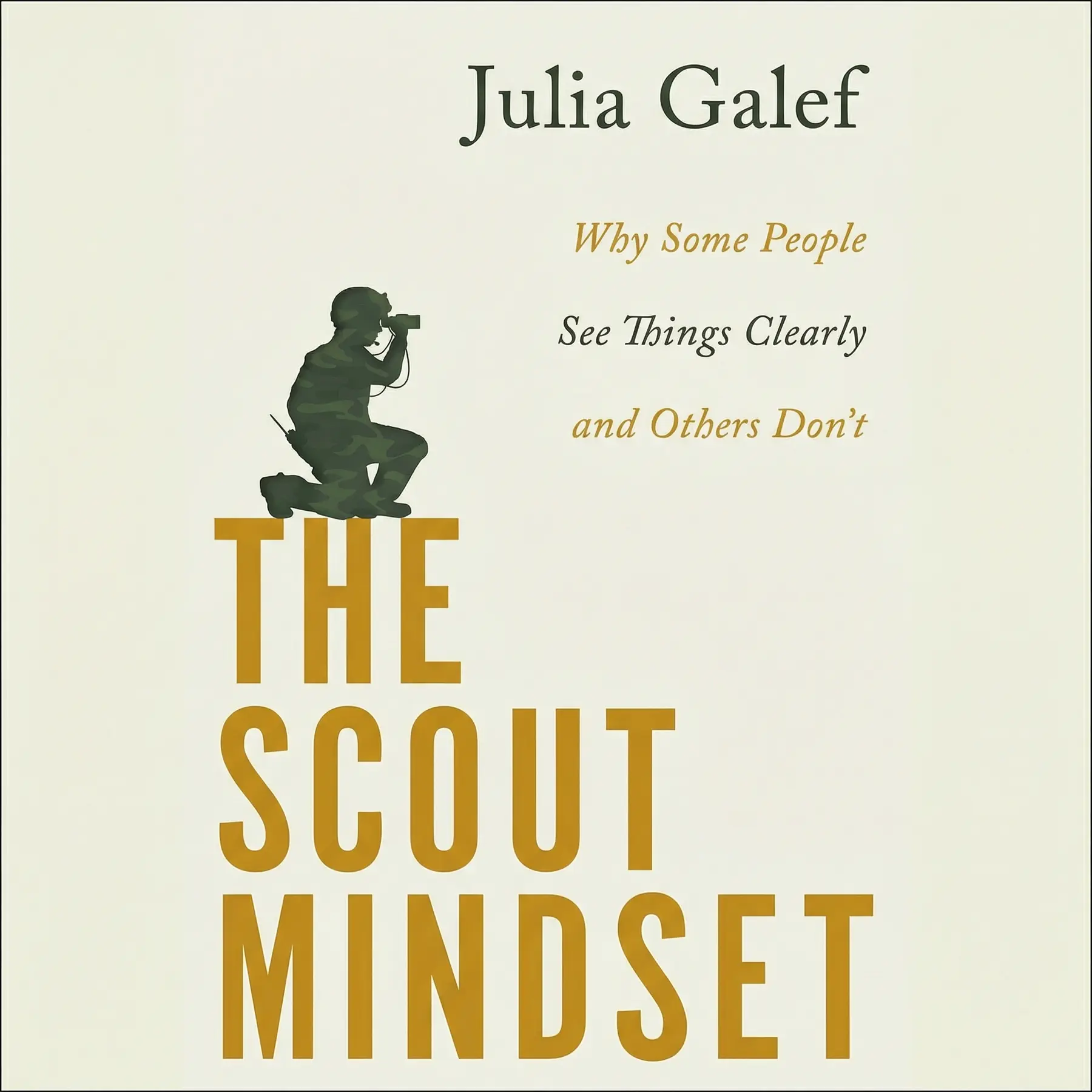
The Scout Mindset: Why Some People See Things Clearly and Others Don't
By Julia Galef
The Scout Mindset explores the psychological divide between defending our existing beliefs like a soldier and seeking objective reality like a scout, offering tools to improve decision-making through better mental clarity.
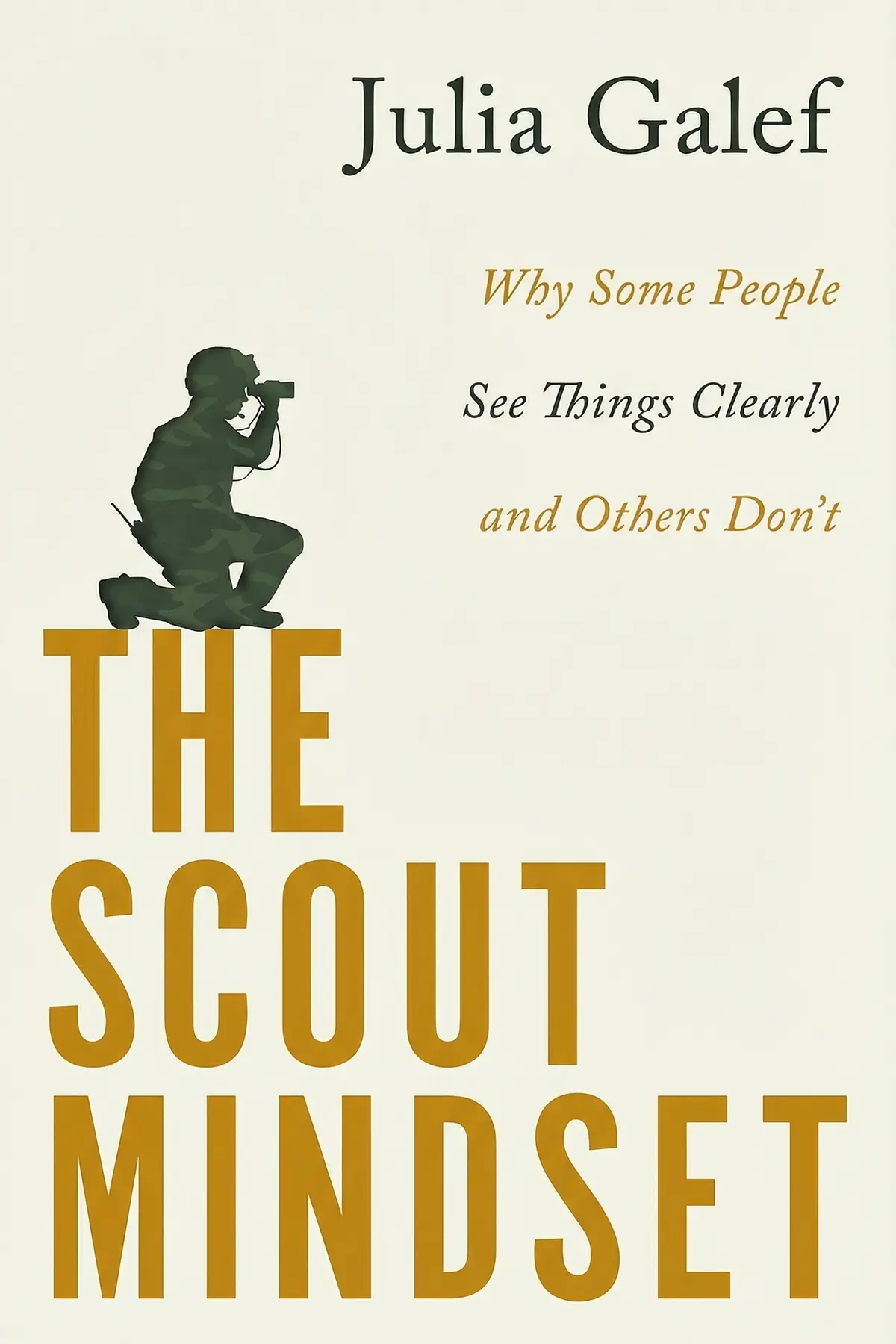
Table of Content
1. Introduction
1 min 41 sec
Have you ever found yourself in an argument where you knew, deep down, that you might be wrong, but you kept fighting anyway? Most of us have. It’s a natural human reaction. We often treat our ideas like a plot of land that we must defend at all costs. But what if there was a better way to navigate the world? What if, instead of being the person who defends the fort, you were the person who mapped the territory?
This is the central question of Julia Galef’s exploration into the human psyche. She suggests that our minds generally operate in one of two modes: the soldier mindset or the scout mindset. To the soldier, information is either a weapon to be used against an enemy or a shield to protect a cherished belief. The goal is victory, not accuracy. To the scout, however, information is a tool for navigation. A scout doesn’t want to win an argument; they want to know where the bridges are, where the hazards lie, and what the ground actually looks like.
In this discussion, we are going to look at why we so often fall into the trap of the soldier and how we can train ourselves to adopt the perspective of the scout. We will look at high-stakes historical dramas, the habits of elite forecasters, and simple mental exercises you can use every day. The throughline here is a shift in values: moving away from the need to *be* right and moving toward the desire to *see* right. By the end of this journey, you’ll understand that the most powerful thing you can do for your career, your relationships, and your personal growth is to develop the courage to see things as they really are, rather than as you wish them to be. Let’s begin by looking at the dangers of the soldier mindset and how it can lead to catastrophic errors in judgment.
2. The High Cost of the Soldier Mindset
2 min 37 sec
Discover how the need to defend a narrative can lead to grave injustice and clouded judgment through the lens of a famous historical treason case.
3. The Hidden Incentives of Self-Deception
2 min 32 sec
Why do we choose to ignore the truth? Explore the social and emotional rewards that make the soldier mindset so attractive.
4. Mastering the Art of Being Wrong
2 min 40 sec
Learn how the world’s best predictors use their mistakes as stepping stones rather than sources of shame.
5. The Power of Active Disproof
2 min 46 sec
How high-achievers from Abraham Lincoln to modern scientists intentionally seek out evidence that contradicts their own views.
6. Three Mental Tools for Clearer Thinking
2 min 42 sec
Equip yourself with practical thought experiments to bypass your brain’s natural tendency toward bias.
7. Forging a Scout Identity
2 min 28 sec
Shift your sense of self from the beliefs you hold to the way you find the truth, making it easier to grow and adapt.
8. Conclusion
1 min 22 sec
In the end, the choice between the soldier and the scout mindset comes down to what you value most: the comfort of being right or the power of being accurate. We have seen how the soldier mindset, though it offers us community and protection for our egos, can lead to disastrous errors like the Dreyfus affair. We’ve also seen that the most effective people in the world—the superforecasters and the great leaders—are those who have the courage to be wrong and the curiosity to keep mapping the truth.
Transitioning to a scout mindset isn’t a one-time event; it’s a lifelong practice. It requires using mental tools like the outsider test to bypass our biases and, more importantly, it requires a shift in how we see ourselves. By taking pride in our ability to update our views, we turn the act of learning into a source of confidence rather than a source of shame.
As you move forward, try to pay attention to that internal ‘soldier’ when it rises up to defend an idea. When you feel that surge of defensiveness, pause. Ask yourself: ‘Am I trying to win, or am I trying to see?’ The world is a complex, ever-changing place, and the only way to navigate it successfully is to have a map that matches the terrain. Be the scout. Seek the truth. The clarity you gain will be worth far more than the temporary satisfaction of winning an argument.
About this book
What is this book about?
The Scout Mindset examines why human beings are naturally inclined to defend their own beliefs, even when those beliefs are demonstrably false. Julia Galef uses the metaphor of the soldier versus the scout to explain how our brains process information. While the soldier mindset focuses on protecting one's internal territory and winning arguments, the scout mindset is driven by curiosity and a desire to see the world as it truly is, regardless of whether the facts are pleasant or convenient. The book promises to help readers transition from a defensive posture to a more inquisitive one. It provides a framework for recognizing the social and emotional incentives that keep us trapped in soldier-like thinking. By following the examples of superforecasters and historical figures like Abraham Lincoln, readers learn to value accuracy over ego. The text offers practical thought experiments designed to bypass cognitive biases, ultimately arguing that seeing things clearly is a skill that can be developed to lead a more grounded and successful life.
Book Information
About the Author
Julia Galef
Julia Galef is an expert in rational decision-making and a cofounder of the nonprofit Center for Applied Rationality, an organization that specializes in rational thinking and human cognition. She’s also the host of Rationally Speaking, a podcast that promotes critical thinking and science education. The Scout Mindset is her first book.
Ratings & Reviews
Ratings at a glance
What people think
Listeners find the writing highly accessible and well-composed, appreciating its smooth and relaxed prose. It serves as an essential manual for thinking rationally, with one listener noting it's more practical than most cognitive psychology books. They also value the evidence-based perspective, with one review highlighting how it's backed by scientific experiments, and find the work truly eye-opening through its compelling stories. This carefully constructed book is considered by listeners to be well worth the time spent.
Top reviews
Arm
Julia Galef has managed to take complex cognitive science and turn it into something genuinely usable for the average person. Most books on rationality feel like a dry lecture, but this one feels like an engaging conversation with a very smart friend. I loved the distinction between the soldier mindset, where you're defending your 'fortress' of beliefs, and the scout mindset, which is all about mapping the terrain accurately. The writing is incredibly accessible, avoiding the dense jargon that usually bogs down this specific genre. To be fair, some of the anecdotes about successful CEOs felt a bit like typical business-book fluff, but the core message remains powerful. It’s the kind of read that makes you want to immediately go out and find a creative way to prove yourself wrong just for the thrill of accuracy.
Show moreAubrey
As a self-professed 'soldier' who loves winning arguments, this book was a much-needed reality check for my ego. The historical account of the Dreyfus Affair served as a perfect anchor for the rest of the theory, illustrating how bias can blind even the 'good guys.' Galef’s tone is encouraging rather than condescending, which makes the medicine go down much easier. I’ve started using the 'Status Quo Bias Test' in my daily work, and it has already saved me from a couple of bad decisions. The book is meticulously crafted and doesn't waste the reader's time with unnecessary filler. It’s easily the most practical guide to thinking rationally that I’ve come across in years. Highly recommended for anyone who values truth over the temporary high of being right.
Show moreEvelyn
Finally got around to reading this, and wow, it really lived up to the reputation. The 'scout mindset' is a lens that makes the world make a lot more sense once you start looking through it. Galef’s argument that our self-esteem shouldn't be tied to being right is incredibly liberating. The book is full of actionable insights that you can apply to everything from politics to personal relationships. I especially enjoyed the discussion on how to find sources that are actually likely to change your mind. It’s not about just 'reading the other side,' but finding the most reasonable voices on the other side. This is essential reading for the modern age where we are all stuck in our own echo chambers.
Show moreKae
This book should be mandatory reading in every school curriculum. Galef provides a toolkit for the mind that is both scientifically grounded and deeply human. I loved the distinction between social confidence and epistemic certainty; it's a nuance that most people completely miss. The anecdotes are engaging, the pacing is perfect, and the advice is genuinely life-improving. In my experience, most books on bias just leave you feeling depressed about human nature, but The Scout Mindset is surprisingly uplifting. It shows that we can get better at seeing the world clearly if we're willing to put in the work. A masterful blend of psychology, history, and practical advice that stays with you long after you finish the final page.
Show moreDen
Picked this up thinking it would be another dry retread of Thinking, Fast and Slow, but I was pleasantly surprised by the actionable nature of the content. Galef doesn't just tell you that you're biased; she gives you 'intellectual empathy exercises' like the Outsider Test and the Ideological Turing Test to actually do something about it. Personally, I found the chapter on holding your identity lightly to be the most impactful part of the whole book. My only real gripe is that it can feel a bit repetitive toward the middle, as if she's trying too hard to hit a specific page count for the publisher. Still, the scientific grounding is solid, and the prose is breezy enough to finish in a single weekend. It's a vital tool for anyone tired of the constant shouting matches on social media.
Show moreSamroeng
Ever wonder why it’s so hard to admit you’re wrong even when the facts are staring you in the face? Galef breaks down 'directionally-motivated reasoning' with such clarity that you start seeing it everywhere in your own life. I particularly appreciated the section on social confidence versus epistemic confidence. It’s a total game-changer to realize you can be self-assured without pretending to have all the answers. The prose is easygoing and the advice is scrupulously backed by evidence. Frankly, I wish I’d had this in high school. The only downside is that some of the 'scout habits' at the end feel a little optimistic, as if changing your mindset is just a matter of willpower. Real change is usually harder than a checklist, but this is a start.
Show moreKwan
The Dreyfus Affair story at the beginning is worth the price of admission alone; it’s a gripping way to introduce the concept of 'motivated reasoning.' Galef is a master at choosing surprising case studies that actually stick in your memory. I loved how she dismantled the idea that Spock is the ultimate rationalist—turns out, he's actually a pretty bad forecaster! The writing is crashingly accessible and moves at a brisk pace. My main criticism is that the marketing makes it look like a standard self-help book, when it's actually something a bit more substantial. It bridges the gap between social psychology and everyday life quite well. It's a solid 4-star read that I'll likely revisit when I feel myself getting too entrenched in my own opinions.
Show moreKrisada
Look, we all like to think we’re the hero of our own story, but Galef shows us how that exact instinct makes us terrible at seeing reality. The book is a friendly first step into honest reason, avoiding the 'vegetable-eating' feel of most educational texts. I found the section on 'holding your identity lightly' to be particularly profound, especially in how it relates to political polarization. Gotta say, the interactive exercises were a nice touch and helped ground the abstract concepts. It’s a bit light on the hard science compared to something like Kahneman, but that actually makes it more readable for a general audience. A very well-written and thought-provoking guide to the art of being less wrong.
Show moreNum
The dichotomy between the scout and the soldier is a useful lens, yet I couldn't help but feel like the book was a bit too 'Silicon Valley rationalist' for its own good. Truth is, Galef is a fantastic writer, but there’s a certain undercurrent of smugness that might rub some readers the wrong way, especially when she starts talking about her circles like Effective Altruism. The anecdotes, like the one about the London Homeopathic Hospital during the cholera outbreak, are fascinating and well-researched. However, the book leans heavily into journalistic storytelling rather than deep academic rigor. It’s more Malcolm Gladwell than Daniel Kahneman. If you want a light, engaging introduction to motivated reasoning, this is great. Just don't expect a revolutionary breakthrough if you've already read the classics of the genre.
Show moreWanphen
Not what I expected after all the hype. While I agree with the basic premise that we should all be more objective, I found the tone to be incredibly self-satisfied throughout. It felt like a primer for a specific subculture of 'rationalists' to congratulate themselves on how much smarter they are than everyone else. The author criticizes tribalism, yet the book feels very tribal in its own way, especially with the nods to Richard Dawkins and the EA crowd. Plus, the idea that you can just 'think' your way out of deep-seated life experiences feels naive. To be fair, the Ideological Turing Test is a cool concept, but it wasn't enough to save the book for me. It’s mostly just repackaged common sense wrapped in a thick layer of intellectual superiority.
Show moreReaders also enjoyed


59 Seconds: Change Your Life in Under a Minute
Richard Wiseman
A Liberated Mind: How to Pivot Toward What Matters
Steven C. Hayes
Acting with Power: Why We Are More Powerful Than We Believe
Deborah Gruenfeld
AUDIO SUMMARY AVAILABLE
Listen to The Scout Mindset in 15 minutes
Get the key ideas from The Scout Mindset by Julia Galef, plus 5,000+ more titles in English and Thai.
- 5,000+ titles
- Listen as much as you want
- 7-day free trial
- Cancel anytime







