

A River in Darkness: One Man’s Escape from North Korea
Masaji Ishikawa
Explore how the modern world of interconnected networks creates a new logic of power, requiring a Seventh Sense to navigate the unprecedented challenges and opportunities of our hyper-connected reality.
1 min 11 sec
Every time you pick up your phone or open your laptop, you aren’t just checking an app; you are stepping into one of the most sophisticated and convoluted environments ever created by human hands. We are living in a moment where a single device connects us to billions of people and trillions of data points instantly. While this unprecedented access makes our lives smoother and faster, it also places us within a web of complexity that most of our existing institutions were never designed to handle.
The world has changed, but our ways of thinking about power and security are often still stuck in the past. In this exploration, we’re going to look at why a new type of human instinct—a Seventh Sense—is becoming essential for survival. We will see how networks create a unique kind of power that can build industries overnight or collapse economies just as quickly. By the end of this journey, you’ll understand how the hidden architecture of the internet, financial markets, and even social circles dictates who wins and who loses in the twenty-first century. This is about more than just technology; it is about a fundamental shift in how the world works and how we must adapt to keep up.
1 min 53 sec
As technology accelerates, the human brain must develop a new way of seeing the world. This instinct allows us to recognize the invisible connections that define modern life.
2 min 01 sec
Understand how the transition from physical objects to digital systems can dismantle entire industries. This power shift replaces old hierarchies with new, fluid structures.
1 min 56 sec
Traditional organizations are often too slow to handle the lightning-fast speed of modern threats. Discover why legacy systems are struggling to keep up.
1 min 42 sec
Power is no longer concentrated solely at the top. Explore how digital distribution allows information to challenge the expertise of traditional professionals.
1 min 45 sec
Misunderstanding the nature of the systems we build can lead to disaster. Learn the vital difference between a predictable machine and a living network.
1 min 43 sec
Every technological advancement brings hidden dangers. Being constantly linked means we are always open to potential disruption and attack.
1 min 38 sec
Humans have a surprising tendency to trust technology over their own judgment. Explore why we are so easily influenced by simple computer programs.
1 min 36 sec
In a world of open networks, access is everything. Discover the power of gatekeepers and why being left outside a network can be a matter of life and death.
1 min 49 sec
The more people use a network, the more valuable it becomes. Learn why this leads to massive monopolies and makes it nearly impossible to switch services.
1 min 54 sec
As physical money disappears, networks will become the new foundations of our economy. Discover how digital currency will reshape the role of government.
1 min 10 sec
As we have seen, the rise of networks is not just a technological trend; it is a total restructuring of human society. The Seventh Sense is our only way to stay afloat in this sea of complexity. It requires us to look past the surface of things and see the web of connections that drive power, economics, and security. We have learned that while networks offer incredible efficiency and opportunity, they also bring profound vulnerabilities that our old institutions are struggling to address.
So, what can you do with this knowledge? The most important takeaway is to be intentional about your own place in these networks. Don’t be a passive user. Take a moment to look at the “gatelands” you inhabit. The next time you download an app or sign up for a service, don’t just click “agree.” Spend a few minutes looking at the privacy policies and the terms of service. Understand what data you are giving away and what kind of network you are joining. By becoming aware of the protocols that govern your digital life, you can start to move from being a subject of the network to being a master of it. The world is more connected than ever—make sure you are the one holding the threads.
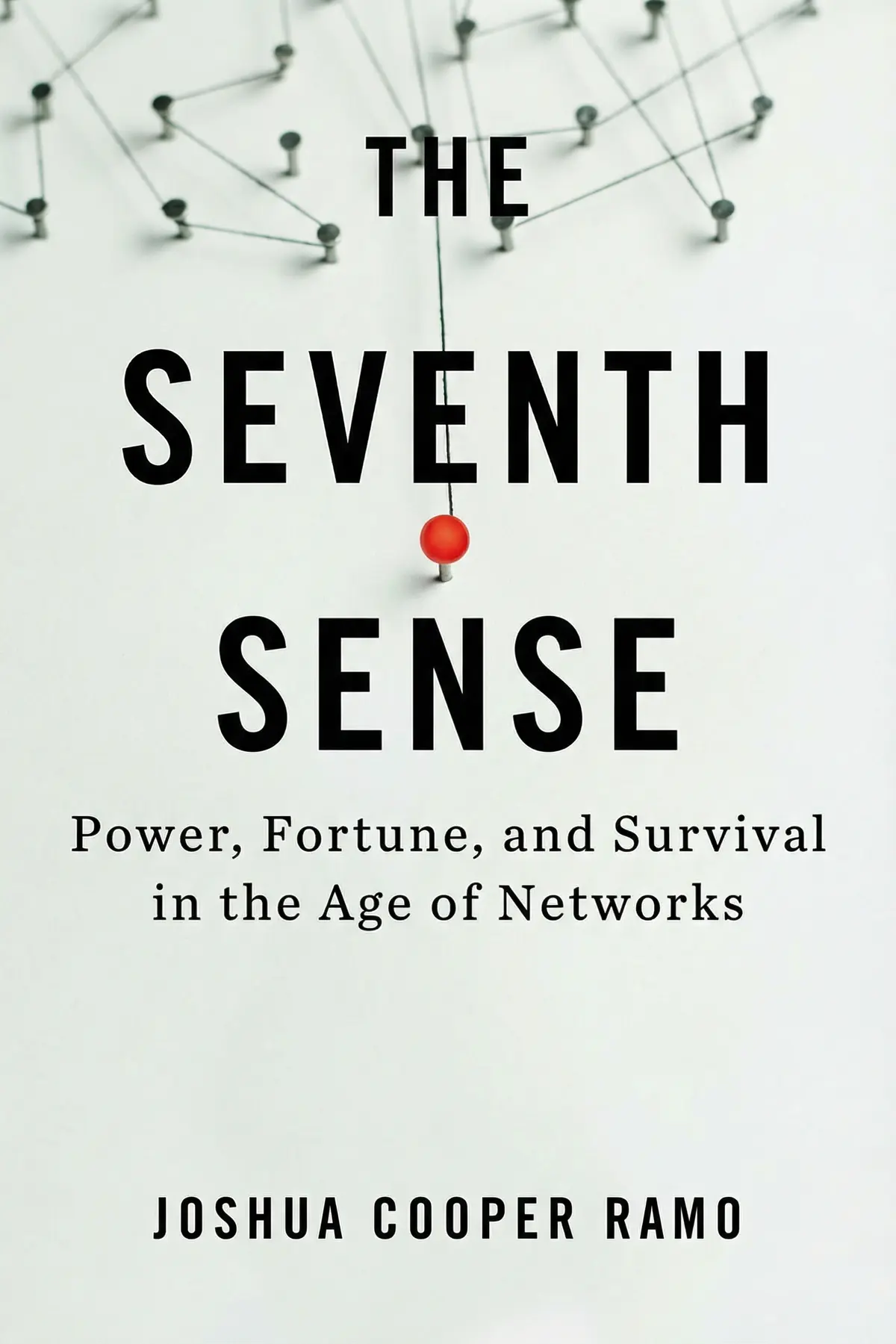
The Seventh Sense investigates the profound transformation of our world caused by the rise of complex networks. It argues that we are living through a shift as significant as the Industrial Revolution, where the traditional structures of power—governments, hierarchies, and institutions—are being outpaced by the speed and scale of digital connections. Joshua Cooper Ramo explains that to thrive in this era, individuals and leaders must develop a new instinct for seeing how things are linked. The book promises to reveal why old methods of security and diplomacy are failing and how understanding the hidden architecture of networks can help us survive the threats of the twenty-first century, from cyber warfare to financial instability.
Joshua Cooper Ramo is the author of the international bestseller The Age of the Unthinkable, published in 2009. He is fluent in Mandarin, and his expertise has been recognized by the World Economic Forum, which named him one of the pioneering scholars of China born overseas. Ramo has contributed to several prestigious publications, including the Wall Street Journal and the New York Times.
Listeners find this work captivating and skillfully crafted, offering superb perspectives on technological disruptions and the significance of interconnected systems. They value the stimulating material, use of historical stories, and how it relates to current affairs, with one listener observing that it acts as a powerful guide using history to shed light on what's ahead. While the prose itself earns high marks, there are varying views regarding how easy it is to follow.
After hearing Ramo discuss his ideas on a podcast, I knew I had to grab this. The concept of the "Seventh Sense" isn't just another tech buzzword; it’s a fundamental shift in how we perceive the modern world. Instead of seeing static objects or isolated nations, Ramo forces you to view everything through the lens of a massive, pulsating network. The historical anecdotes, from the Gutenberg press to the Peloponnesian War, provide a necessary bridge between old-world power and new-world connectivity. While some might find the prose a bit dense, the payoff is immense for anyone trying to understand why traditional structures are failing. It's about recognizing that power now lies with the gatekeepers of these systems. To be fair, not every page is a revelation, but the core thesis is life-changing. Truly a thought-provoking read that will make you look at your smartphone—and your government—differently.
Show moreWow, this book totally reframed my understanding of the digital age. I’ve always felt a bit overwhelmed by how fast things are changing, but Ramo’s concept of the "seventh sense" gave me a way to process it all. Once you start seeing the world as a series of interconnected networks rather than just a collection of separate things, everything clicks. The way he discusses Airbnb turning houses into network nodes or how translation software will eventually erase language barriers is mind-blowing. It’s not just a book about tech; it’s a book about the future of humanity and how we organize ourselves. I found his writing style to be quite beautiful, almost like a grand strategy manual written by a philosopher. If you want to understand the forces shaping our future, you absolutely have to read this. Simply brilliant.
Show moreRamo’s background at Kissinger Associates shines through in his strategic approach to global instability. He argues convincingly that our current leaders are fundamentally illiterate when it comes to the topology of modern power. The chapter on how ISIS uses network dynamics while we try to fight them with 20th-century bombs was chilling and insightful. It’s a call to arms. Policymakers must stop looking at geography and start looking at connection. I appreciated the deep dive into how AI and ARPANET have fundamentally altered the DNA of our social interactions. My only gripe is that the author tends to wander off into barely-related tangents that occasionally break the momentum of his argument. Still, the core thesis is too important to ignore in our current era of constant disruption. It’s a solid look at the future.
Show moreThe analogy between the Athenian destruction of Melos and modern network aggression is worth the price of admission alone. It perfectly illustrates how being a "node" in a network controlled by someone else is a position of extreme vulnerability. Ramo’s exploration of how protocols can be more influential than the actual platforms they support changed how I think about the tech industry. We often focus on the gadgets. The real power lies in the invisible architecture that links them. Personally, I think the writing can be a bit flowery at times, bordering on the poetic when a more direct style would have sufficed. But the intellectual ambition of the project is admirable. It provides a much-needed framework for understanding why the world feels so chaotic and unpredictable lately. It is a dense but rewarding experience for the patient reader.
Show moreAs someone who works in the tech sector, I found the analysis of platform gatekeepers particularly relevant. Ramo explains why the modern marketplace has become a winner-take-all environment where data is the ultimate currency. The way he links Eastern philosophy with Western technological progress provides a unique perspective you won't find in your typical Silicon Valley business book. He correctly identifies that the internet hasn't just changed how we communicate; it has fundamentally altered the nature of power itself. I would recommend this to any business leader or entrepreneur trying to wrap their head around the current landscape. Some of the sections on artificial intelligence feel a bit like a "greatest hits" of common fears, but his overall synthesis of these trends is very sharp. A very solid read that rewards careful study. It's timely and quite relevant.
Show moreFinally got around to reading this after seeing it on several "must-read" lists. Ramo is a gifted writer who manages to weave together history and futurism in a way that feels urgent. The book acts as a fantastic interpreter of the past to help illuminate where we are headed next. While the tone is occasionally a bit too self-important, the actual content is incredibly valuable for understanding the modern world's chaotic nature. He makes a compelling case. Interconnection doesn't necessarily lead to peace, but often creates new avenues for conflict. It’s a dense read that requires focus, but the insights into how networks compress space and time are well worth the effort. It’s definitely one of those books that sticks with you long after you’ve put it down. Not perfect, but certainly essential for the curious mind.
Show morePicked this up because the premise seemed fascinating, but the execution was a bit of a mixed bag for me. On one hand, the idea that we need a new instinct to survive an era of "winner-take-all" platforms is spot on. Ramo does a great job explaining why companies like Amazon and Google dominate by shortening connections between people. However, the book is way longer than it needs to be. I found myself skimming through large sections of historical fluff just to get back to the actual analysis of contemporary technology. Look, there are some genuine "aha" moments here, particularly regarding how networks compress time and space. But you really have to dig through a lot of wordy prose to find them. It’s a decent read if you have the patience, but it could have been a much tighter essay.
Show moreNot what I expected based on the glowing blurbs on the back cover. The central idea—that we need to develop an intuition for how networks function—is genuinely interesting and timely. Unfortunately, the book feels like it was written by someone who enjoys hearing themselves talk a little too much. It’s very dense. It often takes the long way around to prove a point that could have been made in a single paragraph. I liked the stuff about the history of the telegram and how it mirrors our current internet struggles. Yet, the overall pacing was just too slow for my taste. Gotta say, it’s a solid 3-star read for the ideas alone, but the delivery left me wanting something a bit more punchy and less academic. It felt like work to finish.
Show moreTruth is, I have a love-hate relationship with this book. Joshua Cooper Ramo has some brilliant insights into how networks have reversed the law of diminishing returns in economics, which explains the rise of tech giants perfectly. But man, the first few chapters are a total slog. He takes forever to define what the "seventh sense" actually is, leaving the reader wandering in a fog of abstract metaphors and pretentious name-dropping. If you decide to pick this up, I’d actually recommend skipping the intro and jumping straight into the discussion on the power of protocols and network topology. There is a great three-page summary near the end that basically captures everything important. It’s a frustrating experience because the "good" parts are genuinely five-star material, but they are surrounded by so much unnecessary fluff. Read it with a highlighter.
Show moreThis book suffers from a terminal case of "I’m the smartest guy in the room" syndrome. Joshua Cooper Ramo clearly has some high-level connections, but his writing style is so incredibly ponderous and bloated that the actual message gets buried. He spends hundreds of pages trying to define the "seventh sense" without ever really getting to the point. Frankly, the first three chapters were such a disjointed mess that I almost gave up. Most of the "insights" about networks and technology are things that anyone who has been paying attention to the internet for the last decade already knows. It feels like he took a simple, mainstream observation and wrapped it in pseudo-intellectual jargon to make it sound revolutionary. If you’re looking for a concise analysis of technology, look elsewhere. This is 75% filler and 25% ego.
Show moreMasaji Ishikawa
John Rawls
Yuval Noah Harari

Miles Taylor
AUDIO SUMMARY AVAILABLE
Get the key ideas from The Seventh Sense by Joshua Cooper Ramo, plus 5,000+ more titles in English and Thai.







